

The subsidy math your sales team quotes today, ₹30,000 per kW up to 2 kW, ₹18,000 per kW for the next kW, capped at ₹78,000, is about to become a historical footnote. On July 24, 2026, the Ministry of New and Renewable Energy (MNRE) convened a stakeholder consultation, chaired by joint secretary JVN Subramanyam, that has kicked off drafting for what officials are informally calling PM Surya Ghar 2.0. It is not a rebrand. It is a proposal to redesign how the PM Surya Ghar Muft Bijli Yojana pays for rooftop solar, shifting from a one-time capacity-linked subsidy to a structure that rewards actual electricity generation, funds battery storage, and opens the scheme to apartment residents who have no rooftop of their own.
Nothing here is notified policy yet. This is deliberation, reported first by the Times of India and Financial Express following the MNRE consultation, feeding into a policy paper still being drafted. But the direction is clear enough, and consequential enough for anyone quoting PM Surya Ghar systems today, that it is worth understanding in detail before it becomes a circular you have to react to overnight.
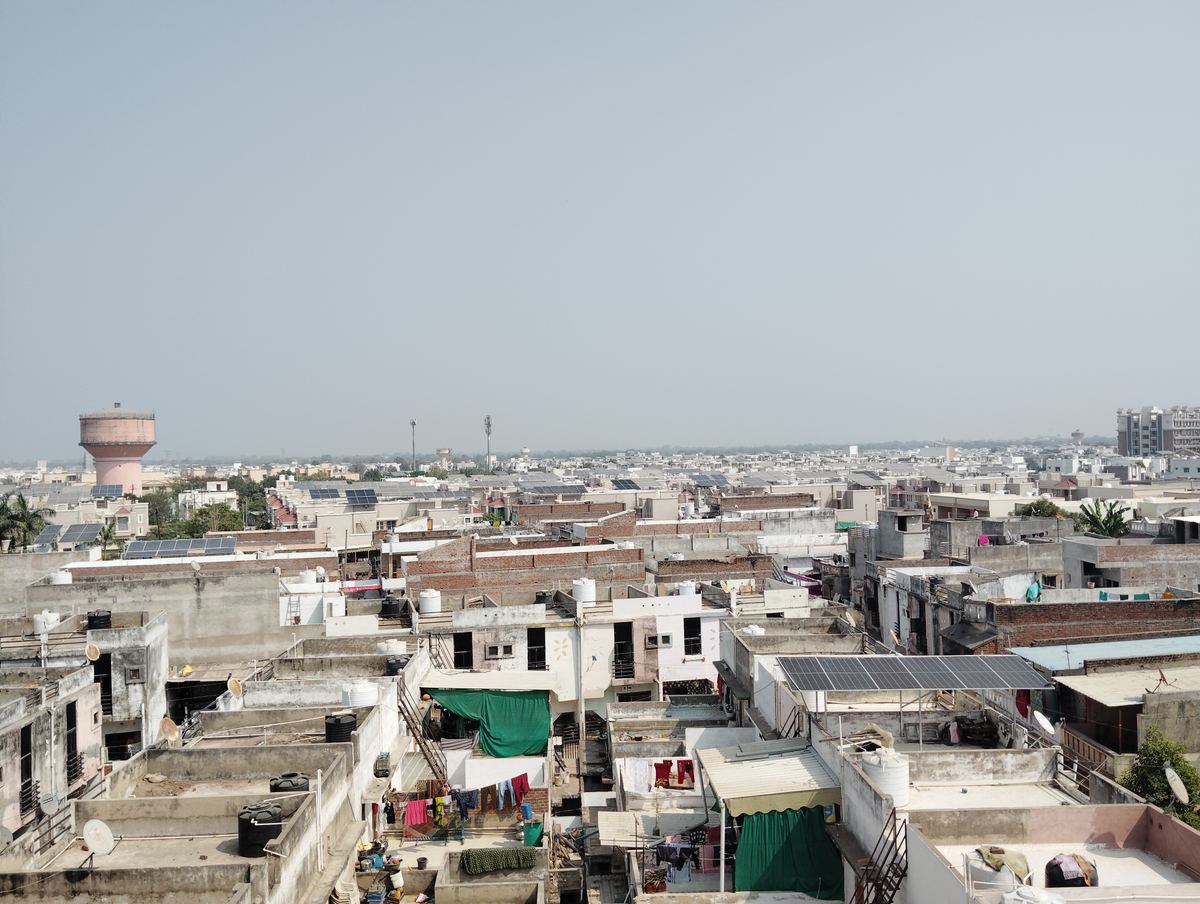
Key takeaway
PM Surya Ghar 2.0 is a proposed redesign, not a live policy. MNRE is drafting a framework that would link part of the subsidy to actual electricity generation rather than installed capacity alone, add support for battery storage, extend the scheme to apartments through virtual and group net metering, and impose stricter maintenance and generation-guarantee obligations on vendors. A consolidated policy paper is expected within 10 to 15 days of the July 24, 2026 consultation, with focused technical consultations to follow over the subsequent 20 days.
What Has Actually Been Announced So Far
Nothing has been notified. What happened is a stakeholder consultation, not a scheme launch, and the distinction matters for anyone tempted to change their pitch this week.
MNRE held a closed-door brainstorming session on July 24, 2026, bringing together ministry officials and industry stakeholders to review the first phase of PM Surya Ghar and identify what needs to change in the next one. According to Times of India's reporting on the meeting, officials acknowledged the scheme had succeeded in creating demand and establishing residential rooftop solar as a functioning national market, then turned to a list of unresolved problems: battery storage, grid integration, DISCOM readiness, consumer access, asset performance, financing, quality assurance, and long-term market sustainability.
A senior MNRE official told Financial Express that "the next phase should not be limited to continuation of the existing subsidy structure," framing the redesign as a mix of regulation, market mechanisms, technology standards, and public support meant to deepen adoption while gradually building a self-sustaining market rather than a permanently subsidised one.
The most concrete detail to emerge is the timeline for the paperwork itself: a consolidated policy paper is expected within 10 to 15 days of the meeting, followed by roughly 20 days of focused consultations on batteries, hybrid inverters, equipment interoperability, DISCOM readiness, and regulatory changes. That puts a full draft framework somewhere around mid-September 2026, though ministry consultations routinely run past their stated windows, and MNRE did not respond to Financial Express's queries before publication.
Why the Government Wants to Redesign a Scheme That's Working
PM Surya Ghar is not failing. That is precisely why this redesign is happening now rather than as crisis management.
Launched on February 13, 2024, with a financial outlay of ₹75,021 crore, the scheme has a headline target of one crore rooftop solar households by March 2027. As of the July 2026 review, more than 40 lakh installations have been completed, benefiting over 48 lakh households, nearing the 50 lakh mark. That is real momentum, and it is also exactly the scale at which the scheme's original design assumptions start to strain.
The current structure pays a fixed subsidy per kilowatt of installed capacity, up to ₹78,000, regardless of how much electricity the system actually generates over its lifetime, how well it is maintained, or whether the household can even use a rooftop in the first place. At 40,000 installations a month and climbing, three structural gaps have become impossible to ignore:
Vendors disappear, and warranties disappear with them. MNRE officials flagged that a meaningful share of homeowners can no longer get repairs or warranty service because the vendor that installed their system has shut down or exited the market. A subsidy paid entirely at commissioning gives installers no financial stake in a system's performance five years later.
Battery storage was deliberately excluded, and that decision is now costing the grid. An official told Times of India that batteries were kept out of the original scheme because they would have raised costs and created an access barrier for first-time adopters. That was a reasonable call in 2024. In 2026, with rooftop capacity scaling fast, DISCOMs are dealing with rising daytime power exports and the grid-management headaches that come with them, exactly the problem batteries are built to solve.
Millions of households cannot participate at all. Apartment residents, tenants, and anyone without a suitable, unshaded rooftop have effectively been locked out of a scheme built around individual rooftop ownership. In a country where urban housing is increasingly vertical, that exclusion caps the scheme's addressable market well below one crore households.
Our read. This isn't a scheme in trouble looking for a rescue. It's a scheme that hit its adoption targets fast enough to expose the next layer of problems: what happens to a system in year six, and who gets left out entirely. Governments rarely redesign a program at this stage unless the first version worked well enough to justify the effort.
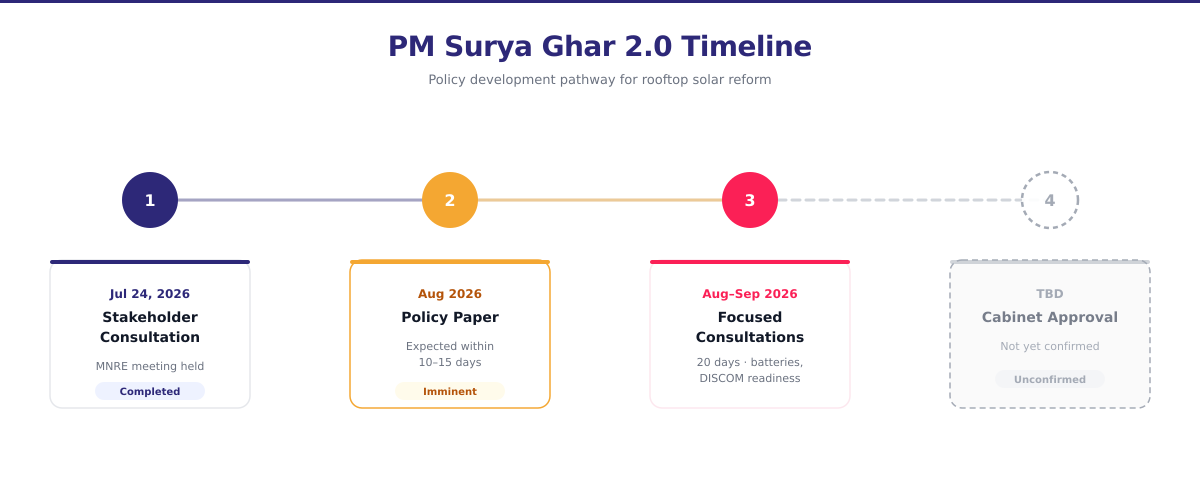
Timeline: What Happens Next, and When
-
1
July 24, 2026, Stakeholder consultation held
MNRE joint secretary JVN Subramanyam chairs a brainstorming session with ministry officials and industry stakeholders on the shape of PM Surya Ghar's next phase.
-
2
Early-to-mid August 2026, Consolidated policy paper
A policy paper is expected within 10 to 15 days of the consultation, according to Financial Express reporting, this is the first document that will show whether the proposals below survive drafting intact.
-
3
Mid-August to mid-September 2026, Focused consultations
Roughly 20 days of technical consultations on batteries, hybrid inverters, equipment interoperability, DISCOM readiness, and regulatory changes follow the policy paper.
-
4
Date not confirmed, Cabinet approval and notification
Neither source article gives a notification date. A scheme of this scale would still need Cabinet Committee on Economic Affairs sign-off before it becomes operational, expect this to land well into 2027 given the current phase runs through March 2027.
Fast tip. Do not change your live proposal templates based on this article. Every number in it is a proposal under discussion, not a notified rate. Track our PM Surya Ghar policy updates tracker for the moment any of this becomes an actual MNRE circular.
The Proposed Policy Changes, In Detail
Six ideas came out of the July 24 consultation and the ministry's internal thinking, according to the two reports. None are finalised.
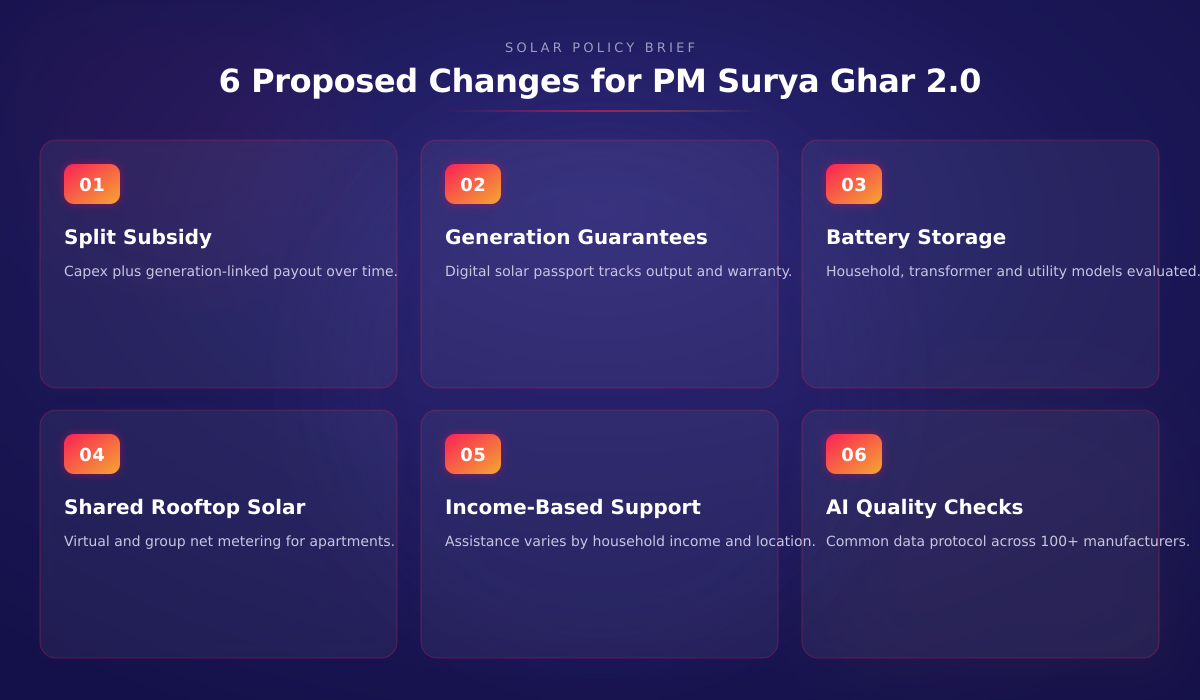
1. A split financial-assistance structure. Rather than one lump-sum subsidy at commissioning, the proposed model separates support into two components: one covering upfront capital expenditure, the other linked to electricity generation, operations and maintenance, battery storage, or service delivery spread over the asset's operating life. In effect, part of the subsidy would be paid out over time, conditional on the system actually producing power.
2. Generation guarantees and a digital solar passport. The MNRE official quoted by Financial Express said the programme "should shift from an installation-centric model towards an asset-performance model." Concrete proposals include generation guarantees, mandatory service periods, insurance against equipment failure and generation shortfall, and a digital solar passport that records a system's output, service history, and warranty status over its lifetime.
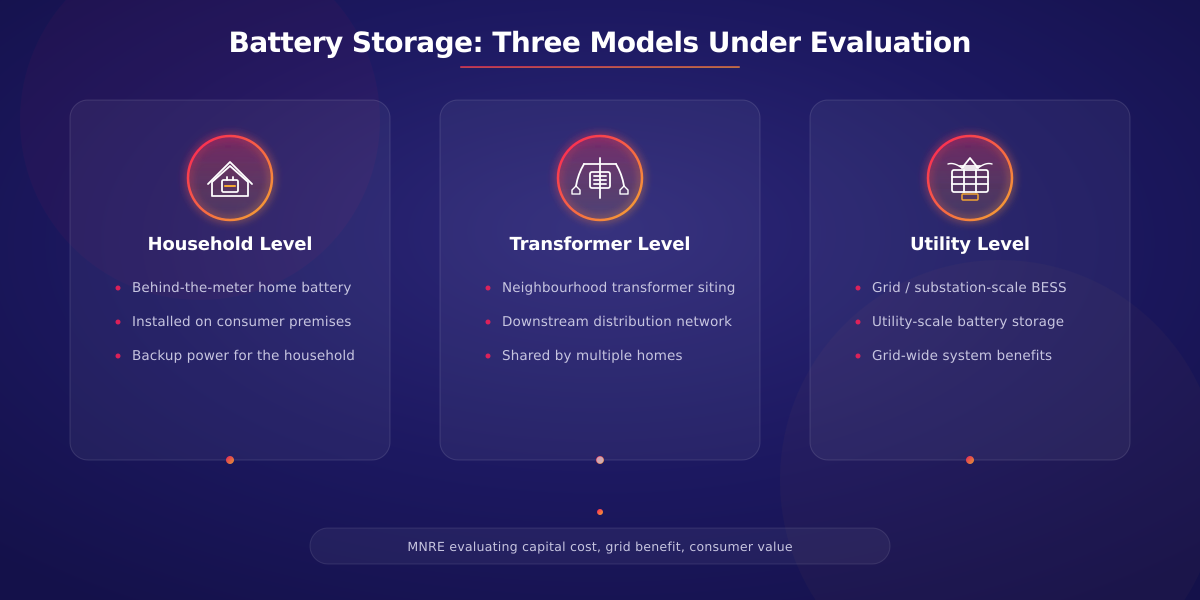
3. Battery storage evaluated at three different levels. MNRE plans to compare household-level, neighbourhood-transformer-level, and utility-scale battery storage models on capital cost, grid benefit, avoided infrastructure spend, consumer value, and operational control before settling on a preferred approach. Two storage pathways were specifically discussed: behind-the-meter batteries at the consumer's premises, and battery systems deployed downstream in the distribution network. A benefit-sharing mechanism is also under consideration, where a share of the savings DISCOMs realise from power-purchase optimisation and avoided network expenditure could be passed back to consumers who install batteries.
4. Shared and virtual rooftop solar for apartments. The scheme may expand to cover apartment residents and households without a suitable rooftop through virtual net metering, group net metering, balcony solar, facade-mounted systems, and building-integrated photovoltaics. Community solar plants of roughly 100 kW are also being explored specifically for low-income consumers who want systems in the 1 to 2 kW range but have nowhere to put one.
5. Income and location-differentiated support. Officials reportedly expect adoption to remain strong as long as payback stays in the five-to-six-year range, but weaken once payback stretches past seven years. The proposed response is to differentiate financial assistance by household income, location, consumer category, and the value a given system provides to the grid, higher-income households would need less support, lower-income households more, or a differently structured one.
6. AI-based quality checks and a common data protocol. MNRE is reportedly planning a common data protocol spanning more than 100 inverter and equipment manufacturers, with daily generation data feeding DISCOM planning, maintenance alerts, and warranty enforcement. AI would be used to verify installations, identify components, and detect defects, addressing the quality-assurance gap that has let underperforming systems slip through empanelment.
48 Lhouseholds
Benefiting from Phase 1 so far
Source: MNRE, via Times of India, Jul 2026
₹75,021 Croutlay
Phase 1 financial outlay
Source: PIB, Feb 2024 launch
10-15 days
Until draft policy paper
Source: Financial Express, Jul 2026
100 kWplants
Proposed community solar size
Source: Financial Express, Jul 2026
PM Surya Ghar Today vs. the Proposed 2.0 Framework
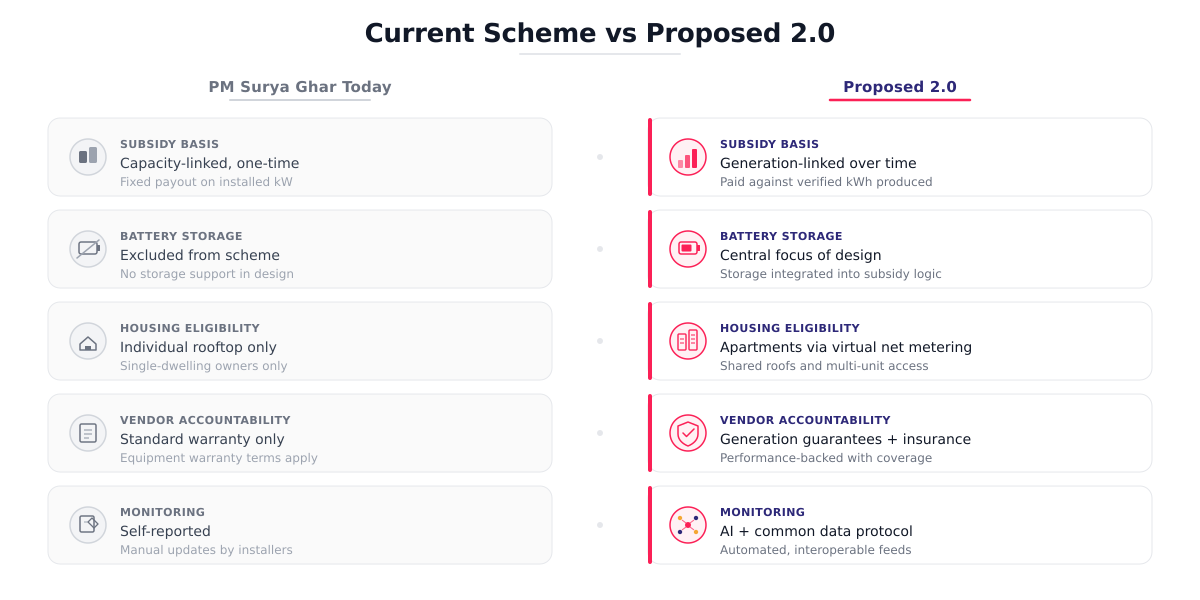
| Dimension | Current scheme (2024-2027) | Proposed 2.0 framework |
|---|---|---|
| Subsidy basis | Installed capacity, paid once at commissioning | Split, capex plus generation/O&M/storage linked over asset life |
| Battery storage | Excluded from central subsidy | Central to the redesign, household, transformer and utility-level models under evaluation |
| Eligible housing | Individual rooftop owners only | Apartments and no-rooftop households via virtual/group net metering, balcony and facade solar |
| Vendor accountability | Standard warranty, weak enforcement after vendor exit | Generation guarantees, mandatory service periods, equipment-failure insurance |
| Support differentiation | Uniform slab regardless of income | Support varies by income, location, consumer category, grid value |
| Monitoring | Largely self-reported, limited digital tracking | Common data protocol across 100+ manufacturers, AI-based installation verification |
For the exact rupee figures the current scheme still uses while this redesign is under discussion, see our breakdown of the current PM Surya Ghar subsidy slabs, and how they stack against the older Central Financial Assistance scheme that preceded PM Surya Ghar.
Industry Reactions
Public reaction so far is limited, since the proposals are barely a week old at the time of writing, but the reaction that has surfaced is broadly welcoming of the direction, with caution about execution.
Ashish K Sharma, fellow at TERI, told Financial Express that "India's rooftop solar story is entering a new phase. The question is no longer how many panels we install, but how effectively we use the energy they generate. Storage is the missing link that can align consumer savings with grid requirements and make distributed solar more valuable for the entire electricity system." That framing, effectiveness over volume, is likely to define how the industry evaluates every proposal that comes out of this consultation.
Among installers we work with, reaction to an early read splits along a predictable line. Lean, high-volume EPCs are wary of anything that pushes part of their subsidy payout later, since it strains working capital between commissioning and DBT credit. EPCs already building O&M and service revenue see the shift toward performance-linked support as validation.
Expected Challenges
What could work
- ✓Generation guarantees push vendors toward better quality equipment and honest sizing
- ✓Virtual/group net metering unlocks a large apartment-dwelling market currently shut out
- ✓Battery benefit-sharing gives DISCOMs a reason to actively support adoption, not just tolerate it
- ✓A common data protocol makes warranty enforcement provable instead of he-said-she-said
What could go wrong
- ✗Generation-linked payouts require metering and data infrastructure most DISCOMs don't have today
- ✗Deferred subsidy components strain EPC cash flow, especially for smaller installers
- ✗Virtual net metering needs state-level regulatory changes, DISCOM readiness varies enormously by state
- ✗Mandatory service periods and insurance push up system cost right as the government wants to keep it affordable
The DISCOM-readiness problem is the one worth sitting with the longest. Virtual and group net metering already exist on paper in several state regulations, but implementation quality varies as widely as the DISCOM approval timelines we track do today. A national policy that assumes uniform DISCOM capability to execute generation-linked payouts and virtual metering will run into the same state-by-state friction that PM Surya Ghar Phase 1 has dealt with since 2024, Gujarat's DGVCL and UGVCL move fast, several northeastern DISCOMs are still catching up on the basics.
Benefits of the Proposed Redesign
If the framework survives roughly as described, the benefits cluster around three groups. Consumers get systems that are more likely to keep working, and more likely to be backed by someone accountable, since insurance and service-period mandates attach real consequences to vendor abandonment. DISCOMs get a grid-management tool, battery storage deployed with their input rather than around them, plus better visibility into distributed generation through the common data protocol. And the addressable market expands meaningfully, apartment dwellers and households without usable rooftops make up a large share of urban India's electricity consumers, and none of them can participate in PM Surya Ghar today.
For EPCs, the benefit is less obvious but potentially larger: a subsidy structure that rewards ongoing service delivery is a subsidy structure that finally puts a price on the O&M relationship most installers already want to build but struggle to monetise against a market trained to think of solar as a one-time purchase.
Expert Analysis: What This Signals About India's Solar Policy Direction
Reading the two source reports together, the through-line is a shift from subsidising installation to subsidising outcomes. That is a harder policy to design and a harder policy to game, which is likely the point. A capacity-linked subsidy can be captured by installing cheap, underperforming equipment that still qualifies for the full payout. A generation-linked component cannot be captured the same way, because the money only flows if the system actually produces power.
The MNRE official's framing, regulation, market mechanisms, technology standards and public support working together rather than public support carrying the scheme alone, echoes a pattern seen in other Indian energy transitions: PM-KUSUM's shift toward viability-gap funding, the ALMM list's move from suggestion to mandate. Subsidy programs in India tend to start broad and blunt to build a market fast, then get sharper and more conditional once the market exists and quality problems surface. PM Surya Ghar 2.0, on this reading, is that second phase arriving roughly on schedule, thirty months after launch, at just past the halfway point to the one-crore-household target.
The caveat worth stating plainly: policy papers in Indian energy governance frequently take longer to become notified schemes than the stated timeline suggests, and often emerge simplified from what stakeholder consultations first propose. The gap between "MNRE is evaluating three battery storage models" and an actual notified subsidy line item for household batteries could be twelve months or more.
What This Means for Your Business Right Now
None of this changes what you quote today. The current slabs, ₹78,000 max on 3 kW, remain in force and will likely stay in force through the rest of Phase 1's run to March 2027, since large government schemes rarely switch mid-stream for consumers already in the pipeline.
What is worth doing now: if your business already leans toward O&M contracts, service plans, or battery-ready design, this redesign signals the market will reward that positioning more directly. If you've been purely install-and-move-on, start building the service-delivery muscle before it becomes a requirement rather than after.
How Quickest Solar CRM Fits
Whatever PM Surya Ghar 2.0 ends up looking like, EPCs will need to track more complexity per project than a single subsidy number, split capex/opex components, battery sizing, service-period obligations, generation performance data. That is infrastructure work most teams are still doing in spreadsheets.
- Proposal Generator, Built to update fast when subsidy structures change. When PM Surya Ghar 2.0 is notified, your proposal templates update once, not project by project.
- Pipeline Management, Track every project against evolving requirements, subsidy disbursement stage, service-period status, warranty documentation, in one pipeline instead of scattered folders.
- Quotation System, If financial assistance splits into capex and performance-linked components, your quotes need to show both clearly. Quickest Solar CRM's line-item structure is built for exactly that kind of breakdown.
For the design and engineering side of battery-ready proposals, SurgePV's guide to hybrid solar system design covers how to size a battery-ready system before MNRE settles on its preferred storage model.
What to Watch, For Your EPC This Quarter
-
Do not change your live proposal templates. Every figure in this article describes a proposal under discussion. Keep quoting the current ₹78,000-capped slabs until MNRE issues an actual notification.
-
Watch for the policy paper, expected within 10 to 15 days of July 24, 2026. That document, not this article or the source reports, will be the first real signal of what survives into a notified scheme. We will update our PM Surya Ghar policy tracker the moment it lands.
-
Start building your O&M and battery-sizing capability now. Whatever the final subsidy mechanics look like, service delivery and storage expertise are clearly becoming more central to the scheme, and to the business, than they were in 2024.
Frequently Asked Questions
Is PM Surya Ghar 2.0 a confirmed government scheme?
No. As of late July 2026, PM Surya Ghar 2.0 is a set of proposals under discussion following an MNRE stakeholder consultation held on July 24, 2026. A consolidated policy paper is expected within 10 to 15 days, followed by further technical consultations. No subsidy structure, timeline for launch, or notification date has been confirmed by the ministry.
Will PM Surya Ghar 2.0 include a subsidy for home batteries?
Battery storage is central to the proposed redesign, but the exact mechanism is still under evaluation. MNRE is comparing household-level, transformer-level, and utility-scale battery models on cost and grid benefit, and considering a benefit-sharing arrangement where DISCOMs pass back part of their savings to consumers who install batteries. No confirmed battery subsidy amount exists yet.
Can apartment residents get PM Surya Ghar subsidy under the new proposal?
The proposed framework would extend the scheme to apartment residents and households without a suitable rooftop through virtual net metering, group net metering, balcony solar, and building-integrated photovoltaics, plus community solar plants of around 100 kW for low-income consumers. This is a proposal under discussion, not a currently available option.
Will the current PM Surya Ghar subsidy slabs change immediately?
No. The current subsidy structure, up to ₹78,000 for a 3 kW system, remains in effect. The Phase 1 scheme runs through March 2027, and any PM Surya Ghar 2.0 framework would need a policy paper, further consultation, and likely Cabinet approval before becoming operational, a process that typically takes months, not weeks. For current figures, see our guide to PM Surya Ghar subsidy slabs.
What happens to installers whose vendors have already exited the market?
The proposed redesign specifically flags this as a Phase 1 gap and suggests stricter maintenance obligations, mandatory service periods, and equipment-failure insurance for the next phase. These are proposals, not current requirements. Homeowners currently facing this issue should check their original vendor's registration status on the PM Surya Ghar national portal and consult their state DISCOM or nodal agency.
When will PM Surya Ghar 2.0 be officially launched?
Neither source report gives a confirmed launch date. The policy paper is expected within 10 to 15 days of the July 24, 2026 consultation, with technical consultations continuing roughly 20 days after that, putting a full draft framework around mid-September 2026. Formal notification and launch would follow further review and is not expected before 2027.
Want to put this into practice?
Quickest Solar CRM gives you everything in this article, proposal automation, lead capture, WhatsApp follow-up, built for Indian solar EPCs.
Start free