
Choosing the right CRM solutions for your solar business is one of the most important decisions you’ll make in 2026. With the Indian solar market growing at a rapid pace, solar EPCs, installers, and B2B service companies need tools that help them manage leads, send proposals fast, and close deals without missing a beat. But before you pick a platform, there’s a fundamental question to answer: should you go with a cloud-based CRM or an on-premise CRM? The answer depends on your team size, budget, growth plans, and how your sales team works in the field. This guide breaks down both options so you can make a confident, informed choice.

What Are CRM Solutions for Solar Businesses?
CRM solutions (Customer Relationship Management software) help solar businesses organize leads, automate follow-ups, generate proposals, and track sales performance from one central platform. Instead of juggling spreadsheets, WhatsApp messages, and paper notes, your entire sales process lives in one place. For solar companies in India, this means faster response times, fewer missed follow-ups, and more deals closed every month.
There are two main ways to deploy a CRM: cloud-based (also called SaaS) and on-premise (self-hosted). Cloud CRM solutions are hosted on the vendor’s servers and accessed via the internet. On-premise CRM solutions are installed on your own company servers and managed by your IT team. Both models have real advantages, and both have trade-offs. Understanding these differences is the first step toward choosing the right fit for your solar business.
India’s solar sector is booming. According to the Ministry of New and Renewable Energy (MNRE), India has set ambitious renewable energy targets that are driving rapid growth in solar installations across residential, commercial, and industrial segments. This growth means solar sales teams are handling more leads, more proposals, and more client relationships than ever before. The right CRM solution can be the difference between scaling smoothly and drowning in administrative work.
Cloud-Based CRM Solutions: Pros and Cons
Cloud-based CRM solutions operate on a Software-as-a-Service (SaaS) model. You pay a subscription fee (monthly or annually), log in through a browser or mobile app, and the vendor handles all the infrastructure, updates, and security patches. There’s no hardware to buy and no IT team required to keep things running.
Advantages of Cloud CRM Solutions
- Low upfront cost: No servers to purchase. You pay a predictable subscription fee, which is easier to budget for small and mid-sized solar businesses.
- Access from anywhere: Your sales team can log in from the office, a client’s rooftop, or on the road using a smartphone or tablet. This is critical for field sales reps in solar.
- Automatic updates: The vendor pushes new features and security updates automatically. You always have the latest version without lifting a finger.
- Fast implementation: Most cloud CRM solutions can be set up and running within days, not months. This means your team starts seeing results quickly.
- Easy scalability: Adding new users or upgrading your plan takes minutes. As your solar business grows, your CRM grows with you.
- Mobile app access: Most cloud CRMs offer iOS and Android apps, keeping your team connected and productive on the go.
Disadvantages of Cloud CRM Solutions
- Ongoing subscription costs: Over several years, subscription fees can add up. You need to factor this into your long-term budget.
- Internet dependency: If your internet connection goes down, access to the CRM is interrupted. This can be a concern in areas with unreliable connectivity.
- Data sovereignty concerns: Some businesses worry about storing sensitive client data on third-party servers. Choosing a vendor with strong data security practices and clear data policies is essential.
Best suited for: Growing solar teams, field sales reps, multi-location businesses, and companies that want to get up and running fast without a large IT investment. If you’re a solar EPC or installer in India looking to scale, cloud CRM solutions are almost always the smarter starting point. For a deeper look at how to evaluate scalability before you commit, read our guide on CRM Scalability: 8 Critical Questions Before You Buy.
On-Premise CRM Solutions: Pros and Cons
On-premise CRM solutions are installed directly on your company’s own servers. You purchase a software license (often a large one-time fee), set up the hardware, and your IT team manages everything from installation to maintenance to security updates. You have full control over the system and your data.
Advantages of On-Premise CRM Solutions
- Full data control: All your customer data stays on your own servers. For businesses with strict data governance requirements, this can be a significant advantage.
- One-time licensing: After the initial purchase, there are no recurring subscription fees (though maintenance and upgrade costs still apply).
- Deep customization: On-premise systems can often be customized at a deeper technical level, which suits large enterprises with very specific workflow requirements.
- Works without internet: Once installed, the system can operate on your local network even without an internet connection.
Disadvantages of On-Premise CRM Solutions
- High upfront cost: Server hardware, software licenses, and implementation fees can run into lakhs of rupees before a single lead is entered.
- IT maintenance burden: You need a dedicated IT team to manage updates, backups, security patches, and troubleshooting. This is an ongoing cost that’s easy to underestimate.
- Limited remote access: Field sales reps and remote teams often struggle to access on-premise systems without complex VPN setups.
- Slow implementation: Setting up an on-premise CRM can take weeks or months, delaying the time-to-value for your sales team.
- Difficult to scale: Adding capacity means buying more hardware and potentially more licenses, which takes time and money.
Best suited for: Large enterprises with dedicated IT departments, businesses with strict regulatory requirements around data storage, or organizations that have already made significant infrastructure investments. For most solar EPCs and installers in India, on-premise CRM solutions represent more complexity and cost than the business actually needs.
Head-to-Head: CRM Solutions Compared Across 6 Key Factors
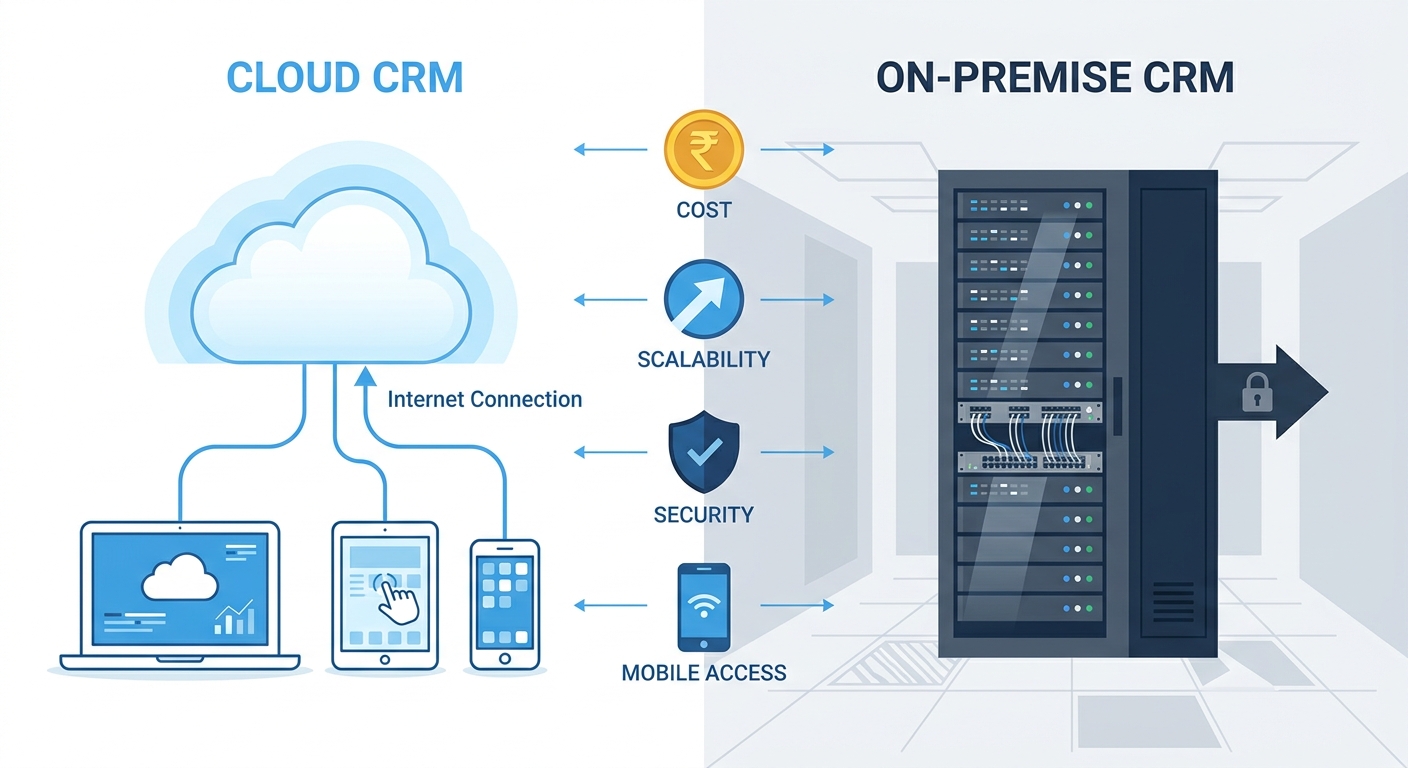
Let’s put both CRM solutions side by side across the factors that matter most to solar businesses in India. This comparison will help you see clearly where each model wins and where it falls short.
1. Cost
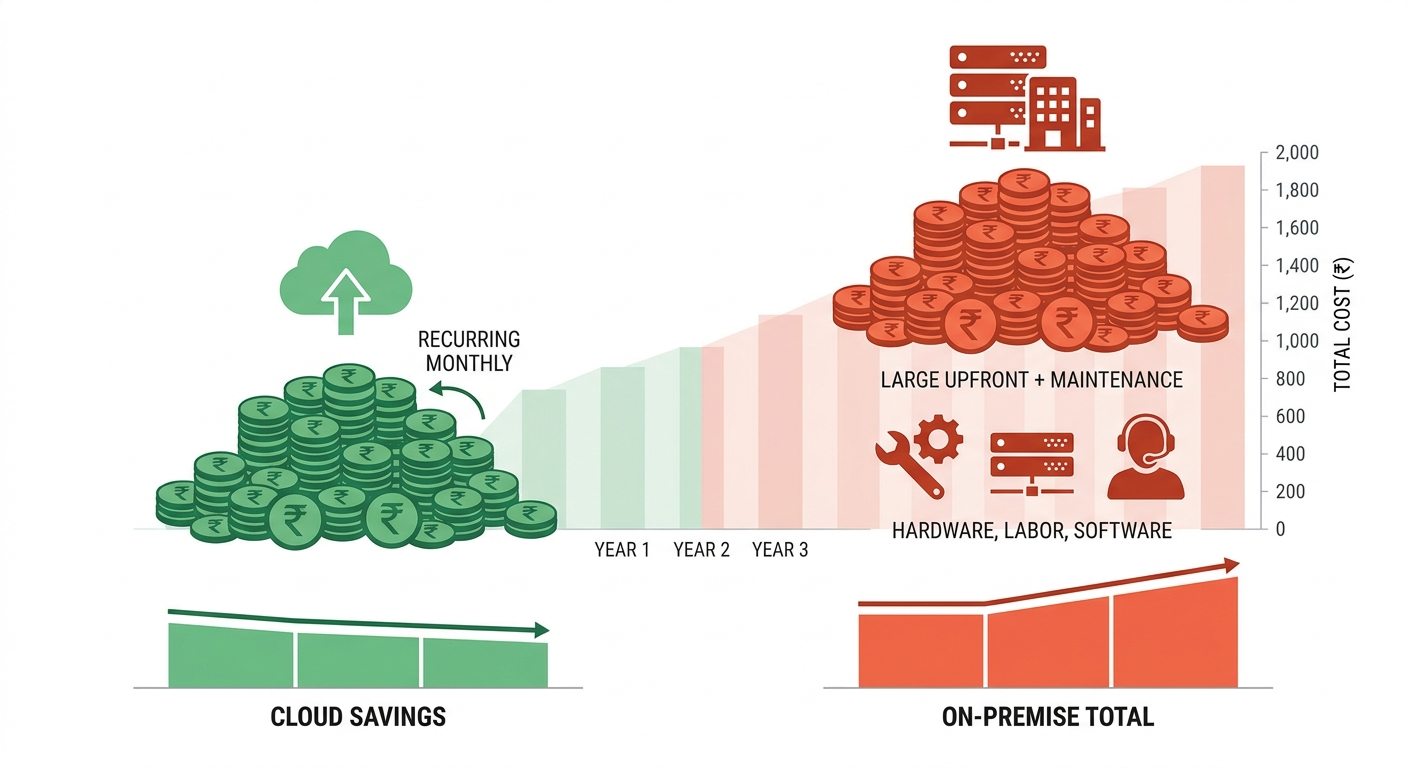
Cloud CRM wins on upfront cost. You pay a monthly or annual subscription per user, with no hardware investment. On-premise CRM requires significant capital expenditure upfront for servers, licenses, and implementation. Over a 3-year period, the total cost of ownership for on-premise systems is often higher when you factor in IT staff, maintenance, and upgrades. For solar businesses watching their margins, cloud CRM solutions offer a much more predictable and manageable cost structure.
2. Scalability
Cloud CRM scales instantly. Add a new sales rep? Add a user in minutes. Open a new branch? No new hardware needed. On-premise CRM scaling requires purchasing additional server capacity and licenses, which takes time and budget. For fast-growing solar companies in India, cloud CRM solutions are the clear winner here. The ability to scale your sales team without infrastructure delays is a genuine competitive advantage.
3. Security and Data Compliance
This is where the debate gets nuanced. On-premise CRM gives you physical control over your data, which some businesses prefer. However, reputable cloud CRM vendors invest heavily in enterprise-grade security, encryption, and compliance certifications that most small businesses could never replicate on their own. For solar businesses in India, choosing a cloud CRM vendor with strong security practices and clear data policies is the practical path to robust data protection.
4. Accessibility for Field Teams
Cloud CRM wins decisively here. Solar sales reps are constantly in the field, visiting client sites, conducting rooftop surveys, and attending meetings. Cloud CRM solutions with mobile apps let them update lead status, send proposals, and log follow-ups from anywhere. On-premise systems typically require VPN access for remote use, which adds friction and slows down your team.
5. Maintenance and IT Requirements
Cloud CRM requires virtually no internal IT maintenance. The vendor handles everything. On-premise CRM demands ongoing IT resources for updates, backups, security patches, and hardware maintenance. For solar businesses that want to focus on selling solar systems rather than managing software infrastructure, cloud CRM solutions remove a significant operational burden.
6. Integration Capabilities
Modern cloud CRM solutions are built with integrations in mind. APIs, webhooks, and native connectors to tools like Facebook Ads, WhatsApp, and automation platforms like Pabbly Connect are standard features. On-premise systems can be integrated too, but it typically requires custom development work and ongoing maintenance. For solar businesses that rely on digital lead generation and WhatsApp communication, cloud CRM integration capabilities are a major advantage.
CRM Pricing in India: What Solar Companies Actually Pay
Understanding CRM pricing in India requires looking beyond the sticker price. Both cloud and on-premise CRM solutions have costs that aren’t always obvious upfront.
Cloud CRM Pricing in India
Cloud CRM solutions in India typically charge on a per-user, per-month or per-user, per-year basis. Entry-level plans can start as low as free (with limited features), while professional plans designed for growing solar teams are priced to be accessible for small and mid-sized businesses. The key advantage is that you know exactly what you’re paying each month, and you can adjust your plan as your team grows. There are no surprise hardware bills or emergency IT costs.
For solar businesses evaluating CRM ROI, the math is straightforward: if a CRM helps your team close even one or two additional deals per month by automating follow-ups and speeding up proposal generation, the subscription cost pays for itself many times over. To understand the full picture of what you’re paying for, read our detailed breakdown of Solar CRM Software Costs: What You’re Really Paying For.
Hidden Costs of On-Premise CRM
On-premise CRM solutions often look cheaper on paper because there’s no monthly subscription. But the true cost includes:
- Server hardware: Physical servers can cost anywhere from ₹1 lakh to several lakhs depending on capacity requirements.
- IT staff or consultants: Someone needs to install, configure, and maintain the system. This is an ongoing cost, not a one-time expense.
- Software upgrades: Major version upgrades often require additional licensing fees.
- Downtime costs: When an on-premise system goes down, your sales team stops working. The cost of lost productivity can be significant.
- Security infrastructure: Firewalls, backup systems, and security audits add to the total bill.
When solar businesses in India calculate the total cost of ownership over three to five years, cloud CRM solutions frequently come out ahead, especially when you factor in the productivity gains from faster implementation and easier access for field teams.
Which CRM Solution Is Right for Your Solar Business?
The right choice between cloud and on-premise CRM solutions depends on several factors specific to your business. Here’s a practical decision framework for solar companies in India.
Choose Cloud CRM Solutions If:
- Your team has fewer than 200 users and is growing
- Your sales reps work in the field and need mobile access
- You want to be up and running within days, not months
- You don’t have a dedicated IT team
- You need integrations with WhatsApp, Facebook Ads, or other digital tools
- You want predictable, manageable monthly or annual costs
- You’re a solar EPC, installer, or B2B service company focused on growth
Choose On-Premise CRM Solutions If:
- You’re a large enterprise with 500+ users and a dedicated IT department
- You have strict regulatory requirements that mandate on-site data storage
- You’ve already made significant server infrastructure investments
- You need extremely deep, custom technical integrations with legacy systems
- Your team works exclusively from a fixed office location with no remote access needs
For the vast majority of solar EPCs, installers, and B2B service companies in India, cloud CRM solutions are the practical, cost-effective, and scalable choice. The question then becomes: which cloud CRM is built for your specific industry? Before you finalize your decision, it’s worth asking the right questions. Our guide on CRM Scalability: 8 Critical Questions Before You Buy walks you through exactly what to evaluate. And when you’re ready to implement, the CRM Implementation India: Step-by-Step Setup Guide 2026 will help you get started without the guesswork.
Why QuickEstimate Stands Out Among CRM Solutions for Solar
Most CRM solutions are built for general business use. QuickEstimate is different. It’s a cloud-based CRM and proposal generation platform built specifically for solar businesses and B2B service companies in India. That focus makes a real difference in how fast your team can get productive and how much value you get from day one.

60-Second Proposal Generation
One of the biggest pain points for solar sales teams is the time it takes to create and send professional proposals. With QuickEstimate, your team can generate and send a professional solar proposal via WhatsApp or Email in under 60 seconds. That speed means you respond to leads faster than your competitors, which directly improves your conversion rate. Compare this to general-purpose CRM solutions like Salesforce, which require significant customization before they can handle solar-specific proposals at all.
Lead Management and Follow-Up Automation
QuickEstimate’s lead management system captures, tracks, and nurtures leads through your entire sales pipeline. The automated follow-up system sends customizable reminders and email sequences so no lead falls through the cracks. For solar businesses where a single deal can be worth lakhs of rupees, missing a follow-up is an expensive mistake. Our guide on Follow-Up Automation India: Complete Service Guide 2026 shows exactly how automation can transform your sales process.
Real-Time Sales Analytics
QuickEstimate’s analytics dashboard gives sales managers real-time visibility into team performance, pipeline health, and conversion rates. You can see which reps are closing deals, which leads need attention, and where your pipeline is stalling. This kind of data-driven insight is what separates high-performing solar sales teams from the rest. For practical strategies to put these insights to work, see our article on 7 Proven Ways to Boost Sales Conversion in Solar 2026.
Mobile App and Integrations
QuickEstimate’s iOS and Android mobile apps keep your field team connected and productive from any location. The platform integrates with Facebook Ads for lead capture, Phonebook for contact management, and Pabbly Connect for workflow automation. Bulk lead import from Excel makes it easy to migrate existing data. These integrations make QuickEstimate one of the most connected CRM solutions available for solar businesses in India.
Trusted by 1000+ Solar Businesses
QuickEstimate is trusted by over 1,000 businesses across India, including well-known solar companies like Sunnovative, Heaven Solar, JJ Solar, and Tata Power. That track record means the platform has been tested and refined in real-world solar sales environments. When you choose QuickEstimate, you’re choosing CRM solutions that have already proven their value for businesses just like yours.
Flexible Plans for Every Stage of Growth
QuickEstimate offers a FREE Plan at ₹0 so you can experience the platform’s core features without any financial commitment. When your team is ready to unlock the full power of solar CRM, the PRO Plan at ₹6,999 per user per year gives you complete access to proposal automation, advanced analytics, team collaboration tools, and all integrations. It’s a straightforward investment that pays for itself the moment your team closes its first deal faster because of it.
Frequently Asked Questions About CRM Solutions
Is cloud CRM safe for solar business data in India?
Yes, reputable cloud CRM solutions use enterprise-grade encryption, secure data centers, and regular security audits to protect your data. In practice, cloud vendors invest far more in security infrastructure than most small or mid-sized solar businesses could afford to implement on their own. Always check that your chosen vendor has clear data policies and strong security certifications before signing up.
Can small solar companies afford CRM solutions?
Absolutely. Cloud CRM solutions like QuickEstimate offer free plans and affordable annual subscriptions that are accessible even for small solar installers and EPCs. The real question is whether you can afford NOT to use a CRM. Missing follow-ups, slow proposals, and disorganized lead management cost small solar businesses significant revenue every month.
How long does CRM implementation take?
Cloud CRM solutions can typically be implemented in a matter of days. On-premise systems can take weeks or months. With QuickEstimate, most solar businesses are fully set up and sending proposals within 24 to 48 hours. For a step-by-step walkthrough, see our CRM Implementation India: Step-by-Step Setup Guide 2026.
What integrations should a solar CRM have?
The most valuable integrations for solar CRM solutions in India include WhatsApp for proposal delivery and client communication, Facebook Ads for lead capture, email platforms for automated follow-ups, and APIs or webhooks for connecting to other business tools. QuickEstimate supports all of these out of the box.
Can I switch from on-premise to cloud CRM later?
Yes, migration from on-premise to cloud CRM solutions is possible, though it requires careful data migration planning. Most cloud CRM vendors, including QuickEstimate, support bulk data import from Excel and other formats, making the transition manageable. The sooner you make the switch, the sooner your team benefits from the flexibility and speed of a cloud-based system.
How do cloud CRM solutions compare to general tools like Zoho or Salesforce for solar businesses?
General-purpose CRM solutions like Zoho CRM or Salesforce can be adapted for solar businesses, but they require significant customization to handle solar-specific workflows like system sizing proposals, rooftop assessments, and subsidy calculations. A purpose-built solar CRM like QuickEstimate comes with these capabilities built in, which means faster implementation, less customization cost, and a better fit for your team’s daily workflow from day one.
Make the Right CRM Decision for Your Solar Business in 2026
The comparison is clear. For most solar EPCs, installers, and B2B service companies in India, cloud-based CRM solutions offer a faster, more affordable, and more scalable path to sales excellence than on-premise alternatives. The ability to generate proposals in 60 seconds, automate follow-ups, manage leads from a mobile app, and track team performance in real time gives your sales team a genuine edge in a competitive market. On-premise systems may suit large enterprises with dedicated IT teams, but for the growing solar business focused on closing more deals and serving more clients, cloud CRM solutions are the smarter investment in 2026.
QuickEstimate is purpose-built for exactly this challenge. With over 1,000 solar businesses already using the platform across India, it’s the CRM solution that understands your industry, your sales process, and your growth ambitions. Start with the FREE Plan at ₹0 and see the difference a solar-specific CRM makes to your team’s productivity and your bottom line. Ready to explore the full feature set? Check out the PRO Plan at ₹6,999 per user per year or contact us to discuss which plan fits your business best. Your next deal is waiting. Don’t let a slow proposal or a missed follow-up cost you the win.
This blog post was written using thestacc.com