

The solar sales landscape in India is more competitive than ever. With hundreds of EPCs, installers, and solar service providers chasing the same pool of residential and commercial prospects, the companies that win are the ones that move fastest. Yet most solar businesses are still running their sales process on spreadsheets, WhatsApp chats, and gut instinct — losing deals to slower follow-ups, delayed proposals, and disorganized pipelines.
This guide breaks down 12 proven solar sales strategies that top-performing solar companies in India are using right now to shorten their sales cycle, close more deals, and grow revenue without adding headcount. Whether you’re a solar EPC, an installer, or a sales manager trying to hit your targets, these tactics will help you move faster and smarter in 2026.

Why Solar Sales Cycles Are Too Long (And What It’s Costing You)
The average solar sales cycle in India can stretch anywhere from two weeks to three months. Every extra day a deal sits in your pipeline is a day your competitor could swoop in and close it. Slow cycles don’t just hurt revenue — they drain your sales team’s energy, inflate your cost per acquisition, and make it nearly impossible to forecast accurately.
The biggest culprits behind long solar sales cycles are almost always the same: proposals that take hours to build, follow-ups that fall through the cracks, leads that pile up without any prioritization, and sales managers who have no real-time visibility into what’s happening in the field. These aren’t talent problems — they’re process problems. And process problems have process solutions.
Modern solar CRM platforms like QuickEstimate are purpose-built to eliminate these bottlenecks. Over 1,000 solar businesses, including Sunnovative, Heaven Solar, JJ Solar, and Tata Power, are already using CRM-driven workflows to respond faster, propose quicker, and close deals that used to slip away. Here’s exactly how they do it.
1. Generate Professional Solar Proposals in Under 60 Seconds
Nothing kills a hot lead faster than a slow proposal. When a prospect asks for a quote and you take 24 hours to send one, you’ve already lost momentum. Studies on B2B sales response times consistently show that the first vendor to respond with a credible proposal wins the deal far more often than the one with the best price.
Proposal automation is the single fastest way to shorten your solar sales cycle. With QuickEstimate’s 60-second proposal generation, your sales team can build a professional, branded solar system quote and send it directly via WhatsApp or Email before the prospect has even finished their coffee. No more copy-pasting from old Excel sheets. No more waiting for a senior engineer to sign off on a template.
The key is having a library of pre-built solar proposal templates that your team can customize in seconds, system size, pricing, ROI calculations, and your company branding all locked in and ready to go. When your competitor is still building their quote manually, you’ve already sent yours and scheduled a follow-up call.
For a deeper look at how faster proposals translate to higher close rates, see our guide on 7 Proven Ways to Boost Sales Conversion in Solar 2026.
2. Automate Follow-Ups to Never Miss a Lead Again
Here’s a hard truth about solar sales in India: most deals are lost not because the prospect said no, but because the sales rep forgot to follow up. Research consistently shows that it takes an average of 5 to 8 touchpoints to close a B2B sale, yet the majority of sales reps give up after just one or two attempts.
Follow-up automation solves this completely. Instead of relying on memory or sticky notes, your CRM automatically sends reminders, emails, and WhatsApp messages at the right intervals, keeping your pipeline warm without any manual effort from your team. You set the sequence once, and the system handles the rest.
QuickEstimate’s automated follow-up system lets you build customizable reminder sequences with pre-written email templates tailored for solar sales conversations. A prospect who went quiet after receiving your proposal gets a gentle nudge at day 3, a value-add message at day 7, and a final check-in at day 14, all without your rep lifting a finger. This kind of consistent, timely outreach is what separates solar companies that grow from those that plateau.
Learn how to set up a complete follow-up automation system in our detailed resource: Follow-Up Automation India: Complete Service Guide 2026.
3. Score and Prioritize Leads with a Solar CRM
Not all leads are created equal. A homeowner who just submitted a rooftop solar inquiry after watching a YouTube ad is very different from a commercial facility manager who has already gotten two competitor quotes and is ready to sign. Treating both the same way wastes your best reps’ time and lets high-value opportunities go cold.
Lead scoring is the practice of ranking your leads based on signals like budget, timeline, property type, engagement level, and source. A good solar CRM India platform makes this automatic, assigning scores to leads as they come in and surfacing the hottest prospects at the top of your team’s queue every morning.
With QuickEstimate’s lead management system, your sales team can capture, track, and nurture leads from multiple channels while the platform helps you identify which ones deserve immediate attention. Your top reps spend their time on 8/10 leads instead of wasting hours on 3/10 tire-kickers. The result is a faster solar sales cycle and a higher close rate across the board.
4. Respond to Inquiries Within Minutes, Not Hours
Speed-to-lead is one of the most powerful variables in the entire solar sales process. According to research published by Harvard Business Review, companies that respond to leads within an hour are nearly 7 times more likely to qualify that lead than those who wait even 60 minutes. In solar sales, where a prospect might be comparing three or four companies simultaneously, being first matters enormously.
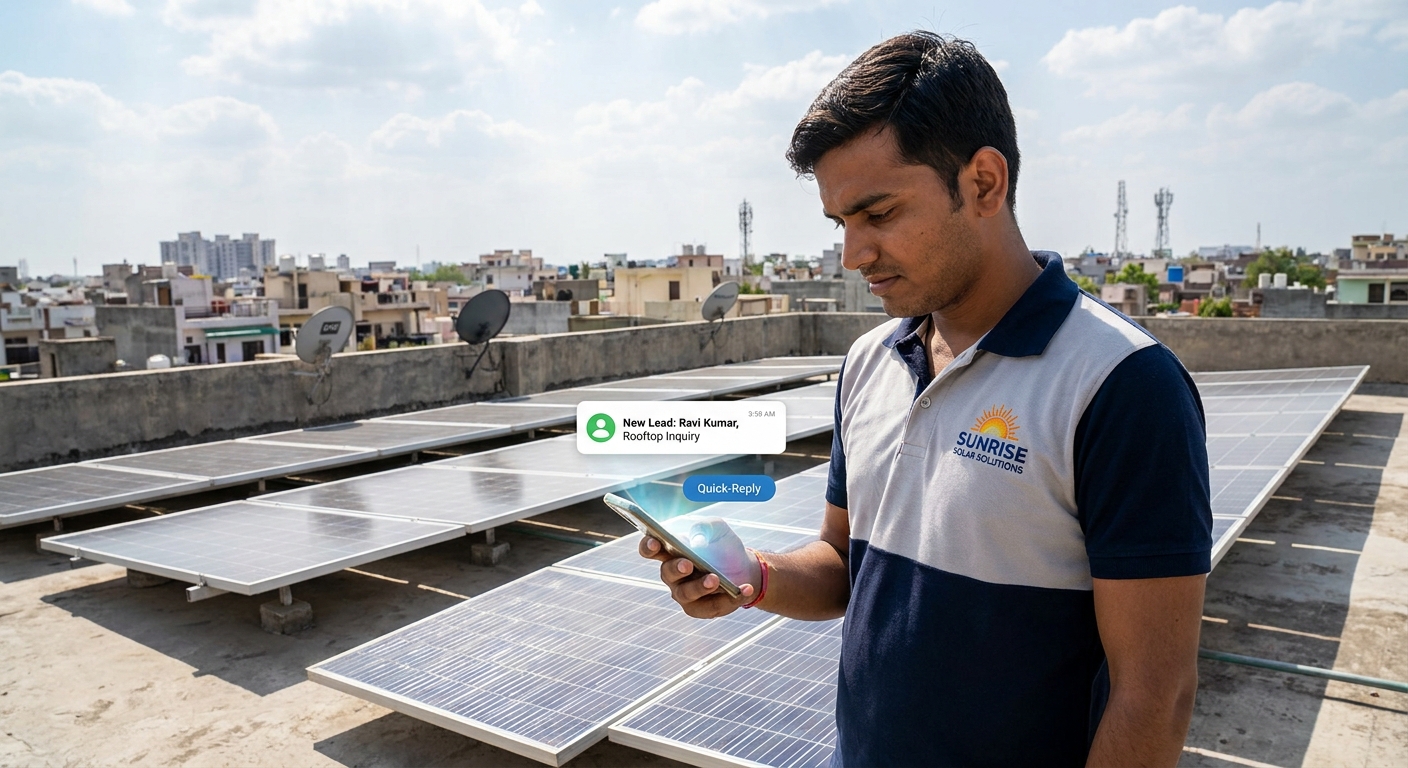
The challenge for most solar companies is that leads come in from multiple channels, Facebook Ads, website forms, referrals, walk-ins, and there’s no centralized system to catch them all. Leads fall through the cracks, response times stretch to hours or days, and prospects move on.
QuickEstimate integrates directly with Facebook Ads, Phonebook, Pabbly Connect, and custom APIs so that every new inquiry lands in your CRM instantly and triggers an automatic notification to the right sales rep. With the QuickEstimate mobile app available on iOS and Android, your team can respond, send a proposal, and schedule a site visit from their phone, whether they’re in the office or on a rooftop installation.
This kind of CRM integration India solar companies need is what turns a good lead generation campaign into a high-converting sales machine.
5. Build a Visual Sales Pipeline to Spot Bottlenecks Fast
If you can’t see your pipeline, you can’t manage it. Most solar sales managers in India are flying blind, they have a rough idea of how many deals are “in progress,” but no clear picture of where each one stands, which ones are stalling, or which reps are carrying the team.
A visual sales pipeline in your solar CRM gives you a real-time, stage-by-stage view of every deal in your funnel. You can see at a glance how many leads are at the inquiry stage, how many proposals have been sent, how many are in negotiation, and how many are ready to close. More importantly, you can see where deals are getting stuck and take action before they go cold.
For solar EPCs managing multiple projects simultaneously, this kind of pipeline visibility is transformative. Sales managers can spot a rep who has 15 deals stuck at the “proposal sent” stage and coach them on follow-up tactics. They can identify that commercial leads convert faster than residential ones and reallocate resources accordingly. Real-time solar sales data turns management from reactive to proactive.
6. Use Data and Analytics to Make Smarter Sales Decisions
Gut instinct has its place in sales, but data wins in the long run. The solar companies growing fastest in India right now are the ones using CRM analytics to understand exactly what’s working in their sales process and what isn’t, and then doubling down on what works.
Key metrics every solar sales team should track include: lead-to-proposal conversion rate, proposal-to-close rate, average deal size, average sales cycle length, and revenue by source. When you track these consistently, patterns emerge. You might discover that leads from Facebook Ads close 30% faster than referral leads, or that proposals sent on Tuesday mornings have a higher open rate than those sent on Fridays.
QuickEstimate’s real-time analytics dashboard puts all of this data in one place, updated live as your team works. Sales managers can run performance reports, identify top performers, and coach underperforming reps with specific, data-backed feedback instead of vague encouragement. This is how sales automation India solar companies use to build a culture of continuous improvement.
7. Centralize Team Collaboration to Eliminate Handoff Delays
In many solar companies, the sales process involves multiple people, a lead generation specialist, a field sales rep, a technical estimator, and a closing manager. When these handoffs happen over WhatsApp groups and verbal conversations, things get lost. A prospect’s specific requirements don’t make it from the field rep to the estimator. A follow-up call gets missed because two reps both assumed the other was handling it.
Centralizing your team’s work inside a solar CRM eliminates these handoff delays. Every team member can see the full history of a lead, every call, every email, every note, and pick up exactly where the last person left off. Managers can assign tasks directly in the CRM, set deadlines, and track completion without chasing people on WhatsApp.
QuickEstimate’s team collaboration tools let you assign leads to specific reps, monitor their activity in real time, and share insights across the team. When everyone is working from the same system with the same information, your solar sales cycle gets shorter because nothing falls through the cracks.
8. Import and Manage Bulk Leads Without Manual Data Entry
If your sales team is spending time manually entering leads into a spreadsheet or CRM, that’s time they’re not spending selling. For solar companies running large marketing campaigns, trade shows, digital ads, referral programs, the volume of incoming leads can quickly overwhelm a team that’s doing data entry by hand.
Bulk lead import is a simple but powerful feature that many solar businesses overlook. With QuickEstimate, you can import hundreds of leads from an Excel file in minutes, with all the relevant data, name, contact, location, system size interest, mapped automatically to the right fields. Your team wakes up to a fully populated CRM instead of spending the first two hours of their day on data entry.
Clean, organized lead management India solar companies need starts with getting data into the system fast and accurately. From there, your CRM can start scoring, assigning, and triggering follow-up sequences automatically, turning a raw list of contacts into an active, working pipeline.
9. Integrate Your CRM with Lead Generation Channels
Your solar sales process is only as strong as the connections between your lead generation channels and your CRM. If leads from your Facebook Ads campaign have to be manually downloaded and uploaded into your CRM every day, you’re introducing delays, errors, and gaps that cost you deals.
Modern CRM integration India solar companies rely on includes direct connections to Facebook Ads, website contact forms, Pabbly Connect workflows, and custom APIs and webhooks. When a prospect fills out a Facebook lead form at 9 PM, their details should be in your CRM and triggering an automated response by 9:01 PM, not waiting for someone to check the Ads Manager the next morning.
QuickEstimate supports integrations with Phonebook, Facebook Ads, Pabbly Connect, and custom APIs, making it straightforward to build a fully connected lead capture system. Every channel feeds into one central pipeline, and no lead ever gets lost in transit. This is the foundation of a truly scalable solar sales operation.
10. Use Professional Proposal Templates to Build Instant Trust
In solar sales, your proposal is often the first formal impression your company makes on a prospect. A poorly formatted quote sent as a plain text email signals that you’re a small, disorganized operation. A polished, branded proposal with clear system specifications, ROI projections, and professional visuals signals that you’re a company worth trusting with a significant investment.

The quality of your solar proposals directly affects your close rate. Prospects who receive a professional, easy-to-understand proposal are more likely to move forward quickly because they feel confident in your competence. They’re also less likely to shop around for a second opinion when your proposal already answers all their questions clearly.
QuickEstimate’s professional proposal template library gives your team a range of branded, customizable templates designed specifically for solar sales, covering residential rooftop systems, commercial installations, and hybrid setups. You can add your company logo, adjust pricing, include system diagrams, and send the finished proposal via WhatsApp or Email in under 60 seconds. Every proposal looks like it was designed by a professional, every time.
For guidance on what to include in a winning solar proposal, explore our resource on boosting solar sales conversion rates.
11. Track Every Interaction with a Complete Customer History
One of the most common frustrations in solar sales is when a prospect calls back and the rep who picks up has no idea what was discussed in the last conversation. The prospect has to repeat themselves, the rep scrambles to find notes, and the whole interaction feels unprofessional. This kind of friction adds days to your sales cycle and erodes trust.
A complete customer interaction history in your solar CRM solves this instantly. Every call, email, WhatsApp message, site visit, and proposal is logged against the lead’s record. Any rep on your team can pull up a prospect’s history in seconds and continue the conversation with full context, making the customer feel valued and keeping the deal moving forward.
This is especially important for solar EPCs managing long-cycle commercial projects where multiple stakeholders are involved over weeks or months. A complete interaction log ensures that nothing gets forgotten, every commitment is tracked, and your team always shows up prepared. It’s a small feature with a big impact on your solar sales cycle length.
12. Measure CRM ROI and Continuously Optimize Your Solar Sales Process
Implementing a solar CRM is not a one-time fix, it’s the beginning of a continuous improvement cycle. The companies that get the most out of their CRM investment are the ones that regularly review their data, identify what’s working, and make deliberate adjustments to their process.
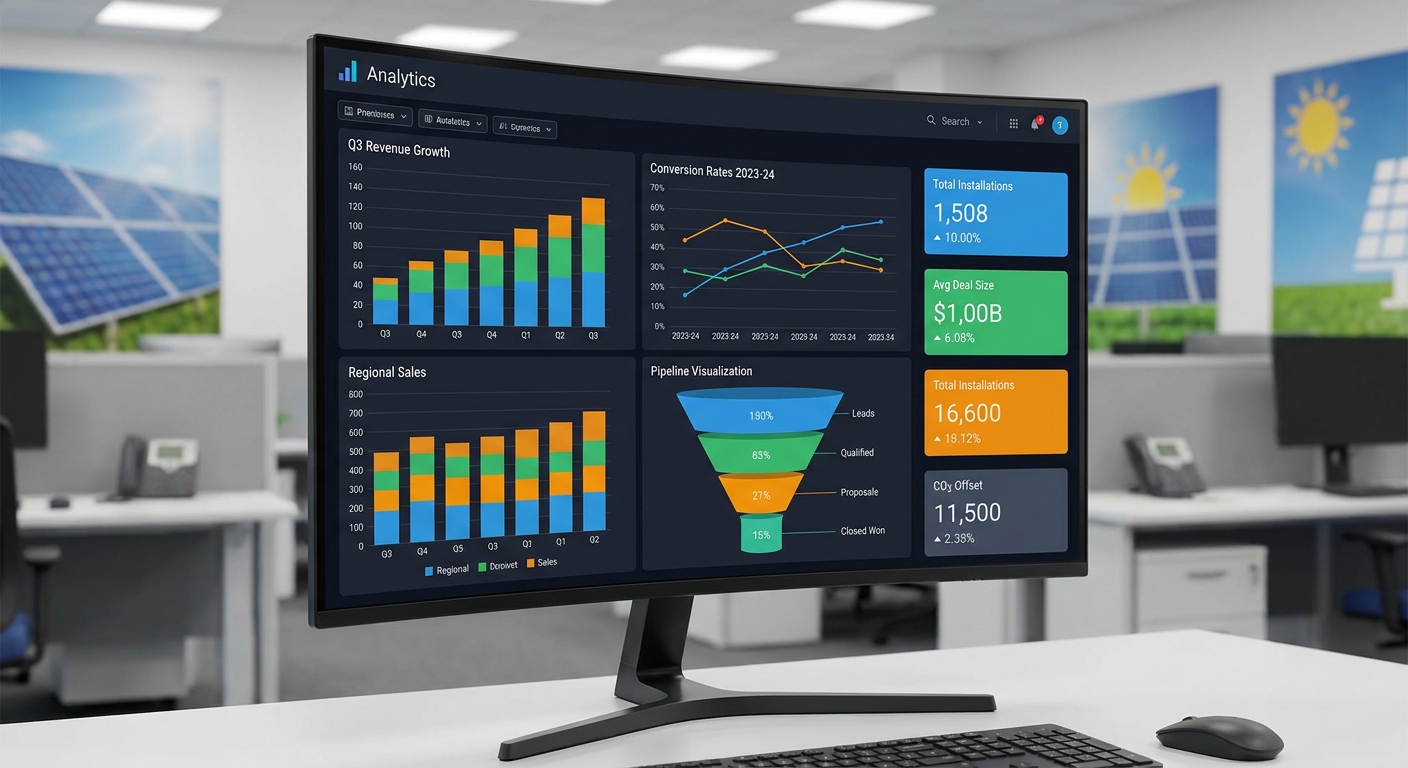
Measuring CRM ROI for solar businesses is straightforward when you have the right data. Track your close rate before and after CRM implementation. Measure the change in average sales cycle length. Calculate the revenue impact of the deals you’re now closing that previously slipped away. Most solar companies using QuickEstimate report significant improvements in all three metrics within the first 90 days.
Beyond the numbers, use your CRM data to run monthly sales reviews with your team. Which lead sources are producing the highest-quality prospects? Which proposal templates have the best conversion rates? Which follow-up sequences are getting the most responses? These insights let you refine your solar sales process continuously, compounding your results over time.
Before choosing a CRM, it’s worth understanding the full cost picture. Our guide on Solar CRM Software Costs: What You’re Really Paying For breaks down exactly what you should expect to invest and what you’ll get in return. And when you’re ready to get started, our CRM Implementation India: Step-by-Step Setup Guide 2026 walks you through the entire setup process.
Frequently Asked Questions About Solar Sales Optimization
How long does it take to implement a solar CRM?
Most solar companies can get a platform like QuickEstimate up and running within a day or two. The setup involves importing your existing leads, configuring your proposal templates, and connecting your lead generation channels. Unlike enterprise CRM platforms that require months of customization, solar-specific CRMs are designed to be operational quickly so your team can start closing deals faster right away.
What is the average solar sales cycle length in India?
For residential solar installations in India, the average sales cycle ranges from 2 to 6 weeks. Commercial and industrial projects typically take longer, anywhere from 4 weeks to 3 months, due to the complexity of site assessments, technical specifications, and procurement approvals. Solar companies using CRM automation and instant proposal generation consistently report cycle lengths 30 to 50 percent shorter than industry averages.
Can small solar companies benefit from CRM software?
Absolutely. In fact, small solar companies often see the biggest gains from CRM adoption because they’re starting from a lower baseline of process maturity. A 3-person solar sales team using QuickEstimate can operate with the efficiency of a 10-person team running manual processes. The solar sales strategies in this guide apply equally to solo installers and large EPCs, the scale changes, but the principles don’t.
How does proposal automation improve solar sales conversion rates?
Proposal automation improves conversion rates in two key ways. First, it dramatically reduces response time, sending a professional proposal within 60 seconds of a prospect’s inquiry instead of 24 hours later. Second, it ensures consistency, every proposal looks professional and includes all the information a prospect needs to make a decision, reducing back-and-forth and objections. Together, these factors can improve proposal-to-close conversion rates significantly.
How do I choose the right solar CRM for my business?
The right solar CRM should be purpose-built for the solar industry (not a generic CRM that requires heavy customization), offer instant proposal generation, automate follow-ups, integrate with your lead sources, and provide real-time analytics. It should also be affordable and easy for your team to adopt without extensive training. Our guide on CRM Scalability: 8 Critical Questions Before You Buy will help you evaluate your options systematically.
Start Closing Solar Deals Faster Today
Every day your solar sales process runs on manual effort and disconnected tools is a day you’re leaving deals on the table. The 12 strategies in this guide, from 60-second proposal generation to automated follow-ups to real-time pipeline analytics, are not theoretical. They’re the exact workflows that over 1,000 solar businesses in India are using right now to close deals faster, respond to leads quicker, and grow revenue without burning out their sales teams.
QuickEstimate is built specifically for solar EPCs, installers, and B2B sales teams who need a smarter, faster way to manage their solar sales process. You don’t need a six-month implementation or an enterprise budget to get started. You can begin optimizing your solar sales cycle today with a plan that fits your business.
Ready to see the difference? Start with our FREE Plan at ₹0 and experience instant proposal generation, lead management, and automated follow-ups at no cost. When you’re ready to unlock the full power of the platform, our PRO Plan at ₹6,999 per user per year gives your team everything they need to dominate their market. Have questions about which plan is right for your solar business? Contact us and our team will help you find the best fit.
This blog post was written using thestacc.com