
In solar sales, client communication is everything. A lead that doesn’t hear back within a few hours often moves on to a competitor. A proposal that looks unprofessional gets ignored. A follow-up that never arrives means a deal that never closes. For solar companies across India, these aren’t hypothetical problems — they’re daily realities that cost real revenue.
In 2026, the solar businesses pulling ahead aren’t necessarily the ones with the lowest prices or the largest teams. They’re the ones that have mastered client communication using CRM systems built for the way solar sales actually works. This post features 8 real-world success stories showing exactly how solar companies transformed their communication workflows, reduced response times, and closed more deals using CRM-powered strategies.

Why Client Communication Makes or Breaks Solar Sales
Solar is a considered purchase. Whether you’re selling to a homeowner in Pune or a factory owner in Surat, the buying journey involves multiple touchpoints, questions, and decision-makers. Every gap in client communication is an opportunity for doubt to creep in — and for a competitor to step in.
The Indian solar market has grown rapidly, with India’s Ministry of New and Renewable Energy reporting record installation targets for 2026. More competition means clients have more choices. The solar companies that respond fastest, communicate most clearly, and follow up most consistently are the ones winning the deals.
Yet most solar businesses still rely on WhatsApp groups, scattered spreadsheets, and manual reminders to manage their client communication. The result? Missed follow-ups, duplicate outreach, inconsistent proposals, and frustrated customers. A solar-specific CRM solves all of these problems in one place.
Here are 8 stories showing what that transformation looks like in practice.
Story 1: Sunnovative Cut Response Time from 48 Hours to Under 2 Hours
The challenge: Sunnovative, a growing solar installer, was losing warm leads simply because their sales team couldn’t respond fast enough. Manually creating proposals in Excel and sending them via email took anywhere from 24 to 48 hours. By the time the proposal arrived, many prospects had already spoken to a competitor.
The solution: Sunnovative implemented QuickEstimate’s CRM with instant proposal generation. Their sales reps could now generate a professional, branded solar proposal in under 60 seconds and send it directly via WhatsApp — the channel their clients actually use. Client communication went from a bottleneck to a competitive advantage.
The result: Average response time dropped from 48 hours to under 2 hours. Lead-to-meeting conversion improved by 3x within the first quarter. The sales team spent less time on paperwork and more time on conversations that actually moved deals forward.
Key CRM feature: 60-second proposal generation with WhatsApp delivery, turning the first point of contact into a professional, memorable experience.
Story 2: Heaven Solar Eliminated Miscommunication with Centralized Lead Tracking
The challenge: Heaven Solar had a common but costly problem: different sales reps were maintaining their own spreadsheets. The same lead was sometimes contacted by two different reps on the same day. Clients complained about receiving duplicate calls. Internally, the team had no shared view of who owned which lead or what stage each deal was at.
The solution: By moving all lead data into a centralized CRM, Heaven Solar gave every team member a single source of truth. Each lead had one owner, one history, and one clear next action. Client communication became consistent because everyone could see exactly what had been said, when, and by whom.
The result: Duplicate outreach dropped to zero. Internal confusion around lead ownership fell by an estimated 40%. More importantly, clients noticed the difference, they were no longer receiving conflicting information from different reps, which built trust and accelerated decision-making.
Key CRM feature: Shared lead pipeline with team visibility and activity logs, the foundation of consistent, professional client communication.
Story 3: JJ Solar Boosted Deal Closure Rates with Automated Follow-Up Sequences
The challenge: JJ Solar’s sales team was diligent about first contact but inconsistent about follow-ups. After sending an initial proposal, reps would move on to new leads and forget to circle back. Deals that were close to closing went cold simply because no one followed up at the right time.
The solution: JJ Solar set up automated follow-up sequences inside their CRM. After a proposal was sent, the system automatically triggered a series of reminders, a WhatsApp message two days later, an email follow-up on day five, and a call reminder on day ten. The sales team didn’t have to remember anything; the CRM handled the client communication schedule automatically.
The result: Deal closure rates increased by 28% within 90 days of implementing the automated follow-up system. The team closed deals they would have previously lost simply due to inaction. For more on how follow-up automation drives results in the Indian market, see Follow-Up Automation India: Complete Service Guide 2026.
Key CRM feature: Automated multi-step follow-up sequences with customizable email and WhatsApp templates, ensuring no deal falls through the cracks.
Story 4: A Mid-Size Solar EPC Scaled Client Communication Across 3 Cities
The challenge: A mid-size solar EPC company operating across Mumbai, Ahmedabad, and Hyderabad struggled to maintain consistent client communication standards across all three offices. Each branch had its own way of doing things. Proposals looked different. Follow-up timelines varied. Clients who interacted with multiple branches received inconsistent experiences.
The solution: The company deployed a cloud-based CRM accessible to all three offices and their field teams via mobile app. Managers in Mumbai could see what was happening in Hyderabad in real time. Field sales reps used the mobile app to update lead status, send proposals, and log client interactions from job sites. A unified communication standard was enforced across all locations.
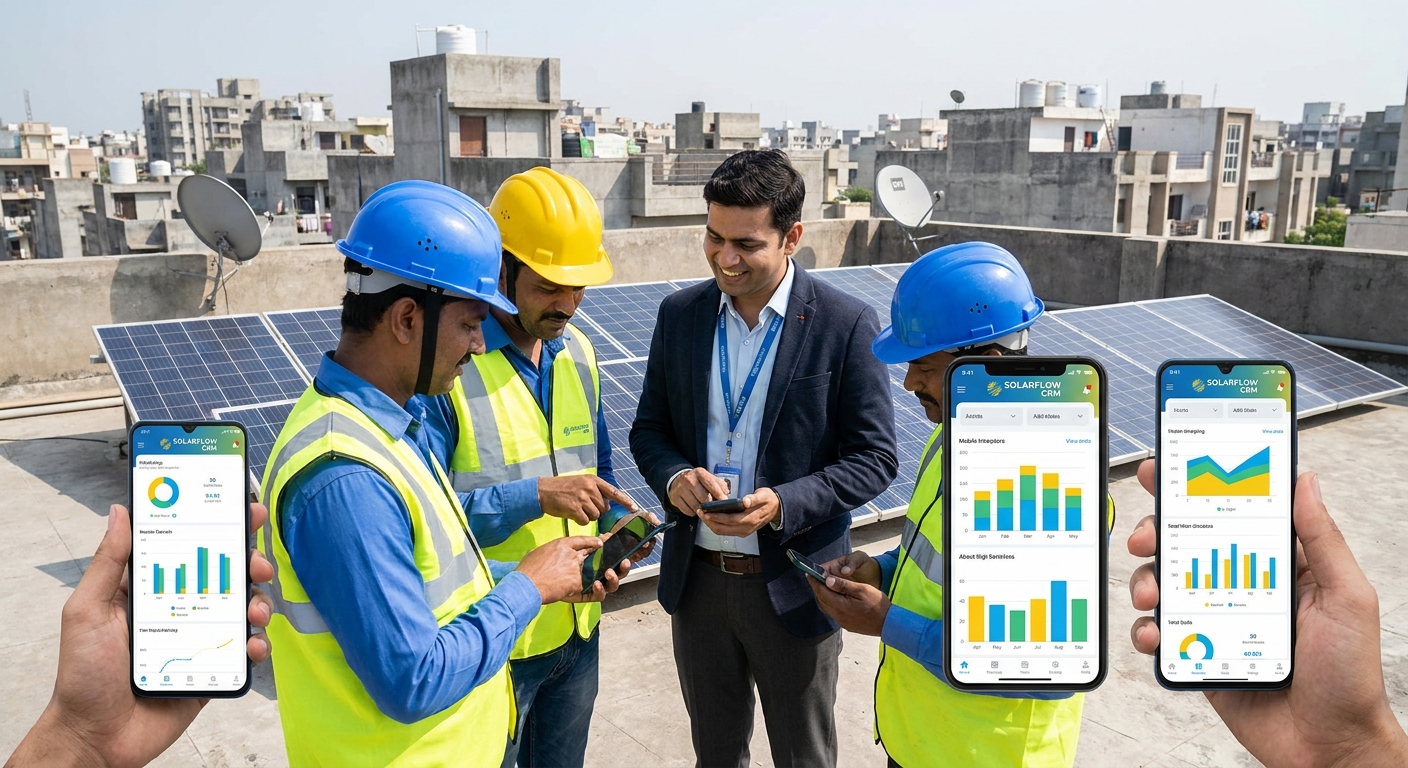
The result: Clients received the same professional experience regardless of which branch they dealt with. Sales managers gained real-time visibility into pipeline performance across all cities. The company could identify which branch was underperforming in client communication and address it quickly with data, not guesswork.
Key CRM features: Mobile app access (iOS and Android), team task assignment, real-time analytics dashboard, enabling consistent client communication at scale.
Story 5: A Residential Solar Installer Improved Customer Satisfaction Scores
The challenge: A residential solar installer in Rajasthan was receiving complaints not about the quality of their installations, but about communication during the project. Customers didn’t know when the site survey would happen, when equipment would arrive, or when installation would begin. The lack of proactive client communication created anxiety and eroded trust, even when the work itself was excellent.
The solution: The company used their CRM to set up automated milestone update messages. When a lead converted to a project, the system sent a WhatsApp message confirming the next steps. When the site survey was scheduled, the client received an automatic reminder. When installation was confirmed, another update went out. Clients were always informed without the sales team having to manually send each message.
The result: Customer satisfaction scores improved noticeably within two months. Referral rates also increased, as satisfied customers were more likely to recommend the company to friends and family. The installer learned that client communication doesn’t end when the deal is signed, it’s just as important during delivery.
Key CRM feature: Automated update workflows and communication templates, keeping clients informed at every stage without adding to the team’s workload.
Story 6: A Commercial Solar Company Won Larger Deals with Professional Proposals
The challenge: A commercial solar company in Gujarat was consistently losing bids to competitors despite offering competitive pricing. When they reviewed the feedback from lost deals, a pattern emerged: clients perceived their proposals as less professional and less detailed than those from larger competitors. The company’s manually created PDF proposals looked inconsistent and took days to produce.
The solution: The company switched to CRM-generated proposals using a professional template library with full brand customization. Every proposal now included the company logo, a detailed system specification, financial projections, and a clear call to action, all generated in under 60 seconds. Client communication at the proposal stage became a differentiator rather than a weakness.
The result: The company won two large commercial contracts within the first three months of using the new proposal system. Decision-makers at both client companies specifically mentioned the quality of the proposal as a factor in their choice. For solar companies looking to improve their overall sales conversion, 7 Proven Ways to Boost Sales Conversion in Solar 2026 offers additional strategies.
Key CRM feature: Professional proposal template library with brand customization, making every client interaction look polished and credible.
Story 7: Tata Power Dealer Network Used CRM to Manage High-Volume Lead Communication
The challenge: A dealer in the Tata Power solar network was running Facebook Ads campaigns that generated a high volume of inbound leads. The problem was capturing and responding to those leads quickly enough. Leads were coming in through Facebook forms, being manually copied into spreadsheets, and then assigned to reps, a process that took hours and meant many leads received their first contact too late.
The solution: The dealer integrated their Facebook Ads account directly with their CRM. New leads from Facebook forms were automatically captured into the CRM, assigned to a sales rep, and triggered an automated first-response WhatsApp message, all within minutes of the lead submitting their details. Client communication began before a human even looked at the lead.
The result: Lead slippage dropped to near zero. First-contact time fell from several hours to under 15 minutes. The sales team could focus on qualifying and converting leads rather than manually managing data entry. The Facebook Ads integration became one of the most valuable tools in their lead management arsenal.
Key CRM features: Facebook Ads integration, bulk lead import, automated first-response messaging, ensuring every lead receives immediate, professional client communication.
Story 8: A Solar Startup Achieved CRM ROI in Under 60 Days
The challenge: A solar startup in Maharashtra had a small but ambitious team. They had the technical expertise to deliver great installations, but no structured sales process. Leads were managed in a shared WhatsApp group. Proposals were created in Word documents. Follow-ups depended entirely on individual reps remembering to act. The team knew their client communication was costing them deals, but they weren’t sure where to start.
The solution: The startup implemented QuickEstimate’s full CRM suite from day one. Within a week, they had a structured lead pipeline, automated follow-up sequences, and a professional proposal template ready to go. The entire team was trained and operational within days, not months. Client communication went from chaotic to systematic almost immediately.
The result: The startup recovered the full cost of their CRM subscription within 60 days through deals closed that they would previously have lost. The ROI was clear and measurable. For solar businesses evaluating the cost of CRM tools, Solar CRM Software Costs: What You’re Really Paying For provides a detailed breakdown of what to expect.
Key CRM features: Full CRM suite including lead management, proposal automation, and analytics, delivering measurable CRM ROI within the first two months.
Key Client Communication Lessons from All 8 Stories
Across all 8 success stories, several clear patterns emerge. These aren’t abstract principles, they’re lessons drawn directly from how real solar businesses in India improved their client communication and their bottom line.
- Speed is the single biggest factor in lead conversion. Every story that involved faster response times resulted in higher conversion rates. In solar sales, the first company to respond professionally almost always gets the meeting.
- Automation enables better human communication, not less of it. Automated follow-ups and updates free your team to focus on high-value conversations. The goal isn’t to replace human interaction, it’s to ensure no communication opportunity is missed.
- Centralized data eliminates miscommunication. When every team member works from the same lead data, duplicate outreach disappears and clients receive a consistent experience. This is especially important for solar companies with multiple sales reps or branch offices.
- Professional proposals signal credibility. In commercial solar sales especially, the quality of your proposal communicates the quality of your company. A polished, branded proposal sent within 60 seconds makes a powerful first impression.
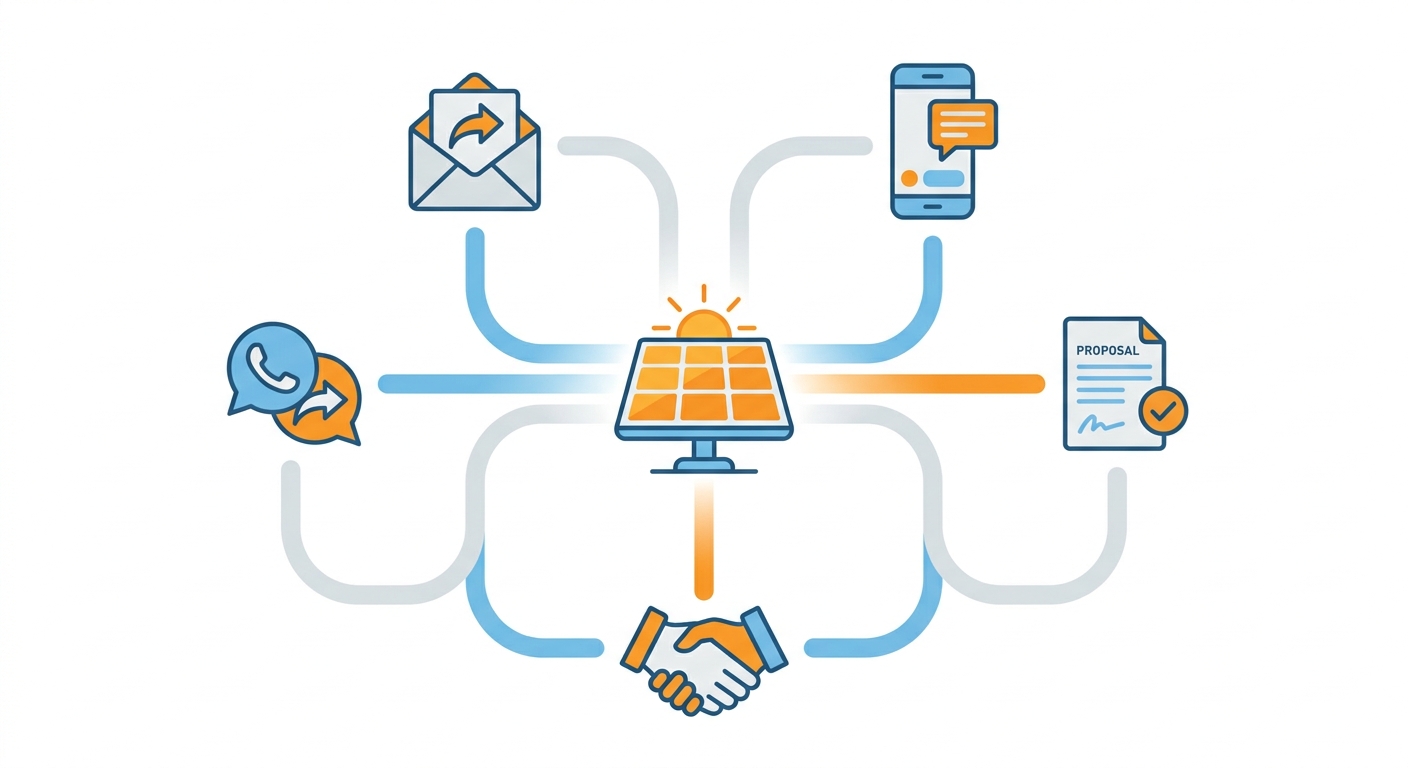
- Multi-channel communication maximizes reach. The most effective solar CRM strategies combine WhatsApp (for speed and familiarity) with email (for documentation and formality). Meeting clients on their preferred channel improves response rates significantly.
- Post-sale communication drives referrals. As Story 5 showed, client communication doesn’t end at the signed contract. Keeping clients informed during delivery builds loyalty and generates word-of-mouth referrals.
These lessons apply whether you’re a solo solar installer or a multi-city EPC company. The scale changes; the principles don’t. To understand how to build a CRM system that can grow with your business, CRM Scalability: 8 Critical Questions Before You Buy is essential reading before you commit to a platform.
How to Implement CRM-Powered Client Communication for Your Solar Business
Reading about other companies’ success is motivating. But the real question is: how do you replicate these results for your own solar business? Here’s a practical five-step framework based on what worked across all 8 stories.

Step 1: Audit Your Current Communication Gaps
Before implementing any tool, identify where your client communication is breaking down. Are leads going cold because of slow response times? Are follow-ups being missed? Are proposals taking too long to create? Are clients complaining about lack of updates? Knowing your specific gaps helps you prioritize which CRM features to set up first.
Step 2: Choose a Solar-Specific CRM
Generic CRM tools like Salesforce or Zoho CRM can be configured for solar, but they require significant customization and often lack solar-specific features like system specification templates or WhatsApp proposal delivery. A purpose-built solar CRM like QuickEstimate comes pre-configured for the way solar sales works, reducing setup time and improving adoption. For a detailed guide on getting started, see CRM Implementation India: Step-by-Step Setup Guide 2026.
Step 3: Set Up Automated Follow-Up Sequences
This single step delivers the fastest ROI for most solar businesses. Map out your typical sales cycle, from first contact to signed contract, and create automated touchpoints at each stage. A well-designed follow-up sequence ensures that every lead receives consistent, timely client communication without relying on individual reps to remember.
Step 4: Train Your Team on Communication Standards
Technology only works if your team uses it consistently. Set clear standards for how leads should be updated, how quickly proposals should be sent, and what information should be logged after every client interaction. Use your CRM’s team collaboration features to monitor adherence and coach reps who need support.
Step 5: Track Metrics and Optimize Over Time
Use your CRM’s analytics dashboard to monitor key client communication metrics: average response time, proposal open rates, follow-up completion rates, and deal closure rates by rep. Review these metrics monthly and make adjustments to your sequences, templates, and processes based on what the data shows.
Frequently Asked Questions About CRM and Client Communication
What is the best CRM for solar client communication in India?
The best CRM for solar client communication in India is one built specifically for the solar industry. QuickEstimate is designed for solar EPCs, installers, and sales teams, with features like 60-second proposal generation, WhatsApp integration, and automated follow-ups that match how Indian solar sales teams actually work. Generic CRMs like Zoho or Salesforce can work but require more customization and typically cost more to configure for solar-specific workflows.
How does WhatsApp CRM integration work for solar companies?
WhatsApp CRM integration allows your sales team to send proposals, follow-up messages, and project updates directly from the CRM to a client’s WhatsApp number. When a proposal is generated in the CRM, it can be sent as a WhatsApp message with a single click. Automated follow-up sequences can also be configured to send WhatsApp messages at scheduled intervals, ensuring consistent client communication without manual effort.
How quickly can a solar company see results from CRM implementation?
Most solar companies see measurable improvements in client communication metrics within the first 30 to 60 days of CRM implementation. Response times typically improve immediately once proposal automation is set up. Follow-up consistency improves within the first week of activating automated sequences. Deal closure rate improvements usually become visible within 60 to 90 days as the pipeline matures under the new system.
Is CRM affordable for small solar businesses in India?
Yes. QuickEstimate offers a free plan that gives small solar businesses access to core CRM and proposal features at no cost. For businesses ready to scale, the Pro Plan at ₹6,999 per user per year provides full access to automation, analytics, and integrations. Compared to the revenue lost from missed follow-ups and slow proposals, the cost of a solar CRM is minimal. The startup in Story 8 recovered their full CRM investment within 60 days.
How does solar CRM improve client communication compared to spreadsheets?
Spreadsheets are static, manual, and siloed. A solar CRM is dynamic, automated, and shared. With a CRM, every team member sees the same lead data in real time. Proposals are generated and sent in seconds. Follow-ups happen automatically. Clients receive consistent, professional communication at every stage. Spreadsheets require someone to remember to do all of this manually, and in a busy solar sales environment, things get missed.
Start Transforming Your Client Communication Today
The 8 solar companies in this post didn’t achieve their results by working harder. They achieved them by working smarter, using CRM systems that made client communication faster, more consistent, and more professional. Whether you’re losing deals to slow response times, struggling with missed follow-ups, or sending proposals that don’t reflect the quality of your work, a solar-specific CRM is the most direct path to fixing those problems.
QuickEstimate is built for exactly this. Solar EPCs, installers, and sales teams across India use it every day to send proposals in 60 seconds, automate follow-ups, and keep clients informed at every stage of the sales cycle. The result is better client communication, stronger relationships, and more deals closed.
Ready to see what structured, CRM-powered client communication can do for your solar business? Start with the Free Plan (₹0) and experience the difference immediately, no credit card required. If you’re ready to unlock the full power of automation and analytics, the Pro Plan at ₹6,999 per user per year gives your team everything they need to compete and win. Have questions about which plan fits your business? Contact us and we’ll help you find the right fit.
This blog post was written using thestacc.com