
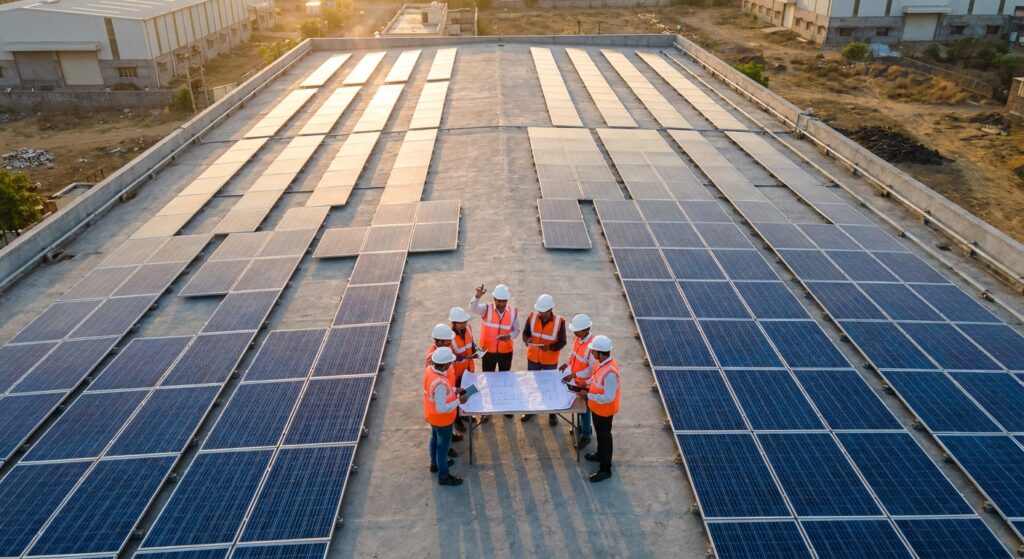
Picture this: your solar EPC company just won a 2 MW commercial rooftop bid. You have three other projects in procurement, two proposals pending client approval, and a government tender deadline in 48 hours. Your sales manager is chasing five different leads on WhatsApp, your procurement team is emailing vendors separately, and nobody has a clear view of which deal is closest to closing. This is the daily reality for most solar EPC companies in India — and it’s exactly why the right CRM makes or breaks your growth.
A solar EPC company operates in a fundamentally different world from a residential solar installer. Your projects are larger, your sales cycles are longer, your teams are bigger, and the cost of a missed follow-up or a delayed proposal is measured in lakhs, not thousands. Generic CRM tools built for retail sales teams simply don’t address these realities. This guide breaks down the 12 must-have CRM features that solar EPC companies need in 2026 to manage complex projects, win more commercial bids, and scale their operations efficiently.

Why Solar EPC Companies Need a Different Kind of CRM
Most CRM platforms are designed for businesses with short, transactional sales cycles. A solar EPC company’s reality is the opposite. A single commercial or industrial project can take three to twelve months from first contact to financial closure. During that time, your team juggles engineering assessments, procurement negotiations, client presentations, regulatory approvals, and construction timelines — all simultaneously, across multiple projects.
Standard solar installers typically handle one customer at a time, with a relatively simple proposal and a quick installation. Solar EPC companies manage multi-stakeholder projects where the client might be a factory owner, a government body, or a large commercial developer. The proposal isn’t a one-page quote — it’s a detailed technical and financial document. The follow-up isn’t a single call, it’s a structured sequence of touchpoints over weeks or months.
Generic CRMs like Salesforce or Zoho CRM can be configured to handle some of this complexity, but they require significant customization, dedicated IT resources, and months of setup time. For a growing solar EPC company in India, that’s time and money you can’t afford to waste. What you need is a CRM built with solar sales workflows in mind, one that handles proposal generation, lead management, and team coordination out of the box.
Here are the 12 features that separate a CRM built for solar EPC success from one that will slow you down.
1. Multi-Project Pipeline Tracking
A solar EPC company rarely works on just one project at a time. You might have a 500 kW industrial project in the proposal stage, a 1 MW government project in procurement, and a 2 MW commercial project in construction, all running concurrently. Your CRM must give every team member a clear, real-time view of where each project stands.
Look for a CRM that offers visual pipeline management with customizable stages that reflect the EPC project lifecycle: prospecting, site assessment, proposal sent, negotiation, PO received, procurement, installation, and commissioning. Each stage should show the deal value, the responsible team member, and the next action required.
Without this visibility, revenue leakage is inevitable. Deals stall because nobody follows up. Proposals expire because the sales team lost track of the timeline. A well-structured pipeline view prevents these losses by making every project’s status impossible to ignore. For more on preventing pipeline revenue loss, see CRM Scalability: 8 Critical Questions Before You Buy.
2. Rapid Commercial Proposal Generation

In the commercial and industrial solar market, the company that sends a professional proposal first has a significant advantage. Clients evaluating multiple EPCs often shortlist based on responsiveness and presentation quality before they even compare technical specifications. If your team takes three days to put together a proposal, you’ve already lost ground to a competitor who responded in three hours.
The best CRM for a solar EPC company includes built-in proposal generation that lets your sales team create detailed, professional proposals in minutes, not days. QuickEst, for example, enables solar EPC teams to generate and send professional proposals within 60 seconds via WhatsApp or Email. That speed isn’t just convenient, it’s a competitive weapon in a market where response time directly influences win rates.
Your proposal tool should support large-scale project specifications, including system size, component breakdowns, financial projections, and ROI calculations. It should also allow your team to customize proposals with your company’s branding, so every document you send reinforces your professional image. For a deeper look at how proposal software drives EPC wins, explore 7 Proven Ways to Boost Sales Conversion in Solar 2026.
3. Vendor and Subcontractor Coordination
Procurement is the backbone of any solar EPC project. Your CRM should help you manage vendor relationships, track procurement timelines, and link supplier communications directly to the relevant project record. When a panel delivery is delayed or a subcontractor needs a revised scope, your sales and project teams should be able to see the impact on the overall project timeline without switching between five different tools.
Look for a CRM that allows you to attach vendor contacts, communications, and documents to specific project records. This keeps all project-related information in one place and prevents the costly miscommunications that happen when procurement data lives in email threads and spreadsheets. The ability to track vendor status alongside client status gives your project managers a single source of truth for every active EPC engagement.
4. Team Collaboration Across Departments

A solar EPC project involves multiple departments: sales, engineering, procurement, finance, and construction. Each team needs access to relevant project information without being overwhelmed by data that doesn’t apply to their role. A CRM that enables structured collaboration across these departments eliminates the information silos that slow down EPC project delivery.
The right CRM lets you assign tasks to specific team members, set deadlines, and monitor progress from a central dashboard. When a sales rep closes a deal, the engineering team should be automatically notified to begin the site assessment. When procurement confirms panel availability, the construction team should be updated without a single manual email.
QuickEst’s team collaboration tools allow solar EPC managers to assign tasks, monitor team activity, and share project insights across departments. This kind of structured coordination is what separates high-performing EPC companies from those that lose projects to internal miscommunication. If your team is still building collaboration habits around a new CRM, the CRM Adoption Guide for Solar Sales Teams 2026 offers a practical roadmap.
5. Lead Management for Long Sales Cycles
Commercial and industrial solar projects don’t close in a week. A government tender might take six months from initial inquiry to purchase order. A factory owner evaluating a 1 MW rooftop installation might need four site visits, three revised proposals, and a detailed financial model before signing. Your CRM must be built to nurture leads over these extended timelines without letting any prospect fall through the cracks.
Effective lead management for solar EPC companies includes the ability to capture leads from multiple sources, Facebook Ads, website inquiries, referrals, trade shows, and direct outreach, and consolidate them in a single system. QuickEst supports bulk lead import from Excel and direct integration with Facebook Ads, so your team spends less time on data entry and more time on high-value conversations.
Lead prioritization is equally important. Not every inquiry deserves the same level of attention. A CRM with lead scoring capabilities helps your sales team focus on the prospects most likely to convert, based on project size, location, timeline, and engagement history. This is especially valuable for solar EPC companies managing dozens of active leads across different project types and geographies.
6. Automated Follow-Up Sequences
The average commercial solar deal requires between seven and twelve follow-up touchpoints before it closes. Most solar EPC sales teams manage three or four. The gap between those numbers represents deals that competitors are winning because they stayed in touch longer and more consistently.
A CRM with automated follow-up sequences solves this problem without adding to your team’s workload. You can set up customizable reminder sequences that trigger based on deal stage, time elapsed since last contact, or proposal status. When a client hasn’t responded to a proposal in five days, the system automatically sends a follow-up email. When a lead goes cold after a site visit, a reminder prompts your sales rep to re-engage.
QuickEst’s automated follow-up system includes customizable reminders and email templates designed for solar sales workflows. For solar EPC companies where each deal represents significant revenue, this kind of systematic follow-up discipline is the difference between a 20% win rate and a 40% win rate. Learn how to build these sequences effectively in the Follow-Up Automation India: Complete Service Guide 2026.
7. Real-Time Sales Performance Dashboard
A solar EPC company’s leadership team needs to know, at any given moment, how many projects are in the pipeline, what the total value of active bids is, which deals are at risk, and how individual sales reps are performing. Without a real-time dashboard, this information requires hours of manual reporting, time that could be spent closing deals.
Your CRM’s analytics dashboard should display key metrics including total pipeline value, conversion rates by project type, average deal cycle length, proposal acceptance rates, and team activity levels. These metrics allow your sales director to make data-driven decisions about resource allocation, pricing strategy, and market focus.
QuickEst’s real-time sales performance tracking gives solar EPC managers a live view of their entire sales operation. When a large project stalls in the negotiation stage, the dashboard flags it immediately. When a particular sales rep is consistently converting commercial leads at a higher rate, the data reveals the pattern so you can replicate it across the team.
8. Mobile Access for On-Site Teams
Solar EPC work happens in the field as much as it happens in the office. Your sales engineers conduct site assessments at factories and commercial buildings. Your project managers visit construction sites daily. Your procurement team travels to vendor facilities. All of these team members need access to the CRM from wherever they are, on whatever device they have.
A CRM with a fully functional mobile app for iOS and Android ensures that your field teams can update project status, log client interactions, access proposal documents, and respond to leads without waiting until they’re back at a desk. This real-time field connectivity keeps your pipeline data accurate and your response times fast, two factors that directly influence your win rate on competitive EPC bids.
QuickEst’s mobile app gives solar EPC professionals full CRM access on the go. A sales engineer who completes a site assessment can immediately update the lead status, attach site photos, and trigger the proposal generation process, all from the project site. That kind of field-to-office connectivity is a significant operational advantage for growing EPC companies.
9. Integration with Lead Sources and Business Tools
A solar EPC company’s lead sources are diverse. Inquiries come through the company website, Facebook Ads campaigns, referral networks, government tender portals, trade associations, and direct outreach. Managing these channels manually means data gets lost, duplicated, or delayed. A CRM with strong integration capabilities centralizes all of this data automatically.
QuickEst integrates with Facebook Ads for automatic lead capture, Phonebook for contact management, and Pabbly Connect for connecting with hundreds of other business tools. The platform also supports APIs and webhooks, allowing solar EPC companies to build custom integrations with their existing project management, accounting, or ERP systems.
For a solar EPC company operating at scale, these integrations eliminate the manual data entry that consumes hours of your team’s time each week. Every lead that comes in through any channel lands directly in the CRM, assigned to the right team member, with the right follow-up sequence triggered automatically. That’s the kind of operational efficiency that lets you handle more projects without proportionally increasing your headcount.
10. Proposal Tracking and Deal Status Visibility
Sending a proposal is only half the battle. Knowing what happens after you send it is where most solar EPC companies lose visibility. Did the client open the proposal? Did they share it with their finance team? Have they been reviewing it for three days without responding? Without proposal tracking, your sales team is operating blind after the most critical moment in the sales process.
A CRM with proposal tracking capabilities notifies your sales team when a client opens a proposal, how long they spent reviewing it, and when they forward it to other stakeholders. This intelligence allows your team to time follow-up calls perfectly, reaching out when the client is actively engaged with your proposal rather than interrupting them at a random moment.
For solar EPC companies managing multiple simultaneous bids, proposal tracking also provides a portfolio-level view of all outstanding proposals, their current status, and their expiry dates. This prevents the common scenario where a proposal expires without a follow-up because the sales team lost track of it in a busy pipeline.
11. Brand-Customized Professional Templates
When you’re pitching a 2 MW commercial solar project to a large manufacturer or a government body, the quality of your proposal document signals the quality of your company. A generic, unbranded proposal template tells the client that you treat their project like any other job. A professionally designed, brand-customized proposal tells them that you take their business seriously.
Your CRM should include a professional proposal template library that you can customize with your company’s logo, color scheme, contact information, and standard project specifications. QuickEst allows solar EPC companies to create and save branded proposal templates that can be deployed in seconds, ensuring every proposal your team sends looks polished and consistent.
This consistency matters more than most EPC companies realize. Clients evaluating multiple vendors often make initial shortlisting decisions based on presentation quality before they dig into technical details. A professional proposal template is a low-cost, high-impact way to differentiate your company in a competitive bid process.
12. Scalable Architecture for Growing EPC Portfolios
The CRM you choose today needs to support your business not just at its current size, but at two or three times its current size. A solar EPC company that wins a major government contract or expands into a new state needs to add users, projects, and data without rebuilding its CRM infrastructure from scratch.
Look for a cloud-based CRM with a scalable architecture that grows with your project portfolio. Cloud deployment means your team can access the system from any location, critical for EPC companies with projects spread across multiple cities or states. It also means you’re always running the latest version of the software without managing on-premise servers or IT infrastructure.
QuickEst’s cloud-based platform supports solar EPC companies at every stage of growth, from small teams handling a handful of projects to large organizations managing dozens of concurrent installations. The ability to add users and expand capabilities without disruption is a key factor in long-term CRM ROI. For a detailed breakdown of what solar CRM software actually costs at different scales, see Solar CRM Software Costs: What You’re Really Paying For.
How Solar EPC Companies in India Are Using QuickEst

QuickEst is already trusted by over 1,000 solar businesses across India, including companies like Sunnovative, Heaven Solar, JJ Solar, and Tata Power. These companies use the platform to manage their sales pipelines, generate proposals, automate follow-ups, and track team performance, all from a single, solar-specific CRM built for the way their businesses actually work.
For solar EPC companies specifically, the platform’s combination of rapid proposal generation, multi-project pipeline tracking, and automated follow-up sequences addresses the three biggest operational challenges that EPC sales teams face: slow proposal turnaround, poor pipeline visibility, and inconsistent follow-up discipline.
Unlike general-purpose CRMs like Salesforce or Zoho CRM, QuickEst doesn’t require months of customization to work for a solar EPC workflow. The platform is designed from the ground up for solar sales, which means the features your team needs are available immediately, not after a lengthy and expensive configuration process. And unlike OpenSolar, which focuses primarily on solar design and engineering tools, QuickEst is built around the sales and CRM capabilities that drive revenue for EPC companies.
The result is a CRM that your sales team will actually use, because it makes their jobs easier rather than adding administrative burden. That adoption rate is what determines whether a CRM investment pays off, and it’s why solar-specific tools consistently outperform generic platforms for EPC companies in India.
“The companies winning the most commercial solar projects in India aren’t necessarily the ones with the best panels or the lowest prices. They’re the ones that respond fastest, follow up most consistently, and present the most professional proposals. A solar EPC CRM is the system that makes all three of those things possible at scale.”
Frequently Asked Questions About Solar EPC CRM
What makes a CRM suitable for solar EPC vs. residential solar installers?
Solar EPC companies need CRM features that support long sales cycles, multi-stakeholder projects, large-scale proposal generation, and cross-department coordination. Residential installers typically need simpler lead management and basic proposal tools. An EPC-suitable CRM must handle concurrent projects at different stages, vendor coordination, and detailed commercial proposals, capabilities that go well beyond what most residential-focused tools offer.
How long does CRM implementation take for a solar EPC company?
With a solar-specific CRM like QuickEst, implementation is significantly faster than with a general-purpose platform. Most solar EPC teams can be fully operational within a few days, including data migration, team onboarding, and template setup. General CRMs like Salesforce can take weeks or months to configure for EPC workflows. The faster your team is up and running, the sooner you start seeing ROI from your CRM investment.
Can a CRM handle both sales and project coordination for solar EPC companies?
A good solar CRM handles the sales side of EPC operations comprehensively, lead management, proposal generation, follow-up automation, and pipeline tracking. For full project management (construction scheduling, resource allocation, site management), you may need a dedicated project management tool integrated with your CRM. QuickEst’s API and webhook capabilities make it straightforward to connect your CRM with project management platforms, giving you a connected workflow across both sales and delivery.
Is QuickEst suitable for large MW-scale solar EPC projects?
Yes. QuickEst’s proposal generation and pipeline management capabilities are designed to handle commercial and industrial solar projects of any scale. The platform supports detailed proposal customization, multi-project tracking, and team collaboration features that are essential for MW-scale EPC operations. Over 1,000 solar businesses in India, including large EPCs, use QuickEst to manage their sales processes efficiently.
How does a solar EPC CRM compare to using spreadsheets and WhatsApp?
Spreadsheets and WhatsApp are the default tools for most solar EPC teams in India, but they create serious operational risks at scale. Data gets duplicated or lost, follow-ups are missed, proposals take hours to prepare, and there’s no visibility into overall pipeline health. A dedicated solar EPC CRM centralizes all of this in one system, automates the repetitive tasks, and gives leadership real-time visibility into sales performance, without the chaos of managing multiple disconnected tools.
Take the Next Step for Your Solar EPC Business
Managing a growing solar EPC company without the right CRM is like running a construction project without a site plan. You might get things done, but you’ll waste time, miss opportunities, and leave money on the table. The 12 features outlined in this guide represent the minimum viable CRM capability for any solar EPC company serious about scaling its commercial and industrial project portfolio in 2026.
QuickEst gives your solar EPC team everything it needs to respond faster, follow up more consistently, and win more commercial bids, without the complexity or cost of enterprise CRM platforms. With over 1,000 solar businesses already using the platform across India, it’s the solar-specific CRM built for the way EPC companies actually work.
Start with the FREE Plan (₹0) to experience how QuickEst transforms your solar EPC sales process at no cost. When you’re ready to unlock the full suite of proposal automation, team collaboration, and advanced pipeline tracking features, the PRO Plan at ₹6,999 per user per year gives your EPC team everything it needs to compete and win at scale. Have questions about which plan fits your EPC operation? Contact us and our team will help you find the right fit.
This blog post was written using thestacc.com