

Picture this: your solar EPC just closed its biggest commercial project yet. The operations team is scrambling to track panel inventory, the finance team is chasing invoices, and your sales reps are still sending proposals from a shared Google Doc. Someone suggests you need an ERP. Someone else says you need a better CRM. And suddenly, a software decision that should take a week turns into a three-month debate that costs you deals.
The CRM vs ERP question is one of the most common — and most misunderstood — decisions solar businesses face as they grow. Both systems promise to fix your problems. Both come with impressive demos and persuasive sales pitches. But they solve fundamentally different problems, and choosing the wrong one at the wrong time can drain your budget and slow your growth.
This guide cuts through the confusion. You’ll get a clear breakdown of what each system does, a direct CRM vs ERP comparison, and a practical recommendation based on your business size and stage. If you’re a solar EPC, installer, or B2B solar service company in India, this is the decision framework you need.

The Question Every Growing Solar Business Faces
Most solar businesses in India start the same way: a founder, a few sales reps, and a pile of WhatsApp messages and Excel sheets. That works until it doesn’t. When leads start slipping through the cracks, proposals take too long, and nobody knows which deals are actually close to closing, the pressure to “get a system” becomes real.
That’s when the CRM vs ERP debate begins. Well-meaning advisors, software vendors, and even competitors will push you toward one or the other. Understanding the difference isn’t just an IT decision — it’s a strategic one that directly affects your revenue, your team’s productivity, and your ability to scale.
Here’s the short version before we go deep: CRM (Customer Relationship Management) software manages your sales process and customer relationships. ERP (Enterprise Resource Planning) software manages your internal business operations. For most solar companies in India, especially those focused on growth, CRM delivers faster, more measurable returns. But there’s a time and place for ERP too. Let’s break it all down.
What Is a CRM? Core Functions Explained
A CRM is software designed to manage every interaction between your business and your customers. It lives on the front end of your business, the part that faces the market, generates revenue, and builds relationships.
For a solar EPC or installer, a CRM typically handles:
- Lead capture and management: Automatically pulling in leads from Facebook Ads, your website, or manual entry, then organizing them in a single pipeline view
- Proposal generation: Creating and sending professional solar quotes to prospects, ideally in minutes, not hours
- Follow-up automation: Sending reminders, emails, and WhatsApp messages to prospects at the right time without manual effort
- Pipeline tracking: Giving sales managers a real-time view of every deal, its stage, and its probability of closing
- Sales analytics: Reporting on conversion rates, proposal win rates, team performance, and revenue forecasts
- Team collaboration: Assigning leads to reps, tracking activities, and sharing customer notes across the team
In the Indian solar market, where competition is intense and response time often determines who wins the deal, a CRM is the tool that keeps your sales engine running. Popular CRM options include general-purpose platforms like Zoho CRM and Salesforce, as well as solar-specific platforms like QuickEstimate that are purpose-built for EPCs and installers.
The key point: CRM software is a revenue tool. Its job is to help you win more deals, faster.
What Is an ERP? Core Functions Explained
An ERP is software designed to manage your internal business operations. Where CRM faces outward toward customers, ERP faces inward toward your organization. It connects departments that would otherwise operate in silos.
A typical ERP system for a solar company might include modules for:
- Inventory and procurement: Tracking solar panels, inverters, mounting hardware, and other materials across warehouses and project sites
- Project management: Scheduling installations, assigning field teams, and tracking project milestones
- Finance and accounting: Managing invoices, payments, GST compliance, and financial reporting
- Human resources: Payroll, attendance, and employee management
- Supply chain management: Coordinating with vendors, managing purchase orders, and tracking deliveries
ERP systems are powerful, but they come with significant complexity. Implementation timelines are measured in months, not days. Costs can run into lakhs of rupees for licensing, customization, and training. And the benefits, while real, are primarily operational rather than revenue-generating.
Well-known ERP platforms used in India include SAP, Oracle NetSuite, Microsoft Dynamics, and Tally (for accounting-focused needs). These are enterprise-grade tools built for organizations with complex, multi-department operations.
The key point: ERP software is an operations tool. Its job is to make your internal processes more efficient and reduce operational costs.
CRM vs ERP: A Side-by-Side Comparison
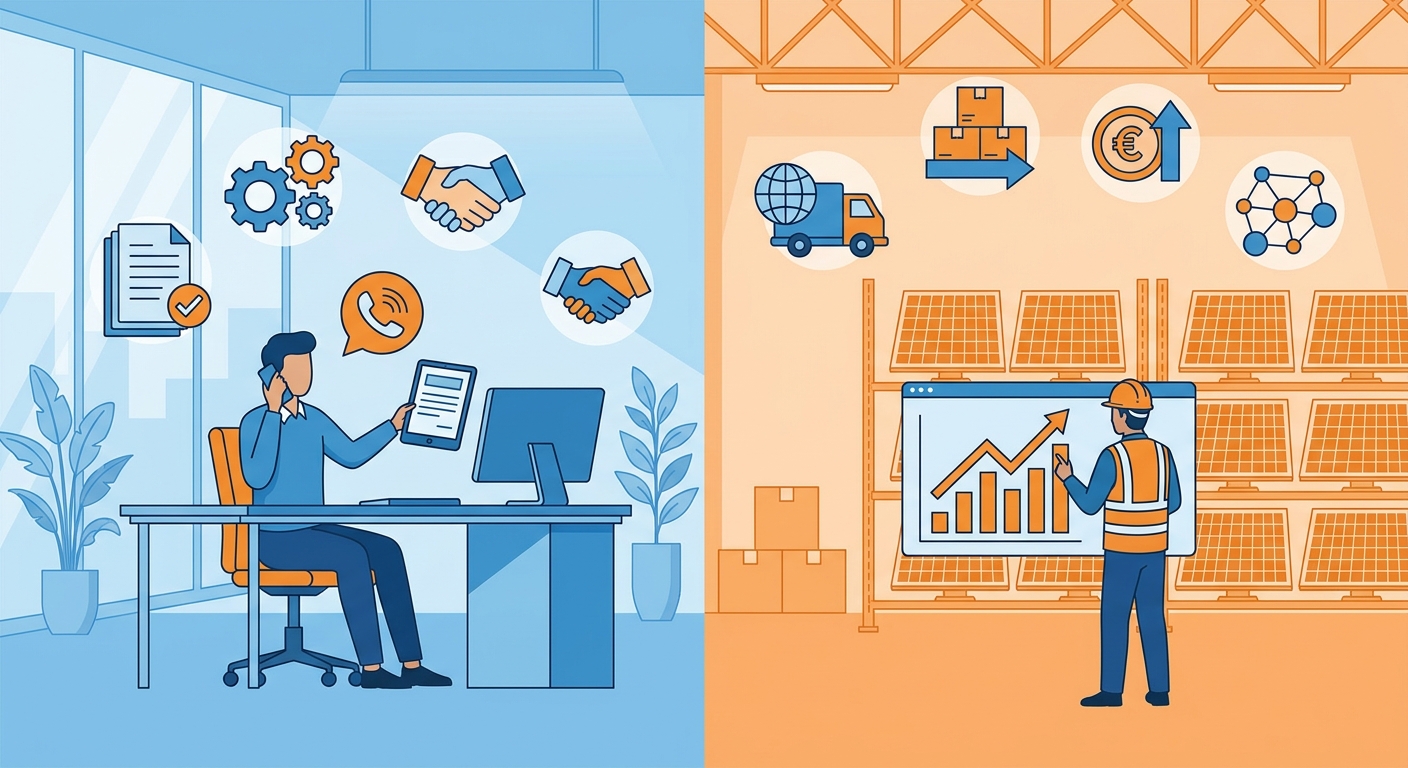
Understanding the difference between CRM vs ERP becomes much clearer when you put them side by side. Here’s how the two systems compare across the dimensions that matter most to solar businesses in India:
Purpose and Primary Function
CRM is built to grow revenue. It manages the customer journey from first inquiry to closed deal and beyond. Every feature, lead tracking, proposal generation, follow-up automation, is designed to help your sales team win more business.
ERP is built to reduce operational costs and improve efficiency. It manages the internal machinery of your business: inventory, finance, HR, and supply chain. It doesn’t directly generate revenue, but it prevents waste and improves margins.
Who Uses Each System
CRM users: Sales reps, sales managers, business development teams, and customer success teams. In a solar company, this means the people who talk to customers, send proposals, and close deals.
ERP users: Operations managers, finance teams, procurement officers, HR departments, and warehouse staff. In a solar company, this means the people who manage materials, track project costs, and handle payroll.
Data and Insights
CRM data is customer-centric: contact details, communication history, proposal status, deal value, and conversion rates. It answers questions like “Which leads are most likely to close?” and “How many proposals did we send this month?”
ERP data is operations-centric: inventory levels, purchase order status, project costs, employee hours, and financial statements. It answers questions like “How much did this installation cost us?” and “Do we have enough inverters in stock for next month’s projects?”
Cost and Implementation
This is where the difference becomes very practical for solar businesses in India. A solar CRM can be set up in days, with costs ranging from free plans to a few thousand rupees per user per year. The learning curve is manageable, and your sales team can start seeing results within weeks.
An ERP system is a much larger investment. Implementation alone can take 3 to 12 months. Licensing costs for mid-market ERP platforms often start at several lakhs per year, and customization for solar-specific workflows adds more. You’ll also need dedicated IT support and extensive staff training.
Integration Between the Two
CRM and ERP are not mutually exclusive. Many mature solar businesses eventually run both, with the CRM handling the sales process and the ERP managing operations after a deal is won. Modern platforms offer integration capabilities, so when a deal closes in your CRM, the project details can automatically flow into your ERP for procurement and scheduling.
But integration is a later-stage consideration. For most growing solar companies, the priority is clear: get the revenue engine running first.
Why Most Solar Companies Should Prioritize CRM First
Here’s a direct answer to the CRM vs ERP question for the majority of solar EPCs and installers in India: start with CRM. Here’s why.
Solar Sales Is Relationship-Driven and Proposal-Heavy
Winning a solar installation contract, whether residential or commercial, depends on three things: responding fast, sending a professional proposal, and following up consistently. These are all CRM functions. An ERP won’t help you send a quote faster or remind your rep to call back a warm lead.
According to industry research, companies that use CRM software see an average sales increase of 29%. For solar businesses competing in a crowded market, that kind of lift comes directly from better lead management, faster proposals, and automated follow-ups, not from inventory optimization.
CRM ROI Is Faster and More Measurable
When you implement a solar CRM, you can measure the impact within 30 to 60 days. How many more proposals did your team send? What’s the conversion rate on those proposals? How many follow-ups were automated that would have been missed? These are concrete, revenue-linked metrics.
ERP ROI is real but slower and harder to attribute. Operational savings from better inventory management or streamlined procurement take months to materialize and are difficult to connect directly to your bottom line.
For solar businesses that need to grow revenue now, CRM wins the ROI race. You can explore this further in our guide on Solar CRM Software Costs: What You’re Really Paying For.
Most Solar EPCs in India Are SMBs That Don’t Need ERP Complexity
The vast majority of solar installation companies in India have fewer than 50 employees. ERP systems are designed for organizations with complex, multi-department operations at scale. Implementing an ERP at this stage is like buying a 40-tonne truck to deliver a few solar panels across town. It’s overkill, and the operational burden of managing the system can actually slow you down.
What these businesses need is a tool that helps their sales team close more deals, respond faster, and stay organized. That’s exactly what a solar CRM delivers.
The Real Pain Points CRM Solves for Solar Businesses
Talk to any solar sales manager in India and you’ll hear the same frustrations:
- Leads that came in last week haven’t been followed up
- Proposals take hours to create and look inconsistent
- Nobody knows which deals are actually close to closing
- Sales reps are working from WhatsApp and personal spreadsheets
- Managers have no visibility into team activity or pipeline health
Every one of these problems is a CRM problem. And every one of them directly costs you revenue. If you’re losing deals because of slow proposals and missed follow-ups, fixing your inventory management system won’t help. You need a CRM.
For a deeper look at how CRM transforms solar sales teams, read our CRM Adoption Guide for Solar Sales Teams.
When Does a Solar Business Actually Need an ERP?
ERP is not the wrong answer, it’s just the wrong answer for most solar businesses at most stages. There are genuine scenarios where an ERP becomes necessary. Here’s how to recognize them.
Signs Your Solar Business Has Outgrown Spreadsheets for Operations
If your operations team is managing procurement, inventory, and project scheduling across multiple sites using Excel, and errors are costing you money, that’s a signal. When a missing shipment of inverters delays three installations, or when your finance team can’t reconcile project costs without a week of manual work, operational software becomes a real need.
When Inventory Management Becomes Critical
Large-scale solar EPCs that procure panels, inverters, and BOS (Balance of System) components in bulk across multiple projects need inventory visibility. If you’re managing ₹5 crore or more in materials across multiple warehouses and project sites, an ERP’s inventory module starts to pay for itself.
Multi-Department Coordination at Enterprise Scale
When your solar business has separate teams for sales, procurement, installation, finance, and HR, and these teams need to share data in real time, an ERP provides the integration layer that spreadsheets and disconnected tools can’t. This typically becomes relevant when you cross 100 employees or manage 50+ concurrent projects.
The Risk of Implementing ERP Too Early
Many solar companies make the mistake of implementing ERP before they’ve solved their sales process. The result: a complex, expensive system that the operations team struggles to use, while the sales team is still losing deals to faster competitors. Get your revenue engine right first. Then optimize operations.
CRM vs ERP: Choosing by Business Size and Stage
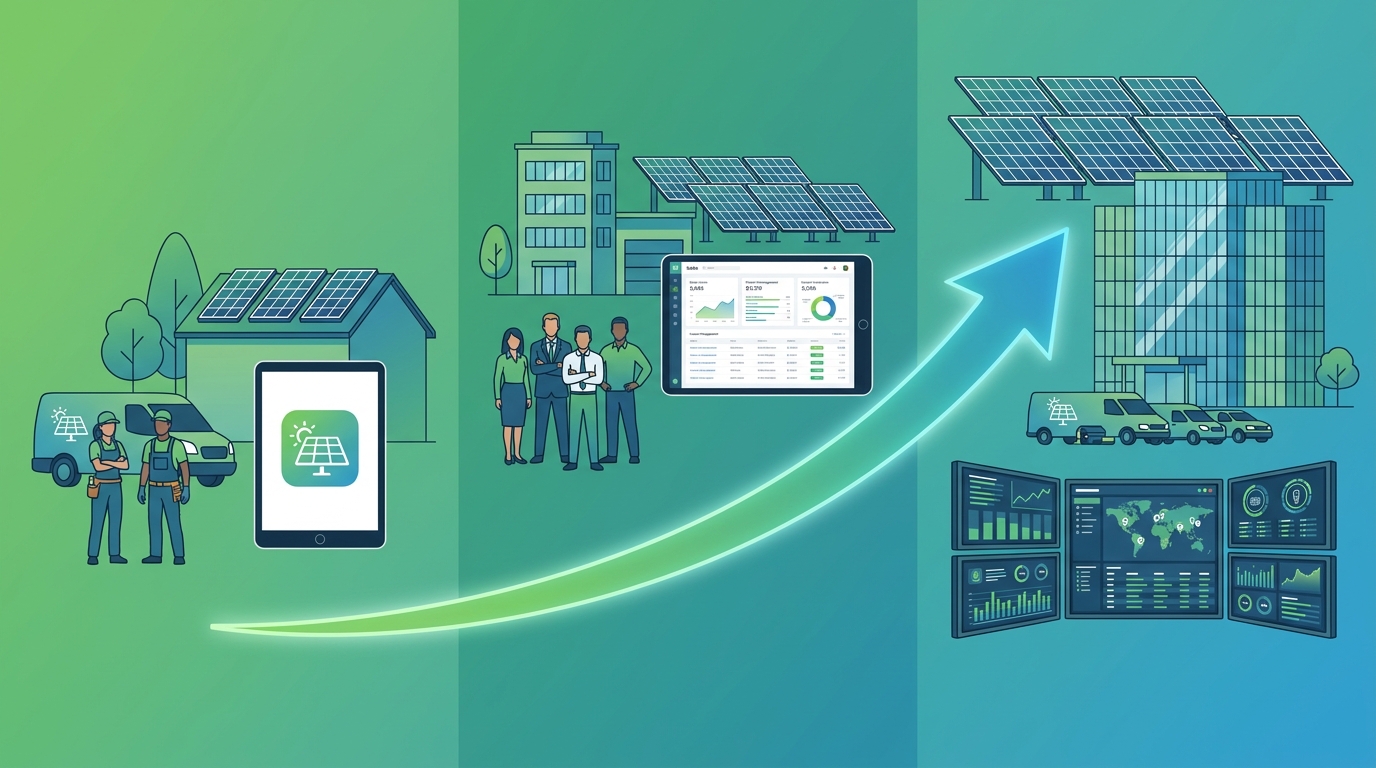
The CRM vs ERP decision isn’t one-size-fits-all. Your business size and growth stage should drive the choice. Here’s a practical framework for solar companies in India.
Small Solar Installers (1, 20 Employees): CRM Is the Clear Choice
At this stage, your biggest challenge is winning deals, not managing operations. You need to respond to leads fast, send professional proposals, and follow up consistently. A solar CRM gives you all of this at a fraction of the cost of an ERP.
Implementation takes days, not months. Your team can learn the system quickly. And you’ll see measurable results, more proposals sent, more deals tracked, more follow-ups completed, within the first month. An ERP at this stage would be a costly distraction.
Recommended approach: Implement a solar-specific CRM. Start with lead management and proposal generation. Add automation as your team grows comfortable with the system.
Mid-Size EPCs (20, 100 Employees): CRM First, ERP Later
At this stage, you likely have a dedicated sales team and a growing operations function. Your sales process needs to be tight, proposals going out fast, follow-ups automated, pipeline visible to management. Your operations team may be starting to feel the strain of manual procurement and project tracking.
The right sequence: get your CRM fully implemented and adopted first. Once your sales process is running smoothly, evaluate whether your operational pain points justify ERP investment. Many mid-size solar EPCs find that a CRM plus a simple accounting tool (like Tally or QuickBooks) covers their needs without the complexity of a full ERP.
Recommended approach: CRM as the primary system. Consider lightweight project management tools for operations. Evaluate ERP only when operational complexity clearly demands it.
For guidance on scaling your sales process, see our post on 7 Proven Ways to Boost Sales Conversion in Solar.
Large Solar Enterprises (100+ Employees): Both Systems, Integrated
At enterprise scale, you genuinely need both. Your sales team needs a CRM to manage a large pipeline across multiple regions and sales reps. Your operations team needs an ERP to coordinate procurement, inventory, project management, and finance across a complex organization.
The key at this stage is integration. Your CRM and ERP should share data, when a deal closes in the CRM, the project details should flow automatically into the ERP for procurement and scheduling. This eliminates manual handoffs and gives leadership a complete view of the business.
Recommended approach: Both systems, with a clear integration strategy. CRM owns the customer relationship; ERP owns the operational execution.
Cost Comparison at Each Stage
To make this concrete, here’s a rough cost comparison for solar businesses in India:
- Solar CRM (small to mid-size): Free plans available; paid plans typically range from a few thousand to ₹6,999 per user per year for professional features
- Mid-market ERP: Implementation costs often start at ₹5, 15 lakhs, with annual licensing adding ₹2, 10 lakhs depending on modules and users
- Enterprise ERP (SAP, Oracle): Total cost of ownership can exceed ₹50 lakhs for a mid-size solar company, including implementation, customization, and ongoing support
For most solar businesses, the math is straightforward: CRM delivers more value per rupee spent, especially in the early and mid-growth stages.
How QuickEstimate Delivers CRM Value for Solar Businesses
QuickEstimate is a cloud-based solar CRM and proposal generation platform built specifically for solar EPCs, installers, and B2B service companies in India. It addresses the exact pain points that cost solar businesses deals every day.

60-Second Proposal Generation
Instead of spending hours building proposals in Word or Excel, QuickEstimate lets your sales team generate professional, branded solar proposals in under 60 seconds and send them directly via WhatsApp or email. When a competitor takes two hours to send a quote and you send one in 60 seconds, you win the first impression, and often the deal.
Lead Management and Automated Follow-Ups
QuickEstimate captures leads from multiple sources, including Facebook Ads, bulk Excel imports, and manual entry, and organizes them in a single pipeline. Automated follow-up reminders and email sequences ensure no lead goes cold because someone forgot to call back. This directly addresses one of the most common revenue leaks in solar sales.
To see how follow-up automation works in practice, read our guide on Follow-Up Automation India: Complete Service Guide 2026.
Real-Time Sales Dashboard and Analytics
Sales managers get a live view of the entire pipeline: how many leads are active, which proposals are pending, which deals are close to closing, and how each rep is performing. This replaces the guesswork of managing a sales team through WhatsApp updates and weekly meetings.
Team Collaboration and Task Assignment
Assign leads to specific reps, track their activities, and share customer notes across the team. QuickEstimate keeps everyone aligned without the chaos of shared spreadsheets and fragmented communication.
Integration Capabilities
QuickEstimate integrates with Facebook Ads for automatic lead capture, Pabbly Connect for workflow automation, and supports APIs and webhooks for connecting with other tools in your sales stack. This means your CRM can grow with your business without requiring a complete system overhaul.
Trusted by 1,000+ Solar Businesses
QuickEstimate is used by over 1,000 businesses across India, including solar companies like Sunnovative, Heaven Solar, JJ Solar, and Tata Power. These companies chose a purpose-built solar CRM over generic platforms because it delivers results without the complexity and cost of enterprise software.
Getting started is straightforward. QuickEstimate offers a FREE Plan at ₹0 for businesses that want to explore the platform, and a PRO Plan at ₹6,999 per user per year for teams that need the full suite of proposal automation, follow-up tools, and analytics. If you’re unsure which plan fits your business, contact the QuickEstimate team for a personalized recommendation.
Frequently Asked Questions: CRM vs ERP for Solar
Can CRM and ERP be integrated?
Yes. Many mature solar businesses run both systems and connect them through APIs or middleware platforms like Pabbly Connect. When a deal closes in the CRM, project details automatically flow into the ERP for procurement and scheduling. This integration eliminates manual handoffs and gives leadership a complete view of the business.
Is ERP too expensive for small solar companies?
For most small solar installers and EPCs in India, yes. ERP implementation costs typically start at several lakhs of rupees, and the operational complexity of managing the system can outweigh the benefits for businesses with fewer than 50 employees. A solar CRM delivers far more value per rupee at this stage.
What’s the typical ROI timeline for a solar CRM?
Most solar businesses see measurable results from a CRM within 30 to 60 days of implementation. Faster proposal turnaround, fewer missed follow-ups, and better pipeline visibility translate directly into more deals closed. ERP ROI typically takes 6 to 18 months to materialize and is harder to attribute to specific revenue outcomes.
Do I need both CRM and ERP to scale my solar business?
Eventually, possibly. But most solar companies in India don’t need both until they reach significant scale, typically 100+ employees or 50+ concurrent projects. Start with CRM to build your revenue engine. Add ERP when operational complexity genuinely demands it.
Which system should I implement first?
For solar businesses focused on growth, CRM should always come first. Revenue growth depends on winning deals, and CRM is the tool that makes your sales process faster, more consistent, and more measurable. Once your sales engine is running well, you can evaluate whether operational software is the next priority.
What makes a solar-specific CRM better than a general CRM?
A solar-specific CRM like QuickEstimate comes with proposal templates designed for solar quotes, workflows built around the solar sales cycle, and integrations relevant to solar businesses. General CRMs like Zoho or Salesforce require significant customization to achieve the same results, and that customization takes time and money. For solar EPCs and installers in India, a purpose-built tool delivers faster time-to-value.
Making the Right Call: CRM vs ERP for Your Solar Business
The CRM vs ERP debate has a clear answer for most solar businesses in India: start with CRM. If your team is losing deals because proposals are slow, follow-ups are missed, and your pipeline is invisible, no amount of inventory optimization will fix that. You need a tool that helps you win more business, and that’s exactly what a solar CRM delivers.
ERP has its place. For large solar enterprises managing complex procurement, multi-site operations, and enterprise-scale finance, ERP is a genuine necessity. But implementing ERP before you’ve solved your sales process is a costly mistake that many growing solar companies make.
The smartest path forward is to get your revenue engine right first. Implement a solar CRM that lets your team send proposals in 60 seconds, automate follow-ups, and track every deal in real time. Then, as your business scales, evaluate whether operational complexity justifies ERP investment.
QuickEstimate is built for exactly this moment in your solar business’s growth. With a FREE Plan at ₹0 to get started and a PRO Plan at ₹6,999 per user per year for full sales automation, there’s no reason to delay. Stop losing deals to slower competitors. Take the first step toward a smarter sales process today, reach out to the QuickEstimate team and see how a purpose-built solar CRM transforms your pipeline.
This blog post was written using thestacc.com