

The Indian solar industry is growing faster than ever. With residential and commercial installations surging across the country, solar companies that rely on gut instinct instead of sales metrics are leaving serious money on the table. Tracking the right key performance indicators (KPIs) is no longer optional — it is the difference between a sales team that consistently closes deals and one that constantly wonders why leads go cold.
This guide covers the 15 most critical sales metrics every solar company in India should monitor in 2026. For each metric, you will find a clear definition, a simple formula, a realistic benchmark, and practical advice on how a solar CRM helps you track it automatically.

Why Sales Metrics Matter for Solar Companies in 2026
India’s solar capacity additions are breaking records year after year. According to the Ministry of New and Renewable Energy (MNRE), the country is on track to exceed its renewable energy targets, creating fierce competition among solar EPCs, installers, and service providers. In this environment, companies that track their sales metrics gain a measurable edge.
Without clear data, your sales team cannot answer basic questions: Which lead source brings the best customers? How long does it take to close a deal? Which sales rep needs coaching? A modern solar CRM like QuickEstimate puts real-time answers to all these questions on a single dashboard, so your team spends less time guessing and more time closing.
Here are the 15 sales metrics that matter most for solar businesses in 2026.
1. Lead Conversion Rate
Lead conversion rate is the percentage of total leads that become paying customers. It is the most fundamental of all sales metrics because it tells you how effective your entire sales process is, from first contact to signed contract.
Formula: (Closed Deals / Total Leads) × 100
Benchmark: For solar companies in India, a healthy lead conversion rate typically falls between 10% and 20%. If you are below 10%, your qualification process or follow-up strategy needs attention.
A solar CRM helps by ensuring no lead falls through the cracks. With automated reminders and a structured pipeline, every lead gets the attention it deserves. Check out 7 Proven Ways to Boost Sales Conversion in Solar 2026 for actionable tactics to push this number higher.
2. Proposal-to-Close Ratio
The proposal-to-close ratio measures how many proposals you send before closing one deal. For solar EPCs and installers, this is one of the most revealing sales metrics because proposals represent significant time and effort.
Formula: (Closed Deals / Proposals Sent) × 100
Benchmark: A ratio of 25% to 35% is considered strong for solar businesses. If you are sending 10 proposals to close 1 deal, your proposal quality or targeting may need work.
QuickEstimate’s 60-second proposal generation means your team can send more professional proposals faster, which directly improves this ratio. When clients receive a polished, branded proposal within minutes of a site visit, their confidence in your company rises immediately.
3. Average Deal Size
Average deal size is the mean revenue value of all closed deals over a given period. This sales metric is essential for revenue forecasting and helps you understand whether your team is targeting the right customer segments.
Formula: Total Revenue from Closed Deals / Number of Closed Deals
Benchmark: This varies widely. Residential solar deals in India typically range from ₹1.5 lakh to ₹5 lakh, while commercial and industrial (C&I) deals can run into crores. Track this metric separately for each segment.
If your average deal size is trending downward, it may signal that your team is focusing too much on small residential projects and missing larger commercial opportunities. Your CRM’s deal tagging and segmentation features make this analysis straightforward.
4. Sales Cycle Length
Sales cycle length is the average number of days from a lead’s first contact with your company to the moment a deal is closed. Among all sales metrics, this one has a direct impact on your cash flow and team capacity.
Formula: Total Days to Close All Deals / Number of Closed Deals
Benchmark: Residential solar deals in India typically close in 14 to 45 days. Commercial projects can take 60 to 120 days or more. If your cycle is longer than these ranges, bottlenecks in your process need attention.
Automation is the fastest way to shorten your sales cycle. Automated follow-up sequences, instant proposal delivery via WhatsApp, and real-time pipeline visibility all reduce the time deals spend stuck in a stage. Learn more in our guide on Follow-Up Automation India: Complete Service Guide 2026.
5. Lead Response Time
Lead response time is how quickly your team contacts a new lead after they express interest. This is one of the most underrated sales metrics in the solar industry, yet research from Harvard Business Review shows that responding within 5 minutes makes you 100 times more likely to connect with a prospect than responding after 30 minutes.
Formula: Total Response Time for All Leads / Number of Leads
Benchmark: Aim for an average lead response time of under 5 minutes for digital leads (Facebook Ads, website forms) and under 1 hour for all other inquiries.
QuickEstimate’s lead management system captures leads from Facebook Ads, website forms, and manual entries, then instantly notifies the assigned sales rep. This eliminates the delays that cause solar companies to lose warm leads to faster competitors.
6. Cost Per Lead (CPL)
Cost per lead (CPL) measures how much you spend on marketing and sales activities to generate a single lead. Tracking this sales metric by channel helps you allocate your budget to the sources that deliver the best results.
Formula: Total Marketing Spend / Total Leads Generated
Benchmark: CPL varies by channel. Facebook Ads campaigns for solar in India typically generate leads at ₹200 to ₹800 per lead. Referral leads cost far less but are harder to scale.
By tagging leads with their source in your CRM, you can compare CPL across channels and double down on what works. QuickEstimate integrates directly with Facebook Ads, so every lead from your campaigns flows automatically into your pipeline with its source tagged.
7. Customer Acquisition Cost (CAC)
Customer acquisition cost (CAC) is the total cost of acquiring one new paying customer, including all marketing, sales, and operational expenses. It is a broader and more important sales metric than CPL because it accounts for your entire funnel, not just lead generation.
Formula: Total Sales and Marketing Costs / Number of New Customers Acquired
Benchmark: For solar companies in India, a CAC below 5% of the average deal value is generally healthy. If your CAC is eating up 15% or more of deal value, your sales process needs to become more efficient.

Reducing CAC is one of the strongest arguments for investing in a solar CRM. When your team automates follow-ups, generates proposals in 60 seconds, and manages leads without manual data entry, the time saved translates directly into lower cost per acquisition. For a deeper look at CRM costs and ROI, read Solar CRM Software Costs: What You’re Really Paying For.
8. Pipeline Velocity
Pipeline velocity measures how fast revenue moves through your sales pipeline. It is arguably the most powerful of all sales metrics because it combines four key variables into a single number that reflects the overall health of your sales engine.
Formula: (Number of Deals × Win Rate × Average Deal Size) / Sales Cycle Length (in days)
Example: If you have 50 active deals, a 20% win rate, an average deal size of ₹3 lakh, and a 30-day sales cycle, your pipeline velocity is (50 × 0.20 × 3,00,000) / 30 = ₹1,00,000 per day.
Benchmark: There is no universal benchmark here. The goal is to increase your pipeline velocity quarter over quarter. Even a 10% improvement in win rate or a 5-day reduction in cycle length can significantly boost this number.
9. Follow-Up Rate
The follow-up rate tracks what percentage of leads in your pipeline receive timely, consistent follow-ups. This sales metric is especially critical for solar companies because most deals require multiple touchpoints before a customer commits to a significant investment.
Formula: (Leads Followed Up On Time / Total Active Leads) × 100
Benchmark: Aim for a follow-up rate above 90%. Studies consistently show that 80% of sales require at least 5 follow-up contacts, yet most sales reps give up after 1 or 2 attempts.
Manual follow-ups are unreliable. QuickEstimate’s automated follow-up system sends reminders, emails, and WhatsApp messages on a schedule you define, so your team never misses a touchpoint. This single feature can dramatically improve your lead conversion rate and shorten your sales cycle simultaneously.
10. Win Rate by Sales Rep
Win rate by sales rep breaks down individual performance, showing you which team members close the most deals relative to the opportunities they handle. This sales metric is invaluable for coaching, incentive planning, and resource allocation.
Formula: (Deals Closed by Rep / Total Opportunities Handled by Rep) × 100
Benchmark: A win rate of 20% to 30% per rep is solid for solar sales in India. Significant gaps between your top and bottom performers signal a need for training or process standardization.
QuickEstimate’s team performance dashboard gives sales managers a clear view of each rep’s pipeline, activity levels, and closed deals in real time. This visibility makes it easy to identify who needs support and who deserves recognition.
11. Proposal Acceptance Rate
The proposal acceptance rate measures what percentage of proposals sent to clients are formally accepted. Unlike the proposal-to-close ratio, this sales metric focuses specifically on the quality and persuasiveness of your proposals.
Formula: (Accepted Proposals / Total Proposals Sent) × 100
Benchmark: A proposal acceptance rate above 30% is strong for solar companies. If clients are consistently rejecting proposals, the issue may be pricing, presentation quality, or a mismatch between the proposal and the client’s needs.
Professional, branded proposals delivered quickly make a strong first impression. QuickEstimate’s template library lets your team create polished solar proposals in under 60 seconds, complete with your company branding, system specifications, and pricing. Clients who receive a professional proposal via WhatsApp within minutes of a site visit are far more likely to accept.
12. Revenue Per Sales Rep
Revenue per sales rep is the total revenue generated by each individual team member over a given period. This sales metric helps you understand team capacity, set realistic targets, and make informed hiring decisions.
Formula: Total Revenue / Number of Sales Reps
Benchmark: This varies by company size and market segment. The key is to track this metric over time and set quarterly improvement targets for each rep based on their experience level and territory.
When your CRM automatically logs every deal, proposal, and interaction, calculating revenue per rep becomes effortless. Managers can pull this data in seconds from the QuickEstimate analytics dashboard instead of spending hours compiling spreadsheets.
13. Lead Source ROI
Lead source ROI tells you which marketing channels generate the highest return on investment. For solar companies in India, common lead sources include Facebook Ads, Google Ads, referrals, walk-ins, and trade events. This sales metric helps you stop wasting budget on channels that do not convert.
Formula: (Revenue from Leads by Source – Cost of That Source) / Cost of That Source × 100
Benchmark: Any channel with a positive ROI is worth maintaining. Channels with an ROI above 300% deserve more investment. Channels with negative ROI should be paused or restructured.
QuickEstimate’s integration with Facebook Ads automatically tags incoming leads with their source. Over time, you build a clear picture of which channels bring customers who actually close, not just leads who fill out forms and disappear.
14. Customer Lifetime Value (CLV)
Customer lifetime value (CLV) estimates the total revenue a customer will generate for your business over the entire relationship. For solar companies, this includes the initial installation, annual maintenance contracts (AMC), system upgrades, referrals, and additional installations.
Formula: Average Purchase Value × Purchase Frequency × Average Customer Lifespan
Benchmark: A healthy CLV-to-CAC ratio is 3:1 or higher. If your CLV is only slightly higher than your CAC, your business model is fragile. Solar companies with strong AMC programs and referral networks often achieve CLV-to-CAC ratios of 5:1 or more.
Tracking CLV requires a CRM that maintains a complete history of every customer interaction, purchase, and service request. This long-term view of customer value changes how you prioritize leads and invest in customer relationships.
15. Sales Metrics Dashboard Adoption Rate
Dashboard adoption rate is a meta-metric: it measures how consistently your sales team actually uses the CRM and its reporting tools. All the other sales metrics on this list are only useful if your team is logging data accurately and reviewing dashboards regularly.
Formula: (Active CRM Users / Total Sales Team Members) × 100
Benchmark: Aim for 100% adoption. Even one rep who avoids the CRM creates blind spots in your data and undermines the accuracy of every other metric.

Low adoption is usually a sign that the CRM is too complex or time-consuming to use. QuickEstimate is built for busy solar sales teams, with a clean mobile app for iOS and Android that lets reps update deals, send proposals, and log calls from the field in seconds. When the tool is easy to use, adoption follows naturally.
How to Start Tracking Sales Metrics with a Solar CRM
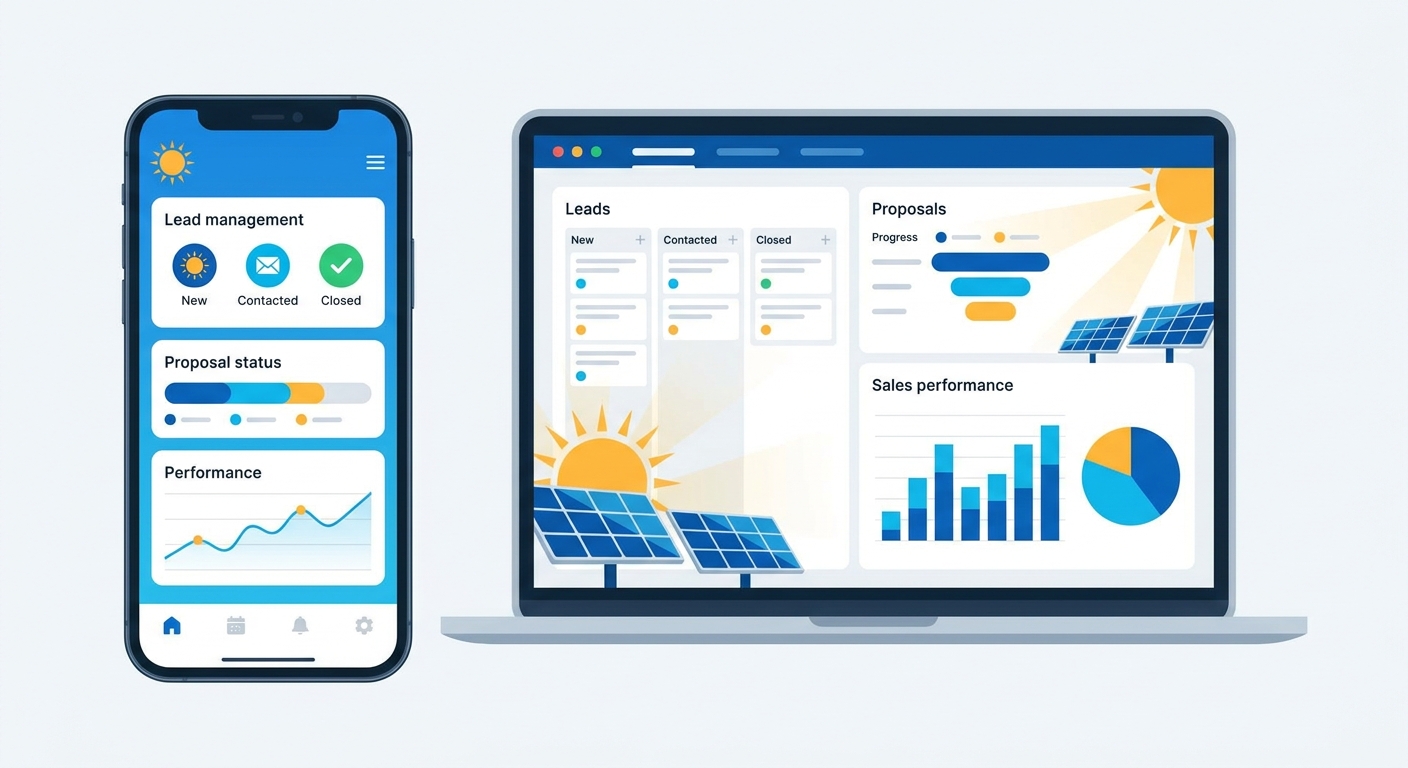
Knowing which sales metrics to track is only half the battle. The other half is setting up a system that captures the right data automatically and presents it in a way your team can act on. Here is a simple approach to get started.
Step 1: Choose a CRM Built for Solar
Generic CRM platforms like Salesforce or Zoho CRM require significant customization before they work well for solar businesses. A purpose-built solution like QuickEstimate comes pre-configured with solar-specific workflows, proposal templates, and KPI dashboards. This means you spend less time on setup and more time selling. For guidance on evaluating your options, see CRM Scalability: 8 Critical Questions Before You Buy.
Step 2: Define Your Baseline Metrics
Before you can improve your sales metrics, you need to know where you stand today. Spend the first two weeks after CRM setup simply logging all leads, proposals, and deals. This gives you a baseline for conversion rate, cycle length, and deal size that you can measure future improvements against.
Step 3: Assign Metric Ownership
Every key sales metric should have an owner, either a sales manager or a team lead, who is responsible for reviewing it weekly and flagging issues. Without ownership, dashboards become wallpaper that nobody acts on.
Step 4: Set Weekly Review Cadences
Schedule a 30-minute weekly sales review where the team looks at the top 5 metrics together: conversion rate, pipeline velocity, follow-up rate, proposal acceptance rate, and lead response time. This keeps the team aligned and creates accountability without overwhelming anyone with data.
Step 5: Automate What You Can
The more data entry you can automate, the more accurate your sales metrics will be. QuickEstimate automatically captures lead sources from Facebook Ads integrations, logs proposal send times, tracks follow-up completion, and records deal stage changes. Your team focuses on selling while the system handles the data.
If you are ready to implement a CRM for your solar business, our step-by-step guide on CRM Implementation India: Step-by-Step Setup Guide 2026 walks you through the entire process.
Frequently Asked Questions About Solar Sales Metrics
What is a good conversion rate for solar companies in India?
A lead-to-customer conversion rate of 10% to 20% is considered healthy for solar companies in India. Rates above 20% indicate an excellent sales process and strong lead qualification. Rates below 10% suggest issues with lead quality, follow-up consistency, or proposal effectiveness.
How often should I review my sales metrics?
Review operational metrics like follow-up rate and lead response time weekly. Review strategic metrics like average deal size, CAC, and CLV monthly. Conduct a comprehensive quarterly review of all 15 sales metrics to identify trends and adjust your strategy.
Which sales metric is most important for solar businesses?
Pipeline velocity is the single most comprehensive sales metric because it combines deal volume, win rate, deal size, and cycle length into one number. However, lead conversion rate and proposal acceptance rate are the most actionable metrics for day-to-day improvement.
Can a CRM automatically track all these sales metrics?
Yes. A well-configured solar CRM like QuickEstimate tracks most of these metrics automatically as your team logs leads, sends proposals, and updates deal stages. The key is consistent data entry and full team adoption. Once those two conditions are met, your dashboard becomes a live, accurate picture of your sales health.
What is the difference between CPL and CAC?
Cost per lead (CPL) measures only the marketing spend needed to generate a lead. Customer acquisition cost (CAC) includes all sales and marketing expenses divided by the number of customers actually acquired. CAC is a more complete picture of your true cost to win a customer.
Start Tracking Your Solar Sales Metrics Today
Tracking the right sales metrics is what separates solar companies that scale from those that stagnate. When you know your conversion rate, pipeline velocity, follow-up rate, and proposal acceptance rate, you can make precise improvements that compound over time. The solar companies winning in India’s competitive market in 2026 are not the ones with the most leads — they are the ones who manage every lead with data-driven precision.
QuickEstimate gives your solar sales team a purpose-built CRM with real-time sales metrics dashboards, 60-second proposal generation, automated follow-ups, and full pipeline visibility. Over 1,000 solar businesses, including Sunnovative, Heaven Solar, JJ Solar, and Tata Power, already use it to close more deals faster.
Ready to take control of your sales metrics? Start with our FREE Plan at ₹0 and see your pipeline data come to life immediately. When your team is ready to unlock advanced analytics, automation, and unlimited proposals, upgrade to the PRO Plan at ₹6,999 per user per year. Have questions about which plan fits your team? Contact us and we will help you find the right fit.
This blog post was written using thestacc.com