
Every day, solar companies across India lose deals they should have won. Not because their pricing was wrong. Not because their panels were inferior. They lost because a competitor sent a proposal faster. Proposal software is changing that reality for hundreds of solar EPCs and installers, and the results are hard to ignore.
In 2026, the solar market in India is more competitive than ever. Residential and commercial clients are getting multiple quotes within hours of expressing interest. If your sales team is still building proposals manually in Word or Excel, you are already behind. This article examines real-world case studies from solar companies that adopted proposal software and the measurable impact it had on their win rates, response times, and revenue.

The Proposal Problem Costing Solar Companies Deals Every Day
Before we look at the case studies, it helps to understand the scale of the problem. The average solar salesperson in India spends between two and four hours creating a single proposal manually. That includes pulling system specifications, calculating pricing, formatting the document, adding company branding, and then sending it via email or WhatsApp. By the time the proposal reaches the client, a faster competitor may have already followed up twice.
The problem compounds quickly. A sales team of five people, each spending three hours per proposal and handling ten proposals per week, is burning 150 hours every week on document creation alone. That is time not spent on site visits, client calls, or closing deals. Proposal software eliminates this bottleneck by automating the entire creation and delivery process.
There is also the follow-up problem. Most solar companies rely on salespeople to manually remember when to follow up with each prospect. Missed follow-ups are one of the top reasons deals go cold. When proposal software includes automated follow-up reminders and email sequences, the entire sales process becomes more reliable and consistent.
The companies featured in the case studies below all faced versions of this same challenge. Here is how they solved it.
Case Study 1: How Sunnovative Cut Proposal Time from 3 Hours to 60 Seconds
The Situation Before Proposal Software
Sunnovative, a growing solar EPC company, had a sales team that was working hard but not efficiently. Every proposal was built from scratch using a combination of Word documents, Excel pricing sheets, and manually inserted images. The process took an average of three hours per proposal. Branding was inconsistent across the team, and there was no standard template everyone followed.
When a client requested a quote, the salesperson would spend most of the day preparing it. By the time the proposal was sent, the client had often already received quotes from two or three other companies. Sunnovative’s close rate was suffering not because of their product quality, but because of their speed.
What Changed with Proposal Software
After adopting proposal software through QuickEst, Sunnovative’s sales team was able to generate a complete, branded solar proposal in under 60 seconds. The platform’s professional template library meant every proposal looked polished and consistent. Salespeople simply entered the system size, selected the product configuration, and hit send directly via WhatsApp or email.
The automated follow-up system meant that after a proposal was sent, the client received a structured sequence of reminders without the salesperson having to remember to do it manually. This alone recovered several deals that would previously have gone cold.
The Results
- Proposal creation time: Reduced from 3 hours to under 60 seconds
- Client response rate: Improved significantly due to faster delivery and professional presentation
- Follow-up consistency: 100% of proposals received automated follow-up sequences
- Sales team capacity: Each salesperson could now handle three times as many proposals per day
The key insight from Sunnovative’s experience: in solar sales, speed of response is directly correlated with deal closure. The company that responds first with a professional proposal wins more often than the company with the slightly better price.
For solar companies looking to replicate this kind of improvement, understanding proven ways to boost sales conversion in solar is a strong starting point alongside adopting the right tools.
Case Study 2: Heaven Solar’s Journey from Scattered Leads to a Structured Pipeline
The Situation Before Proposal Software
Heaven Solar was dealing with a different but equally damaging problem. Their leads were coming in from multiple sources: WhatsApp messages, phone calls, Facebook inquiries, and walk-in referrals. There was no central system to track any of it. Salespeople kept notes in personal notebooks, on phone contacts, and in scattered WhatsApp chats.
The result was predictable. Leads fell through the cracks. A promising inquiry from three weeks ago would be forgotten. A client who had asked for a follow-up call would never receive one. The team had no visibility into how many active leads they had, which stage each was at, or which salesperson was responsible for what.
What Changed with Proposal Software and Lead Management
Heaven Solar implemented QuickEst’s combined proposal software and lead management system. All incoming leads, regardless of source, were now captured in a single dashboard. The team could import existing leads from Excel, connect their Facebook Ads account to capture new inquiries automatically, and assign each lead to a specific salesperson.
When a lead was ready for a proposal, the salesperson could generate and send a professional quote in seconds directly from the same platform. The automated follow-up system then took over, sending reminders and tracking whether the client had opened the proposal. This kind of follow-up automation is particularly powerful in the Indian solar market, where clients often need multiple touchpoints before making a decision.
The Results
- Lead visibility: Full pipeline visibility for the first time, with every lead tracked from inquiry to close
- Missed follow-ups: Reduced to near zero with automated reminder sequences
- Proposal consistency: Every client received the same professional, branded proposal regardless of which salesperson handled the account
- Conversion improvement: More leads converted to proposals, and more proposals converted to closed deals
Heaven Solar’s experience illustrates a critical point: proposal software delivers its full value when it is integrated with lead management. Generating a fast proposal means nothing if you cannot track whether the right leads are receiving it at the right time.
Case Study 3: JJ Solar Scales Its Sales Team Without Scaling Chaos
The Situation Before Proposal Software
JJ Solar was in a growth phase. The company had expanded its sales team from three people to eight within a year. But growth brought new problems. There was no visibility into what each salesperson was doing. Managers could not tell which deals were progressing, which had stalled, or which team members needed support. Proposals were inconsistent in quality and branding. Sometimes two salespeople would reach out to the same lead without knowing it.
The sales manager was spending hours each week chasing updates from the team instead of coaching them. The lack of a structured system was turning growth into chaos.

What Changed with Proposal Software
JJ Solar adopted QuickEst’s proposal software platform with a focus on team collaboration and performance tracking. Each salesperson now had their own login, and the sales manager had a real-time dashboard showing every lead, every proposal sent, and every deal in the pipeline. Tasks could be assigned directly within the platform, and progress was visible to everyone on the team.
The proposal template library ensured that every client received a consistent, professional document regardless of which team member handled the account. The mobile app meant field sales reps could generate and send proposals on-site, immediately after a client meeting, without waiting to get back to the office.
The Results
- Manager visibility: Real-time dashboard showing all team activity, pipeline status, and individual performance
- Proposal quality: Consistent, branded proposals across all eight salespeople
- Field efficiency: Proposals sent on-site via mobile app, reducing response time to minutes
- Team coordination: Eliminated duplicate outreach and miscommunication between team members
JJ Solar’s case demonstrates that proposal software is not just a tool for individual salespeople. It is a management platform that gives leaders the visibility they need to coach their teams, identify bottlenecks, and make data-driven decisions. Before investing in any platform, it is worth reviewing critical questions about CRM scalability to ensure the solution can grow with your business.
The ROI of Proposal Software: Before vs. After Comparison

The three case studies above tell a consistent story. But it helps to look at the numbers more directly. Here is a structured before-and-after comparison based on the experiences of solar companies that adopted proposal software.
Time Investment
| Activity | Before Proposal Software | After Proposal Software |
|---|---|---|
| Creating one proposal | 2 to 4 hours | Under 60 seconds |
| Following up with clients | Manual, often forgotten | Automated sequences, zero effort |
| Tracking lead status | Scattered notes, no system | Real-time dashboard, always current |
| Manager reporting | Hours of manual data collection | Instant analytics, always available |
Revenue Impact
The revenue impact of proposal software comes from three sources. First, faster proposals mean more deals won before competitors respond. Research consistently shows that the first vendor to respond with a professional proposal has a significantly higher chance of winning the deal. Second, automated follow-ups recover deals that would otherwise go cold. Third, better pipeline visibility helps sales managers identify and address bottlenecks before they cost the company revenue.
Understanding the full cost picture is important before making a decision. A detailed breakdown of what solar CRM software actually costs can help you evaluate the true return on investment beyond the subscription fee.
CRM ROI Metrics to Track
- Proposal-to-close rate: What percentage of sent proposals convert to signed contracts?
- Time-to-proposal: How long does it take from lead inquiry to proposal delivery?
- Follow-up completion rate: What percentage of leads receive all scheduled follow-ups?
- Lead response time: How quickly does your team respond to new inquiries?
- Revenue per salesperson: Is each team member’s productivity improving over time?
Key Features That Make Proposal Software Work for Solar Companies
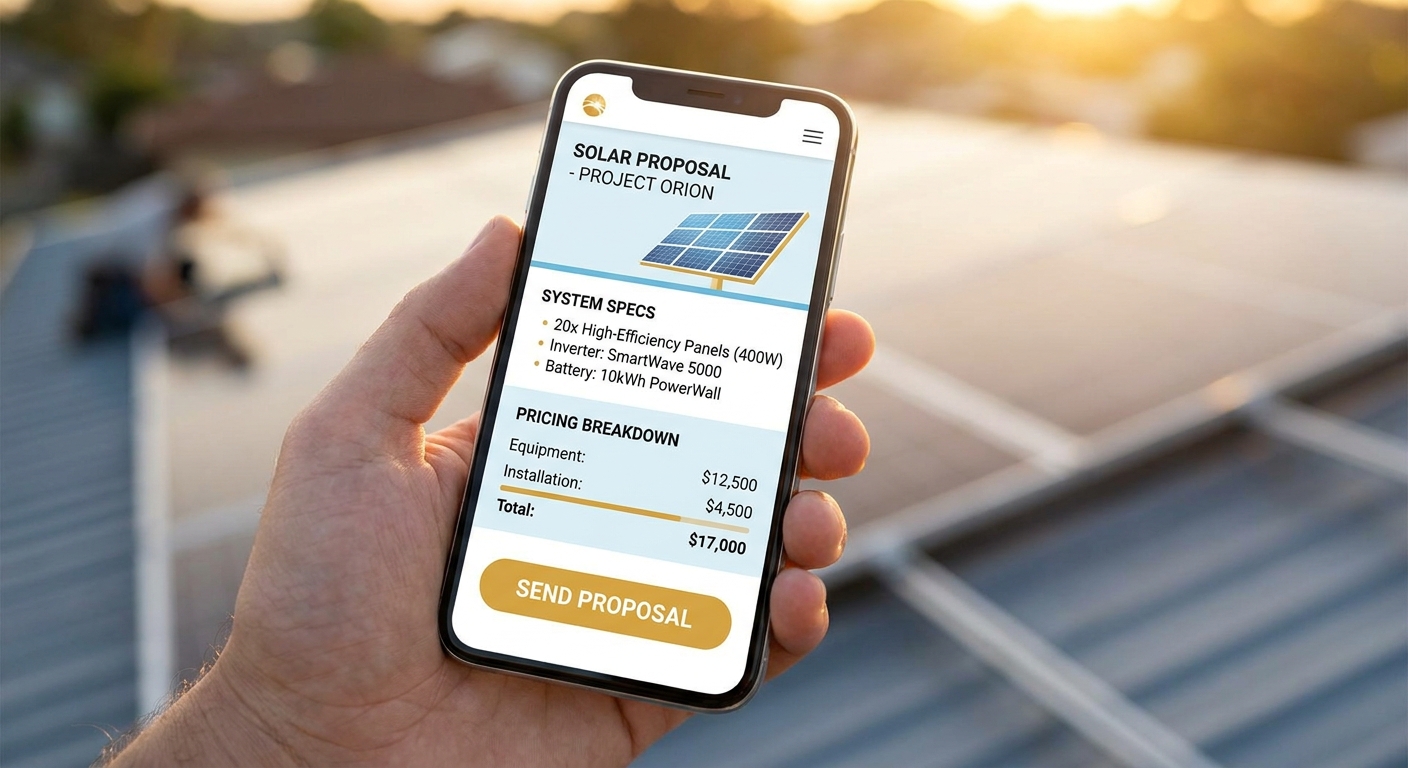
Not all proposal software is built the same. Solar companies have specific needs that generic business tools do not address well. Here are the features that make the biggest difference for solar EPCs and installers in India.
60-Second Proposal Generation
The core value of solar proposal software is speed. A platform like QuickEst allows salespeople to generate a complete, professional solar proposal in under 60 seconds and send it directly via WhatsApp or email. This is possible because the system stores product configurations, pricing, and templates in advance. The salesperson simply selects the relevant options and sends.
Professional Template Library with Brand Customization
Every proposal your team sends represents your brand. Solar-specific proposal software includes industry-relevant templates that can be customized with your company logo, colors, and contact details. This ensures every client receives a consistent, professional document that builds trust and credibility.
Automated Follow-Up System
After a proposal is sent, the platform automatically schedules follow-up reminders and email sequences based on rules you define. If a client has not responded in three days, they receive a follow-up. If they open the proposal but do not reply, the system flags it for the salesperson. This kind of proposal automation removes the human error from follow-up management entirely.
Lead Management and Pipeline Tracking
Effective proposal software does not exist in isolation. It connects to a lead management system that tracks every prospect from first inquiry to closed deal. Sales managers can see the full pipeline at a glance, identify which stage has the most drop-off, and take action before deals are lost.
Mobile App Access for Field Teams
Solar sales often happens on-site. A mobile app that allows field salespeople to generate and send proposals immediately after a client meeting is a significant competitive advantage. QuickEst’s iOS and Android app gives your team full proposal and CRM functionality from anywhere.
Integration Capabilities
The best proposal software connects with the tools your team already uses. QuickEst integrates with Facebook Ads for automatic lead capture, Pabbly Connect for workflow automation, and supports bulk lead import from Excel. This means your existing data and processes can be migrated without starting from scratch.
How Proposal Software Compares to Generic CRM Tools
Many solar companies in India start with a general-purpose CRM like Zoho CRM or consider enterprise platforms like Salesforce. These are powerful tools, but they come with a significant trade-off for solar businesses: they require extensive customization before they can handle solar-specific proposals, pricing structures, and workflows.
A general CRM is built to manage contacts and pipelines. It is not built to generate a solar system proposal in 60 seconds with the right technical specifications, product configurations, and branded formatting. Getting a generic CRM to do that requires custom development, third-party integrations, and ongoing maintenance. That is time and money that most solar companies in India cannot afford to spend.
Pipeline-focused tools like Pipedrive are excellent for tracking deal stages, but they do not include proposal generation at all. You would still need a separate tool to create and send proposals, which means more software, more cost, and more complexity for your team.
OpenSolar is a strong option for solar design and engineering, but its focus is on technical system design rather than sales process management. It does not replace the need for a CRM and proposal software combination that handles lead management, follow-ups, and team collaboration.
Solar-specific proposal software like QuickEst is built from the ground up for the way solar companies sell. It combines proposal generation, lead management, follow-up automation, and team collaboration in a single platform designed for the Indian solar market. There is no customization required to get started, and the learning curve is minimal.
How to Implement Proposal Software in Your Solar Business
Adopting proposal software does not have to be a complex project. Here is a straightforward implementation path that solar companies in India have used successfully.
Step 1: Audit Your Current Proposal and Follow-Up Process
Before you set up any new tool, document how your team currently creates proposals and follows up with clients. How long does each proposal take? Where do leads come from? How are follow-ups tracked? This audit will help you configure the new system to match your actual workflow and identify the biggest areas for improvement.
Step 2: Set Up Your Company Profile and Proposal Templates
Upload your company logo, set your brand colors, and configure your standard proposal templates. Add your product catalog with pricing so that salespeople can select configurations quickly. This setup typically takes a few hours and is done once.
Step 3: Import Existing Leads and Configure Your Pipeline
Use the bulk Excel import feature to bring your existing leads into the system. Set up your pipeline stages to match your sales process (for example: New Inquiry, Site Visit Scheduled, Proposal Sent, Negotiation, Closed). Assign existing leads to the appropriate salespeople and stages.
Step 4: Train Your Sales Team and Go Live
QuickEst is designed to be intuitive, so training is typically quick. Walk your team through generating a proposal, sending it via WhatsApp, and logging follow-up notes. The mobile app means field reps can be productive from day one. For a more detailed walkthrough of the setup process, the CRM implementation guide for India covers each step in depth.
Step 5: Track Performance and Optimize Using Analytics
Once your team is live, use the analytics dashboard to track key metrics: proposals sent per day, response rates, conversion rates by stage, and individual salesperson performance. Review these numbers weekly and use them to coach your team and refine your process.
Frequently Asked Questions About Proposal Software for Solar Companies
How long does it take to set up proposal software?
Most solar companies using QuickEst are fully set up and sending proposals within a day. The initial configuration of templates, product catalog, and company profile takes a few hours. Importing existing leads from Excel is straightforward. Your team can be generating 60-second proposals on day one.
Can proposal software integrate with our existing tools?
Yes. QuickEst integrates with Facebook Ads for automatic lead capture, Pabbly Connect for connecting with other business tools, and supports API and webhook connections for custom integrations. Bulk lead import from Excel means you can migrate your existing data without manual re-entry.
Is proposal software suitable for small solar installers?
Absolutely. Proposal software delivers the most immediate value for smaller teams because it multiplies the capacity of each salesperson. A two-person sales team using QuickEst can handle the proposal volume of a much larger manual team. QuickEst offers a free plan that allows small installers to get started without any upfront investment.
What is the typical ROI timeline for proposal software?
Most solar companies see measurable improvement within the first month. The time savings on proposal creation are immediate. Improvements in follow-up consistency and lead conversion typically show up in pipeline metrics within four to eight weeks. The full revenue impact, including higher win rates and increased deal volume, is usually visible within a quarter.
How does proposal software handle follow-ups automatically?
When a proposal is sent, the system automatically schedules follow-up reminders based on rules you configure. For example, if a client has not responded in 48 hours, they receive an automated follow-up email. If they open the proposal but do not reply within 24 hours, the salesperson receives an alert to call them. This ensures no lead goes cold due to a forgotten follow-up.
Start Winning More Deals with Proposal Software Today
The solar companies featured in these case studies, Sunnovative, Heaven Solar, and JJ Solar, all faced the same core problem: their sales process was too slow, too manual, and too disorganized to compete effectively in a fast-moving market. Proposal software gave them the speed, consistency, and visibility they needed to win more deals without adding more headcount.
If your team is still spending hours on manual proposals, losing leads to disorganized follow-ups, or struggling to get visibility into your pipeline, the solution is clear. The right proposal software can transform your sales process in days, not months. Over 1,000 solar and B2B businesses in India are already using QuickEst to send professional proposals in 60 seconds, automate their follow-ups, and close more deals.
You can start for free and see the impact on your own pipeline. QuickEst’s Free Plan at ₹0 gives you access to the core proposal generation and lead management features with no commitment required. If you are ready to unlock the full power of sales automation, the Pro Plan at ₹6,999 per user per year includes advanced analytics, team collaboration tools, and unlimited proposal automation. Not sure which plan fits your business? Contact the QuickEst team and they will help you find the right fit for your solar company’s needs.
This blog post was written using thestacc.com