

In the competitive solar industry landscape of 2026, generating leads is only half the battle. The real challenge lies in converting those leads into paying customers. For solar EPCs and installers across India, improving sales conversion rates can mean the difference between thriving growth and stagnant revenue. Every missed opportunity represents not just lost revenue, but wasted marketing spend and sales effort.
This comprehensive guide explores seven proven strategies specifically designed for solar businesses to boost their sales conversion rates. From lightning-fast proposal delivery to data-driven lead prioritization, these actionable tactics will help you close more deals, shorten your sales cycle, and maximize the return on every lead that enters your pipeline.

Why Sales Conversion Matters for Solar Companies in 2026
Sales conversion rate measures the percentage of leads that ultimately become customers. In the solar industry, where project values can range from residential installations to large commercial contracts, even small improvements in sales conversion can dramatically impact your bottom line.
Consider this: if your solar company generates 100 qualified leads per month with a 15% conversion rate, you close 15 deals. Improving that rate to just 20% means 20 closed deals—a 33% increase in revenue without spending an additional rupee on marketing. For a solar EPC handling projects worth ₹3-5 lakhs on average, that improvement translates to ₹15-25 lakhs in additional monthly revenue.
The Indian solar market continues to expand rapidly in 2026, but so does competition. Solar companies that can respond faster, follow up consistently, and present professional proposals have a significant advantage. Unfortunately, many solar businesses still struggle with disorganized sales processes, manual proposal creation, and inconsistent follow-ups—all factors that directly harm sales conversion rates.
The pain is real: sales teams spend hours creating custom proposals instead of talking to prospects. Follow-ups get forgotten in busy schedules. High-potential leads slip through the cracks while resources get wasted on low-intent inquiries. Without proper systems in place, even the best solar products and competitive pricing can’t overcome these operational inefficiencies.
1. Accelerate Proposal Delivery to Strike While the Iron Is Hot
Speed is critical in solar sales. When a potential customer requests a quote, they’re often comparing multiple providers simultaneously. The first company to deliver a professional, detailed proposal has a significant advantage in the sales conversion race.
Research consistently shows that response time directly correlates with conversion rates. Leads contacted within the first hour are seven times more likely to convert than those contacted after two hours. Yet many solar companies still take 24-48 hours—or even longer, to prepare and send proposals, giving competitors ample time to capture the opportunity.
This is where proposal automation becomes a game-changer for solar businesses. Instead of spending 2-3 hours manually creating each proposal in Excel or Word, modern solar CRM systems enable you to generate professional, branded proposals in under 60 seconds. QuickEst, for example, allows solar sales teams to input basic project details and instantly create comprehensive proposals complete with system specifications, pricing breakdowns, and energy savings projections.
The impact on sales conversion is immediate and measurable. Solar companies using QuickEst report being able to send proposals via WhatsApp or email while still on the phone with prospects or immediately after site visits. This responsiveness creates a positive first impression, demonstrates professionalism, and keeps your company top-of-mind during the decision-making process.
Actionable steps to accelerate proposal delivery:
- Implement a solar CRM with built-in proposal generation templates
- Create a library of pre-approved proposal templates for common project types (residential rooftop, commercial, agricultural, etc.)
- Ensure your proposal system is accessible via mobile app so sales teams can generate quotes on-site
- Set internal targets for proposal delivery time (aim for under 2 hours maximum, ideally within minutes)
- Track proposal delivery speed as a key performance metric alongside sales conversion rates
By reducing proposal creation time from hours to minutes, your sales team can focus their energy where it matters most: building relationships, addressing customer concerns, and closing deals. This efficiency directly improves sales conversion by ensuring no opportunity goes cold due to delayed responses.
2. Implement Automated Follow-Up Systems to Never Miss an Opportunity
Here’s a sobering statistic: 80% of sales require five follow-up calls or interactions after the initial contact, yet 44% of salespeople give up after just one follow-up. In the solar industry, where purchase decisions involve significant investment and careful consideration, consistent follow-up is absolutely essential for strong sales conversion rates.
The challenge is that manual follow-up systems simply don’t work at scale. Sales representatives get busy with new leads, site visits, and administrative tasks. Follow-up reminders written on sticky notes get lost. Spreadsheet tracking systems become outdated within days. The result? Promising leads go cold because nobody reached out at the right time with the right message.
Automated follow-up systems solve this problem by ensuring every lead receives timely, relevant communication without requiring constant manual effort. A robust solar CRM India platform should enable you to set up automated reminder sequences that trigger based on specific actions or timeframes.
For example, you might configure your system to automatically send a follow-up email three days after a proposal is sent, another reminder a week later, and a final check-in two weeks after that. These automated touchpoints keep your company visible and demonstrate persistence without overwhelming your sales team or annoying prospects.
Best practices for automated follow-up systems:
- Create customizable email templates for different stages of the sales cycle (post-proposal, post-site visit, post-objection handling, etc.)
- Use WhatsApp automation for quick, informal check-ins that feel personal and immediate
- Set reminders for sales reps to make personal phone calls at critical decision points
- Track which follow-up sequences generate the highest response and conversion rates
- Personalize automated messages with customer name, project details, and specific value propositions
- Include clear calls-to-action in every follow-up (schedule a call, review the proposal, ask questions, etc.)
QuickEst’s automated follow-up system allows solar companies to configure custom reminder schedules and email templates that align with their specific sales process. The platform tracks all interactions automatically, ensuring sales managers have complete visibility into follow-up activities and can identify when leads need additional attention.
By implementing systematic follow-up automation, solar companies can dramatically improve their sales conversion rates while actually reducing the manual workload on sales teams. No more lost opportunities due to forgotten follow-ups, every lead receives consistent, professional engagement throughout their buying journey. Learn more about implementing these systems in our guide to follow-up automation in India.
3. Leverage CRM Data for Smarter Lead Prioritization
Not all leads are created equal. A residential homeowner researching solar options for the first time requires a different approach than a commercial facility manager with an approved budget and a three-month timeline. Yet many solar sales teams treat every inquiry the same, wasting valuable time on low-potential leads while high-value opportunities don’t receive the attention they deserve.
Smart lead prioritization is one of the most powerful ways to improve sales conversion rates because it ensures your best salespeople focus their energy on the most promising prospects. This requires leveraging the data captured in your lead management India system to identify and rank opportunities based on their likelihood to convert and potential value.
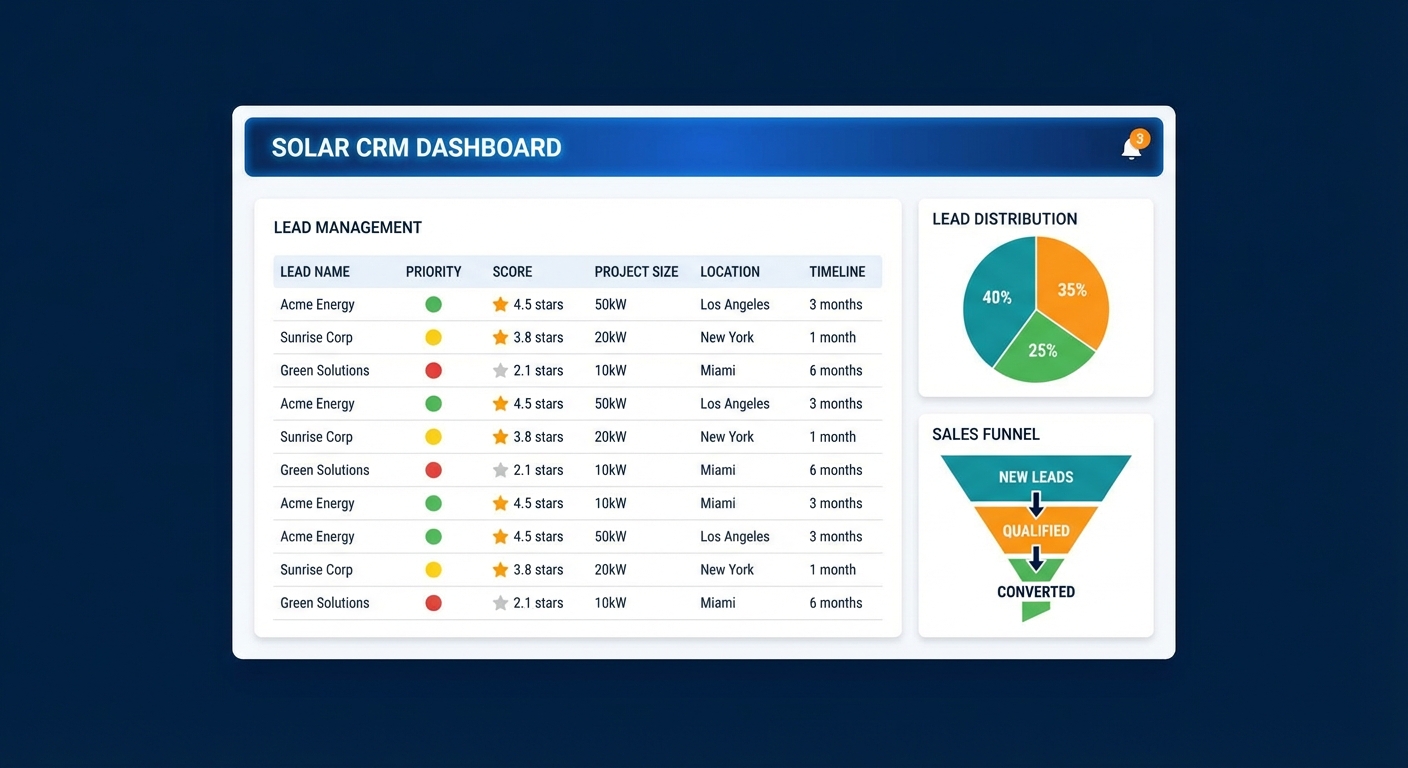
Modern solar CRM platforms enable sophisticated lead scoring based on multiple factors including project size, timeline, budget confirmation, engagement level, and lead source. For example, a lead who has visited your website multiple times, downloaded a solar savings calculator, requested a site visit, and indicated a project timeline of 1-2 months would score much higher than someone who simply filled out a contact form with minimal information.
QuickEst’s analytics dashboard provides real-time visibility into your entire sales pipeline, allowing you to quickly identify which leads deserve immediate attention. The platform tracks engagement metrics like proposal opens, email responses, and follow-up interactions, giving you behavioral data that indicates genuine interest versus casual browsing.
Key factors for effective lead prioritization in solar sales:
- Project size and value: Commercial and industrial projects typically represent higher revenue than residential installations
- Timeline urgency: Leads with immediate timelines (1-3 months) should receive priority over those still in early research phases
- Budget confirmation: Prospects who have confirmed budgets or financing approval are more likely to convert
- Engagement level: Leads who open proposals, respond to emails, and ask detailed questions demonstrate higher intent
- Lead source quality: Referrals and direct inquiries typically convert better than cold leads from broad advertising
- Decision-maker access: Direct contact with property owners or authorized decision-makers accelerates the sales process
By implementing a data-driven lead prioritization system, solar companies can improve their sales conversion rates by 25-40% simply by ensuring the right leads get the right level of attention at the right time. Your top performers focus on high-value opportunities while junior team members handle early-stage nurturing for lower-priority leads.
The key is having a solar CRM India system that makes this prioritization visible and actionable. Color-coded lead statuses, automated priority rankings, and customizable pipeline views ensure your entire team knows exactly where to focus their efforts each day.
4. Optimize Your Sales Process with Real-Time Performance Tracking
You can’t improve what you don’t measure. Solar companies serious about boosting sales conversion rates need comprehensive visibility into their sales performance metrics, not just monthly revenue reports but real-time data on every stage of the sales funnel.
Real-time performance tracking enables you to identify bottlenecks in your sales process before they become serious problems. Are proposals getting opened but not converting? That suggests a pricing or value proposition issue. Are leads going cold after site visits? Your follow-up process may need strengthening. Are certain sales reps consistently outperforming others? Their techniques can be documented and shared across the team.
A comprehensive sales automation India platform should provide dashboards that track critical metrics including:
- Lead-to-proposal conversion rate (what percentage of inquiries receive proposals)
- Proposal-to-customer conversion rate (what percentage of proposals result in closed deals)
- Average sales cycle length (time from first contact to signed contract)
- Proposal open rates and engagement metrics
- Individual sales rep performance and activity levels
- Pipeline value by stage (total potential revenue at each sales stage)
- Win/loss analysis by lead source, project type, and competitor
QuickEst provides solar companies with intuitive analytics dashboards accessible from desktop and mobile devices. Sales managers can monitor team performance in real-time, identify coaching opportunities, and make data-driven decisions about resource allocation and process improvements.
The mobile accessibility is particularly valuable for solar businesses where sales teams spend significant time in the field conducting site visits. Reps can update lead statuses, log activities, and check pipeline metrics from anywhere, ensuring data stays current and managers maintain visibility even when the team is distributed.
Actionable steps for implementing performance tracking:
- Define your key performance indicators (KPIs) for each stage of the sales funnel
- Set realistic benchmarks based on historical data and industry standards
- Conduct weekly pipeline reviews with your sales team to discuss progress and obstacles
- Use performance data to identify top performers and document their best practices
- Track conversion rates by lead source to optimize your marketing spend
- Monitor trends over time to measure the impact of process improvements
When solar companies implement systematic performance tracking, they typically discover specific, actionable insights that directly improve sales conversion. Perhaps Friday afternoon proposals have lower open rates, suggesting you should prioritize sending them earlier in the week. Maybe leads from a particular advertising channel consistently fail to convert, indicating you should reallocate that budget. These insights only become visible when you have proper tracking systems in place.
5. Enhance Team Collaboration to Close Deals Faster
Solar sales rarely happen in isolation. A typical deal might involve an initial sales rep who qualifies the lead, a technical specialist who conducts the site survey, a proposal designer who creates the system specifications, and a senior closer who negotiates final terms. When these team members work in silos without proper coordination, opportunities fall through the cracks and sales conversion suffers.
Effective team collaboration ensures everyone has access to the same customer information, understands their role in the sales process, and can seamlessly hand off responsibilities without losing momentum. This requires more than just good communication, it demands systems and tools that facilitate coordination.
A collaborative solar CRM India platform serves as the single source of truth for all customer interactions. When a technical specialist completes a site visit, they can immediately update the lead record with system requirements, roof specifications, and any concerns that need addressing. The proposal designer sees these notes and creates an accurate quote. The sales rep receives a notification that the proposal is ready and can immediately send it to the customer.
Key collaboration features that improve sales conversion:
- Task assignment and tracking: Assign specific actions to team members with due dates and automatic reminders
- Shared customer notes: Centralized record of all interactions, concerns, and commitments made to each prospect
- Activity feeds: Real-time updates when team members interact with leads or complete tasks
- File sharing: Centralized storage for site photos, technical documents, and signed contracts
- Team notifications: Alerts when leads reach critical stages requiring specific expertise
- Role-based permissions: Appropriate access levels for different team members while maintaining data security
QuickEst’s team collaboration tools enable solar companies to assign tasks, monitor progress, and share insights seamlessly across their sales organization. When a lead requires technical expertise, the system can automatically notify the appropriate specialist. When a proposal needs approval before sending, the workflow ensures proper review without creating delays.
This coordination is particularly valuable for solar EPCs managing multiple simultaneous projects across different locations. Sales managers can monitor all team activities from a central dashboard, identify when leads are stalling, and intervene with additional resources or support to keep deals moving forward.
By eliminating miscommunication, preventing duplicate efforts, and ensuring smooth handoffs between team members, collaborative CRM systems directly improve sales conversion rates while creating a better experience for prospects who receive consistent, professional service throughout their buying journey.
6. Personalize Customer Interactions with Professional Branding
In a competitive market, professionalism and attention to detail can be the deciding factors that tip a prospect toward choosing your solar company over competitors. Every customer interaction, from initial emails to final proposals, represents an opportunity to build trust and demonstrate the quality of service customers can expect.
Professional branding in your sales materials signals credibility, stability, and attention to detail. A polished, well-designed proposal with your company logo, consistent color scheme, and clear formatting creates a dramatically different impression than a hastily assembled spreadsheet or generic template with obvious placeholder text.
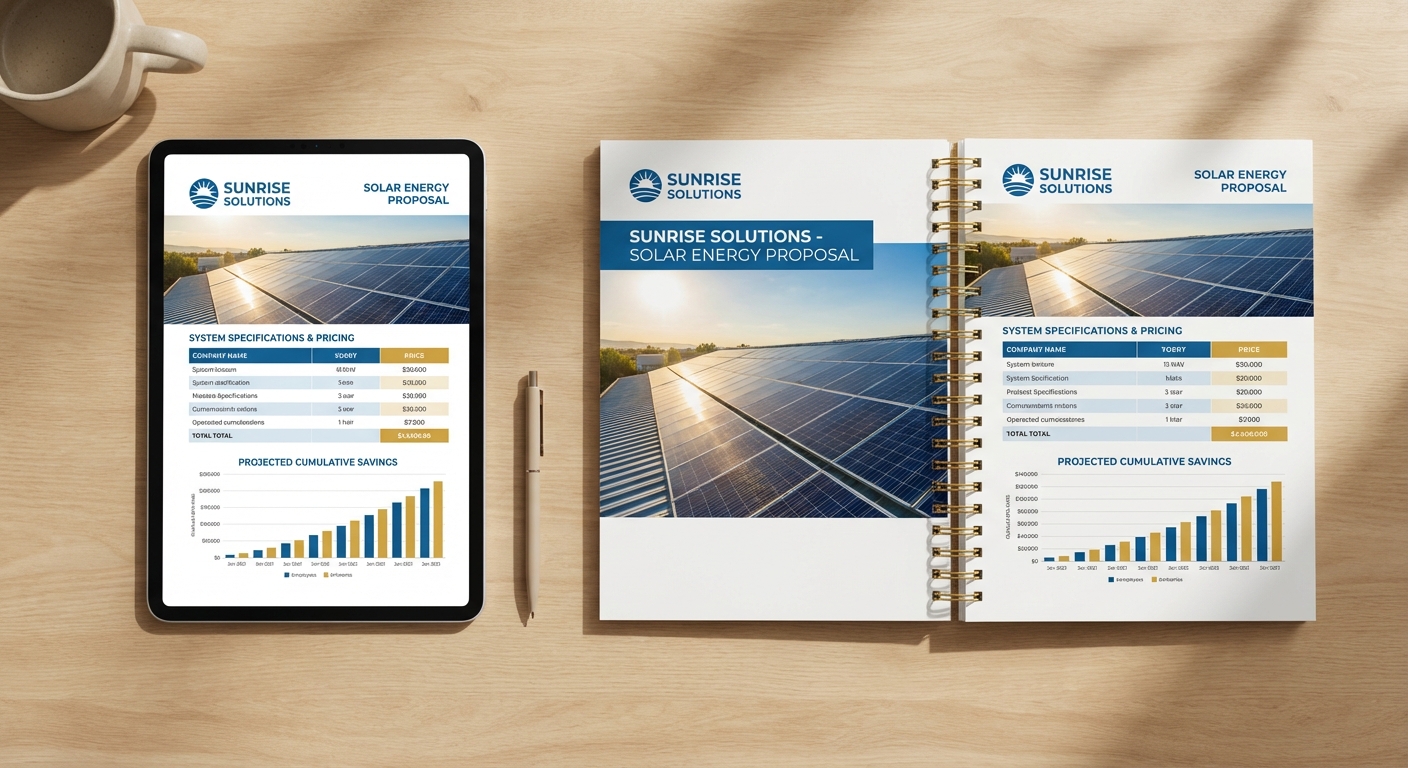
Beyond aesthetics, personalization demonstrates that you understand the customer’s specific needs and have tailored your solution accordingly. Generic proposals that could apply to any customer feel impersonal and suggest a one-size-fits-all approach. Personalized proposals that reference the customer’s property, energy consumption patterns, specific concerns, and financial goals create connection and show genuine attention.
QuickEst provides solar companies with a professional proposal template library that can be fully customized with company branding including logos, color schemes, and standard terms. More importantly, the platform makes it easy to personalize each proposal with customer-specific details, system specifications, and customized messaging, all while maintaining the speed advantage of 60-second generation.
Elements of effective proposal personalization:
- Customer-specific details: Property address, roof specifications, current energy consumption, and usage patterns
- Customized system design: Panel layout, inverter specifications, and mounting solutions tailored to their property
- Personalized financial analysis: Savings projections based on their actual electricity bills and consumption
- Relevant case studies: Examples of similar projects you’ve completed for comparable customers
- Addressed concerns: Specific responses to questions or objections the customer has raised
- Tailored payment options: Financing solutions that match their budget and preferences
The combination of professional branding and thoughtful personalization significantly improves sales conversion rates because it builds trust and demonstrates value. Customers feel confident that they’re working with a legitimate, established company that has taken the time to understand their unique situation.
This doesn’t require hours of custom design work for each proposal. Modern proposal automation systems allow you to create templates with variable fields that automatically populate with customer-specific information. The result is proposals that look custom-designed but can be generated in seconds.
For solar companies looking to differentiate themselves in a crowded market, investing in professional, personalized customer communications delivers measurable returns through improved conversion rates and higher average project values.
7. Integrate Your Sales Tools for Seamless Lead Capture
Every minute your sales team spends on manual data entry is a minute they’re not spending talking to prospects and closing deals. Yet many solar companies still operate with disconnected systems that require constant manual data transfer between marketing platforms, lead forms, spreadsheets, and CRM databases.
This fragmentation creates multiple problems that directly harm sales conversion rates. First, manual data entry introduces errors and inconsistencies that can lead to lost leads or incorrect information in proposals. Second, the time lag between lead capture and CRM entry means slower response times. Third, the administrative burden reduces the time available for actual selling activities.
Seamless CRM integration India solves these problems by automatically capturing leads from all sources and routing them directly into your sales pipeline. When a potential customer fills out a form on your website, submits a Facebook lead ad, or calls your business, their information should flow automatically into your CRM system where it can be immediately acted upon.
QuickEst offers integration capabilities with multiple lead sources including Facebook Ads, phonebook contacts, and custom APIs. The platform also supports bulk lead import from Excel spreadsheets, making it easy to migrate existing databases or import leads from trade shows and other offline sources.
Key integration capabilities that improve sales conversion:
- Facebook Ads integration: Automatically capture leads from Facebook and Instagram advertising campaigns
- Website form integration: Connect contact forms directly to your CRM for instant lead capture
- Phonebook sync: Import contacts from mobile devices for easy access and follow-up
- API and webhook support: Connect with other business systems for custom workflows
- Bulk import tools: Upload large lead lists from Excel or CSV files
- Email integration: Sync email communications with customer records
The value of these integrations extends beyond just saving time. Automated lead capture ensures faster response times, which as discussed earlier, directly correlates with higher conversion rates. It also provides complete tracking of lead sources, enabling you to measure the ROI of different marketing channels and optimize your lead generation strategy.
For solar companies running multiple marketing campaigns across different channels, integrated systems provide a unified view of all leads regardless of source. This prevents leads from being overlooked and ensures consistent follow-up processes apply to every inquiry.
When evaluating solar CRM India platforms, integration capabilities should be a top priority. The ability to connect your CRM with existing marketing tools, communication platforms, and business systems creates a seamless workflow that maximizes sales conversion by ensuring no lead falls through the cracks and sales teams can focus entirely on selling rather than administrative tasks. For more guidance on this topic, explore our comprehensive guide to solar CRM integration in India.
Measuring Your Sales Conversion Success
Implementing these seven strategies will undoubtedly improve your sales conversion rates, but measuring that improvement requires tracking the right metrics and establishing clear benchmarks. Without proper measurement, you can’t demonstrate ROI, identify which strategies are working best, or make data-driven decisions about future investments.
Key performance indicators for solar sales conversion:
- Overall conversion rate: Total leads divided by total customers (benchmark: 15-25% for qualified solar leads)
- Stage-specific conversion rates: Inquiry-to-proposal rate, proposal-to-site-visit rate, site-visit-to-close rate
- Average sales cycle length: Days from first contact to signed contract (target: reduce by 20-30%)
- Proposal acceptance rate: Percentage of proposals that result in closed deals (benchmark: 30-40%)
- Response time metrics: Average time to first response and proposal delivery (target: under 2 hours)
- Follow-up effectiveness: Conversion rates by number of follow-up touchpoints
- Lead source ROI: Conversion rates and customer acquisition cost by marketing channel
Calculate your baseline metrics before implementing new strategies, then track improvements over time. Most solar companies see measurable improvements within 30-60 days of implementing comprehensive CRM and automation systems.
The CRM ROI calculation is straightforward: compare the cost of your CRM platform and implementation against the additional revenue generated from improved conversion rates. For example, if your CRM costs ₹6,999 per user annually and helps you close just two additional projects worth ₹4 lakhs each, the ROI is over 10,000%—and that’s a conservative estimate.
QuickEst’s analytics dashboard makes it easy to track these metrics over time and demonstrate the business impact of your sales process improvements. The platform provides customizable reports that can be shared with stakeholders to show progress and justify continued investment in sales optimization.
Beyond the numbers, pay attention to qualitative improvements as well. Are sales reps reporting less stress and better work-life balance? Are customers providing positive feedback about your responsiveness and professionalism? Are team members collaborating more effectively? These softer benefits contribute to long-term success even if they’re harder to quantify.
For solar companies considering CRM investments, understanding the total cost and potential returns is essential. Our detailed analysis of solar CRM software costs can help you evaluate options and make informed decisions.
Take Action: Start Boosting Your Sales Conversion Today
Improving sales conversion rates isn’t about working harder, it’s about working smarter with the right systems, processes, and tools. The seven strategies outlined in this guide provide a comprehensive roadmap for solar companies ready to transform their sales performance in 2026.
To recap, focus on these proven approaches:
- Accelerate proposal delivery with automation to respond while leads are hot
- Implement automated follow-up systems to ensure consistent engagement
- Leverage CRM data for smarter lead prioritization and resource allocation
- Optimize your sales process with real-time performance tracking
- Enhance team collaboration to eliminate bottlenecks and miscommunication
- Personalize customer interactions with professional branding
- Integrate your sales tools for seamless lead capture and management
The solar companies that thrive in 2026 will be those that embrace technology to streamline their sales processes, eliminate inefficiencies, and deliver exceptional customer experiences. Every day you delay implementing these strategies is another day of lost opportunities and suboptimal sales conversion rates.
QuickEst is specifically designed to help solar EPCs and installers implement all seven of these strategies through a single, integrated platform. With 60-second proposal generation, automated follow-ups, comprehensive analytics, team collaboration tools, and seamless integrations, QuickEst addresses the core challenges that prevent solar companies from achieving their full sales potential.
Over 1,000 businesses including leading solar companies like Sunnovative, Heaven Solar, JJ Solar, and Tata Power already use QuickEst to boost their sales conversion rates and accelerate growth. The platform is accessible via mobile apps for iOS and Android, ensuring your sales team stays productive whether they’re in the office or in the field.
Ready to transform your solar sales conversion rates? QuickEst offers flexible options to match your business needs. Start with the FREE PLAN – ₹0 to explore the platform’s core features and experience the difference that purpose-built solar CRM software can make. For growing teams ready to unlock the full power of sales automation, the PRO PLAN – ₹6999 Per User / Year provides comprehensive features including advanced analytics, unlimited proposals, and priority support.
Don’t let another qualified lead slip away due to slow responses, missed follow-ups, or disorganized sales processes. The strategies outlined in this guide work, but only if you implement them. Take the first step toward better sales conversion today by exploring how QuickEst can streamline your solar sales process and help you close more deals faster. Contact us to schedule a personalized demo and discover how much revenue you’re leaving on the table with your current sales process.
Your competitors are already optimizing their sales conversion rates. The question is: will you lead the market or struggle to keep up? The choice is yours, and the time to act is now.
This blog post was written using thestacc.com