
Choosing the right CRM vendor can make or break your solar installation business. With India’s solar market projected to reach 500 GW by 2030, solar companies face intense competition and need powerful tools to manage leads, close deals faster, and scale operations efficiently. But with dozens of CRM vendors India offering solutions ranging from generic platforms to solar-specific tools, how do you choose the right partner for your business?
This comprehensive guide compares the top CRM vendors serving solar installation companies and EPCs across India in 2026. We’ll evaluate pricing models, implementation support, solar-specific features, local presence, and long-term partnership potential to help you make an informed decision that drives real ROI for your solar business.

Understanding the Solar CRM Vendor Landscape in India
The Indian solar CRM market has evolved dramatically over the past few years. What started as solar companies adapting generic CRM platforms has transformed into a specialized ecosystem where CRM vendors India now offer purpose-built solutions for the solar industry’s unique needs.
Solar installation companies face challenges that generic CRMs weren’t designed to solve. Creating technical solar proposals with system sizing, panel specifications, and ROI calculations takes hours in traditional platforms. Following up with leads across WhatsApp, email, and phone calls becomes chaotic without solar-specific workflows. Tracking installation timelines, managing site surveys, and coordinating technical teams requires industry-specific features that most general CRMs lack.
This is why evaluating CRM vendors India specifically for solar capabilities matters. A platform built for generic B2B sales will require extensive customization, third-party integrations, and ongoing maintenance to handle solar workflows. Meanwhile, solar-specific CRMs come pre-configured with proposal templates, technical calculators, and industry workflows that let your team start selling immediately.
When comparing vendors, solar companies should prioritize three critical factors. First, speed to value determines how quickly your team can start using the system productively. Second, solar-specific functionality reduces the need for expensive customization and workarounds. Third, local support and presence in India ensures you get timely help when issues arise, especially during critical sales periods.
Key Evaluation Criteria for CRM Vendors India
Before diving into specific vendors, let’s establish the evaluation framework that will help you compare options objectively. These criteria apply whether you’re a small solar installer with five salespeople or a large EPC managing hundreds of projects annually.

Pricing models and total cost of ownership extend far beyond the monthly subscription fee. When evaluating CRM vendors India, calculate the true cost including implementation fees, customization charges, training expenses, integration costs, and ongoing support. Some vendors charge per user monthly, while others offer annual plans with discounts. Hidden costs often include data migration, custom report development, and premium support tiers. A platform that appears affordable initially might become expensive once you factor in the customization needed to handle solar proposals and technical workflows.
Implementation support and onboarding determines whether your CRM becomes a productivity tool or a expensive paperweight. The best CRM vendors India provide dedicated implementation managers, structured onboarding programs, and hands-on training for your sales team. Ask vendors about their typical implementation timeline, what resources they provide, and how they ensure user adoption. A CRM that takes six months to implement means six months of lost productivity and continued reliance on spreadsheets.
Local presence and customer support becomes critical when your sales team encounters issues during peak selling seasons. Vendors with support teams in India can respond during your business hours, understand local market dynamics, and communicate without language barriers. Evaluate support channels (phone, email, chat), response times, and whether support is included or costs extra. International vendors may offer excellent products but struggle with time zone differences and cultural context.
Integration capabilities determine whether your CRM becomes the central hub of your sales operations or another disconnected tool. Solar businesses need integrations with lead generation sources like Facebook Ads, communication platforms like WhatsApp, accounting software, and project management tools. Review each vendor’s integration marketplace, API availability, and whether they support popular Indian business tools. Poor integration capabilities force your team into manual data entry and duplicate work across systems.
Scalability for growing businesses ensures your CRM investment remains valuable as you expand. Can the platform handle increasing user counts, larger lead volumes, and more complex workflows without performance degradation? Do pricing tiers accommodate growth without forcing expensive mid-contract upgrades? The right CRM vendors India offer clear upgrade paths that align with your business growth trajectory.
Data security and compliance protects your customer information and business reputation. Evaluate vendors on data encryption standards, backup procedures, access controls, and compliance with Indian data protection regulations. Ask about data residency (where your data is stored), disaster recovery plans, and security certifications. A data breach or loss could devastate your solar business’s reputation and customer trust.
QuickEst: Purpose-Built Solar CRM for Indian Market
QuickEst (Quickest CRM) represents a new generation of CRM vendors India that built their platform specifically for solar installation companies and EPCs. Rather than adapting a generic CRM for solar use cases, QuickEst designed every feature around the solar sales process from initial lead capture through proposal generation to deal closure.
The platform’s standout capability is 60-second proposal generation. Sales teams can create professional solar proposals with system specifications, financial projections, and branded templates in under a minute, then send them directly via WhatsApp or email. This addresses one of the biggest pain points for Indian solar companies where speed matters and customers expect quick responses on messaging platforms they already use daily.
QuickEst’s lead management system captures leads from multiple sources including Facebook Ads integration, website forms, and bulk Excel imports from your existing database. The automated follow-up system ensures no lead falls through the cracks with customizable reminders and email templates that keep prospects engaged throughout the sales cycle. For solar companies struggling with disorganized lead tracking and missed follow-ups, this systematic approach transforms conversion rates.
The platform includes real-time sales analytics showing pipeline value, conversion rates by stage, team performance metrics, and revenue forecasts. Solar business owners get visibility into which salespeople are performing, where deals are getting stuck, and which lead sources deliver the best ROI. This data-driven approach replaces guesswork with actionable insights for sales pipeline management.
Mobile accessibility through iOS and Android apps lets sales teams manage their pipeline, create proposals, and update lead status from customer sites or while traveling. This mobility is essential for solar sales where site visits and field work are standard parts of the sales process.
Regarding pricing, QuickEst offers transparent plans designed for solar businesses of all sizes. The platform provides a free plan at ₹0 for teams getting started, and a Pro Plan at ₹6,999 per user annually that includes full access to proposal generation, automation, and analytics features. This straightforward pricing eliminates the confusion and hidden costs common with other CRM vendors India.
Strengths and Weaknesses
Strengths: QuickEst’s solar-specific design means zero customization required to start generating proposals and managing leads. The 60-second proposal generation dramatically accelerates sales cycles compared to manual proposal creation. WhatsApp integration aligns perfectly with how Indian customers prefer to communicate. The mobile app enables true field sales productivity. Implementation typically takes days rather than months, with straightforward onboarding that doesn’t require technical expertise. The pricing structure offers clear value without enterprise-level complexity or costs.
Considerations: As a specialized solar CRM, QuickEst focuses deeply on solar sales workflows rather than offering the broad feature set of enterprise platforms. Companies needing extensive customization for unique workflows or integration with legacy enterprise systems might find the platform’s focused approach limiting. The vendor is newer to the market compared to established global CRM brands, though this also means the platform is built with modern technology and current solar industry needs in mind.
For solar installation companies and EPCs prioritizing speed, ease of use, and solar-specific functionality, QuickEst delivers immediate value. The platform suits businesses from small installers with a few salespeople to mid-sized EPCs managing dozens of projects monthly. Companies see ROI within the first month as proposal generation time drops from hours to minutes and automated follow-ups recover leads that would otherwise go cold.
Salesforce: Enterprise-Grade CRM Platform
Salesforce dominates the global CRM market and maintains a significant presence among CRM vendors India serving large enterprises. The platform offers unmatched breadth of features, extensive customization capabilities, and a massive ecosystem of third-party integrations and consulting partners.
For solar companies, Salesforce provides a blank canvas that can be configured to handle any workflow imaginable. The platform’s custom objects, workflow automation, and AppExchange marketplace enable solar businesses to build exactly the system they envision. Large solar EPCs with dedicated IT teams and complex requirements often choose Salesforce for this flexibility.
Salesforce’s pricing follows a tiered model starting with Essentials for small teams, Professional for growing businesses, Enterprise for larger organizations, and Unlimited for companies needing maximum customization. Monthly per-user costs range from approximately ₹2,000 to ₹12,000+ depending on the tier and features required. However, these subscription costs represent only part of the total investment.
Implementation costs for Salesforce typically exceed the first year’s subscription fees. Solar companies need Salesforce consultants or implementation partners to configure the platform for solar workflows, build custom proposal generation tools, create solar-specific reports, and train users. Implementation timelines commonly span three to six months for mid-sized deployments, during which your team continues using existing systems.
Salesforce maintains a strong partner ecosystem in India with numerous consulting firms, implementation specialists, and certified administrators. This local presence provides access to expertise, though it also means ongoing dependency on external resources for customization and support. The platform’s complexity requires either in-house Salesforce expertise or ongoing consulting relationships.
For solar businesses, Salesforce excels when you need deep integration with other enterprise systems, complex approval workflows, advanced reporting across multiple business units, or customization that extends beyond standard CRM functionality. Large solar EPCs managing thousands of projects, multiple product lines, and complex organizational structures find value in Salesforce’s enterprise capabilities.
Strengths and Weaknesses
Strengths: Salesforce offers unmatched customization potential and can be configured to handle any solar business process imaginable. The platform scales from small teams to global enterprises without limitations. The AppExchange marketplace provides thousands of pre-built integrations and extensions. Robust reporting and analytics capabilities enable sophisticated business intelligence. The large partner ecosystem in India ensures access to implementation and support resources. Enterprise-grade security and compliance meet the highest standards.
Weaknesses: High total cost of ownership including subscription fees, implementation costs, ongoing customization, and consultant dependencies makes Salesforce expensive for small to mid-sized solar companies. The platform requires significant customization to handle solar-specific workflows like proposal generation and technical specifications. Complexity creates a steep learning curve for sales teams accustomed to simpler tools. Implementation timelines of three to six months delay time to value. The generic platform design means solar companies must build or buy solar-specific functionality rather than getting it out of the box.
Salesforce suits large solar EPCs with enterprise budgets, dedicated IT resources, and complex requirements that justify the investment. Small to mid-sized solar installation companies often find the platform over-engineered and expensive for their needs, especially when evaluating CRM software costs against expected ROI.
Zoho CRM: Versatile Platform with Indian Roots
Zoho CRM holds a unique position among CRM vendors India as an Indian company with global reach. Founded in Chennai, Zoho understands the Indian market intimately and maintains strong local presence with support teams, data centers, and development resources across India.
The platform offers a middle ground between specialized solar CRMs and enterprise platforms like Salesforce. Zoho CRM provides solid core CRM functionality including lead management, contact tracking, deal pipelines, email integration, and workflow automation at price points accessible to small and medium solar businesses.
Zoho’s pricing tiers start with a free plan for up to three users, then scale through Standard (approximately ₹800/user/month), Professional (₹1,400/user/month), Enterprise (₹2,400/user/month), and Ultimate (₹2,700/user/month) plans. Annual billing provides discounts of 20-30% compared to monthly payments. This tiered approach lets solar companies start affordably and upgrade as needs grow.
For solar businesses, Zoho CRM requires customization to handle industry-specific workflows. The platform’s custom modules, fields, and layouts enable solar companies to build proposal tracking, technical specification management, and installation project workflows. However, this customization requires time investment and technical knowledge, or engaging Zoho consultants to configure the system.
Zoho’s advantage lies in its ecosystem of integrated business applications. Solar companies using Zoho CRM can seamlessly connect Zoho Books for accounting, Zoho Projects for installation management, Zoho Campaigns for email marketing, and dozens of other Zoho applications. This integrated suite approach reduces integration complexity compared to connecting multiple vendors’ products.
The platform’s local presence in India means customer support operates during Indian business hours with teams that understand local market dynamics. Zoho also offers training resources, webinars, and documentation in regional languages, making adoption easier for teams across India.
Strengths and Weaknesses
Strengths: Affordable pricing makes Zoho accessible to small and medium solar businesses with limited budgets. Strong local presence in India ensures responsive support and cultural understanding. The integrated Zoho ecosystem reduces integration complexity when using multiple business tools. Customization capabilities allow solar companies to adapt the platform to their workflows. The familiar interface and extensive documentation ease user adoption. Regular feature updates and improvements keep the platform current.
Weaknesses: Generic CRM design requires customization for solar-specific workflows like proposal generation and technical specifications. The platform lacks purpose-built solar features, forcing companies to build custom solutions or use workarounds. Customization complexity increases with advanced requirements, often requiring consultant help. Some users report the interface feels dated compared to newer CRM platforms. Advanced features are locked behind higher pricing tiers, increasing costs as needs grow. The breadth of features can overwhelm small teams who need simpler, focused tools.
Zoho CRM works well for small to medium solar businesses seeking affordable, customizable CRM functionality with strong local support. Companies comfortable with some technical customization or willing to engage consultants can adapt Zoho to solar workflows. However, businesses prioritizing speed to value and solar-specific features may find the customization effort frustrating compared to purpose-built alternatives.
Pipedrive: Sales-Focused CRM Solution
Pipedrive takes a different approach among CRM vendors India by focusing intensely on visual pipeline management and sales process simplicity. The platform’s core philosophy centers on helping sales teams move deals forward through clear, visual pipeline stages rather than overwhelming them with features.
The platform’s visual pipeline interface shows deals as cards moving through customizable stages from initial contact through closed-won. This visual approach helps solar sales teams quickly understand where each opportunity stands and what actions are needed to advance deals. Drag-and-drop functionality makes updating deal status intuitive and fast.
Pipedrive’s pricing includes Essential (approximately ₹1,000/user/month), Advanced (₹1,650/user/month), Professional (₹2,500/user/month), and Enterprise (₹4,150/user/month) tiers. Annual billing provides discounts. The platform’s pricing falls between specialized solar CRMs and enterprise platforms, positioning it as a mid-market solution.
Implementation is straightforward compared to enterprise platforms. Solar companies can typically get Pipedrive configured and running within days or weeks rather than months. The intuitive interface requires minimal training, reducing the adoption challenges common with more complex CRM systems.
However, Pipedrive lacks solar-specific functionality. The platform doesn’t include proposal generation tools, technical specification management, or solar industry workflows out of the box. Solar companies must either handle proposals outside the CRM, build custom solutions using Pipedrive’s API, or integrate third-party tools for proposal generation.
Pipedrive’s mobile app provides solid field sales capabilities, letting teams update deals, log activities, and communicate with prospects from anywhere. This mobility supports solar sales teams who spend significant time at customer sites and in the field.
The platform offers integrations with popular business tools through its marketplace, though the integration ecosystem is smaller than Salesforce or Zoho. Solar companies can connect email, calendar, communication tools, and some business applications, but may find gaps for solar-specific integrations.

Strengths and Weaknesses
Strengths: Intuitive visual pipeline interface makes deal tracking simple and clear for sales teams. Quick implementation gets teams productive within days rather than months. Minimal learning curve reduces training requirements and speeds user adoption. Strong mobile app supports field sales activities effectively. Focused feature set avoids overwhelming users with unnecessary complexity. Reasonable pricing for core sales pipeline functionality. Good email integration and communication tracking.
Weaknesses: Lacks solar-specific features like proposal generation, technical specifications, and industry workflows. Generic sales focus means solar companies must build or integrate solutions for solar-specific needs. Limited customization compared to enterprise platforms restricts adaptation to unique workflows. Smaller integration ecosystem may not include solar industry tools. Reporting capabilities are basic compared to more robust platforms. The platform works best for simple sales processes and may not scale for complex solar EPC operations.
Pipedrive suits solar sales teams prioritizing simplicity and visual pipeline management over comprehensive features. Small solar installation companies with straightforward sales processes and teams who value ease of use over depth of functionality find Pipedrive appealing. However, companies needing integrated proposal generation and solar-specific workflows will need to supplement Pipedrive with additional tools or choose more specialized alternatives.
OpenSolar: Design-First Solar Platform
OpenSolar approaches the solar software market from a different angle than traditional CRM vendors India. The platform started as a solar design and engineering tool, then added CRM functionality to create an integrated workflow from initial customer contact through system design to proposal generation.
OpenSolar’s core strength lies in its sophisticated solar design capabilities. The platform enables solar companies to create detailed system designs with 3D modeling, shade analysis, panel layout optimization, and accurate production estimates. This technical depth appeals to solar businesses that prioritize engineering accuracy and want design and CRM in a single platform.
The integrated workflow lets solar companies capture leads, design systems, generate proposals, and track deals without switching between multiple tools. For technically-focused solar businesses, this integration eliminates data transfer between design software and CRM systems.
OpenSolar’s pricing varies based on features and usage, with plans typically ranging from free tiers for basic functionality to paid plans for advanced features and higher project volumes. The platform’s pricing structure focuses on design capabilities with CRM features included rather than positioning primarily as a CRM solution.
However, OpenSolar’s CRM functionality is less robust than dedicated CRM platforms. The lead management, pipeline tracking, and sales automation features provide basic capabilities but lack the depth of purpose-built CRM solutions. Solar companies prioritizing sales process optimization and lead management may find OpenSolar’s CRM features limiting.
The platform’s learning curve is steeper than simpler CRM tools because users must understand both the design functionality and CRM features. Sales teams focused purely on selling rather than technical design may find the platform more complex than necessary for their needs.
OpenSolar maintains a presence in the Indian market, though its primary focus has been international markets. Support and local presence may not match India-focused vendors, potentially creating challenges for solar companies needing responsive local assistance.
Strengths and Weaknesses
Strengths: Excellent solar design and engineering capabilities with 3D modeling and shade analysis. Integrated workflow eliminates switching between design and CRM tools. Accurate production estimates and technical specifications enhance proposal credibility. The platform handles the complete workflow from design through proposal for technical teams. Good for solar businesses where engineering and design are central to the sales process.
Weaknesses: CRM functionality is less robust than dedicated CRM platforms, limiting sales process optimization. Steeper learning curve due to technical design features that sales-focused teams may not need. The design-first approach may be overkill for solar companies with simple product offerings or those who don’t need detailed system design for every proposal. Limited sales automation and lead nurturing compared to specialized CRM solutions. Pricing can become expensive as project volumes increase. Local support in India may not match India-focused vendors.
OpenSolar works best for technically-oriented solar businesses where system design is integral to the sales process. Solar EPCs handling complex commercial installations, custom residential systems, or projects requiring detailed engineering analysis benefit from the integrated design and CRM workflow. However, solar installation companies focused primarily on sales efficiency, lead management, and rapid proposal generation may find dedicated CRM platforms more aligned with their needs.
Side-by-Side Comparison: CRM Vendors India
Now let’s compare these CRM vendors India across the key dimensions that matter most to solar installation companies and EPCs. This side-by-side analysis helps you evaluate which platform aligns best with your business size, budget, and priorities.
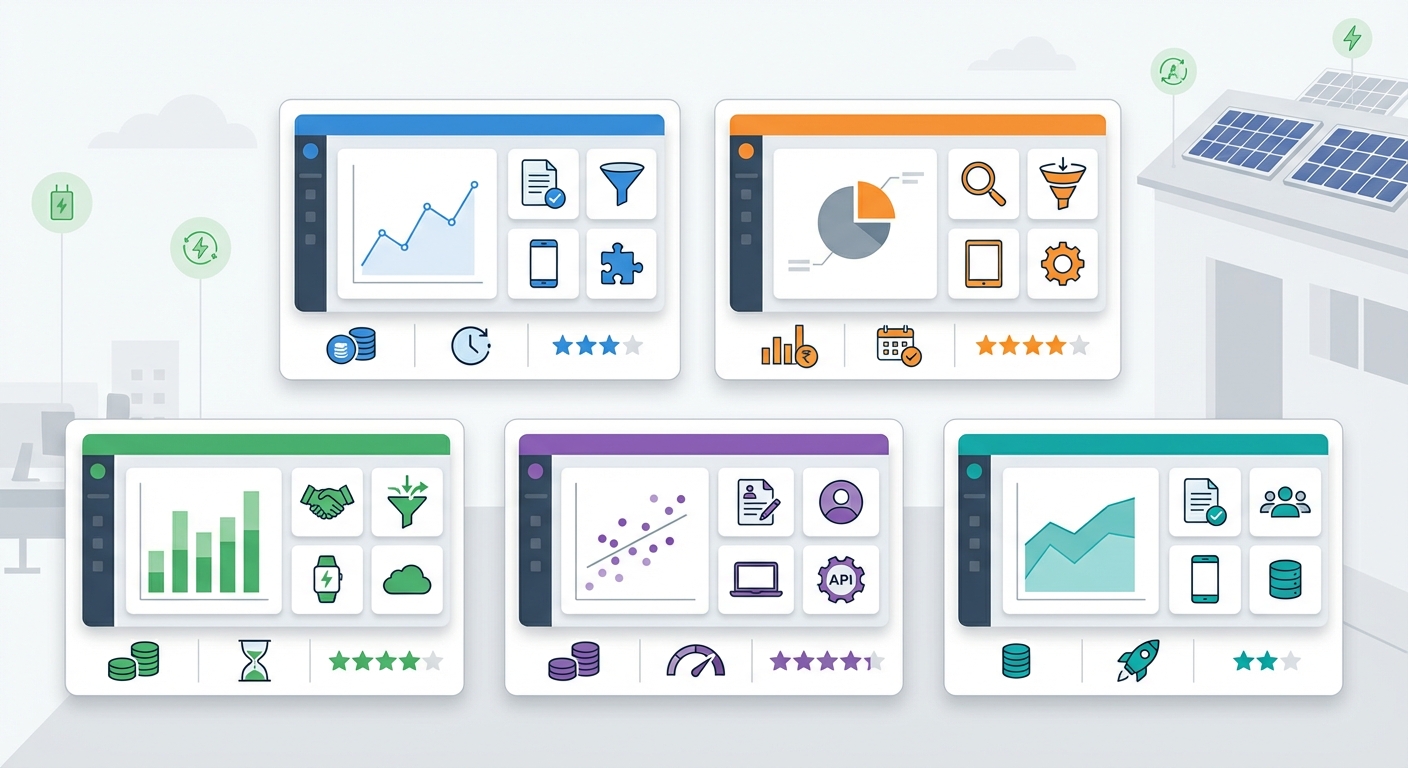
Pricing Comparison: QuickEst offers the most transparent and affordable pricing with a free plan and Pro Plan at ₹6,999 per user annually. Zoho CRM provides competitive pricing starting around ₹800/user/month for basic features, scaling to ₹2,700/user/month for advanced capabilities. Pipedrive ranges from ₹1,000 to ₹4,150/user/month depending on features. Salesforce represents the highest investment starting around ₹2,000/user/month but often exceeding ₹12,000/user/month with implementation costs adding significantly to total ownership cost. OpenSolar’s pricing varies based on usage and features, typically falling in the mid-range but potentially increasing with project volume.
Solar-Specific Features: QuickEst leads with purpose-built solar proposal generation, WhatsApp integration, and solar industry workflows requiring zero customization. OpenSolar provides excellent solar design and engineering capabilities but lighter CRM features. Salesforce, Zoho, and Pipedrive require significant customization to handle solar-specific workflows, with Salesforce offering the most customization potential but at the highest cost and complexity.
Implementation Timeline: QuickEst and Pipedrive offer the fastest implementation, typically days to weeks, getting teams productive quickly. Zoho CRM falls in the middle with weeks to months depending on customization needs. Salesforce requires the longest implementation, commonly three to six months, due to extensive configuration and customization requirements. OpenSolar’s timeline depends on whether teams need training on both design and CRM features.
Ease of Use: Pipedrive and QuickEst prioritize intuitive interfaces requiring minimal training. Zoho CRM offers moderate complexity with a learning curve for advanced features. Salesforce presents the steepest learning curve due to its comprehensive feature set and customization options. OpenSolar’s ease of use depends on user technical background, with design features adding complexity for sales-focused teams.
Local Support in India: Zoho CRM excels with its Indian roots, local teams, and regional language support. QuickEst focuses specifically on the Indian solar market with local presence and understanding. Salesforce maintains a strong partner ecosystem in India though direct support may involve international teams. Pipedrive and OpenSolar have more limited local presence, potentially creating support challenges during critical periods.
Integration Capabilities: Salesforce offers the most extensive integration ecosystem through its AppExchange marketplace. Zoho provides strong integration within its own ecosystem of business applications. QuickEst focuses on key integrations for solar businesses including Facebook Ads, WhatsApp, and Pabbly Connect. Pipedrive offers moderate integration options through its marketplace. OpenSolar’s integrations focus primarily on solar industry tools and design software.
Best Use Cases: QuickEst suits solar installation companies and EPCs of all sizes prioritizing speed, solar-specific features, and ease of use. Salesforce fits large enterprises with complex requirements, dedicated IT resources, and budgets for extensive customization. Zoho CRM works for small to medium solar businesses seeking affordable, customizable solutions with strong local support. Pipedrive appeals to sales-focused teams wanting simple, visual pipeline management. OpenSolar serves technically-oriented solar businesses where design capabilities are central to the sales process.
When evaluating these vendors, consider which factors matter most to your solar business. Companies prioritizing rapid deployment and solar-specific functionality lean toward QuickEst. Businesses with complex enterprise requirements and IT resources consider Salesforce. Budget-conscious companies with customization capabilities explore Zoho. Sales teams valuing simplicity examine Pipedrive. Technical teams needing integrated design evaluate OpenSolar.
Making Your CRM Vendor Selection Decision
Choosing among CRM vendors India requires a systematic approach that aligns vendor capabilities with your solar business’s specific needs, resources, and growth trajectory. Follow this framework to make a confident decision.
Assess your business size and needs: Start by honestly evaluating your current situation. How many salespeople will use the CRM daily? What’s your monthly lead volume? Do you need basic lead tracking or complex workflow automation? Small solar installers with five salespeople have different needs than EPCs managing hundreds of projects. Match vendor capabilities to your actual requirements rather than buying features you’ll never use or choosing platforms that can’t scale with your growth.
Define your budget realistically: Calculate what you can invest not just in subscription fees but in total cost of ownership. Include implementation costs, training time, customization expenses, integration development, and ongoing support. A platform with a ₹1,000/month subscription that requires ₹5 lakhs in customization costs more than a ₹2,000/month platform that works out of the box. Consider both upfront investment and ongoing monthly costs over a three-year period to understand true financial commitment.
Evaluate implementation resources: Do you have technical staff who can configure CRM systems, or do you need vendors who provide complete implementation support? Can your sales team tolerate a three-month implementation period, or do you need to be productive within weeks? Your available resources and timeline constraints should heavily influence vendor selection. Companies without technical resources should prioritize vendors offering comprehensive implementation support and quick time to value.
Prioritize user adoption factors: The best CRM is the one your team actually uses. Evaluate platforms from your sales team’s perspective. Is the interface intuitive? Does it fit their daily workflow? Will they resist using it? Involve sales team members in vendor demos and gather their feedback. A technically superior platform that your team won’t use delivers zero value. Prioritize ease of use and alignment with how your team actually works.
Test before committing: Take advantage of free trials and proof-of-concept periods offered by CRM vendors India. Test the platform with real leads, actual proposals, and your team’s daily workflows. Evaluate whether the vendor’s promises match reality. Can you really generate proposals in 60 seconds? Does the mobile app work reliably in the field? Is support responsive when you encounter issues? Real-world testing reveals gaps that sales demos don’t show.
Ask critical questions during demos: Prepare specific questions based on your solar business needs. How does the platform handle solar proposal generation? What’s included in implementation support? How long until our team is fully productive? What happens if we need customization later? How do you handle data migration from our existing system? What’s your typical customer retention rate? Vendors’ answers to tough questions reveal their true capabilities and commitment to customer success.
Consider long-term partnership potential: You’re not just buying software; you’re entering a multi-year partnership. Evaluate the vendor’s financial stability, product roadmap, and commitment to the solar industry. Are they investing in solar-specific features? Do they understand the Indian solar market? Will they be around in five years? Switching CRMs is painful and expensive, so choose a vendor you can grow with long-term. For guidance on getting started with your chosen platform, review our CRM implementation guide.
Common Pitfalls When Choosing CRM Vendors India
Solar companies frequently make predictable mistakes when selecting CRM vendors. Avoid these common pitfalls to ensure your CRM investment delivers expected returns.
Focusing only on price without considering total cost: The cheapest subscription fee often becomes the most expensive choice once you factor in customization, implementation, training, and lost productivity during lengthy deployments. A ₹500/month platform requiring ₹10 lakhs in customization costs far more than a ₹2,000/month platform that works immediately. Evaluate total cost of ownership over three years, not just monthly subscription fees.
Overlooking implementation and training requirements: Many solar companies underestimate the time and resources needed to get a CRM fully operational. They assume buying the software means instant productivity, then face months of configuration, data migration, and user training. Ask vendors for realistic implementation timelines and resource requirements upfront. Factor this transition period into your decision and budget.
Ignoring user adoption and ease of use: Technical decision-makers sometimes choose platforms based on feature lists without considering whether sales teams will actually use those features. A CRM with 500 features that your team finds confusing delivers less value than a simple platform with 50 features they use daily. Prioritize user experience and adoption likelihood over feature count.
Not validating local support availability: International vendors may offer excellent products but struggle with time zone differences, language barriers, and understanding of Indian market dynamics. When your sales team encounters issues during peak selling periods, responsive local support becomes critical. Verify that vendors provide support during your business hours with teams who understand your market context.
Underestimating integration complexity: Solar companies often assume integrating their CRM with existing tools will be straightforward, then discover that APIs don’t work as expected, data formats don’t match, or integrations require custom development. Validate integration capabilities during trials with your actual tools and data. Test whether integrations work reliably in real-world conditions, not just in vendor demos.
Choosing based on brand recognition alone: Well-known global CRM brands aren’t automatically the best choice for solar businesses. A specialized solar CRM from a smaller vendor may deliver more value than a famous general-purpose platform requiring extensive customization. Evaluate vendors based on how well they solve your specific solar business challenges, not just brand reputation.
Skipping the trial period: Some companies make CRM decisions based solely on sales presentations without testing the platform with real data and workflows. Demos show ideal scenarios; trials reveal actual usability. Always test platforms with your team, your leads, and your processes before committing to multi-year contracts.
Frequently Asked Questions About CRM Vendors India
What is the average cost of solar CRM in India? Solar CRM costs in India vary widely based on vendor, features, and business size. Specialized solar CRMs like QuickEst offer plans from ₹0 for basic features to ₹6,999 per user annually for comprehensive functionality. General CRM platforms range from ₹800 to ₹4,000+ per user monthly depending on tier and features. Enterprise platforms like Salesforce can exceed ₹12,000 per user monthly plus significant implementation costs. Total cost of ownership including implementation, customization, and training often equals or exceeds the first year’s subscription fees for complex platforms. For detailed cost breakdowns, see our guide on solar CRM software costs.
How long does CRM implementation typically take? Implementation timelines vary dramatically by vendor and complexity. Specialized solar CRMs like QuickEst typically deploy within days to two weeks with minimal configuration needed. Mid-market platforms like Zoho CRM and Pipedrive generally require two to eight weeks depending on customization needs. Enterprise platforms like Salesforce commonly take three to six months for full implementation including customization, data migration, integration development, and user training. Your implementation timeline also depends on your team’s availability, data quality, and complexity of existing processes being migrated to the new system.
Can I migrate data from my existing system? Most CRM vendors India support data migration from spreadsheets, other CRMs, and business systems. The ease of migration varies by vendor and data complexity. Simple lead and contact data typically migrates easily through CSV imports. Complex data with custom fields, relationships, and historical activities requires more sophisticated migration tools or professional services. Ask vendors about their data migration support, whether they provide migration tools or services, and typical success rates. Test data migration during trial periods to identify potential issues before committing.
What level of technical expertise is required? Required technical expertise varies significantly by platform. Specialized solar CRMs like QuickEst require minimal technical knowledge, with most users productive after basic training. General platforms like Zoho CRM and Pipedrive require moderate technical comfort for customization and configuration. Enterprise platforms like Salesforce typically require dedicated administrators with platform-specific training or external consultants. Evaluate your team’s technical capabilities honestly and choose vendors whose complexity matches your resources. Companies without technical staff should prioritize vendors offering comprehensive support and minimal configuration requirements.
How do I measure CRM ROI for my solar business? Measure CRM ROI by tracking specific metrics before and after implementation. Key indicators include proposal generation time (hours reduced per proposal), lead response time (minutes from inquiry to first contact), conversion rates (percentage improvement at each pipeline stage), sales cycle length (days from lead to close), revenue per salesperson (monthly sales productivity), and cost per acquisition (total sales costs divided by closed deals). Calculate hard savings from time reduction and soft benefits from improved customer experience and data visibility. Most solar companies see positive ROI within three to six months when choosing platforms aligned with their needs. For more insights on evaluating CRM capabilities, review our essential CRM features checklist.
Should I choose a solar-specific CRM or general platform? This decision depends on your priorities and resources. Solar-specific CRMs offer immediate value with pre-built proposal templates, solar workflows, and industry-specific features requiring zero customization. They deliver faster time to value and lower total cost for most solar businesses. General platforms provide more flexibility and customization potential but require significant configuration to handle solar-specific needs. Choose solar-specific CRMs if you prioritize speed, ease of use, and solar functionality out of the box. Consider general platforms if you have unique requirements, technical resources for customization, and need deep integration with complex enterprise systems.
What happens if I need to switch CRM vendors later? Switching CRM vendors is possible but involves significant effort and cost. You’ll need to export data from your current system, clean and format it for the new platform, import it, reconfigure workflows and automations, retrain your team, and manage the transition period where productivity drops. Most vendors provide data export capabilities, though format and completeness vary. Plan for switching costs of 20-40% of your annual CRM investment in time and resources. This switching cost makes initial vendor selection critical. Choose vendors you can grow with long-term rather than platforms you’ll quickly outgrow.
Take the Next Step: Choose Your Solar CRM Partner
Selecting the right CRM vendor will transform how your solar business captures leads, creates proposals, and closes deals. The CRM vendors India landscape offers options for every business size, budget, and requirement from specialized solar platforms to enterprise solutions.
For solar installation companies and EPCs prioritizing speed, solar-specific functionality, and ease of use, QuickEst delivers immediate value without the complexity and cost of enterprise platforms. The platform’s 60-second proposal generation, WhatsApp integration, and purpose-built solar workflows eliminate the customization burden that makes other CRM vendors India time-consuming and expensive to implement.
Start with QuickEst’s free plan at ₹0 to experience solar-specific CRM capabilities without risk. Test the proposal generation, lead management, and automation features with your actual sales process. When you’re ready to unlock full functionality including advanced analytics and team collaboration, upgrade to the Pro Plan at ₹6,999 per user annually. Your solar business deserves CRM tools built specifically for how you sell, not generic platforms requiring months of customization.
The right CRM vendor becomes your partner in growth, helping you capture more leads, close deals faster, and scale your solar business efficiently. Make your decision based on which vendor best solves your specific challenges, supports your team effectively, and aligns with your long-term vision. Your choice of CRM vendors India will impact your sales productivity and business growth for years to come.
Ready to see how specialized solar CRM transforms your sales process? Contact us to schedule a personalized demo showing how QuickEst handles your specific solar business workflows, or explore our comprehensive guide on CRM integration strategies to maximize your investment.
This blog post was written using thestacc.com