
Managing a sales pipeline effectively can make the difference between a thriving solar business and one that struggles to close deals. For solar companies in India, where competition is intensifying and customers are becoming more informed, having a well-structured sales pipeline isn’t just helpful—it’s essential for survival and growth.
Whether you’re a solar installation company, an EPC firm, or part of a sales team trying to maximize conversions, understanding how to build, track, and optimize your sales pipeline will directly impact your bottom line. This comprehensive FAQ guide answers the 18 most critical questions about sales pipeline management for solar businesses, covering everything from pipeline stages and conversion metrics to automation strategies and CRM tools that can transform your sales process.
Let’s dive into the expert answers that will help you unlock your sales potential and close more solar deals faster.
Understanding Sales Pipeline Fundamentals
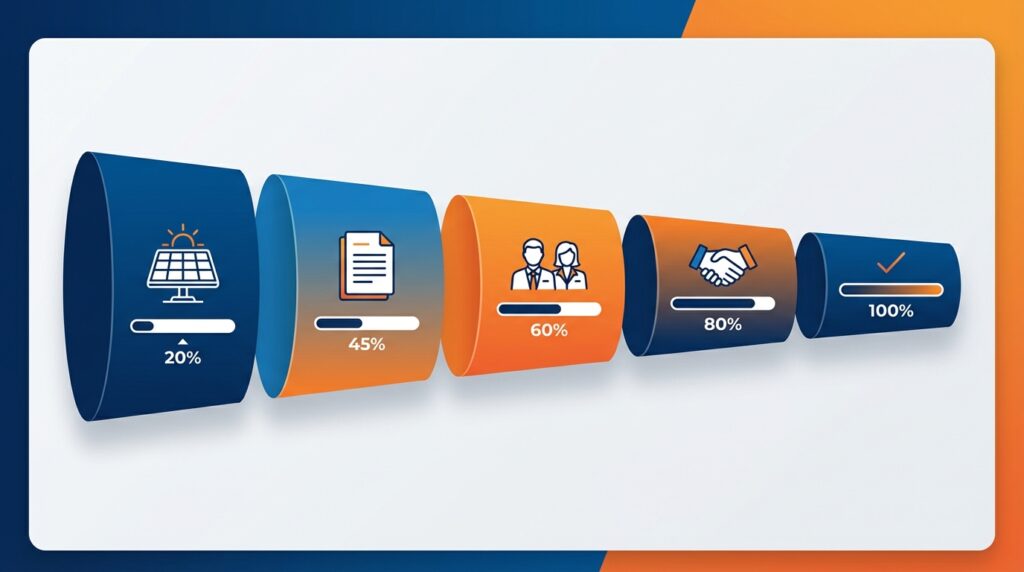
Before we explore specific questions, it’s important to establish what a sales pipeline actually is and why it matters for your solar business. A sales pipeline is a visual representation of where prospects are in your sales process. It shows every stage a potential customer goes through, from initial contact to closed deal, giving you complete visibility into your sales activities and revenue forecasts.
For solar companies operating in India’s dynamic market, a well-managed sales pipeline provides clarity on which leads are most likely to convert, where deals are getting stuck, and how your team is performing against targets. Unlike a sales funnel, which focuses on conversion rates at each stage, a sales pipeline emphasizes the active management of opportunities and the specific actions needed to move deals forward.
The key components of an effective solar sales pipeline include clearly defined stages, measurable criteria for moving between stages, consistent data tracking, and regular reviews to identify trends and bottlenecks. When these elements work together with the right CRM tools, your solar business gains a competitive advantage through improved forecasting, faster response times, and higher close rates.
1. What Are the Essential Stages of a Solar Sales Pipeline?
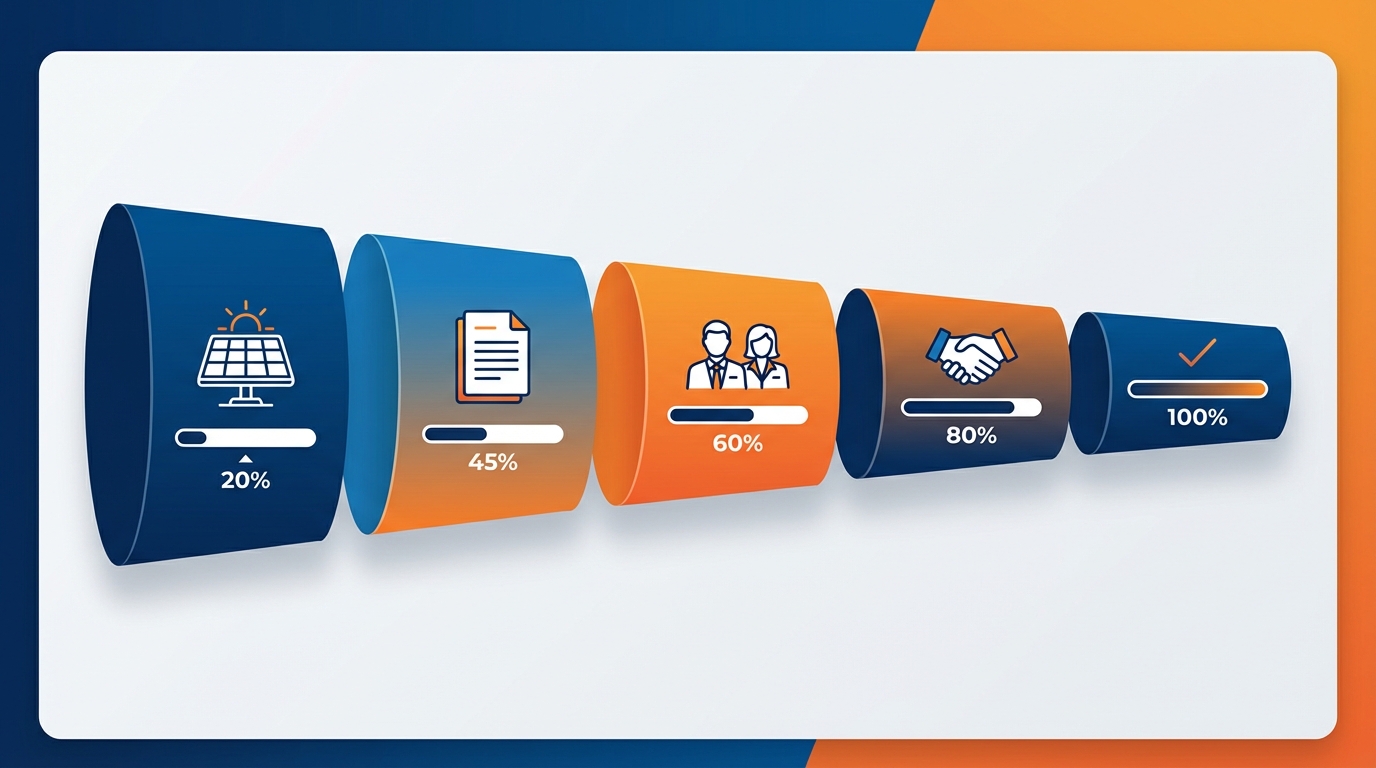
A typical sales pipeline for solar businesses includes five to seven core stages, though you can customize these based on your specific sales process. The essential stages are:
- Lead Generation: Capturing potential customers through various channels like website inquiries, Facebook Ads, referrals, or trade shows. At this stage, you’re identifying people who have shown interest in solar solutions.
- Lead Qualification: Evaluating whether the lead meets your ideal customer profile. This involves assessing factors like budget, property ownership, electricity consumption, and decision-making authority.
- Initial Contact and Needs Assessment: Making first contact with qualified leads to understand their energy needs, pain points, and goals. This is where relationship-building begins.
- Site Survey and Proposal: Conducting a technical site assessment and creating a customized solar proposal. With tools like QuickEst, solar companies can generate professional proposals within 60 seconds, significantly accelerating this stage.
- Negotiation and Objection Handling: Addressing customer concerns, discussing financing options, and refining the proposal based on feedback.
- Closing: Finalizing contracts, securing signatures, and processing payments to convert the opportunity into a customer.
- Post-Sale and Referrals: Following up after installation to ensure satisfaction and requesting referrals to feed new leads back into your pipeline.
Each stage should have clear exit criteria that define when an opportunity is ready to move forward. This prevents deals from stagnating and ensures your team maintains momentum throughout the sales process.
2. How Do You Calculate Sales Pipeline Conversion Rates?
Understanding your conversion rates is fundamental to optimizing your sales pipeline. The overall conversion rate is calculated by dividing the number of closed deals by the total number of leads that entered your pipeline, then multiplying by 100 to get a percentage.
Overall Conversion Rate Formula: (Closed Deals ÷ Total Leads) × 100
However, tracking stage-by-stage conversion rates provides much deeper insights. For example, you might calculate:
- Lead-to-Qualified conversion rate: What percentage of raw leads meet your qualification criteria?
- Qualified-to-Proposal conversion rate: How many qualified leads receive a formal proposal?
- Proposal-to-Close conversion rate: What percentage of proposals result in signed contracts?
For solar businesses in India, typical conversion rates vary by market segment. Residential solar might see overall conversion rates of 15-25%, while commercial projects often have lower conversion rates (8-15%) but higher deal values. Using a specialized solar CRM with built-in analytics allows you to track these metrics automatically without manual calculation, giving you real-time visibility into pipeline performance.
3. What Metrics Should Solar Companies Track in Their Sales Pipeline?
Beyond basic conversion rates, successful solar companies monitor several critical sales pipeline metrics:
- Pipeline Velocity: The speed at which deals move through your pipeline, calculated by multiplying the number of opportunities by average deal value by win rate, then dividing by sales cycle length. Faster velocity means more revenue in less time.
- Average Deal Size: The typical value of closed solar projects. Tracking this helps with revenue forecasting and identifying whether you’re moving upmarket or downmarket.
- Win Rate: The percentage of opportunities that result in closed deals. A declining win rate might indicate pricing issues, competitive pressure, or qualification problems.
- Sales Cycle Length: The average time from first contact to closed deal. Shorter cycles improve cash flow and allow your team to handle more opportunities.
- Pipeline Coverage Ratio: The total value of opportunities in your pipeline divided by your revenue target. Most solar businesses need 3-5x coverage to reliably hit their goals.
- Lead Response Time: How quickly your team contacts new leads. Studies show that responding within five minutes can increase conversion rates by up to 400%.
- Proposal-to-Close Ratio: What percentage of proposals turn into signed contracts. Low ratios might indicate proposal quality issues or pricing misalignment.
Modern CRM platforms provide dashboards that display these metrics in real-time, allowing sales managers to identify trends and take corrective action quickly. When your team can see exactly where they stand against targets, accountability and performance naturally improve.
4. How Can You Identify Bottlenecks in Your Sales Pipeline?
Bottlenecks are stages where deals consistently get stuck or drop off at higher-than-expected rates. Identifying these problem areas is crucial for optimizing your sales pipeline and improving overall conversion rates.
Start by analyzing the average time deals spend in each stage. If opportunities are sitting in the proposal stage for weeks while other stages move quickly, you’ve found a bottleneck. Similarly, if you notice a dramatic drop-off between two specific stages—say, 60% of qualified leads never receive proposals—that transition point needs attention.

Common bottlenecks in solar sales pipelines include:
- Slow Proposal Generation: If creating customized proposals takes days, prospects lose interest or choose faster competitors. This is where instant proposal tools become game-changers.
- Inadequate Follow-Up: Leads that don’t receive timely follow-up communications often go cold. Automated reminder systems prevent this leakage.
- Complex Approval Processes: Internal bottlenecks where proposals need multiple sign-offs before reaching customers can kill momentum.
- Financing Confusion: If customers struggle to understand financing options, they stall in the negotiation stage.
- Technical Assessment Delays: Slow site surveys or engineering reviews extend sales cycles unnecessarily.
Use your CRM’s reporting features to create stage duration reports and conversion funnel visualizations. Red flags include stages where the average duration exceeds your target by 50% or more, or where conversion rates fall below industry benchmarks. Once identified, you can implement targeted solutions like automation, training, or process redesign to eliminate these bottlenecks.
5. What’s the Ideal Length for a Solar Sales Cycle?
The ideal sales cycle length for solar projects varies significantly based on customer type and project complexity. In India’s solar market, residential projects typically close in 30-60 days from initial contact, while commercial and industrial projects can take 90-180 days or longer due to multiple stakeholders and technical requirements.
Several factors influence your sales cycle length:
- Customer Segment: Homeowners make decisions faster than corporate procurement committees.
- Financing Method: Cash purchases close faster than financed deals requiring loan approvals.
- Project Size: Small residential systems (3-5 kW) move faster than large commercial installations (100+ kW).
- Seasonal Factors: Solar sales often accelerate before monsoon season when customers want installations completed.
- Competitive Intensity: In highly competitive markets, customers compare multiple proposals, extending decision times.
To reduce your sales cycle length, focus on three key areas: faster response times to new leads, instant proposal generation capabilities, and automated follow-up sequences that maintain engagement without manual effort. Solar companies using specialized CRM tools report sales cycle reductions of 20-40% compared to manual processes, directly impacting revenue and team capacity.
6. How Do You Qualify Leads Effectively in a Solar Sales Pipeline?
Effective lead qualification prevents your sales pipeline from clogging with opportunities that will never close. The BANT framework (Budget, Authority, Need, Timeline) provides a solid foundation, but solar businesses should add industry-specific criteria:
- Property Ownership: Does the prospect own the property or have landlord approval for installation?
- Roof Condition and Suitability: Is the roof structurally sound with adequate sun exposure and minimal shading?
- Electricity Consumption: Are monthly bills high enough to justify solar investment (typically ₹3,000+ for residential)?
- Financial Capacity: Can the prospect afford the investment through cash, loan, or financing options?
- Decision-Making Authority: Are you speaking with the actual decision-maker or an influencer?
- Timeline and Urgency: Is there a compelling reason to move forward now (rising electricity costs, new construction, tax incentives)?
- Competitive Situation: Are they comparing multiple vendors or is this an exclusive conversation?
Implementing automated lead scoring in your CRM system assigns points based on these criteria, helping your team prioritize high-quality opportunities. Leads scoring above your threshold move forward to proposal stage, while lower-scoring leads enter nurture campaigns until they’re ready. This systematic approach ensures your sales team focuses energy on opportunities most likely to convert, improving both efficiency and morale.
7. What Role Does CRM Software Play in Sales Pipeline Management?
A specialized CRM system is the backbone of effective sales pipeline management for solar companies. While spreadsheets might work for very small teams, they quickly become unmanageable as your business grows and lack the automation capabilities that drive efficiency.
Modern solar CRM platforms like QuickEst provide several critical capabilities:
- Centralized Lead and Opportunity Tracking: Every lead, interaction, proposal, and deal stage is recorded in one place, accessible to your entire team. No more lost sticky notes or forgotten follow-ups.
- Automated Follow-Up Systems: Customizable reminder sequences ensure no lead falls through the cracks. The system automatically prompts team members when it’s time to reach out, maintaining consistent engagement.
- Real-Time Pipeline Visibility: Dashboards show exactly where every opportunity stands, how much revenue is in each stage, and which deals need attention. Managers can spot problems before they become crises.
- Instant Proposal Generation: Creating professional solar proposals in 60 seconds instead of hours or days dramatically accelerates your sales cycle and improves response times when customers are hot.
- Performance Analytics: Track individual and team metrics, identify top performers, and pinpoint coaching opportunities based on actual pipeline data.
- Mobile Accessibility: Field sales teams can update opportunities, send proposals, and check pipeline status from anywhere using mobile apps.
- Integration Capabilities: Connect your CRM with lead sources like Facebook Ads, communication platforms like WhatsApp, and other business tools to create seamless workflows.
The investment in solar CRM software pays for itself through increased conversion rates, reduced sales cycle times, and improved team productivity. Solar companies report that CRM implementation typically delivers ROI within 3-6 months through these efficiency gains.
8. How Can You Improve Pipeline Forecasting Accuracy?
Accurate sales pipeline forecasting allows you to make informed decisions about hiring, inventory, cash flow, and growth investments. Poor forecasting leads to missed targets, resource shortages, or wasted capacity.
To improve forecasting accuracy, implement these practices:
- Historical Data Analysis: Review past performance to identify seasonal patterns, average conversion rates by stage, and typical sales cycle lengths. Use this baseline to project future results.
- Weighted Pipeline Method: Assign probability percentages to each pipeline stage (e.g., qualified leads 20%, proposal sent 40%, negotiation 70%) and multiply opportunity values by these weights to calculate expected revenue.
- Regular Pipeline Reviews: Conduct weekly pipeline meetings where team members update opportunity status and probability assessments. Stale data produces inaccurate forecasts.
- Stage Exit Criteria: Clearly defined criteria for advancing opportunities prevent optimistic stage progression that inflates forecasts artificially.
- CRM Analytics: Leverage your CRM’s predictive analytics features that use machine learning to forecast based on historical patterns and current pipeline composition.
- Conservative Assumptions: When in doubt, use lower probability estimates. It’s better to exceed conservative forecasts than miss aggressive ones.
Track your forecast accuracy over time by comparing predicted revenue to actual closed deals. If you’re consistently off by more than 15-20%, revisit your probability assignments and qualification criteria. Most solar businesses find that forecasting accuracy improves significantly after 6-12 months of consistent CRM usage as historical data accumulates.
9. What Are the Best Practices for Moving Leads Through Pipeline Stages?
Maintaining momentum throughout your sales pipeline requires deliberate strategies at each stage. Here are proven best practices for solar companies:
- Define Clear Stage Exit Criteria: Document exactly what must happen before an opportunity advances. For example, a lead doesn’t move to proposal stage until you’ve completed a site assessment and confirmed budget.
- Implement Timely Follow-Up Protocols: Establish response time standards for each stage. New leads should be contacted within 5 minutes, proposal follow-ups within 24 hours, and negotiation updates within 48 hours.
- Personalize Communication: Generic messages get ignored. Reference specific details from previous conversations and tailor your value proposition to each prospect’s unique situation.
- Use Automated Workflows: Set up trigger-based actions in your CRM. When a lead reaches qualified status, automatically assign it to a sales rep and schedule a site survey. When a proposal is sent, trigger a follow-up sequence.
- Generate Proposals Quickly: Speed matters enormously in solar sales. The faster you can deliver a professional proposal after a site visit, the higher your close rate. Tools that create proposals in 60 seconds give you a significant competitive advantage.
- Provide Multiple Touchpoints: Use varied communication channels—phone calls, emails, WhatsApp messages, and in-person meetings—to stay engaged without being annoying.
- Address Objections Proactively: Anticipate common concerns (ROI timeline, financing, maintenance) and address them before they become deal-blockers.
- Create Urgency Appropriately: Highlight time-sensitive factors like seasonal pricing, government incentive deadlines, or electricity rate increases without resorting to false pressure tactics.
The key is consistency. When every team member follows the same process and uses the same tools, your entire sales pipeline operates more predictably and efficiently.
10. How Do You Handle Stalled Deals in Your Sales Pipeline?
Every solar sales pipeline contains opportunities that lose momentum and stall. The question is how to identify and address them before they become dead weight distorting your forecasts.
First, define what “stalled” means for your business. A reasonable definition might be any opportunity that hasn’t progressed or had meaningful contact in 14-21 days. Your CRM should flag these automatically so they don’t hide in your pipeline unnoticed.
When you identify a stalled deal, take these steps:
- Diagnose the Cause: Why did momentum stop? Common reasons include budget concerns, internal approval delays, competing priorities, or simply forgetting about the project.
- Re-Engage with Value: Don’t just ask “Have you made a decision?” Instead, provide new information, a case study, updated incentive information, or a revised proposal addressing previous concerns.
- Offer a Clear Next Step: Make it easy for the prospect to move forward with a specific, low-commitment action like a brief call or updated site assessment.
- Set a Decision Deadline: Politely establish a timeline: “I want to ensure we can still deliver installation before monsoon season. Can we finalize details by next Friday?”
- Know When to Move On: If multiple re-engagement attempts fail, move the opportunity to a long-term nurture campaign rather than keeping it in your active pipeline inflating forecasts.
Regular pipeline cleaning, removing or reclassifying stalled deals, keeps your forecasts accurate and helps your team focus on opportunities that are actually moving forward. Most solar businesses benefit from monthly pipeline hygiene reviews where stalled deals are systematically addressed.
11. What’s the Optimal Sales Pipeline Coverage Ratio?
Your pipeline coverage ratio compares the total value of opportunities in your sales pipeline to your revenue target. It answers the question: “Do we have enough in the pipeline to hit our goals?”
The formula is simple: Pipeline Coverage Ratio = Total Pipeline Value ÷ Revenue Target
For solar businesses, the optimal ratio typically ranges from 3x to 5x, meaning you need three to five times your revenue target in pipeline value. This accounts for the fact that not every opportunity will close, and some will close at lower values than initially projected.
Your ideal ratio depends on several factors:
- Historical Win Rate: If you close 25% of opportunities, you need at least 4x coverage. If you close 40%, 3x might suffice.
- Pipeline Stage Distribution: If most opportunities are in early stages (lower probability), you need higher coverage than if they’re concentrated in late stages.
- Sales Cycle Predictability: More predictable cycles allow lower coverage ratios because forecasting is more accurate.
- Deal Size Variability: If deal values fluctuate significantly, maintain higher coverage as a buffer.
Monitor your coverage ratio weekly. If it drops below your target threshold, it’s time to increase lead generation activities. If it’s consistently too high, you might be qualifying leads too loosely or not moving opportunities through stages efficiently. The right CRM dashboard makes tracking this metric effortless, providing early warning when pipeline health deteriorates.
12. How Can Solar Companies Reduce Sales Pipeline Leakage?
Pipeline leakage occurs when opportunities drop out of your sales pipeline unnecessarily, not because they weren’t qualified, but because of process failures, poor follow-up, or competitive losses that could have been prevented.
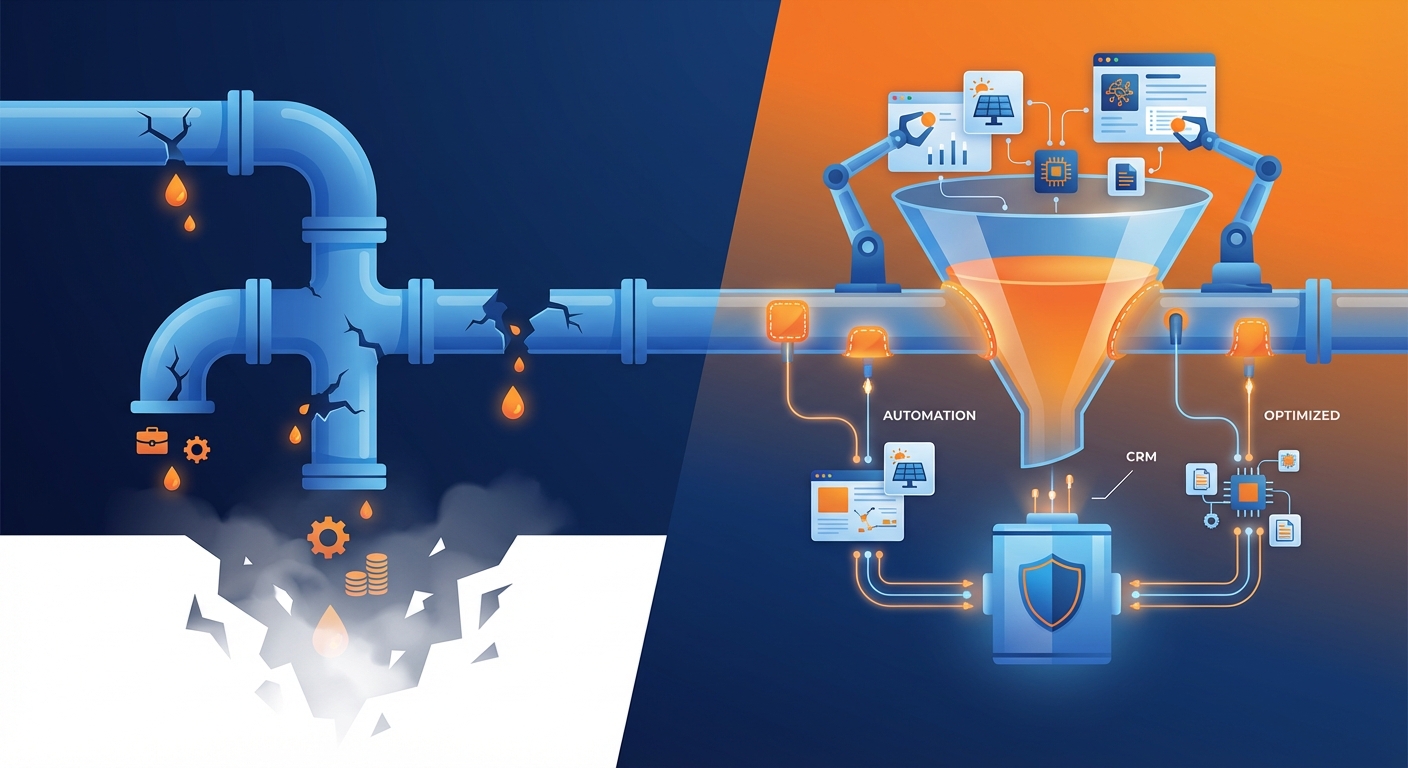
Common causes of pipeline leakage in solar businesses include:
- Slow Response Times: When leads wait hours or days for initial contact, they often choose faster competitors.
- Inconsistent Follow-Up: Forgetting to follow up after sending a proposal or missing scheduled check-ins causes prospects to lose interest.
- Poor Lead Qualification: Allowing unqualified leads into your pipeline wastes time and inflates your numbers artificially.
- Weak Value Communication: Failing to differentiate your offering or clearly articulate ROI makes price the only decision factor.
- Inadequate Objection Handling: Not addressing concerns about financing, installation disruption, or maintenance allows small doubts to become deal-killers.
- Lack of Urgency: Without compelling reasons to act now, prospects procrastinate indefinitely.
To reduce leakage, implement these solutions:
- Automated Follow-Up Systems: Use CRM automation to ensure every lead receives timely follow-up regardless of how busy your team gets. Automated email sequences, WhatsApp reminders, and task assignments prevent opportunities from falling through the cracks.
- Instant Proposal Generation: The ability to create and send professional proposals within 60 seconds while the prospect is still engaged dramatically reduces leakage at the proposal stage.
- Lead Scoring and Routing: Automatically prioritize high-quality leads and route them to your best sales reps, ensuring top opportunities get appropriate attention.
- Pipeline Discipline: Train your team to update CRM records after every interaction, maintaining data accuracy that enables effective management.
- Regular Pipeline Reviews: Weekly team meetings to discuss stuck deals, share successful strategies, and identify at-risk opportunities before they’re lost.
- Competitive Differentiation: Develop clear value propositions that emphasize your unique advantages, whether that’s faster installation, better warranties, superior customer service, or specialized expertise.
Reducing pipeline leakage by even 10-15% can significantly impact your bottom line without requiring additional lead generation investment. Focus on plugging the holes before trying to fill the bucket faster.
13. What Are the Key Differences Between B2B and B2C Solar Sales Pipelines?
Solar companies serving both residential customers (B2C) and commercial clients (B2B) need to recognize that these sales pipelines operate quite differently:
Decision-Making Complexity: Residential solar decisions typically involve one or two people (homeowner and spouse), while commercial projects require approval from multiple stakeholders, facility managers, CFOs, sustainability officers, and sometimes board members. This makes B2B pipelines longer and more complex.
Sales Cycle Length: B2C solar sales in India typically close in 30-60 days, while B2B deals often take 90-180 days or longer due to procurement processes, budget cycles, and technical evaluations.
Number of Touchpoints: Residential customers might need 5-8 interactions before closing, while commercial clients often require 15-25 touchpoints across multiple stakeholders and decision-making stages.
Proposal Complexity: Residential proposals focus on savings, aesthetics, and financing options. Commercial proposals require detailed ROI analysis, technical specifications, integration with existing systems, and often competitive bidding processes.
Deal Size and Risk: Commercial projects have much higher values but also higher risk of cancellation or delay. This affects pipeline management strategies and forecasting approaches.
Relationship Importance: While relationships matter in both contexts, B2B solar sales rely more heavily on long-term relationship building, networking, and reputation within industries.
Smart solar companies maintain separate pipeline stages and metrics for B2C and B2B opportunities, recognizing that what works for residential sales doesn’t necessarily apply to commercial projects. Your CRM should allow you to segment and analyze these pipelines independently while still providing consolidated reporting for overall business performance.
14. How Do You Track Team Performance Across the Sales Pipeline?
Effective sales pipeline management requires visibility into both team and individual performance. The right metrics help you identify top performers, coaching opportunities, and process improvements.
Key individual performance metrics include:
- Number of New Opportunities Created: How many qualified leads is each rep adding to the pipeline?
- Conversion Rate by Stage: Where do individual reps excel or struggle? One might be great at initial contact but weak at closing, while another shows the opposite pattern.
- Average Deal Size: Are some reps consistently landing larger projects? What can others learn from their approach?
- Sales Cycle Length: Which reps move deals through the pipeline fastest? What techniques are they using?
- Activity Metrics: Track calls made, emails sent, proposals generated, and site visits completed. Low activity often predicts poor results.
- Pipeline Value: How much total opportunity value does each rep currently manage?
- Win Rate: What percentage of opportunities does each rep ultimately close?
Modern CRM dashboards display these metrics in real-time, allowing sales managers to spot trends immediately. When a rep’s activity drops or their pipeline thins, you can intervene before it impacts results. When someone discovers a technique that improves conversion rates, you can share it across the team.
The key is using data for coaching and improvement, not just evaluation. Regular one-on-one pipeline reviews where managers and reps analyze performance together create accountability while building skills. The right CRM implementation makes this level of performance tracking effortless, transforming sales management from guesswork to data-driven decision-making.
15. What Integration Capabilities Should Your Sales Pipeline Tool Have?
A sales pipeline management tool that operates in isolation creates data silos and manual work. The most effective solar CRM systems integrate seamlessly with other tools in your technology stack:
- Lead Source Integrations: Automatically capture leads from your website contact forms, Facebook Ads campaigns, Google Ads, and other marketing channels directly into your CRM. This eliminates manual data entry and ensures instant follow-up.
- Communication Platform Connections: Integration with WhatsApp, email platforms, and phone systems allows you to communicate with prospects without leaving your CRM, while automatically logging all interactions for future reference.
- Proposal and Documentation Tools: The ability to generate professional solar proposals, contracts, and other documents directly from CRM data saves hours and reduces errors from manual transcription.
- Calendar and Scheduling: Sync with Google Calendar or Outlook to schedule site visits, follow-up calls, and meetings while automatically creating CRM tasks and reminders.
- Analytics and Reporting: Export data to business intelligence tools or use built-in dashboards that provide real-time visibility into pipeline health and team performance.
- Mobile Accessibility: Native iOS and Android apps that sync with your main CRM database allow field teams to update opportunities, send proposals, and check pipeline status from anywhere.
- Accounting and Invoicing: Integration with accounting software ensures smooth handoff from sales to finance when deals close.
- Marketing Automation: Connect with email marketing platforms to nurture leads that aren’t yet ready to buy, keeping your brand top-of-mind until they enter active sales conversations.
When evaluating solar CRM options, integration capabilities should be a top consideration. The time saved through automation and the insights gained from connected data often justify higher software costs. QuickEst, for example, offers integrations with Facebook Ads, Pabbly Connect for workflow automation, and phonebook imports, creating a connected ecosystem that eliminates manual data transfer and accelerates your sales process.
16. How Often Should You Review and Clean Your Sales Pipeline?
Regular pipeline reviews and cleaning are essential for maintaining an accurate, actionable sales pipeline. Without consistent maintenance, your pipeline becomes cluttered with dead opportunities, stalled deals, and outdated information that distorts forecasts and wastes team energy.
Implement a multi-level review cadence:
Daily Individual Reviews (5-10 minutes): Each sales rep should start their day reviewing their personal pipeline, identifying which opportunities need attention, updating deal status, and planning their daily activities. This keeps information current and ensures nothing falls through the cracks.
Weekly Team Pipeline Meetings (30-60 minutes): Gather your sales team to review the entire pipeline together. Discuss deals that are progressing well, identify opportunities that need help, share successful strategies, and flag stalled deals for re-engagement or removal. This creates accountability and facilitates knowledge sharing.
Monthly Deep-Dive Analysis (1-2 hours): Conduct a comprehensive pipeline review examining metrics like conversion rates by stage, average deal size trends, sales cycle length, pipeline coverage ratio, and individual performance. Identify patterns, bottlenecks, and opportunities for process improvement.
Quarterly Strategic Assessments (2-4 hours): Step back to evaluate whether your pipeline stages, qualification criteria, and sales process still align with market realities. Adjust based on competitive changes, customer feedback, and performance data.
During these reviews, apply clear criteria for removing opportunities:
- No meaningful contact or progress in 30+ days despite multiple re-engagement attempts
- Prospect explicitly states they’re not moving forward
- Opportunity no longer meets qualification criteria (budget eliminated, property sold, etc.)
- Deal has been in pipeline for 2-3x your average sales cycle with no clear path to close
Don’t be afraid to clean aggressively. A smaller, accurate pipeline is far more valuable than an inflated one full of wishful thinking. Removed opportunities can move to long-term nurture campaigns where they receive occasional check-ins without cluttering your active sales focus.
17. What Are the Most Common Sales Pipeline Mistakes Solar Companies Make?
Even experienced solar businesses fall into common sales pipeline management traps that undermine their sales effectiveness:
Poorly Defined Pipeline Stages: Vague stage definitions like “interested” or “considering” create confusion about where opportunities actually stand. Clear, action-based stages with specific exit criteria eliminate ambiguity.
Inconsistent Data Entry and Updates: When team members don’t consistently log activities and update opportunity status, your pipeline becomes unreliable. This makes forecasting impossible and prevents effective management. Establishing CRM usage as a non-negotiable expectation solves this problem.
Ignoring Pipeline Velocity Metrics: Many solar companies focus solely on conversion rates while ignoring how long deals take to close. A 30% conversion rate with a 90-day sales cycle generates less revenue than a 25% conversion rate with a 45-day cycle.
Over-Optimistic Forecasting: Moving opportunities to advanced stages prematurely or assigning unrealistic close probabilities creates forecasts that consistently miss targets. This leads to poor business decisions about hiring, inventory, and growth investments.
Lack of Follow-Up Automation: Relying on manual follow-up processes guarantees that opportunities will be forgotten when team members get busy. Automated reminder systems ensure consistent engagement.
Not Using Specialized Solar CRM Tools: General-purpose CRM platforms lack solar-specific features like instant proposal generation, solar design integration, and industry-specific reporting. This forces workarounds that slow your team down and reduce adoption.
Failing to Segment Different Customer Types: Treating residential and commercial opportunities identically, or not distinguishing between cash and financed deals, leads to inappropriate sales approaches and inaccurate forecasting.
Neglecting Pipeline Cleaning: Allowing dead and stalled opportunities to accumulate creates false confidence and prevents realistic assessment of pipeline health.
Inadequate Sales Training: Assuming team members instinctively know how to manage pipeline opportunities leads to inconsistent execution. Regular training on your sales process, CRM usage, and best practices ensures everyone operates at a high level.
Avoiding these mistakes requires deliberate process design, the right technology tools, and consistent management attention. The good news is that once you establish strong pipeline management practices, they become self-reinforcing as team members see the benefits in their own results.
18. How Can Automation Improve Your Sales Pipeline Efficiency?
Automation is perhaps the single most powerful lever for improving sales pipeline performance in solar businesses. By eliminating repetitive manual tasks, automation allows your team to focus on high-value activities like relationship building and closing deals.

Key areas where automation transforms solar sales pipelines:
Automated Lead Capture and Assignment: When a prospect fills out a website form or responds to a Facebook Ad, automation instantly creates a CRM record and assigns it to the appropriate sales rep based on territory, specialization, or workload. This eliminates manual data entry and ensures immediate follow-up.
Follow-Up Reminders and Email Sequences: Automated reminder systems prompt team members when it’s time to contact prospects, while pre-built email sequences maintain engagement without requiring manual effort. For example, after sending a proposal, an automated sequence might send a follow-up email after 2 days, another after 5 days, and create a task for a phone call after 7 days.
Instant Proposal Generation: This is where solar-specific automation delivers massive value. Instead of spending hours creating customized proposals, systems like QuickEst allow you to generate professional, branded solar proposals in 60 seconds. You can send them immediately via WhatsApp or email while the prospect is still engaged, dramatically improving conversion rates.
Automated Reporting and Alerts: Rather than manually compiling pipeline reports, automation delivers daily or weekly summaries showing key metrics, deals needing attention, and performance trends. Alerts notify managers when opportunities stall or when team members fall behind on activities.
Task Creation and Workflow Triggers: When an opportunity moves to a new stage, automation can automatically create the next required tasks. For example, moving to “Qualified” might trigger tasks for scheduling a site visit, sending introductory materials, and setting a follow-up reminder.
Data Enrichment: Automated systems can pull additional information about leads from public sources, social media, and business databases, giving your team more context for personalized outreach.
Communication Logging: Integration with email and phone systems automatically logs all customer interactions in your CRM, creating a complete history without manual note-taking.
Real-world efficiency gains from solar CRM automation are substantial. Solar companies report that automation typically saves 10-15 hours per week per sales rep, time that can be redirected to revenue-generating activities. Proposal generation time drops from 2-4 hours to under a minute. Follow-up consistency improves from 60-70% to 95%+. These improvements directly translate to shorter sales cycles, higher conversion rates, and increased revenue per sales rep.
The key is choosing a CRM platform built specifically for solar businesses with these automation capabilities already integrated, rather than trying to cobble together generic tools that require extensive customization.
Building a High-Performance Sales Pipeline for Your Solar Business
Mastering sales pipeline management is not optional for solar companies that want to thrive in India’s competitive market. The difference between businesses that struggle and those that consistently hit their targets often comes down to how well they track, manage, and optimize their sales processes.
The 18 questions we’ve explored cover the essential elements of effective pipeline management: clearly defined stages, accurate metrics and forecasting, systematic lead qualification, bottleneck identification, appropriate technology tools, and consistent team execution. When these elements work together, your solar business gains predictable revenue, improved team performance, and the ability to scale efficiently.
The action steps to implement immediately include:
- Define clear pipeline stages with specific exit criteria for your solar sales process
- Implement a specialized solar CRM system that provides automation, instant proposal generation, and real-time visibility
- Establish regular pipeline review cadences at daily, weekly, monthly, and quarterly intervals
- Train your team on consistent CRM usage and pipeline management best practices
- Set up automated follow-up sequences and reminder systems to prevent leakage
- Track key metrics like conversion rates, sales cycle length, pipeline velocity, and coverage ratio
- Clean your pipeline regularly, removing stalled and dead opportunities that distort forecasts
The competitive advantage of an optimized sales pipeline cannot be overstated. When you can respond to leads within minutes, generate professional proposals in 60 seconds, maintain consistent follow-up automatically, and forecast revenue accurately, you operate at a fundamentally different level than competitors still using spreadsheets and manual processes.
The right CRM tools accelerate these results dramatically. QuickEst is specifically designed for solar businesses in India, combining instant proposal generation, automated follow-up systems, real-time analytics, and mobile accessibility in one platform. Solar companies using QuickEst report sales cycle reductions of 20-40%, conversion rate improvements of 15-30%, and significant time savings that allow teams to handle more opportunities without adding headcount.
Whether you’re a solar installation company looking to close more residential deals, an EPC managing complex commercial projects, or a sales team trying to maximize your conversion rates, implementing the sales pipeline management strategies outlined in this guide will transform your results. Start with the FREE PLAN at ₹0 to experience how specialized solar CRM software can streamline your sales process, or explore the PRO PLAN at ₹6999 per user per year for advanced automation and team collaboration features. Take the first step today toward building a high-performance sales pipeline that consistently delivers the revenue growth your solar business deserves. Contact us to learn how QuickEst can optimize your sales pipeline and help you close more solar deals faster.