
In India’s rapidly growing solar industry, speed and efficiency can make the difference between winning and losing a deal. Solar installation companies and EPCs face mounting pressure to respond to leads faster, create professional proposals quickly, and manage growing sales pipelines without expanding their teams proportionally. This is where proposal automation becomes a game-changer.
Manual proposal creation—with its spreadsheets, calculations, formatting, and back-and-forth revisions—can take hours or even days. Meanwhile, potential customers are comparing quotes from multiple vendors, and the first company to deliver a professional, accurate proposal often has the competitive advantage. For solar businesses across India, from Mumbai to Bangalore to Delhi, automated quote generation is no longer a luxury—it’s becoming essential for staying competitive.
This comprehensive FAQ guide answers the 15 most common questions solar businesses have about proposal automation. Whether you’re a solar installation company evaluating CRM solutions, a sales team leader looking to boost productivity, or a solar distributor seeking to streamline B2B operations, you’ll find practical answers about how automated quote generation works, what it costs, how to implement it, and what results you can expect.

Understanding Proposal Automation Basics
Before diving into specific questions, it’s important to understand what proposal automation actually means in the context of solar businesses. At its core, proposal automation is the use of specialized software to automatically generate professional, accurate sales proposals based on predefined templates, pricing rules, and customer data.
Unlike manual proposal creation where sales teams build each quote from scratch using spreadsheets or word processors, automated systems pull information from integrated databases, apply pricing logic, perform calculations automatically, and format everything into branded, professional documents—all in a fraction of the time.
For solar businesses specifically, this means systems that understand solar industry terminology, can calculate system sizing based on energy requirements, apply appropriate pricing for panels, inverters, and installation, and present technical specifications in a format that customers can easily understand. The technology behind these platforms typically includes solar CRM systems, template engines, calculation algorithms, and integration capabilities with other business tools.
1. How Does Proposal Automation Actually Work for Solar Businesses?
The proposal automation process for solar companies typically follows a streamlined workflow that transforms raw customer data into polished proposals in minutes rather than hours.
First, sales representatives input basic customer information—name, location, contact details, and energy requirements. This data can be entered manually, imported from lead capture forms, or pulled automatically from integrated lead management systems. Many modern platforms also support bulk lead import from Excel spreadsheets, making it easy to migrate existing customer databases.
Next, the system uses this information to calculate appropriate solar system specifications. Based on the customer’s energy consumption, roof space, location, and preferences, the software recommends system size, panel quantities, inverter specifications, and other technical details. These calculations happen automatically using pre-configured rules and pricing databases.
The platform then applies your pricing structure—including equipment costs, installation charges, government subsidies, financing options, and any applicable discounts—to generate accurate quotes. All calculations are performed automatically, eliminating the risk of manual errors that can damage credibility or profitability.
Finally, the system formats everything into a professional, branded proposal document using your selected template. Within seconds, you have a complete proposal ready to send via email or WhatsApp directly from the platform. For solar businesses using specialized solutions like QuickEst, this entire process can be completed in as little as 60 seconds, allowing sales teams to respond to leads while they’re still hot.
2. How Much Time Can Solar Companies Save with Proposal Automation?
Time savings represent one of the most compelling benefits of proposal automation, and the numbers are significant. Traditional manual proposal creation for solar projects typically takes between 2-4 hours per proposal when you account for gathering information, performing calculations, creating designs, formatting documents, and reviewing for accuracy.
With automated quote generation, this same process shrinks to just 1-5 minutes. That’s a time reduction of approximately 95-98%. For a solar sales team that creates 20 proposals per week, this translates to saving roughly 40-80 hours weekly—equivalent to one or two full-time employees.
But the time savings extend beyond just proposal creation. Automated follow-up systems eliminate the need for sales reps to manually track which proposals need follow-up calls or emails. Customizable reminder schedules and email templates mean that nurturing leads happens automatically, freeing up sales professionals to focus on high-value activities like customer consultations and closing deals.
For solar businesses in India’s competitive market, this speed advantage is crucial. When a potential customer submits an inquiry, they’re often reaching out to multiple solar companies simultaneously. The vendor who delivers a professional proposal first—while the customer is still actively researching—has a significant advantage in winning the business. Sales automation tools ensure your team is always first to respond.
3. Can Automated Proposals Be Customized to Match Our Brand?
A common concern about proposal automation is whether automated proposals will look generic or impersonal. The reality is that modern proposal automation platforms offer extensive customization options that allow you to maintain—and even enhance—your brand identity.
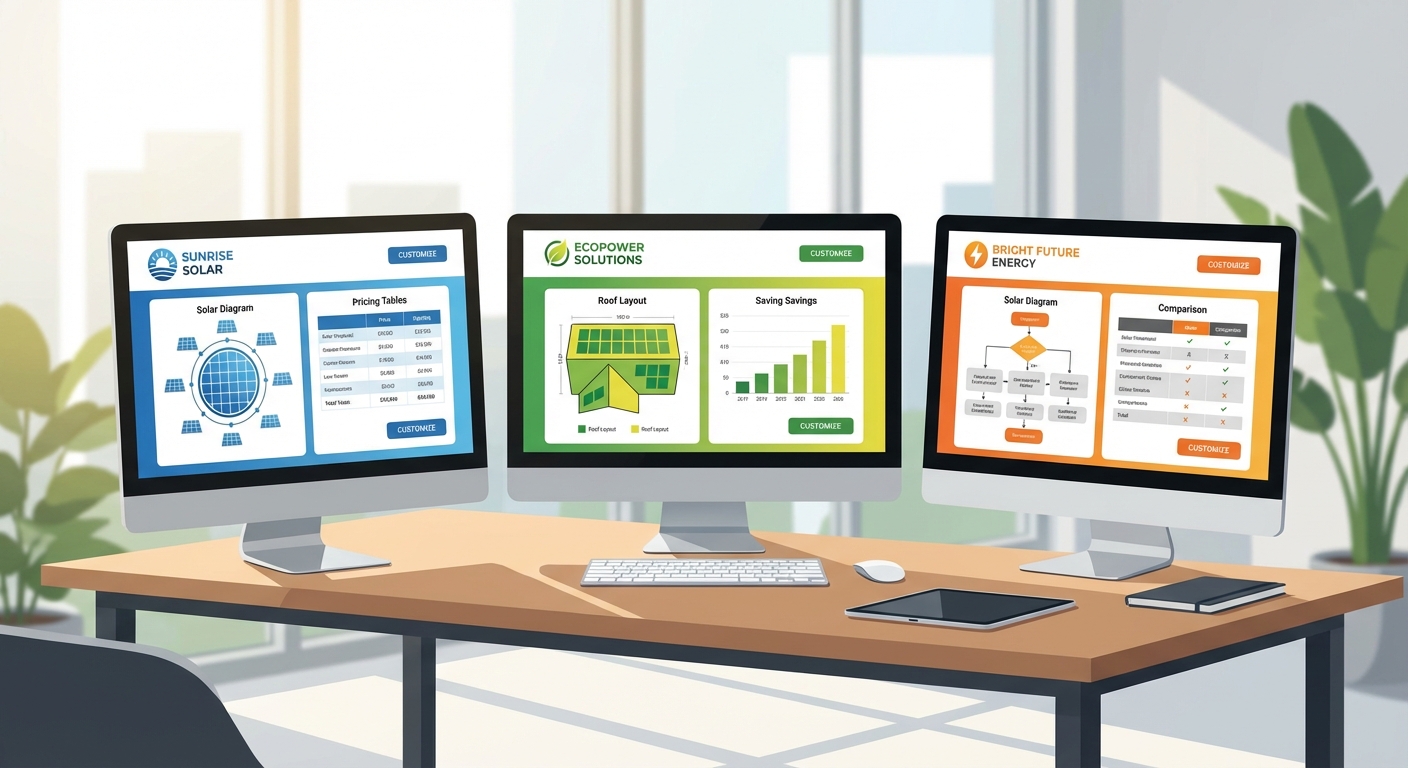
Professional proposal automation systems provide template libraries where you can customize every visual element. This includes adding your company logo, selecting brand colors, choosing fonts, and designing layouts that reflect your corporate identity. Many platforms offer multiple template options, allowing you to create different proposal styles for residential vs. commercial clients, or for different product lines.
Beyond visual branding, you can also customize the content and structure of your proposals. Add custom sections for your unique value propositions, include specific warranty information, incorporate customer testimonials, or add technical specifications that differentiate your offerings. The goal is to create templates that look professionally designed and uniquely yours—not cookie-cutter documents that could come from any solar company.
QuickEst, for example, provides a professional proposal template library with full brand customization capabilities. Solar businesses can create proposals that look like they were custom-designed by a graphic designer, but generate automatically in seconds. This combination of professional appearance and automation speed gives solar companies the best of both worlds.
The key is choosing a proposal automation platform that prioritizes customization flexibility. During your evaluation process, ask vendors to show examples of how their templates can be branded, and request a demo where you can see the customization interface firsthand.
4. How Accurate Are Automated Solar Proposals Compared to Manual Ones?
Accuracy is actually one of the strongest arguments in favor of proposal automation. While it might seem counterintuitive, automated proposals are typically more accurate than manually created ones—and the reason comes down to eliminating human error.
Manual proposal creation involves numerous opportunities for mistakes: transposing numbers when entering data, using outdated pricing, making calculation errors in spreadsheets, forgetting to apply discounts, or copying information incorrectly between documents. Even experienced sales professionals make these errors occasionally, especially when working under time pressure or handling multiple proposals simultaneously.
Automated systems eliminate these error sources by performing all calculations programmatically. Once you’ve configured your pricing rules, system sizing algorithms, and product specifications correctly, the software applies them consistently every single time. There’s no risk of forgetting to include installation costs, miscalculating panel quantities, or using last month’s pricing by mistake.
Additionally, automated systems enforce data validation rules. If a sales rep tries to input information that doesn’t make sense—like a residential system requiring 500 panels—the system can flag the error before generating a proposal. This quality control mechanism catches mistakes that might slip through in manual processes.
For solar businesses concerned about accuracy, the implementation phase is critical. Take time to properly configure your pricing structures, validate calculation formulas, and test proposals thoroughly before going live. Once configured correctly, your automated quote generation system will deliver consistent, accurate proposals that build customer trust and protect your profit margins.
5. What Information Do I Need to Input to Generate an Automated Proposal?
One of the advantages of proposal automation is that it requires minimal input to generate comprehensive proposals. The specific data fields vary by platform and your business requirements, but most solar proposal systems need just a few key pieces of information.
Customer information forms the foundation: name, contact details (phone number, email address), and property location. This basic data allows the system to personalize the proposal and determine location-specific factors like solar irradiance, applicable government subsidies, and regional pricing.
Energy requirements represent the next critical input. This might be the customer’s average monthly electricity bill, annual energy consumption in kWh, or specific power requirements. Some systems allow you to input multiple months of electricity bills to calculate more accurate system sizing recommendations.
System preferences help tailor the proposal to customer needs. This includes preferred panel brands, budget constraints, roof type and available space, aesthetic preferences, and whether they’re interested in battery storage or grid-tied systems only.
The beauty of modern proposal automation platforms is that much of this information can be captured automatically through integrated lead forms, imported from your CRM, or pulled from previous customer interactions. For returning customers or follow-up proposals, the system remembers previous inputs, making subsequent proposals even faster to generate.
Platforms like QuickEst streamline this process further by offering mobile app access, allowing sales teams to input information during site visits or customer meetings and generate proposals on the spot. This immediate response capability impresses customers and accelerates the sales cycle significantly.
6. Can Proposal Automation Integrate with Our Existing CRM or Tools?
Integration capabilities are crucial for maximizing the value of proposal automation, and modern platforms recognize that solar businesses use multiple tools in their sales and marketing workflows. The ability to connect your proposal system with existing software eliminates data silos and creates seamless workflows.
Most professional proposal automation platforms offer integration with popular business tools through APIs, native integrations, or middleware platforms. Common integration points include CRM systems, marketing automation platforms, lead capture forms, accounting software, and communication tools.
For solar businesses in India, particularly valuable integrations include Facebook Ads for lead capture, WhatsApp for proposal delivery and customer communication, email marketing platforms for automated follow-ups, and phonebook integration for easy contact management. These connections ensure that leads flow automatically from your marketing channels into your proposal system, and that completed proposals sync back to your CRM for tracking and follow-up.
QuickEst specifically offers integration capabilities with Facebook Ads for seamless lead capture, Pabbly Connect for connecting with hundreds of other business applications, and phonebook integration for easy contact management. These integrations mean that when a potential customer fills out a lead form on your Facebook ad, their information automatically flows into the system, allowing your sales team to generate and send a proposal within minutes.
When evaluating proposal automation solutions, create a list of your current business tools and ask vendors specifically about integration capabilities. The goal is to create a connected ecosystem where data flows automatically between systems, eliminating manual data entry and ensuring all your tools work together seamlessly.
7. Do Clients Accept Automated Proposals as Readily as Manual Ones?
This question reflects a common concern: will customers perceive automated proposals as impersonal or lower quality? The evidence suggests that not only do clients accept automated proposals readily, but they often prefer them for several reasons.
First, speed matters to customers. When someone requests a solar quote, they’re actively researching and comparing options. Receiving a professional, detailed proposal within minutes or hours—rather than days—demonstrates responsiveness and professionalism. Customers interpret this speed as a sign that your company is organized, technologically advanced, and values their time.
Second, professional presentation quality impresses customers. Well-designed automated proposals often look more polished than manually created ones because they use professionally designed templates with consistent formatting, high-quality graphics, and clear information hierarchy. Customers can’t tell (and don’t care) whether the proposal was created manually or automatically—they only care that it looks professional and contains the information they need.
Third, accuracy and consistency build trust. Automated proposals eliminate the typos, calculation errors, and formatting inconsistencies that sometimes appear in rushed manual proposals. This attention to detail signals professionalism and competence, making customers more confident in choosing your company.
The key to customer acceptance is ensuring your automated proposals maintain personalization where it matters. Include the customer’s name, reference specific details from your conversations, and customize recommendations based on their unique requirements. Modern proposal automation platforms make this easy by allowing you to add custom notes or sections to individual proposals while still benefiting from automated generation of the technical and pricing components.
8. What’s the ROI of Implementing Proposal Automation?
Understanding the return on investment for proposal automation helps solar businesses make informed decisions about implementation. The ROI comes from multiple sources, and most companies see positive returns within the first few months.
Time savings translate directly to cost savings. If your sales team currently spends 40 hours per week creating proposals manually, and automation reduces this to 2 hours, you’ve freed up 38 hours weekly. At an average fully-loaded cost of ₹500 per hour for sales professionals, that’s ₹19,000 in weekly savings, or approximately ₹9.8 lakhs annually. This single benefit often exceeds the cost of proposal automation software.
Increased conversion rates provide additional ROI. Solar companies that respond to leads within 5 minutes are 9 times more likely to convert them compared to those who respond after 30 minutes. Proposal automation enables this rapid response, directly impacting your close rate. Even a modest 5-10% improvement in conversion rates can translate to significant revenue increases.
Capacity expansion without hiring represents another ROI component. With automation, your existing sales team can handle 2-3 times more leads without sacrificing quality or burning out. This means you can grow revenue without proportionally increasing headcount, improving your profit margins.
Reduced errors and rework eliminate costly mistakes. Underpricing a project due to calculation errors can cost thousands of rupees per installation. Automated systems with built-in validation prevent these expensive mistakes, protecting your margins.
For solar businesses evaluating CRM ROI and proposal automation benefits, the typical payback period is 3-6 months, with ongoing benefits continuing indefinitely. When you factor in competitive advantages, improved customer experience, and the ability to scale operations efficiently, the ROI becomes even more compelling.
9. How Difficult Is It to Implement Proposal Automation in Our Solar Business?
Implementation complexity varies significantly depending on the platform you choose and your business’s current processes. However, modern proposal automation solutions designed specifically for solar businesses prioritize ease of implementation to minimize disruption and accelerate time-to-value.
The typical implementation process includes several phases. Initial setup and configuration involves creating your account, uploading your logo and branding elements, setting up product catalogs with pricing, and configuring calculation rules for system sizing and quoting. For solar-specific platforms like QuickEst, much of this is pre-configured with industry-standard calculations, requiring only customization to your specific pricing and products.
Template creation comes next, where you design proposal templates that match your brand and include the information your customers need. Many platforms provide template libraries to start from, significantly reducing the design work required.
Team training is crucial for successful adoption. Sales teams need to learn how to input customer information, generate proposals, and use follow-up automation features. The good news is that modern platforms prioritize user-friendly interfaces, and most sales professionals can become proficient within a few hours of training. Mobile app access makes adoption even easier, as sales reps can generate proposals from their smartphones—a familiar interface for most users.
Data migration involves importing existing customer and lead data into the new system. Platforms that support bulk import from Excel make this straightforward, allowing you to transfer your existing database quickly.
Common CRM implementation challenges include resistance to change from team members comfortable with existing processes, initial time investment in setup and configuration, and ensuring data accuracy during migration. These can be mitigated through clear communication about benefits, dedicated implementation support, and phased rollouts that allow teams to adapt gradually.
Most solar businesses find that with proper planning and support, they can implement proposal automation and see meaningful results within 2-4 weeks. The key is choosing a platform with strong customer support and implementation assistance.
10. Can We Include Technical Details Like System Design in Automated Proposals?
Absolutely. Modern proposal automation platforms designed for solar businesses are built to handle the technical complexity that solar proposals require. These aren’t simple quote generators—they’re comprehensive proposal systems that can include detailed technical specifications, system designs, and engineering details.
Automated proposals can include system sizing calculations showing how the recommended system size was determined based on energy consumption, available roof space, and solar irradiance data for the customer’s location. This transparency helps customers understand why you’re recommending a specific system size.
Equipment specifications can be detailed extensively, including panel specifications (wattage, efficiency, dimensions, warranty terms), inverter details (capacity, type, brand, features), mounting system information, and optional components like battery storage or monitoring systems. You can include as much or as little technical detail as your customer segment requires.
Performance projections are another valuable technical element. Automated systems can calculate and display expected energy production (monthly and annually), estimated savings on electricity bills, payback period calculations, and return on investment projections. These financial projections help customers make informed decisions.
Visual elements enhance technical understanding. Many platforms allow you to include system diagrams, roof layout visualizations, electrical schematics, and charts showing energy production over time. These visual aids make complex technical information more accessible to customers who may not have engineering backgrounds.
The advantage of including these technical details in automated proposals is consistency and accuracy. Once you’ve configured the calculations and specifications correctly, every proposal includes complete, accurate technical information without requiring manual effort from your sales team.
11. How Does Proposal Automation Handle Different Pricing Scenarios?
Pricing flexibility is essential for solar businesses that serve different customer segments, offer various product tiers, or operate in multiple regions. Professional proposal automation platforms are designed to handle complex pricing scenarios while maintaining the speed and efficiency that makes automation valuable.
Multiple pricing tiers allow you to offer good-better-best options within a single proposal. Customers might see a basic system with standard panels, a mid-tier option with higher-efficiency panels, and a premium option including battery storage. Automated systems can generate all three options simultaneously, giving customers choice while increasing your average deal size.
Discount structures can be configured to apply automatically based on various criteria. This might include volume discounts for larger systems, seasonal promotions, early-bird discounts for customers who commit quickly, or referral discounts. The system applies these automatically based on the rules you’ve configured, ensuring consistency and eliminating the need for sales reps to calculate discounts manually.
Regional pricing variations are particularly relevant for solar businesses operating across multiple cities or states in India. Different regions may have varying installation costs, transportation expenses, or applicable government subsidies. Automated systems can maintain separate pricing structures for each region and apply the correct one based on the customer’s location.
Dynamic pricing based on system characteristics ensures accurate quotes regardless of project size or complexity. Pricing per watt might decrease for larger systems, installation costs might vary based on roof type, and equipment costs might change based on selected brands. Automated systems handle these variables seamlessly.
When evaluating CRM pricing and proposal automation platforms, ask specifically about pricing flexibility and how the system handles your particular pricing scenarios. The goal is to find a solution that accommodates your business model without forcing you to simplify your pricing structure.
12. Can Automated Proposals Be Sent via WhatsApp and Email?
Multi-channel delivery is a critical feature of modern proposal automation, and the ability to send proposals via both WhatsApp and email is particularly valuable for solar businesses operating in India, where WhatsApp is the dominant communication platform.
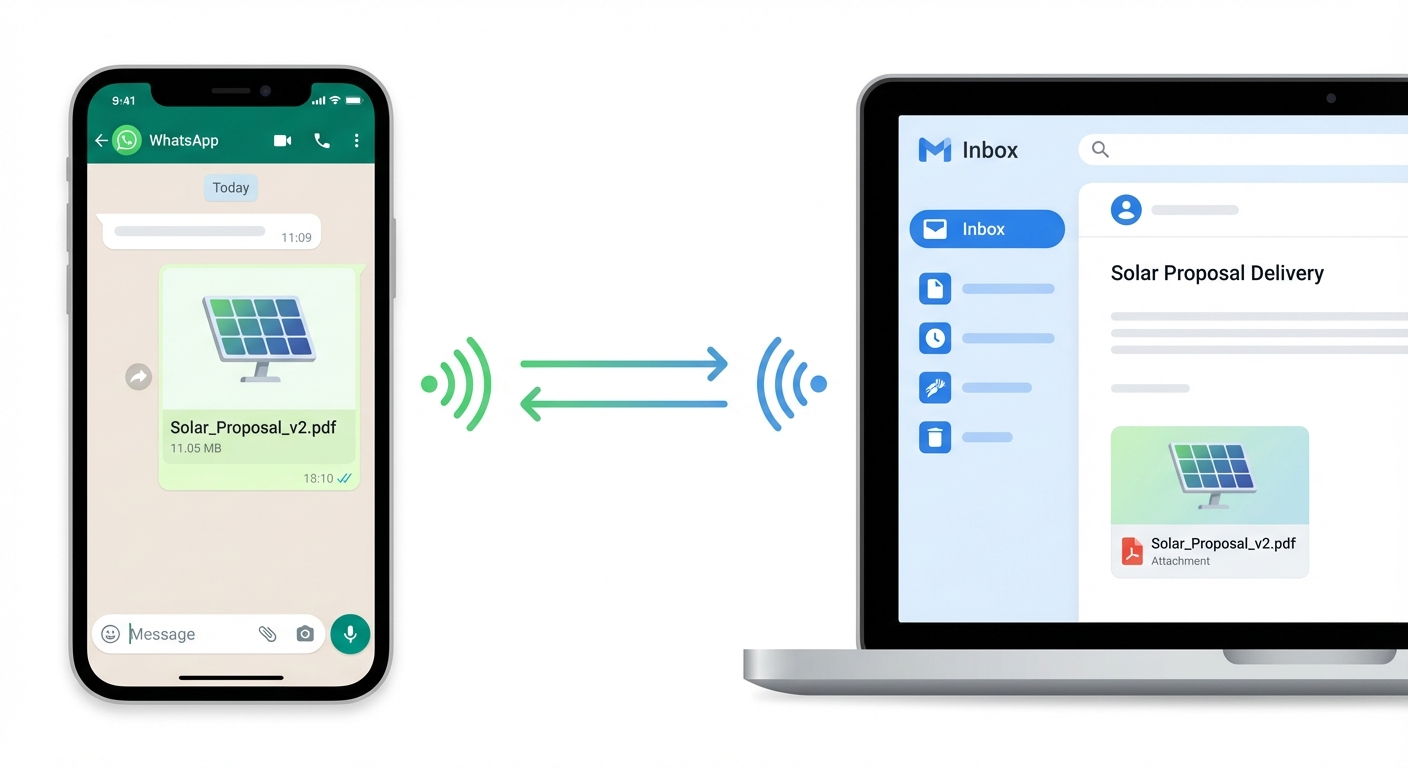
WhatsApp delivery offers several advantages for the Indian market. First, it meets customers where they already are—most Indian consumers and business owners use WhatsApp daily and check it frequently. Sending proposals via WhatsApp ensures high open rates and quick response times. Second, WhatsApp creates a conversational channel for follow-up questions, making it easy for customers to ask for clarifications or request modifications. Third, WhatsApp’s mobile-first design means customers can review proposals on their smartphones, even if they’re not at a computer.
QuickEst specifically enables solar businesses to send professional proposals via WhatsApp within 60 seconds of lead capture, capitalizing on the platform’s ubiquity in India. This capability transforms the sales process, allowing sales reps to generate and deliver proposals during customer meetings or site visits, creating an impressive customer experience.
Email delivery remains important for certain customer segments and business contexts. Commercial clients and larger projects often prefer email for formal documentation and record-keeping. Email also allows for more detailed proposals with multiple attachments, technical specifications, and supporting documents.
The best proposal automation platforms offer both delivery methods, allowing sales reps to choose the most appropriate channel for each customer. Some systems even support sending via both channels simultaneously, ensuring the customer receives the proposal through their preferred medium.
Beyond just delivery, look for platforms that provide tracking capabilities—showing when proposals were opened, how much time customers spent reviewing them, and which sections received the most attention. This engagement data helps sales teams time their follow-ups effectively and understand customer interests.
13. What Happens to Follow-Ups After Sending an Automated Proposal?
Sending the proposal is just the beginning of the sales process, and this is where proposal automation platforms truly shine by extending automation beyond initial quote generation into the entire nurturing and follow-up process.
Automated follow-up systems ensure that no lead falls through the cracks. After sending a proposal, the system can automatically schedule follow-up tasks for sales reps, send reminder emails to customers at predetermined intervals, and track the status of each proposal through the sales pipeline. This systematic approach to follow-up dramatically improves conversion rates compared to manual tracking methods where busy sales reps might forget to follow up with some prospects.
Customizable reminder schedules allow you to design follow-up sequences that match your sales process. For example, you might configure the system to send a follow-up email 2 days after proposal delivery, schedule a phone call reminder for the sales rep after 5 days, send another email after 7 days, and flag the lead for personal outreach after 10 days if there’s been no response. These sequences can be customized based on lead source, project size, or customer segment.
Email templates for follow-ups maintain consistency and save time. Instead of writing each follow-up email from scratch, sales reps can use pre-written templates that can be personalized with customer-specific details. These templates might include gentle reminders, additional information about financing options, customer testimonials, or answers to frequently asked questions.
Proposal tracking and engagement monitoring provide valuable intelligence for timing follow-ups. If the system shows that a customer opened the proposal multiple times and spent significant time reviewing it, that’s a strong buying signal warranting immediate personal follow-up. Conversely, if a proposal hasn’t been opened, the follow-up might focus on ensuring the customer received it and asking if they have questions.
QuickEst’s automated follow-up system with customizable reminders and email templates ensures that solar businesses maintain consistent communication with prospects without overwhelming sales teams with manual tracking tasks. This combination of automation and intelligence helps convert more proposals into signed contracts.
14. How Secure Is Customer Data in Proposal Automation Systems?
Data security is a critical concern for any business handling customer information, and solar companies collecting personal details, financial information, and property data have a responsibility to protect this information. Professional proposal automation platforms prioritize security through multiple layers of protection.
Encryption in transit protects data as it moves between users and the platform. Industry-standard TLS 1.2 (Transport Layer Security) encryption ensures that data transmitted over the internet cannot be intercepted or read by unauthorized parties. This is the same encryption technology used by banks and financial institutions.
Encryption at rest protects stored data. Advanced platforms use 256-bit AES (Advanced Encryption Standard) encryption for data stored in their databases. This military-grade encryption ensures that even if someone gained unauthorized access to the physical servers, they couldn’t read the encrypted data without the encryption keys.
Access controls and permissions ensure that team members only see data relevant to their role. Sales reps might access customer information and proposals, while managers have broader access to analytics and team performance data. Administrative controls allow you to add or remove users, assign permissions, and audit who accessed what information.
Data backup and recovery systems protect against data loss from technical failures, natural disasters, or other disruptions. Regular automated backups ensure that your customer data, proposals, and business information can be recovered quickly if needed.
Compliance considerations are increasingly important as data protection regulations evolve. While India’s data protection framework continues to develop, forward-thinking businesses choose platforms that follow international best practices for data security and privacy.
QuickEst implements secure data encryption using TLS 1.2 and 256-bit AES, providing enterprise-grade security for solar businesses of all sizes. When evaluating proposal automation platforms, ask specifically about their security measures, certifications, and compliance practices to ensure your customer data remains protected.
15. What Features Should We Look for in a Proposal Automation Solution?
Choosing the right proposal automation platform is a critical decision that will impact your sales efficiency for years to come. Understanding which features matter most helps you evaluate options effectively and select a solution that meets your specific needs.
Solar-specific functionality should be your first consideration. Generic proposal tools designed for all industries will require extensive customization to handle solar-specific calculations, terminology, and workflows. Look for platforms built specifically for solar businesses that understand system sizing, panel specifications, inverter selection, and solar industry pricing models. This specialization dramatically reduces implementation time and ensures the platform handles your unique requirements out of the box.
Speed and ease of use determine whether your team will actually adopt the platform. If generating a proposal still takes 30 minutes, you haven’t gained much advantage over manual methods. Look for platforms that can generate professional proposals in under 5 minutes, ideally under 2 minutes. User-friendly interfaces with intuitive workflows ensure that sales reps can become productive quickly without extensive training.
Mobile app access is increasingly essential for field sales teams. Solar sales often involve site visits, customer meetings, and on-location consultations. The ability to generate and send proposals from a smartphone or tablet—while still at the customer’s property—creates a powerful competitive advantage and impressive customer experience. Ensure the platform offers full-featured mobile apps for both iOS and Android.
Customization and branding capabilities allow you to maintain your unique identity while benefiting from automation. Look for platforms offering template customization, logo and color scheme integration, and the ability to add custom sections or content to proposals.
Integration capabilities ensure the platform works seamlessly with your existing business tools. At minimum, look for integration with lead capture systems, email platforms, and communication tools like WhatsApp. More advanced integrations with accounting software, project management tools, and marketing automation platforms provide additional value.
Analytics and reporting capabilities provide visibility into sales performance. Real-time dashboards showing proposal volume, conversion rates, average deal size, and sales pipeline metrics help you manage your team effectively and identify improvement opportunities. Look for platforms offering sales pipeline visualization and performance tracking.
Team collaboration features become important as your business grows. Task assignment, progress monitoring, shared customer notes, and team communication tools ensure everyone stays coordinated and informed.
Automated follow-up systems extend the value of automation beyond initial proposal generation. Customizable reminder schedules, email templates, and engagement tracking help nurture leads systematically.
When conducting solar CRM comparison and evaluating proposal automation platforms, create a checklist of must-have features based on your specific business needs, then systematically evaluate each option against these criteria.
Making the Switch to Proposal Automation: Your Next Steps
If you’ve read this far, you understand the compelling benefits of proposal automation for solar businesses: dramatic time savings, improved accuracy, faster response times, better customer experiences, and ultimately, higher conversion rates and revenue growth. The question now is how to move from consideration to implementation.

Start by evaluating your current proposal process. Document how long proposals currently take to create, how many proposals your team generates weekly, what your current conversion rate is, and where bottlenecks exist. This baseline assessment helps you measure improvement after implementation and builds the business case for investment.
Define your requirements clearly. Based on the features discussed in this guide, create a prioritized list of must-have capabilities, nice-to-have features, and deal-breakers. Consider your team size, customer segments, pricing complexity, and integration needs. This requirements list guides your evaluation process and ensures you choose a platform that fits your specific situation.
Research and compare options. Look specifically for CRM vendors in India that specialize in solar businesses and understand the unique requirements of the Indian market. Request demos, ask detailed questions about the features that matter most to you, and if possible, speak with existing customers about their experiences.
Consider starting with a trial or entry-level plan. Many platforms offer free trials or affordable starter plans that allow you to test the system with real customer data before committing to a larger investment. This hands-on experience is invaluable for understanding whether the platform truly meets your needs.
QuickEst offers solar businesses in India a specialized solution designed specifically for the challenges discussed throughout this guide. With the ability to create professional solar proposals in 60 seconds, send them via WhatsApp or email, automate follow-ups, and manage your entire sales pipeline from a mobile app, QuickEst addresses the core needs of solar installation companies, EPCs, and sales teams.
The platform offers flexible options to match different business sizes and needs. For solar businesses just starting with automation or smaller teams, the FREE PLAN – ₹0 provides an opportunity to experience proposal automation without financial risk. For established solar companies ready to fully leverage automation’s benefits, the PRO PLAN – ₹6999 Per User / Year delivers comprehensive features including unlimited proposals, advanced analytics, team collaboration tools, and priority support.
Plan your implementation carefully. Once you’ve selected a platform, dedicate time to proper setup and configuration. Invest in training your team thoroughly, migrate your existing customer data systematically, and consider a phased rollout that allows your team to adapt gradually. Most implementation challenges stem from rushing this process rather than from the technology itself.
Measure and optimize continuously. After implementation, track key metrics like proposal generation time, response time to leads, conversion rates, and sales team satisfaction. Use these metrics to identify areas for improvement and optimize your processes over time. The best proposal automation implementations evolve based on real-world usage and feedback.
The solar industry in India is growing rapidly, with increasing competition for every lead and customer. Solar businesses that embrace proposal automation and modern CRM selection gain significant competitive advantages: they respond faster, present more professionally, operate more efficiently, and ultimately close more deals. The question isn’t whether to automate your proposal process—it’s how quickly you can implement automation to start realizing these benefits.
Ready to transform your solar sales process with proposal automation? Contact us to learn how QuickEst can help your solar business create professional proposals in 60 seconds, automate follow-ups, and close more deals faster. Whether you’re a small solar installation company or a large EPC managing multiple sales teams, QuickEst provides the tools you need to compete effectively in India’s dynamic solar market.
The future of solar sales is automated, efficient, and customer-focused. The companies that embrace this future today will be the market leaders tomorrow. Start your proposal automation journey now and unlock your solar business’s full sales potential.