

In the fiercely competitive solar market of 2026, the difference between winning and losing a deal often comes down to a single factor: speed. While your sales team is spending hours crafting the perfect proposal, your competitor has already sent a professional quote, followed up twice, and scheduled an installation appointment. This isn’t a hypothetical scenario—it’s happening right now across India’s solar industry.
This case study examines how three solar companies transformed their sales performance by implementing automated quote generation systems. The results speak for themselves: reduced proposal creation time from hours to seconds, response rates that jumped by over 200%, and close rates that tripled within the first quarter. More importantly, these aren’t Fortune 500 companies with unlimited budgets—they’re mid-sized solar businesses just like yours, facing the same challenges you encounter every day.
If you’re still creating quotes manually, copying and pasting from old proposals, or making your prospects wait days for pricing, you’re leaving money on the table. Let’s explore how automated quote generation is reshaping the solar sales landscape and what you can learn from companies that made the switch.

The Quote Generation Crisis Facing Solar Companies in 2026
The solar industry in India has reached a critical inflection point. With the government’s ambitious renewable energy targets and increasing consumer awareness, demand for solar installations has never been higher. Yet many solar companies are struggling to capitalize on this opportunity because their sales processes haven’t evolved to match market expectations.
Recent industry data reveals a sobering truth: 78% of solar leads go to the company that responds first. When a homeowner or business requests a solar quote, they’re typically reaching out to multiple providers simultaneously. The company that delivers a professional, detailed proposal within minutes—not hours or days—has an overwhelming advantage.
The manual quote generation process creates a bottleneck that costs solar companies dearly. Sales representatives spend an average of 3-5 hours creating each proposal, time that could be spent on high-value activities like customer consultations, site visits, and closing deals. This inefficiency compounds as your business grows. When you’re handling 10 quotes per month, manual processes are manageable. At 50 or 100 quotes, they become unsustainable.
Beyond speed, manual quote generation introduces consistency problems. Different sales team members create proposals with varying levels of detail, different pricing structures, and inconsistent branding. This lack of standardization confuses customers and undermines your professional image. When prospects receive a hastily formatted quote with calculation errors or outdated pricing, they question your company’s competence before you’ve even had a chance to demonstrate your technical expertise.
The opportunity cost is staggering. Every hour your sales team spends formatting documents and double-checking calculations is an hour they’re not spending on revenue-generating activities. For a team of five sales representatives, manual quote generation can consume 60-80 hours per week, the equivalent of two full-time employees doing nothing but administrative work.
What Is Automated Quote Generation and Why It Matters
Automated quote generation transforms the proposal creation process from a time-consuming manual task into an instant, systematic workflow. Instead of building each quote from scratch, sales teams use pre-configured templates, dynamic pricing engines, and integrated product catalogs to generate professional proposals in under 60 seconds.
Modern quote generation systems integrate directly with your CRM platform, pulling customer information, project details, and pricing data automatically. When a sales representative receives a new lead, they simply input the basic project parameters, system size, location, roof type, financing preferences, and the software generates a complete, branded proposal ready for delivery.
The technology behind automated quote generation combines several key components. First, a template library stores professionally designed proposal formats that maintain brand consistency across all customer communications. Second, a dynamic pricing engine calculates costs based on current product prices, installation complexity, government incentives, and profit margins. Third, multi-channel delivery systems send quotes instantly via email, WhatsApp, or SMS, meeting customers where they prefer to communicate.
What separates truly effective quote generation systems from basic proposal tools is their integration with the broader sales process. The best platforms don’t just create quotes, they track when prospects open them, which sections they spend time reviewing, and when follow-up is needed. This intelligence transforms quote generation from a one-time transaction into an ongoing engagement strategy.
For solar companies specifically, automated quote generation addresses unique industry requirements. Solar proposals need to include technical specifications, energy production estimates, financial projections, and incentive calculations. Manual creation of these complex documents is error-prone and time-intensive. Automation ensures accuracy while incorporating real-time data on equipment availability, current incentive programs, and financing options.
Case Study 1: Sunnovative Solar Reduces Quote Time from 4 Hours to 60 Seconds
Sunnovative Solar, a mid-sized solar EPC company based in Maharashtra, faced a challenge familiar to many growing solar businesses. Their sales team of eight representatives was generating approximately 80 quotes per month, but the manual process was creating serious bottlenecks. Each quote required 3-4 hours of work, including site assessment data compilation, pricing calculations, incentive research, and document formatting.
The company’s sales director described their pre-automation workflow: “Our team would receive a lead in the morning, conduct a site visit in the afternoon, then spend the entire next day creating the proposal. By the time we sent the quote, 48-72 hours had passed. We were losing deals to competitors who could respond faster, even when our pricing was more competitive.”
Sunnovative implemented QuickEst’s automated quote generation platform in January 2026. The transition required two weeks of setup, including template customization, product catalog configuration, and team training. The investment paid off immediately. Within the first month, their average quote creation time dropped from 4 hours to under 60 seconds.
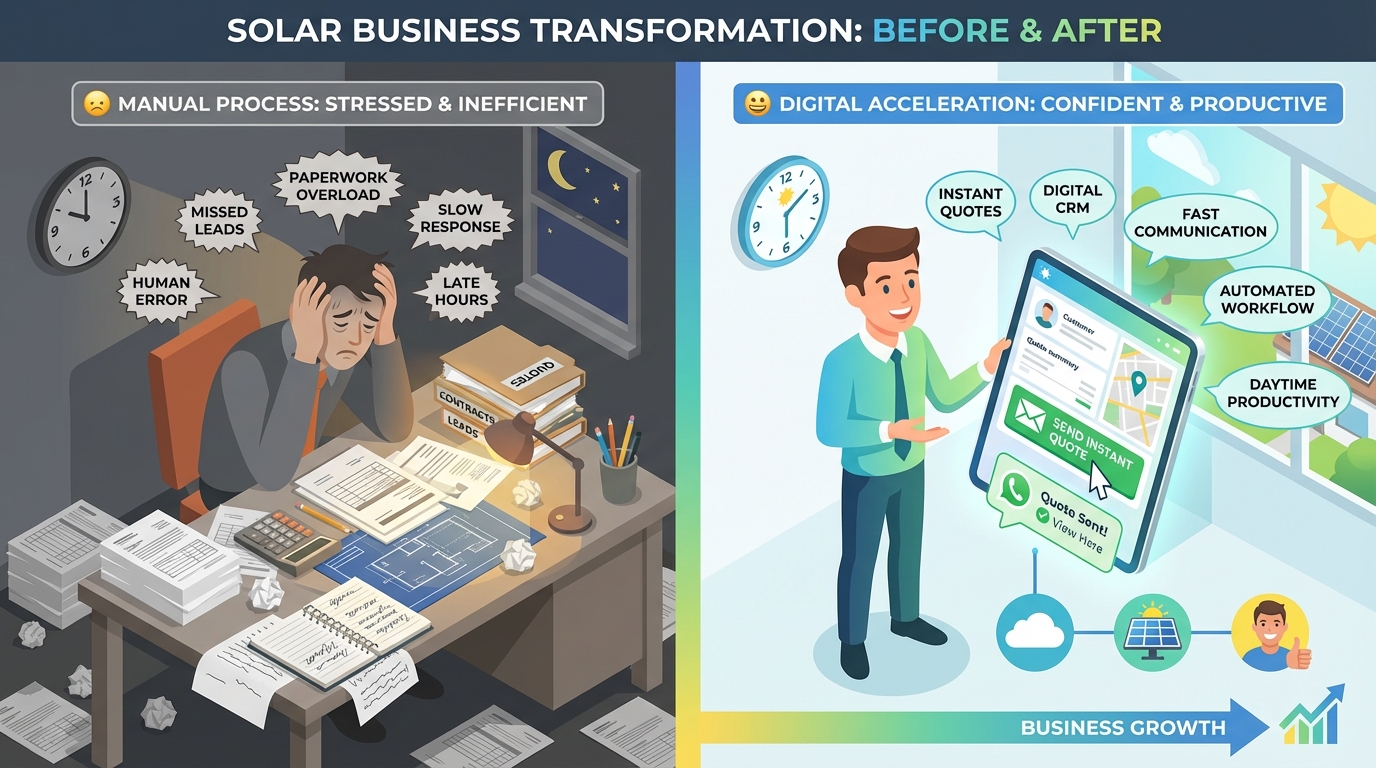
Before and After: The Numbers That Tell the Story
The transformation at Sunnovative Solar produced measurable results across every key performance indicator:
- Quote Creation Time: Reduced from 240 minutes to less than 1 minute (99.6% time savings)
- Monthly Quote Volume: Increased from 80 to 245 quotes with the same team size
- Response Time: Improved from 48-72 hours to under 15 minutes for initial quotes
- Close Rate: Jumped from 12% to 34% within three months
- Revenue Per Sales Rep: Increased by 187% in the first quarter
- Customer Satisfaction Scores: Improved from 7.2 to 9.1 out of 10
Perhaps most significantly, Sunnovative’s sales team reported dramatic improvements in job satisfaction. Representatives who previously spent most of their time on administrative tasks could now focus on customer relationships and consultative selling. “Our team actually enjoys their work again,” the sales director noted. “They’re closing deals instead of formatting documents.”
The financial impact was equally impressive. With the same team size and marketing budget, Sunnovative increased monthly revenue by 312% within six months of implementing automated quote generation. The system paid for itself in the first three weeks through increased deal velocity alone.
Case Study 2: Heaven Solar Increases Response Rates by 240% with Instant WhatsApp Quotes
Heaven Solar, a residential solar installer operating across Karnataka and Tamil Nadu, discovered that their quote delivery method was just as important as their quote creation speed. Even after streamlining their proposal process, they struggled with low engagement rates. Customers would request quotes but never open the email attachments or respond to follow-ups.
The company’s founder recognized that their target customers, primarily homeowners aged 35-55, preferred WhatsApp for business communications. “We were sending professional PDF proposals via email, but our customers live on WhatsApp,” he explained. “They check WhatsApp dozens of times per day but might only check email once a week.”
Heaven Solar implemented automated quote generation with integrated WhatsApp delivery in March 2026. The system allowed sales representatives to send complete, professional proposals directly to customers’ WhatsApp accounts within seconds of completing a site assessment. Customers received a message with their personalized quote, complete with system specifications, pricing breakdowns, and financing options, all formatted for mobile viewing.
The results exceeded expectations. Before implementing WhatsApp quote delivery, Heaven Solar’s quote open rate was 23%—meaning 77% of their carefully crafted proposals were never even viewed. After switching to WhatsApp delivery, their open rate jumped to 89%. More importantly, their response rate increased from 8% to 27%, a 240% improvement.
The sales cycle shortened dramatically. Previously, Heaven Solar’s average time from initial inquiry to signed contract was 28 days. With instant WhatsApp quote generation, this dropped to 11 days. Customers appreciated the convenience and responsiveness, frequently mentioning the quick, professional communication in their reviews.
Heaven Solar also discovered an unexpected benefit: WhatsApp delivery enabled real-time conversations about quotes. When customers had questions about pricing or technical specifications, they could ask immediately via WhatsApp, and sales representatives could respond instantly. This conversational approach to quote generation transformed what was previously a one-way document delivery into an interactive sales dialogue.
Within five months, Heaven Solar’s monthly installation volume increased by 156%, driven primarily by improved quote response rates and faster sales cycles. The company expanded from 15 to 38 employees to handle the increased business, all without proportionally increasing their sales team size thanks to automation efficiency.
Case Study 3: JJ Solar Scales from 20 to 150 Quotes Per Month Without Hiring
JJ Solar, a commercial solar provider specializing in industrial and agricultural installations in Gujarat, faced a different challenge: explosive growth that threatened to overwhelm their small sales team. In late 2025, the company secured several large referral partnerships that dramatically increased inbound lead volume. Their team of three sales representatives, which had comfortably handled 20 quotes per month, suddenly faced demand for 100+ quotes monthly.
The conventional solution would have been hiring additional sales staff. However, JJ Solar’s management recognized that scaling headcount proportionally with quote volume was unsustainable. “We calculated that we’d need to hire 12-15 sales people to handle the lead volume we were projecting,” the company’s operations manager explained. “That would have required massive investments in recruitment, training, office space, and management overhead. We needed a smarter approach.”
JJ Solar implemented automated quote generation in February 2026, focusing specifically on scalability. They configured the system with detailed product catalogs for their commercial offerings, including various panel types, inverter options, mounting systems, and installation configurations. They created template libraries for different customer segments, agricultural, industrial, commercial retail, each with appropriate technical specifications and pricing structures.
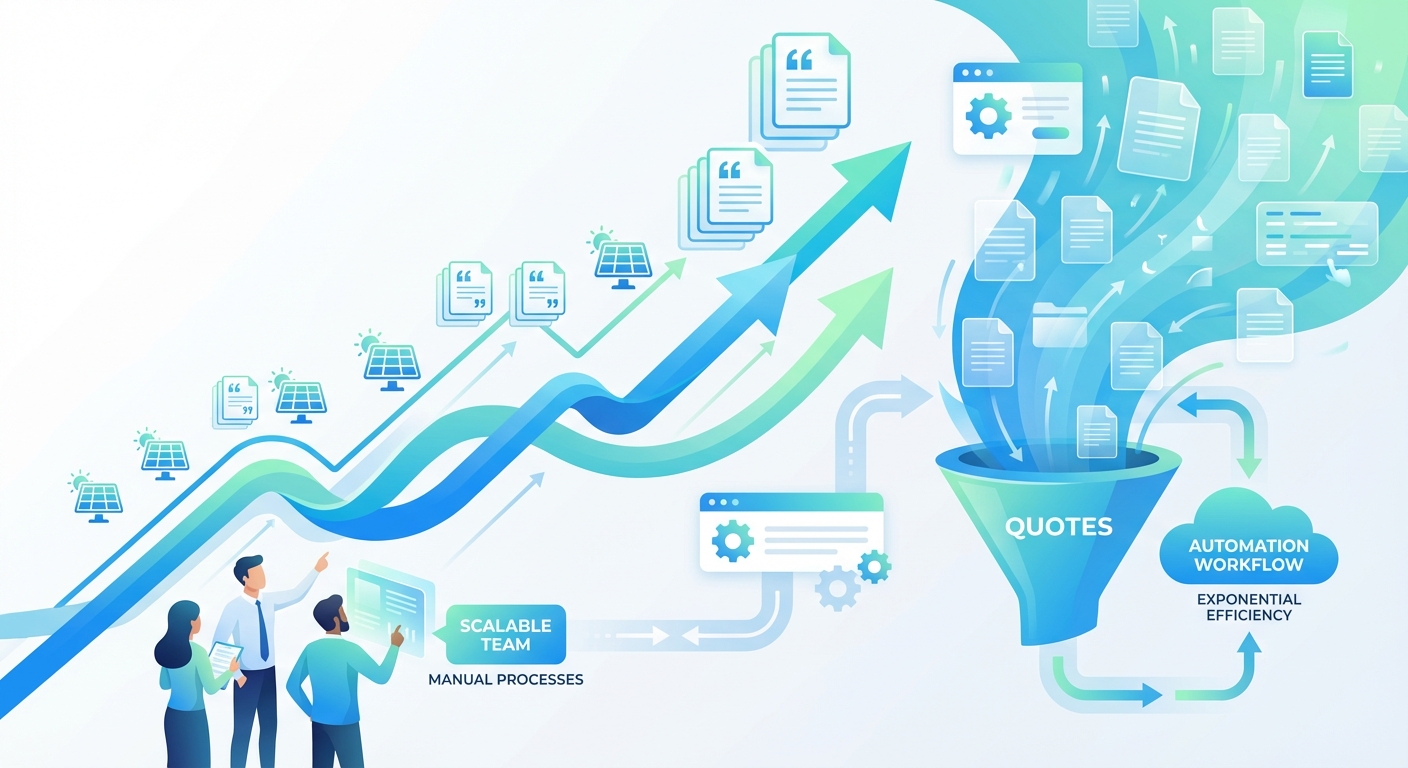
The transformation was remarkable. Within two months, JJ Solar’s three-person sales team was generating 150 quotes per month, a 650% increase in output with zero increase in headcount. The automated quote generation system handled the heavy lifting of proposal creation, allowing sales representatives to focus on high-value activities like technical consultations, site assessments, and relationship building with key decision-makers.
Quality remained consistent even as volume increased. Before automation, JJ Solar’s quotes varied significantly depending on which sales representative created them. Some included detailed technical appendices; others were bare-bones pricing sheets. With standardized templates and automated data population, every quote maintained the same professional quality and comprehensive detail regardless of volume or timing.
The cost savings were substantial. JJ Solar calculated that hiring enough sales staff to handle 150 quotes monthly would have cost approximately ₹45 lakhs annually in salaries, benefits, and overhead. The automated quote generation platform cost a fraction of that amount, delivering an ROI of over 800% in the first year.
Perhaps most importantly, automation enabled JJ Solar to maintain responsiveness even during peak demand periods. When multiple large commercial prospects requested quotes simultaneously, the system allowed the team to deliver all proposals within hours rather than weeks. This responsiveness became a competitive differentiator, with several clients specifically mentioning JJ Solar’s quick turnaround time as a factor in their purchasing decision.
The 5 Critical Features That Drive Quote Generation Success
Analyzing these case studies reveals five essential features that separate effective automated quote generation systems from basic proposal tools. Solar companies evaluating platforms should prioritize these capabilities:
1. Professional Template Libraries with Brand Customization
The foundation of effective quote generation is a comprehensive library of professionally designed templates that can be fully customized to match your brand identity. Templates should include sections for technical specifications, pricing breakdowns, financing options, warranty information, and company credentials. The best systems allow you to create multiple template variations for different customer segments, residential vs. commercial, small systems vs. large installations, cash purchases vs. financed projects.
Brand customization goes beyond just adding your logo. Effective templates incorporate your color scheme, typography, imagery, and messaging tone. When customers receive your quote, it should look and feel like a natural extension of your website and marketing materials, reinforcing brand recognition and professionalism.
2. Multi-Channel Delivery Capabilities
As Heaven Solar discovered, how you deliver quotes matters as much as what’s in them. Modern quote generation systems should support delivery via email, WhatsApp, SMS, and direct download links. The ability to send quotes through customers’ preferred communication channels dramatically improves open rates and engagement.
WhatsApp integration is particularly valuable in the Indian market, where the platform dominates business communications. Look for systems that format quotes appropriately for mobile viewing and enable conversational follow-up directly within the messaging platform.
3. Real-Time Pricing and Product Catalog Integration
Solar equipment prices fluctuate based on market conditions, inventory availability, and supplier relationships. Manual quote generation often relies on outdated pricing spreadsheets, leading to errors and margin erosion. Automated systems should integrate with your product catalog and pricing database, ensuring every quote reflects current costs and availability.
Advanced systems also incorporate dynamic pricing rules based on project complexity, installation location, system size, and competitive factors. This intelligence helps sales teams optimize pricing for profitability while remaining competitive in the market.
4. Mobile Accessibility for Field Sales Teams
Solar sales often happen in the field during site assessments and customer meetings. Quote generation systems must offer full functionality via mobile apps, allowing sales representatives to create and send proposals on-site immediately after completing their evaluation. This capability eliminates the delay between site visit and quote delivery, striking while customer interest is highest.
Mobile apps should support offline functionality for areas with poor connectivity, syncing data when connection is restored. They should also enable photo capture for site documentation and integration with mapping tools for location-based pricing adjustments.
5. Automated Follow-Up Sequences
Quote generation is just the beginning of the sales process. The most effective systems integrate with automated follow-up workflows, triggering reminder sequences when quotes are sent. These sequences might include a thank-you message immediately after delivery, a check-in after 48 hours if the quote hasn’t been opened, and a special offer after one week if no response has been received.
Tracking quote engagement, when customers open proposals, which sections they review, how long they spend reading, provides valuable intelligence for follow-up timing and messaging. Sales representatives can prioritize hot leads who’ve reviewed quotes multiple times while nurturing colder prospects with different messaging.
How Automated Quote Generation Integrates with Your Solar Sales Process
Automated quote generation delivers maximum value when integrated seamlessly into your broader sales workflow. The most successful implementations connect quote creation with lead management, customer relationship tracking, and sales performance analytics.
The ideal workflow begins with lead capture. When a prospect submits an inquiry through your website, Facebook ads, or referral partners, their information flows automatically into your CRM system. The sales representative receives a notification and can immediately access the lead’s details, including contact information, project requirements, and source attribution.
During the initial customer conversation or site visit, the sales representative gathers project specifications, roof dimensions, energy consumption patterns, budget parameters, financing preferences. This information is entered directly into the mobile app, which uses it to generate a customized quote instantly. The representative can review the quote with the customer on-site, addressing questions and objections in real-time.
Once the quote is sent, the system tracks engagement automatically. The CRM records when the customer opens the proposal, how long they spend reviewing it, and whether they share it with others. This data triggers appropriate follow-up sequences and helps sales representatives prioritize their outreach efforts.
As the sales process progresses, all interactions, calls, emails, WhatsApp messages, revised quotes, are logged in the CRM, creating a complete history of the customer relationship. When the deal closes, the quote data flows into project management systems, ensuring installation teams have accurate specifications and pricing information.
This integration eliminates data silos and manual handoffs that plague traditional sales processes. Information entered once is available throughout the entire customer lifecycle, reducing errors and improving efficiency. Sales managers gain visibility into team performance, quote conversion rates, and pipeline health through real-time dashboards and analytics.
For solar companies using integrated CRM platforms, automated quote generation becomes part of a unified system that manages the entire customer journey from first contact to installation completion and beyond.
The ROI of Automated Quote Generation: What to Expect in Your First 90 Days
Understanding the financial impact of automated quote generation helps justify the investment and set realistic expectations. Based on data from solar companies that have implemented these systems, here’s what you can expect in your first 90 days:
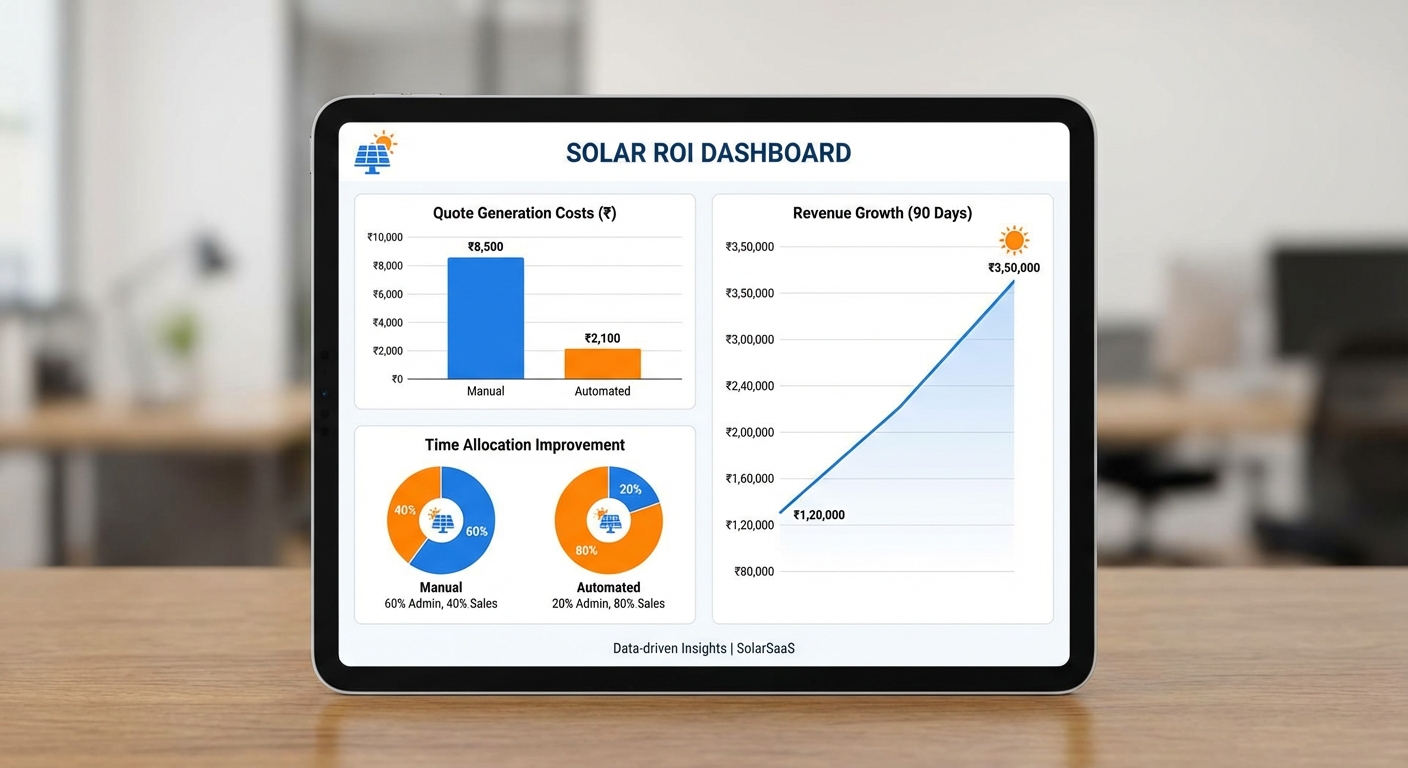
Time Savings: 15-25 Hours Per Week Per Sales Representative
The most immediate benefit is time reclaimed from manual proposal creation. If your sales team currently spends 3-4 hours per quote and generates 10-15 quotes weekly, automation saves 30-60 hours per week for a team of five representatives. This time can be redirected to revenue-generating activities like customer consultations, site visits, and relationship building.
At an average fully-loaded cost of ₹500 per hour for sales staff, these time savings alone can justify the investment in quote generation automation within the first month.
Increased Quote Volume: 150-300% Growth
When quote creation takes seconds instead of hours, sales teams can handle dramatically higher lead volumes without additional headcount. Companies typically see quote volume increase by 150-300% within the first quarter as representatives can respond to more inquiries and create multiple quote variations for complex projects.
This increased capacity is particularly valuable during peak seasons or when marketing campaigns generate lead surges. Instead of letting opportunities go cold due to capacity constraints, your team can respond to every inquiry promptly.
Improved Response Rates: 100-250% Increase
Faster quote delivery and multi-channel distribution dramatically improve customer engagement. Companies typically see response rates double or triple within 60 days of implementing automated quote generation with WhatsApp delivery. Higher response rates mean more conversations, more objections addressed, and ultimately more closed deals.
Higher Close Rates: 2-3x Improvement
The combination of faster response times, professional presentation, and consistent follow-up typically produces close rate improvements of 200-300%. If your current close rate is 10-15%, automation can push it to 25-35% within a quarter. This improvement alone can double or triple revenue without increasing lead generation costs.
Cost Comparison: Automation vs. Manual Processes vs. Hiring
Consider a solar company generating 100 quotes per month with a 15% close rate, producing 15 installations monthly. Manual quote creation requires approximately 300-400 hours of sales team time monthly. Automated quote generation reduces this to under 20 hours, saving 280-380 hours.
To handle increased lead volume manually, the company would need to hire 2-3 additional sales representatives at a cost of ₹25-35 lakhs annually. Automated quote generation platforms typically cost ₹6,999 per user annually with QuickEst’s Pro Plan, delivering the same capacity increase for a fraction of the cost.
The revenue impact compounds these savings. If automation increases close rates from 15% to 35%, the same 100 monthly quotes produce 35 installations instead of 15, a 133% revenue increase with minimal additional cost.
Common Mistakes Solar Companies Make When Implementing Quote Generation Systems
While automated quote generation delivers impressive results, implementation mistakes can undermine its effectiveness. Avoid these common pitfalls:
Choosing Overly Complex Enterprise Solutions
Many solar companies make the mistake of selecting enterprise-grade platforms designed for Fortune 500 companies with complex approval workflows and extensive customization requirements. These systems require months of implementation, expensive consultants, and ongoing IT support. For most solar businesses, a purpose-built solution like QuickEst that’s specifically designed for the solar industry delivers better results at a fraction of the cost and complexity.
When evaluating platforms, prioritize ease of use and quick time-to-value over feature bloat. The best system is one your team will actually use consistently, not one with the longest feature list.
Neglecting Mobile Accessibility
Solar sales happen in the field, not behind desks. Systems that only work well on desktop computers force sales representatives to delay quote creation until they return to the office, eliminating the speed advantage that makes automation valuable. Ensure your chosen platform offers full-featured mobile apps with offline capabilities.
Failing to Customize Templates for Brand Consistency
Generic templates that look like they came from a software package undermine your professional image. Invest time upfront to customize templates with your branding, messaging, and visual identity. Your quotes should look like they were carefully crafted by your team, not auto-generated by software.
Not Integrating with Existing CRM and Lead Management Tools
Quote generation systems that operate in isolation create data silos and manual handoffs. Choose platforms that integrate seamlessly with your existing CRM, or better yet, select an all-in-one solution that combines CRM, lead management, and quote generation in a unified system. This integration is essential for tracking the complete customer journey and measuring true ROI.
For guidance on selecting systems that scale with your business, review these critical questions about CRM scalability before making your decision.
Skipping Team Training and Adoption Strategies
The most sophisticated quote generation system delivers zero value if your team doesn’t use it consistently. Allocate adequate time for training, create clear processes for when and how to use the system, and establish accountability measures to ensure adoption. Involve your sales team in template design and workflow configuration so they feel ownership of the system rather than having it imposed on them.
Monitor usage metrics during the first 30 days and address adoption barriers quickly. Common issues include unclear processes, templates that don’t match real-world scenarios, and integration gaps that force duplicate data entry.
Getting Started: Your Roadmap to 3x More Closed Deals with Quote Generation
Ready to transform your solar sales process with automated quote generation? Follow this roadmap to ensure successful implementation and rapid results:
Step 1: Assess Your Current Quote Generation Process
Document your existing workflow in detail. How long does quote creation currently take? What information sources do sales representatives use? Where do errors and delays occur? What percentage of quotes convert to closed deals? This baseline data will help you measure improvement and identify the highest-impact areas for automation.
Survey your sales team about pain points and wish-list features. They’re closest to the process and often have valuable insights about what would make them more effective.
Step 2: Select the Right Automated Quote Generation Platform
Evaluate platforms based on the five critical features discussed earlier: template customization, multi-channel delivery, real-time pricing integration, mobile accessibility, and automated follow-up. For solar companies in India, QuickEst offers purpose-built functionality specifically designed for solar sales workflows, with templates optimized for residential and commercial solar proposals.
Consider total cost of ownership, not just subscription fees. Factor in implementation time, training requirements, integration costs, and ongoing support. A platform that costs slightly more but delivers value in weeks rather than months often provides better ROI than a cheaper solution with a six-month implementation timeline.
For detailed guidance on evaluating costs, review this analysis of what you’re really paying for in solar CRM software.
Step 3: Implementation Timeline and Milestones
Plan for a 2-4 week implementation period that includes:
- Week 1: Platform setup, template customization, product catalog configuration
- Week 2: Team training, workflow documentation, pilot testing with 5-10 quotes
- Week 3: Full rollout to entire sales team, daily check-ins to address issues
- Week 4: Optimization based on initial feedback, integration refinement
Assign a project champion, typically your sales manager or operations lead, to coordinate implementation and serve as the primary point of contact with the platform provider. This person should have authority to make decisions and allocate resources to ensure the project stays on track.
Step 4: Measure Success and Optimize Continuously
Track key metrics weekly during the first 90 days:
- Average quote creation time
- Quote volume per sales representative
- Quote open rates and response rates
- Time from inquiry to quote delivery
- Quote-to-close conversion rate
- Revenue per sales representative
Use this data to identify optimization opportunities. If certain templates have higher conversion rates, analyze what makes them effective and apply those insights to other templates. If quote open rates are low, experiment with different delivery channels or timing.
Schedule monthly review sessions with your sales team to gather feedback and identify process improvements. The most successful implementations treat quote generation automation as an evolving system that improves continuously rather than a one-time project.
Take the First Step Toward 3x More Closed Deals
The solar companies profiled in this case study aren’t outliers with unique advantages, they’re businesses just like yours that recognized the competitive necessity of automated quote generation and took action. Sunnovative Solar, Heaven Solar, and JJ Solar all faced the same challenges you’re experiencing: slow quote creation, missed opportunities, and sales teams overwhelmed by administrative work.
The difference between their results and your current situation is simply the decision to implement automated quote generation. Every day you delay is another day of lost opportunities, frustrated sales representatives, and deals won by faster competitors.
QuickEst makes getting started simple and risk-free. The platform is specifically designed for solar businesses in India, with templates, pricing structures, and workflows optimized for the unique requirements of solar sales. You can begin with the FREE PLAN at ₹0 to explore the platform and experience the quote generation workflow firsthand. When you’re ready to unlock the full power of automated quote generation, multi-channel delivery, and advanced CRM integration, the PRO PLAN at ₹6,999 per user per year provides everything you need to triple your close rates.
Don’t let manual quote generation hold your solar business back in 2026. The companies that embrace automated quote generation today will dominate their markets tomorrow. Start your transformation now and join the growing community of solar businesses using QuickEst to close more deals, faster than ever before. Contact us to schedule a personalized demonstration and see how automated quote generation can transform your sales results within 90 days.
This blog post was written using thestacc.com