
Choosing a CRM system for your solar business isn’t just about what you need today—it’s about whether that system can grow with you tomorrow. Every year, countless solar EPCs and installation companies face a painful reality: the CRM that worked perfectly for their 5-person team has become a bottleneck now that they’ve grown to 25 employees. The cost of switching? Often hundreds of hours in data migration, tens of thousands in implementation costs, and weeks of productivity loss while teams adapt to new systems.
CRM scalability is the single most overlooked factor in CRM selection, yet it’s one of the most expensive mistakes solar businesses make. When evaluating CRM systems in 2026, you need to think beyond your current team size and ask the hard questions about how the platform will perform when you’re managing 10x more leads, generating hundreds of proposals monthly, and coordinating multiple sales teams across different locations.
This guide walks you through eight critical questions every solar business must ask before committing to a CRM platform. Whether you’re a small solar installer planning to scale or an established EPC looking to upgrade, understanding CRM scalability will save you from costly migrations and ensure your sales technology grows alongside your business ambitions.

Why CRM Scalability Matters for Growing Solar Businesses
The solar industry in India is experiencing unprecedented growth, with installations increasing year over year and more businesses entering the market. As your solar company expands from handling 20 leads per month to 200, from managing 3 sales representatives to 30, your CRM needs to scale seamlessly without requiring a complete system overhaul.
The true cost of outgrowing your CRM extends far beyond the subscription price. Consider what happens when a solar EPC realizes their current system can’t handle their growth:
- Data migration challenges: Transferring thousands of customer records, proposal histories, and interaction logs between systems often results in data loss or corruption
- Training disruption: Your entire sales team must learn a new platform, typically requiring 2-4 weeks before they return to full productivity
- Lost institutional knowledge: Custom workflows, templates, and processes built over months or years must be recreated from scratch
- Customer experience gaps: During transitions, follow-ups get missed, proposals are delayed, and customer relationships suffer
- Financial impact: Between implementation costs, training time, and lost deals during transition, switching CRMs can cost solar businesses ₹3-8 lakhs or more
Solar businesses face unique scalability challenges compared to other industries. Your CRM must handle complex proposal generation with technical specifications, manage long sales cycles that span weeks or months, coordinate between sales teams and installation crews, and maintain detailed project histories for warranty and service purposes. A CRM that works for a general B2B service company may completely fail when scaled to meet solar-specific requirements.
The businesses that thrive are those that choose platforms with CRM scalability built into their core architecture from day one. This means evaluating not just current features, but the platform’s capacity to grow across multiple dimensions: user count, data volume, feature complexity, integration needs, and performance requirements.
1. Can the CRM Handle Your User Growth Without Breaking the Bank?
The most immediate scalability concern for growing solar businesses is user pricing. Many CRM platforms advertise attractive entry-level prices, but their per-user costs can become prohibitively expensive as your team expands. Understanding the true economics of user scalability is essential before making your CRM selection.
Per-user pricing models are the most common approach in the CRM industry. Platforms like Salesforce and Zoho CRM charge monthly or annual fees for each user account. While this seems straightforward, the math becomes concerning when you project growth. A CRM that costs ₹1,000 per user per month might seem reasonable for 5 users (₹5,000/month), but at 25 users, you’re paying ₹25,000 monthly—₹3 lakhs annually just for CRM access.
Hidden costs emerge as you scale user counts. Many platforms have different user types (admin users, standard users, read-only users) with varying price points. Some charge extra for mobile app access per user. Others limit features like automation or reporting to higher-tier user licenses. When evaluating CRM scalability for user growth, calculate your total cost at three projection points:
- Current state: Your team size today
- 12-month projection: Realistic growth over the next year
- 36-month projection: Your ambitious but achievable three-year target
For example, if you’re a solar EPC with 8 team members today, planning to reach 20 within a year and 40 within three years, calculate the exact CRM costs at each milestone. A platform charging ₹8,000 per user annually will cost you ₹64,000 today, ₹1.6 lakhs at 12 months, and ₹3.2 lakhs at 36 months. Compare this against platforms with flat-rate or tiered pricing that doesn’t multiply linearly with every new hire.
QuickEst takes a different approach to user scalability with transparent annual pricing that makes growth predictable. Rather than penalizing you for building a larger team, the platform offers clear pricing tiers that provide better value as you scale. This pricing transparency allows solar businesses to budget accurately for growth without worrying about exponentially increasing CRM costs eating into their margins.
When assessing CRM scalability around user growth, ask vendors these specific questions: What is the exact cost per user at 10, 25, and 50 users? Are there volume discounts for larger teams? Can we add users mid-contract without penalties? What features are restricted by user license type? Getting clear answers upfront prevents expensive surprises as your solar business expands.
2. What Happens to Performance When Your Data Grows?
A CRM that feels fast and responsive with 500 contacts and 100 proposals can become frustratingly slow when you’re managing 10,000 contacts and generating 500 proposals monthly. Performance scalability is where many CRM systems reveal their architectural limitations, and it’s a critical factor that only becomes apparent after you’ve already committed to the platform.
Database capacity and lead volume limits vary dramatically across CRM platforms. Some systems impose hard caps on the number of contacts or records you can store. Others use “soft limits” where performance degrades gradually as your database grows, but you’re never explicitly told you’ve hit a ceiling. For solar businesses managing residential and commercial leads across multiple market segments, these limitations can appear suddenly and without warning.
Search and reporting speed are the first casualties of poor data scalability. When your sales team needs to quickly find a customer’s proposal history or generate a monthly performance report, they expect results in seconds, not minutes. CRM systems built on outdated database architectures or inadequate cloud infrastructure struggle when querying large datasets. A report that takes 3 seconds with 1,000 records might take 3 minutes with 50,000 records—a 60x performance degradation that kills productivity.
Consider the typical growth trajectory of a successful solar EPC in India. You start with a few hundred leads in your first year. By year three, you might have 5,000+ contacts, 2,000+ proposals generated, thousands of follow-up activities logged, and hundreds of closed deals with ongoing service records. Your CRM must maintain consistent performance across this entire data lifecycle.
Cloud infrastructure quality determines how well a CRM handles data scalability. Modern platforms built on robust cloud services like AWS or Google Cloud can scale database resources dynamically as your data grows. Legacy systems or platforms built on shared hosting infrastructure lack this flexibility, resulting in performance bottlenecks that affect all users simultaneously.
When evaluating CRM scalability for data growth, request specific performance benchmarks from vendors:
- What is the maximum number of contact records the system can handle efficiently?
- How does search performance change between 1,000 and 100,000 records?
- Are there any limits on proposal or document storage?
- What happens to mobile app performance with large datasets?
- Can you provide references from customers with similar data volumes?
QuickEst’s cloud-based architecture is designed specifically to maintain fast proposal generation and lead management performance regardless of your data volume. Solar businesses using the platform report consistent 60-second proposal creation times whether they’re generating their 10th proposal or their 10,000th, because the system’s infrastructure scales automatically with usage.
3. Will You Hit Feature Walls as Your Needs Evolve?
One of the most frustrating aspects of poor CRM scalability is discovering that the features you need as you grow are locked behind expensive enterprise tiers or simply don’t exist in the platform at all. Understanding feature scalability before you commit prevents the painful realization that your CRM can’t support your evolving business requirements.

Most CRM vendors structure their offerings in tiers: Starter, Professional, Enterprise, and sometimes Ultimate or Premium levels. The challenge is that critical features for scaling solar businesses are often reserved for the highest tiers. You might start with a basic plan that handles contact management and simple proposals, only to discover that advanced automation, custom reporting, API access, or team collaboration tools require upgrading to a plan that costs 3-5x more per user.
Advanced automation and workflow needs become essential as your team grows. When you have 5 sales representatives, manual follow-up reminders might work. At 25 reps managing hundreds of active leads, you need sophisticated automation that triggers actions based on lead behavior, proposal status, and time-based rules. If your CRM restricts automation features to enterprise plans, you’re forced to choose between operational efficiency and budget constraints.
Custom reporting and analytics requirements expand dramatically with business growth. Small teams can manage with basic dashboards showing lead counts and conversion rates. Larger solar EPCs need detailed analytics across multiple dimensions: performance by sales representative, conversion rates by lead source, proposal acceptance rates by system size, revenue forecasting by quarter, and comparative analysis across regional teams. CRM platforms that limit reporting capabilities in lower tiers create blind spots in your business intelligence exactly when you need visibility most.
API access and integration capabilities represent another common feature wall. As solar businesses scale, they need their CRM to connect with accounting software, project management tools, solar design platforms, and marketing automation systems. Many CRM vendors restrict API access or limit the number of API calls to their highest pricing tiers, effectively preventing growing businesses from building the integrated technology stack they need.
When assessing feature scalability, create a roadmap of capabilities you’ll need at different growth stages:
- Current needs (0-12 months): Basic lead management, proposal generation, follow-up reminders
- Near-term needs (12-24 months): Advanced automation, team performance tracking, custom proposal templates
- Future needs (24-36 months): Multi-location support, advanced analytics, extensive integrations, custom workflows
Then verify that your chosen CRM provides these capabilities within pricing tiers you can afford at each stage. Platforms that gate essential features behind enterprise plans that cost ₹15,000+ per user annually may be financially unviable for growing solar businesses, forcing you to either limit your operational capabilities or switch CRMs mid-growth.
QuickEst provides comprehensive features across its pricing tiers, ensuring that solar businesses have access to professional proposal generation, automated follow-ups, team collaboration tools, and performance analytics without hitting artificial feature walls. The platform’s approach to essential solar CRM features prioritizes accessibility, making advanced capabilities available to growing businesses rather than reserving them exclusively for enterprise customers.
4. Can the CRM Support Multiple Teams, Branches, or Business Units?
As solar businesses expand, organizational complexity increases exponentially. What starts as a single sales team in one location often evolves into multiple teams handling different market segments, regional branches serving different territories, or separate business units for residential and commercial solar installations. Your CRM’s ability to support this organizational scalability determines whether it remains useful or becomes an obstacle to growth.
Multi-location support is essential for solar EPCs expanding across cities or states. Each branch may have its own sales team, lead sources, pricing strategies, and operational processes. A scalable CRM must allow you to segment data and reporting by location while maintaining centralized visibility for management. Without proper multi-location architecture, you end up with either complete data silos (where branches can’t learn from each other) or chaotic mixed data (where Mumbai leads appear in Delhi dashboards).
Role-based permissions and hierarchical access become critical with organizational growth. Your CRM needs to support different permission levels: sales representatives who see only their own leads, team leaders who monitor their team’s performance, branch managers who oversee regional operations, and executives who need company-wide visibility. Platforms with simplistic “admin” and “user” roles lack the granularity required for complex organizational structures.
Team segmentation and performance tracking must scale beyond simple individual metrics. Growing solar businesses need to compare performance across teams, identify best practices from high-performing branches, and allocate resources based on data-driven insights. Your CRM should enable questions like: Which regional team has the highest proposal-to-close rate? How does our residential solar team’s average deal size compare to our commercial team? Which branch generates the most revenue per sales representative?
Managing different product lines or service offerings adds another layer of complexity. Many solar businesses expand from residential installations into commercial projects, add battery storage solutions, offer maintenance contracts, or diversify into related B2B services. A scalable CRM accommodates multiple product catalogs, different proposal templates for each offering, and separate sales pipelines that reflect the unique sales cycles of each business unit.
When evaluating CRM scalability for organizational complexity, ask these questions:
- Can we create separate teams or branches with isolated lead pools?
- Does the platform support hierarchical reporting structures?
- Can team leaders access their team’s data without seeing other teams’ information?
- How does the system handle lead assignment across multiple teams?
- Can we generate comparative reports across different organizational units?
- Is there support for multiple product catalogs or proposal types?
Solar businesses that plan to expand geographically or diversify their service offerings need CRM platforms built to handle organizational complexity from the ground up. Systems designed for small, single-location teams often lack the architectural foundation to support multi-branch operations, forcing growing businesses to implement workarounds that create data management nightmares.
5. How Does the CRM Handle Integration Complexity at Scale?
A CRM never operates in isolation. As your solar business grows, your technology stack expands to include accounting software, project management platforms, solar design tools, marketing automation systems, and industry-specific applications. CRM scalability in the integration dimension determines whether your CRM becomes the central hub of your operations or an isolated data silo that creates more problems than it solves.
Integration limits and API rate restrictions are where many CRM platforms reveal their scalability constraints. Some systems limit the number of third-party integrations you can activate. Others impose API rate limits—caps on how many data requests can be made per hour or day—that become bottlenecks when you’re syncing data across multiple systems. A solar EPC might need to sync leads from Facebook Ads, push closed deals to accounting software, update project management tools with installation schedules, and pull design specifications from solar engineering platforms. If your CRM’s API limits can’t handle this volume of data exchange, integrations fail or slow to a crawl.
Connecting with accounting, project management, and design tools is non-negotiable for scaling solar businesses. Your CRM should seamlessly share data with platforms like Tally or Zoho Books for invoicing, integrate with project management tools to track installation progress, and connect with solar design software to attach technical specifications to proposals. Without these integrations, your team wastes hours manually transferring data between systems, introducing errors and delays that damage customer experience.
Webhook capabilities for custom workflows represent advanced integration scalability. Webhooks allow your CRM to automatically trigger actions in other systems when specific events occur—like notifying your project management tool when a proposal is accepted, or updating your marketing platform when a lead reaches a certain stage. CRM platforms that lack webhook support or restrict them to enterprise tiers limit your ability to build sophisticated, automated workflows that scale with your business.
Real-world integration scenarios for solar businesses illustrate why this matters. Consider a solar EPC that generates 50 proposals monthly. Each accepted proposal needs to create a project in their project management system, generate an invoice in their accounting software, trigger a welcome email sequence, and notify the installation team. Without proper CRM integration capabilities, this process requires manual data entry across four different systems for every deal—consuming hours of administrative time and creating opportunities for errors.
QuickEst provides robust integration capabilities including connections to phonebook systems, Facebook Ads for lead capture, and Pabbly Connect for workflow automation. The platform’s API and webhook support enables solar businesses to build custom integrations that match their specific operational needs. For businesses requiring deeper integration capabilities, understanding solar CRM integration strategies helps maximize the value of your technology investments.
When evaluating integration scalability, request detailed documentation about:
- Available native integrations with popular business tools
- API documentation quality and developer resources
- API rate limits and whether they scale with your subscription tier
- Webhook support and event triggers available
- Integration marketplace or partner ecosystem
- Custom integration support and professional services availability
The most scalable CRM platforms treat integrations as a core capability, not an afterthought. They provide comprehensive APIs, generous rate limits, extensive documentation, and active developer communities that help you build the connected technology ecosystem your growing solar business requires.
6. What Level of Customization Will You Need as You Grow?
Every solar business operates differently, and as you scale, your unique processes and requirements become more pronounced. CRM scalability in customization determines whether the platform adapts to your business or forces you to adapt your business to the platform’s limitations. Understanding customization scalability prevents the frustration of discovering that your CRM can’t accommodate your evolving operational needs.
Custom fields, pipelines, and workflow requirements expand as your business matures. A startup solar installer might need just basic contact information and a simple sales pipeline. A growing EPC needs custom fields for system size, panel type, inverter specifications, roof characteristics, financing options, and installation timeline. They need different sales pipelines for residential quick-install projects versus complex commercial installations. They need custom workflows that reflect their unique qualification, proposal, approval, and installation processes.
CRM platforms vary dramatically in customization flexibility. Some systems allow unlimited custom fields and multiple pipeline configurations. Others restrict customization to higher pricing tiers or limit the number of custom fields you can create. For solar businesses with technical sales processes requiring detailed specification tracking, these limitations can make a CRM unusable as you scale.
Proposal template flexibility is particularly critical for solar businesses serving different market segments. You need different templates for residential rooftop installations, commercial ground-mount systems, agricultural solar pumps, and industrial power projects. Each template should reflect different technical specifications, pricing structures, financing options, and value propositions. A scalable CRM provides template customization that allows you to create professional, branded proposals for each market segment without starting from scratch every time.
Branding and white-label capabilities matter for solar businesses building strong market identities. Your proposals, follow-up emails, and customer communications should reflect your brand consistently. As you grow, you may need different branding for different business units or regional operations. CRM platforms that restrict branding customization or charge premium prices for white-label capabilities limit your ability to present a professional, cohesive brand identity at scale.
The balance between customization and ease of use is where many CRM platforms struggle. Highly customizable systems like Salesforce offer nearly unlimited flexibility but require significant technical expertise and ongoing administration. Simpler platforms are easy to use but lack the customization depth growing businesses need. The ideal scalable CRM provides meaningful customization options without requiring a dedicated administrator or technical team to manage the system.
When assessing customization scalability, consider:
- How many custom fields can you create, and are there limits by object type?
- Can you configure multiple sales pipelines for different business processes?
- What level of proposal template customization is available?
- Can you customize email templates, follow-up sequences, and automated communications?
- Does the platform support custom branding across all customer touchpoints?
- How difficult is it to make customization changes, can business users do it, or do you need technical resources?
QuickEst provides extensive customization options specifically designed for solar businesses, including professional proposal template libraries that can be customized for different market segments, brand customization for company profiles, and flexible lead management that adapts to your unique sales processes. The platform balances customization depth with user-friendliness, allowing solar businesses to tailor the system to their needs without requiring technical expertise.
7. Does the Vendor Provide Scalable Support and Training?
The best CRM platform becomes useless if you can’t get help when you need it or if onboarding new team members becomes a bottleneck to growth. Support and training scalability is an often-overlooked dimension of CRM scalability that directly impacts your ability to expand your team and maintain productivity as you grow.
Onboarding support for new team members becomes increasingly important as your hiring accelerates. When you’re adding one sales representative every six months, you can personally train each new hire on your CRM. When you’re hiring five reps in a quarter to support rapid expansion, you need structured onboarding resources: video tutorials, documentation, training modules, and ideally, vendor-provided onboarding assistance. CRM platforms that lack comprehensive training resources force you to build your own training programs, consuming management time and creating inconsistent user adoption.
Technical support response times and channels vary dramatically across CRM vendors. Some platforms offer 24/7 phone support with guaranteed response times. Others provide only email support with 48-hour response windows. For solar businesses operating in competitive markets where proposal speed matters, waiting two days for help with a CRM issue that’s blocking proposal generation is unacceptable. As you scale, support quality becomes even more critical because CRM downtime affects more team members and more customer interactions.
Training resources and documentation quality separate scalable CRM platforms from those that create ongoing support burdens. Comprehensive knowledge bases, video tutorials, use case guides, and best practice documentation enable your team to self-serve answers to common questions. Poor documentation means your team constantly interrupts managers or submits support tickets for basic questions, creating productivity drains that worsen as your team grows.
Account management for growing businesses provides strategic value beyond technical support. As your solar business scales, you benefit from a dedicated account manager who understands your business, helps you optimize CRM usage, recommends features you’re not leveraging, and advocates for your needs with the product team. CRM vendors that reserve account management for only their largest enterprise customers leave growing businesses without strategic guidance during their most critical growth phases.
When evaluating support and training scalability, investigate:
- What support channels are available (phone, email, chat, ticket system)?
- What are guaranteed response times for different support tiers?
- Is support available during your business hours (considering time zones for international vendors)?
- What training resources are provided for new users?
- Is there a comprehensive knowledge base or documentation library?
- At what customer size or subscription level do you get a dedicated account manager?
- Are there additional costs for premium support or training services?
Solar businesses implementing new CRM systems benefit from understanding the complete CRM implementation process, including training and change management strategies that ensure successful adoption across growing teams.
QuickEst provides responsive support channels and resources designed to help solar businesses succeed at every growth stage. The platform’s focus on user-friendly design reduces the training burden for new team members, while comprehensive documentation and support ensure that growing teams can get help when they need it without productivity disruptions.
8. What’s the Migration and Exit Strategy?
The final critical question about CRM scalability might seem counterintuitive: how easy is it to leave? Understanding your migration and exit options before you commit to a CRM platform protects your business from vendor lock-in and ensures you maintain control over your most valuable asset, your customer data, regardless of how your needs evolve.
Data export capabilities and formats determine whether you truly own your data or are held hostage by your CRM vendor. Scalable, customer-friendly CRM platforms provide comprehensive data export functionality that allows you to download all your contacts, proposals, activities, and historical records in standard formats like CSV or JSON. Restrictive platforms limit exports to basic contact information, exclude historical data, or provide exports in proprietary formats that are difficult to import into other systems.
Migration support if you need to switch becomes relevant even if you never plan to leave. Business needs change, companies get acquired, vendors discontinue products, or better solutions emerge. A CRM vendor confident in their product provides migration assistance both for customers coming to their platform and, if necessary, for customers leaving. Vendors that make it deliberately difficult to migrate away from their platform reveal their lack of confidence in customer retention through product quality.
Avoiding vendor lock-in protects your long-term flexibility. Some CRM platforms create lock-in through proprietary data formats, restrictive API access, or contractual terms that penalize early termination. Others use technical lock-in by making their system so deeply integrated into your operations that switching becomes prohibitively complex. When evaluating CRM scalability, consider not just how the platform grows with you, but whether you maintain the freedom to change direction if your needs evolve in unexpected ways.
Backup and data ownership policies clarify who actually controls your business data. Read the fine print: Does the CRM vendor claim any ownership rights over your customer data? What happens to your data if you stop paying? How frequently are backups performed, and can you access backup copies? Can you schedule automated exports to maintain your own backup copies? Solar businesses managing years of customer relationships, proposal histories, and project records need absolute clarity on data ownership and backup procedures.
When assessing migration and exit scalability, ask vendors:
- What data can be exported, and in what formats?
- Can we export all historical data, including activities, notes, and attachments?
- Is there any data that cannot be exported?
- Do you provide migration assistance for customers leaving the platform?
- What are the contract terms regarding early termination?
- Who owns the customer data stored in the system?
- Can we schedule automated data exports for backup purposes?
- What happens to our data if we stop paying or if the company discontinues the product?
The most reputable CRM vendors treat data portability as a customer right, not a privilege. They provide comprehensive export capabilities, transparent data ownership policies, and migration support because they’re confident that customers will stay based on product value, not because they’re trapped by technical or contractual barriers.
How QuickEst Addresses CRM Scalability for Solar Businesses
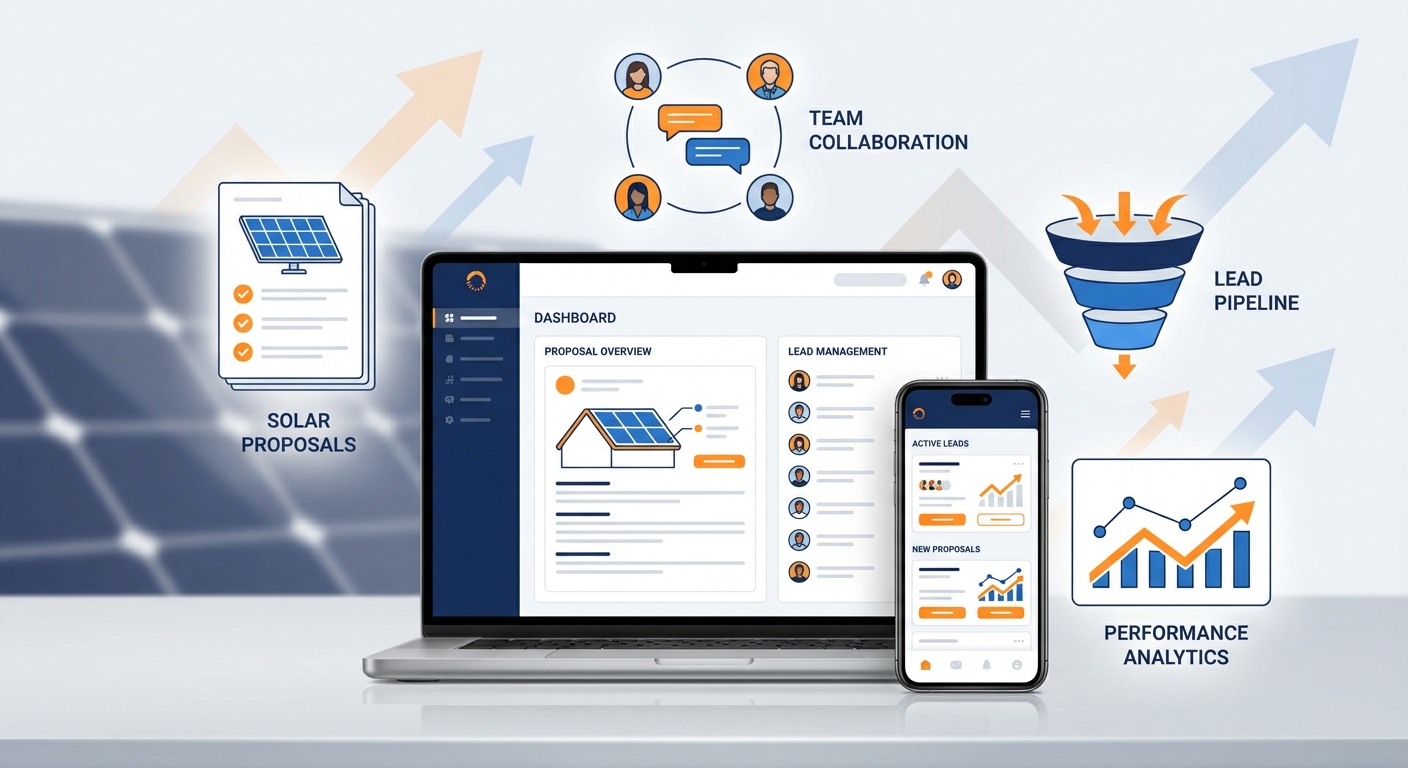
QuickEst was built specifically to address the CRM scalability challenges that solar businesses face as they grow from small installation teams to established EPCs managing hundreds of projects annually. The platform’s architecture and pricing model reflect a deep understanding of how solar companies scale and what they need at each growth stage.
Transparent pricing that grows with your team is fundamental to QuickEst’s approach. Rather than penalizing growth with exponentially increasing per-user costs, QuickEst offers clear annual pricing tiers that provide predictable costs as you scale. The platform’s pricing structure allows solar businesses to budget accurately for growth without worrying that adding team members will make their CRM financially unsustainable. For businesses just starting their CRM journey, QuickEst offers a free plan that provides core functionality at no cost, allowing you to validate the platform before committing to paid tiers.
Cloud infrastructure built for performance at scale ensures that QuickEst maintains its signature 60-second proposal generation speed regardless of your data volume or team size. Whether you’re creating your first proposal or your ten-thousandth, whether you have 100 contacts or 10,000, the platform’s performance remains consistent. This architectural foundation means solar businesses don’t experience the performance degradation that plagues many CRM systems as data volumes grow.
Feature accessibility across pricing tiers ensures that growing solar businesses have access to the capabilities they need without hitting artificial feature walls. QuickEst provides professional proposal generation, automated follow-up systems, team collaboration tools, and performance tracking across its pricing structure. Advanced features aren’t locked behind enterprise-only tiers that are financially out of reach for growing businesses. This approach to feature scalability means you can implement sophisticated sales processes and automation as soon as your business needs them, not only after you’ve reached enterprise scale.
Integration capabilities and API access enable QuickEst to serve as the central hub of your solar business technology stack. The platform connects with essential tools including phonebook systems for contact management, Facebook Ads for lead capture, and Pabbly Connect for workflow automation. API and webhook support allows technical teams to build custom integrations that match their specific operational requirements. As your technology needs evolve with business growth, QuickEst’s integration architecture scales to accommodate increasing complexity.
Real examples from solar EPCs scaling with QuickEst demonstrate the platform’s practical scalability. Solar companies like Sunnovative, Heaven Solar, JJ Solar, and Tata Power use QuickEst to manage their sales operations, from lead capture through proposal generation to deal closure. These businesses represent different scales and market segments, yet all find that QuickEst’s architecture supports their specific needs without requiring constant workarounds or expensive customizations.
The platform’s focus on solar-specific functionality means that scalability isn’t just about handling more users or more data, it’s about supporting the unique ways solar businesses grow. As you expand from residential installations into commercial projects, add battery storage solutions, or diversify into related services, QuickEst’s proposal templates and customization options adapt to your evolving product offerings. As you open new regional branches, the platform’s team management and reporting capabilities provide the visibility you need across multiple locations.
For solar businesses evaluating their options, understanding the complete picture of solar CRM software costs helps contextualize QuickEst’s value proposition. The platform’s transparent pricing, comprehensive features, and scalable architecture deliver strong ROI for growing solar businesses that need a CRM partner capable of supporting their expansion ambitions.
Red Flags: Signs a CRM Won’t Scale With Your Business
Recognizing warning signs early in your CRM evaluation process can save you from costly mistakes. Certain characteristics consistently indicate that a CRM platform lacks the scalability your growing solar business needs. Watch for these red flags when assessing potential CRM solutions:
Vague pricing structures and hidden upgrade costs are immediate warning signs. If a CRM vendor can’t provide clear, written pricing for different user counts and feature tiers, or if they require you to “contact sales” for pricing information, expect unpleasant surprises as you scale. Transparent vendors publish their pricing openly because they’re confident in their value proposition. Opaque pricing often hides expensive upgrade costs, per-user fees that multiply rapidly, or feature restrictions that force you into premium tiers.
Hard limits on contacts, proposals, or storage indicate architectural constraints that will become bottlenecks. CRM platforms that cap your contact database at 10,000 records or limit you to 100 proposals per month reveal that their infrastructure can’t handle growth. These artificial limits force growing businesses to either delete historical data (losing valuable customer insights) or upgrade to expensive enterprise plans. Scalable CRM platforms either have no hard limits or set them so high that typical solar businesses will never encounter them.
Poor performance reviews from larger customers provide valuable insights into scalability issues. When researching CRM options, specifically seek reviews from businesses similar to your target size, not your current size. If you’re a 10-person team planning to grow to 50 people, read reviews from 50-person companies. Complaints about slow performance, degraded search functionality, or system crashes during high-usage periods indicate that the platform doesn’t scale well beyond small team sizes.
Limited integration options suggest that the CRM will become an isolated data silo as your technology stack grows. Solar businesses need their CRM to connect with accounting software, project management tools, marketing platforms, and industry-specific applications. CRM platforms that offer only a handful of pre-built integrations and lack robust API access will force you into manual data entry and disconnected workflows that don’t scale. The most scalable platforms treat integrations as a core capability and provide extensive integration marketplaces or comprehensive APIs.
Lack of API documentation or developer resources indicates that the vendor doesn’t prioritize integration scalability. Even if you don’t currently have technical resources to build custom integrations, you may need them as you grow. CRM platforms with poor API documentation, restrictive API rate limits, or no developer community make it difficult or impossible to build the custom integrations that scaling businesses require. This limitation becomes increasingly problematic as your operational complexity grows.
Additional red flags to watch for include:
- Frequent downtime or reliability issues: Check vendor status pages and user forums for patterns of outages
- Slow feature development: Platforms that haven’t released significant updates in years may be in maintenance mode
- Poor mobile app reviews: As teams grow, mobile access becomes essential for field sales representatives
- Restrictive contract terms: Long-term contracts with expensive early termination penalties trap you in unsuitable platforms
- Lack of customer success stories at your target scale: If the vendor can’t show successful customers at your growth target, they may not support that scale
- Defensive responses to scalability questions: Vendors confident in their scalability answer tough questions directly
Trust your instincts during the evaluation process. If a CRM vendor seems evasive about scalability questions, provides vague answers about performance at scale, or can’t connect you with reference customers similar to your target size, these are signals that the platform may not support your growth ambitions. The right CRM partner welcomes tough scalability questions because they’re confident in their platform’s ability to grow with your business.
Making Your CRM Scalability Decision: A Practical Framework

Armed with the eight critical questions and an understanding of scalability red flags, you need a practical framework for making your final CRM selection. This systematic approach ensures you evaluate CRM scalability comprehensively rather than making decisions based on incomplete information or short-term considerations.
Creating your 3-year growth projection provides the foundation for scalability evaluation. Document realistic projections for key metrics that impact CRM scalability:
- Team size: Current users, 12-month projection, 36-month projection
- Lead volume: Monthly leads today, expected growth trajectory
- Proposal volume: Current monthly proposals, projected volume at scale
- Contact database size: Current contacts, expected growth rate
- Geographic expansion: Current locations, planned branch openings
- Product/service diversification: Current offerings, planned additions
- Integration needs: Current tools, planned technology additions
Be realistic but ambitious in your projections. If you’re planning aggressive growth, your CRM needs to support that ambition. If you’re planning steady, measured expansion, your scalability requirements may be less demanding. The key is having clear projections against which to evaluate each CRM platform’s capabilities.
Calculating total cost of ownership at different scales reveals the true financial impact of your CRM choice. For each CRM platform you’re seriously considering, calculate:
- Year 1 costs: Subscription fees, implementation costs, training time, integration development
- Year 2 costs: Subscription fees at projected user count, additional features or tier upgrades, ongoing training
- Year 3 costs: Subscription fees at target scale, advanced features, additional integrations
- Migration costs: Estimated cost if you need to switch CRMs (data migration, training, productivity loss)
This total cost of ownership analysis often reveals that platforms with higher upfront costs but better scalability deliver lower long-term costs than cheaper platforms that require expensive upgrades or complete replacement as you grow.
Testing scalability during trial periods provides hands-on validation of vendor claims. When evaluating CRM platforms, don’t just test basic functionality, specifically test scalability factors:
- Import a large dataset (if possible) to test performance with realistic data volumes
- Create multiple user accounts to test team collaboration and permission structures
- Build complex proposals or workflows to test customization capabilities
- Attempt to set up integrations with your existing tools
- Test mobile app performance with realistic usage scenarios
- Generate reports and analytics to evaluate reporting scalability
Most CRM vendors offer 14-30 day trial periods. Use this time strategically to validate scalability claims rather than just exploring basic features.
Getting references from similar-sized solar businesses provides real-world validation. Ask CRM vendors to connect you with reference customers who match your target scale, not your current size. Prepare specific questions for these references:
- How has the CRM performed as your team has grown?
- Have you encountered any scalability limitations?
- What were the unexpected costs as you scaled?
- How has performance changed as your data volume increased?
- What features did you need as you grew that weren’t available initially?
- Would you choose the same CRM if you were starting over today?
Reference conversations often reveal scalability issues that aren’t apparent in vendor demos or marketing materials.
Building your CRM scalability scorecard brings all your evaluation criteria together in a structured format. Create a spreadsheet that scores each CRM platform across the eight critical scalability dimensions:
- User growth scalability (0-10 points): Pricing transparency, cost at target scale, user management flexibility
- Data performance scalability (0-10 points): Database limits, performance at scale, search and reporting speed
- Feature scalability (0-10 points): Feature availability across tiers, upgrade path clarity, advanced capabilities access
- Organizational scalability (0-10 points): Multi-location support, role-based permissions, team segmentation
- Integration scalability (0-10 points): API quality, integration options, webhook support, rate limits
- Customization scalability (0-10 points): Custom fields, workflow flexibility, template customization, branding options
- Support scalability (0-10 points): Training resources, support quality, onboarding assistance, account management
- Exit strategy (0-10 points): Data export capabilities, migration support, contract flexibility, data ownership
Score each platform honestly based on your research, demos, trials, and reference conversations. The platform with the highest total score (maximum 80 points) represents your best scalability match. This structured approach prevents emotional decision-making and ensures you weight all scalability factors appropriately.
Remember that perfect scores are rare. Every CRM platform has trade-offs. The goal is finding the platform whose strengths align with your most critical scalability needs and whose weaknesses are in areas less important to your specific business model and growth plans.
For solar businesses in India navigating the complex landscape of CRM options, understanding how different platforms approach scalability helps you make informed decisions that support long-term growth rather than creating obstacles that force expensive mid-growth migrations.
Take the First Step Toward Scalable CRM Success
Choosing a CRM system with true CRM scalability is one of the most important technology decisions your solar business will make. The right platform grows seamlessly with your team, maintains performance as your data expands, provides features when you need them, and supports your operational complexity without forcing costly migrations or workarounds. The wrong platform becomes an expensive bottleneck that limits your growth potential and forces disruptive system changes exactly when your business can least afford the distraction.
The eight critical questions outlined in this guide provide a comprehensive framework for evaluating CRM scalability across all the dimensions that matter for growing solar businesses: user growth economics, data performance, feature evolution, organizational complexity, integration capabilities, customization flexibility, support quality, and exit strategy. By systematically assessing potential CRM platforms against these criteria, you protect your business from the costly mistakes that plague solar companies who prioritize short-term convenience over long-term scalability.
QuickEst was built specifically to address the CRM scalability challenges that solar EPCs and installation companies face as they grow. With transparent pricing that makes growth predictable, cloud infrastructure that maintains performance at scale, comprehensive features accessible across pricing tiers, and robust integration capabilities, QuickEst provides the scalable foundation that ambitious solar businesses need. Over 1000 businesses, including leading solar companies across India, trust QuickEst to support their sales operations from startup through enterprise scale.
Don’t let an unscalable CRM limit your solar business’s growth potential. Start with QuickEst’s free plan at ₹0 to experience how the platform handles your current needs, then scale confidently knowing that the same system will support you as you grow to 25, 50, or 100+ team members. For businesses ready to unlock advanced features and automation, the Pro Plan at ₹6,999 per user per year provides comprehensive CRM capabilities at a predictable annual cost that doesn’t penalize growth.
Take control of your CRM scalability decision today. Evaluate your growth projections, assess your scalability requirements across the eight critical dimensions, and choose a CRM partner that will grow with your solar business rather than holding it back. Your future self, managing a thriving, scaled solar operation, will thank you for making the scalable choice now. Contact us to discuss how QuickEst’s scalable CRM architecture can support your specific growth plans and operational requirements.
This blog post was written using thestacc.com