

In India’s rapidly growing solar market, sales teams face a common challenge: juggling multiple software tools that don’t talk to each other. Your leads live in Facebook Ads, proposals sit in one system, invoices in another, and customer communications scatter across WhatsApp, email, and phone calls. This disconnected approach costs solar businesses countless hours in manual data entry and, worse, leads to missed follow-ups that could have closed deals. CRM integrations solve this problem by connecting your sales tools into a unified ecosystem where data flows automatically, eliminating bottlenecks and helping your team close more deals faster.
For solar EPCs and installers competing in 2026’s dynamic market, the right CRM integrations transform how you operate. Instead of switching between five different apps to move a lead from inquiry to installation, integrated systems let you capture leads, send proposals, collect payments, and schedule site visits from a single platform. This article explores the 15 most valuable CRM integrations that solar businesses in India should implement to streamline workflows, reduce manual work, and unlock their full sales potential.
Why CRM Integrations Matter for Solar Businesses
The cost of disconnected systems extends far beyond wasted time. When your sales team manually copies lead information from Facebook into your CRM, then re-enters customer details into your accounting software, and finally types the same data into WhatsApp to send a proposal, you’re creating multiple opportunities for errors. A single typo in a phone number means a lost follow-up. A forgotten lead import means a potential customer never receives your quote.

Solar businesses using integrated CRM systems report 40-60% reduction in administrative time, allowing sales teams to focus on what they do best: building relationships and closing deals. When your CRM automatically captures Facebook leads, sends them a WhatsApp proposal within 60 seconds, logs all communications, and syncs payment information with your accounting software, your team operates at peak efficiency.
In India’s competitive solar market, response time determines success. Research shows that companies responding to leads within five minutes are 100 times more likely to connect with decision-makers compared to those waiting 30 minutes. CRM integrations enable this speed by eliminating the manual steps between lead capture and first contact. Your prospect fills out a Facebook form, and seconds later receives a personalized proposal on WhatsApp—all without human intervention.
Beyond speed, integrations provide complete visibility into your sales pipeline. When all your tools connect to your CRM, you gain a single source of truth for customer data. Sales managers can see which marketing campaigns generate the best leads, which team members close deals fastest, and where prospects drop off in the sales process. This data-driven approach helps solar companies in India make smarter decisions about where to invest their marketing budgets and how to optimize their sales processes.
1. WhatsApp Business API Integration
WhatsApp dominates business communication in India, with over 500 million active users. For solar companies, WhatsApp integration with your CRM transforms how you engage prospects. Instead of manually sending proposals through the WhatsApp app, integrated systems let you deliver professional solar quotes directly from your CRM with a single click.
QuickEst’s WhatsApp integration enables sales teams to send complete proposals within 60 seconds of receiving a lead inquiry. The system automatically formats your solar system design, pricing, and payment terms into a mobile-friendly proposal that opens perfectly on WhatsApp. Customers can review specifications, see panel layouts, and understand financing options without downloading files or switching apps.
Automated follow-up sequences through WhatsApp keep your deals moving forward. Set up reminder messages that trigger three days after sending a proposal, or create custom sequences for different customer segments. The CRM tracks all WhatsApp interactions, so your entire team sees the complete conversation history when they open a customer record. This prevents duplicate messages and ensures consistent communication.
Open rates for WhatsApp messages exceed 90% in India, compared to 20-30% for email. This makes WhatsApp your most reliable channel for time-sensitive communications like payment reminders, site visit confirmations, and installation updates. When integrated with your CRM, every WhatsApp interaction automatically logs to the customer timeline, creating a complete record of your relationship.
2. Email Marketing Platform Integration
While WhatsApp excels for direct sales conversations, email remains essential for nurturing long-term relationships and educating prospects. Email marketing integration with your solar CRM ensures that every lead automatically enters appropriate nurture campaigns based on their interests and stage in the buying journey.
When a prospect downloads your solar savings calculator but doesn’t request a quote, your integrated system can automatically enroll them in an educational email series explaining solar benefits, financing options, and customer success stories. These drip campaigns keep your company top-of-mind until the prospect is ready to move forward, without requiring manual list management.
Popular email platforms like Mailchimp, SendGrid, and Zoho Campaigns integrate seamlessly with modern CRM systems. The integration syncs contact information, tracks email opens and clicks within your CRM dashboard, and triggers sales alerts when prospects engage with your content. If a lead clicks on your commercial solar email three times in one week, your sales team receives a notification to follow up while interest is high.
Segmentation becomes powerful when your CRM and email platform share data. Create targeted campaigns for residential versus commercial prospects, or send region-specific content about state solar subsidies. The CRM’s lead scoring data can trigger different email sequences—hot leads receive immediate consultation offers, while cold leads get longer educational nurtures. This personalization increases conversion rates while reducing the manual work of list management.
3. Facebook Ads and Lead Generation Integration
Facebook and Instagram advertising drives significant lead volume for solar companies in India, but manual lead management creates dangerous delays. When leads submit Facebook Lead Ads forms, every minute of delay reduces your connection rate. Facebook Ads integration eliminates this bottleneck by automatically importing leads into your CRM the moment they submit their information.
QuickEst’s Facebook integration captures lead details including name, phone number, location, and custom questions about property type or electricity bills. This data populates directly into a new CRM lead record, triggering your automated follow-up sequence. Within seconds, the prospect receives a WhatsApp message with a preliminary proposal, while your sales team gets a notification to call.
The integration also enables closed-loop reporting on advertising ROI. When a Facebook lead converts to a customer, that revenue data flows back to your advertising analytics. You can see exactly which ad campaigns, audiences, and creative variations generate the most profitable customers—not just the most leads. This insight helps solar companies optimize their advertising spend toward campaigns that actually drive business growth.
For solar businesses running multiple campaigns across different regions or customer segments, automated lead routing becomes essential. Set up rules that assign residential leads to one team member, commercial leads to another, and specific geographic areas to regional sales representatives. The Facebook integration combined with CRM automation ensures every lead reaches the right person instantly, maximizing your chances of conversion.
4. Accounting Software Integration
The handoff between sales and finance creates friction in many solar businesses. Sales teams close deals and create proposals with pricing, payment terms, and project details. Then finance teams manually re-enter this information into accounting software to generate invoices, track payments, and manage cash flow. Accounting software integration eliminates this duplicate work and reduces errors.
When your CRM integrates with platforms like Tally, Zoho Books, or QuickBooks, accepted proposals automatically convert to invoices in your accounting system. Customer information, line items, pricing, tax calculations, and payment terms transfer seamlessly. Finance teams receive new invoices without data entry, and sales teams can check payment status without leaving their CRM.
For solar projects with milestone-based payments—advance payment, post-installation payment, and final payment after commissioning, integrated systems track each stage automatically. When a customer makes an advance payment through your payment gateway, the accounting integration updates both systems. Sales teams see payment confirmation in the CRM, while finance teams see the transaction in their accounting software with proper categorization.
This integration proves especially valuable for solar EPCs managing dozens of simultaneous projects. Real-time visibility into which customers have paid, which invoices are overdue, and which projects are ready for the next billing milestone helps companies manage cash flow effectively. The CRM can trigger automated payment reminders based on accounting data, ensuring timely collections without manual follow-up from finance teams.
5. Automation Platforms (Pabbly Connect, Zapier, Make)
Not every software tool offers direct integration with your CRM, but automation platforms bridge this gap. Pabbly Connect, Zapier, and Make (formerly Integromat) connect thousands of applications without requiring coding skills, enabling solar businesses to create custom workflows that match their unique processes.
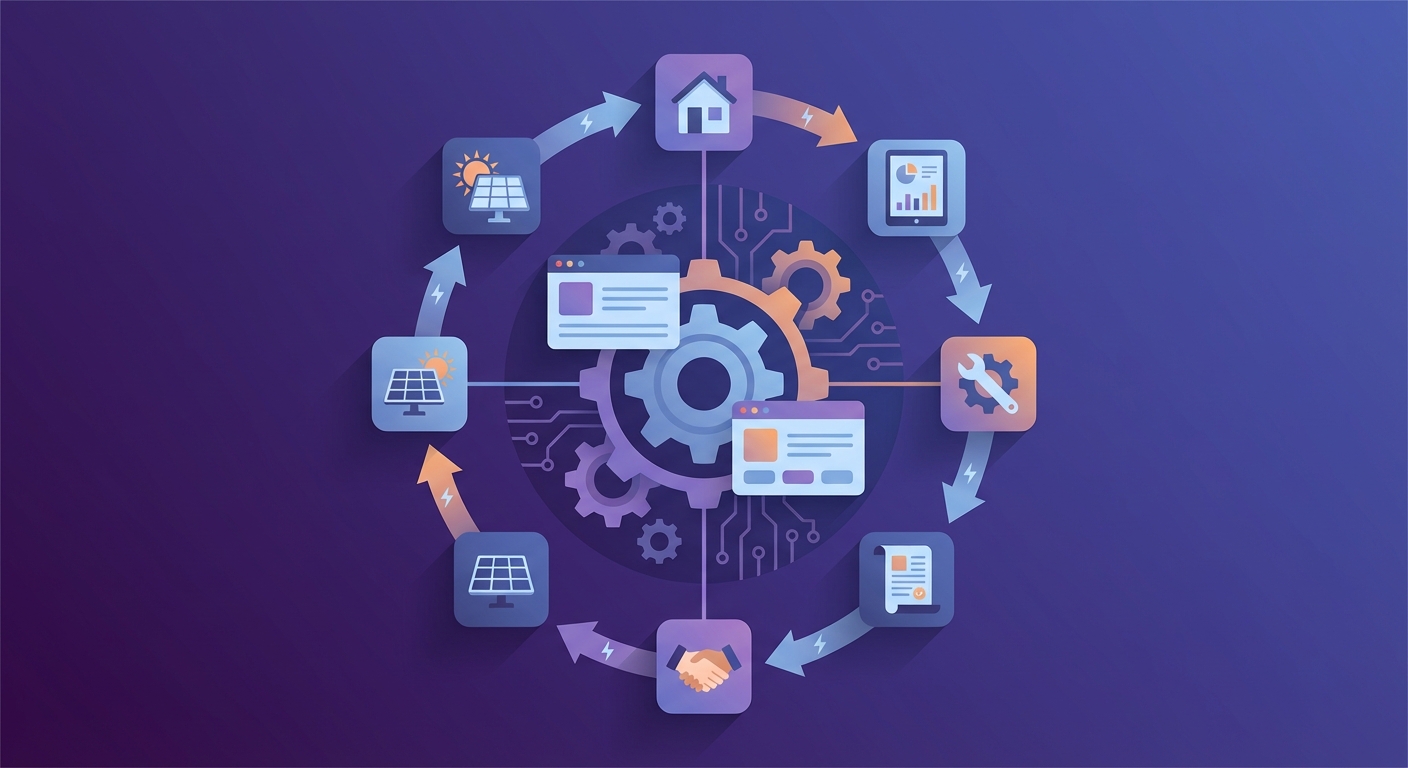
QuickEst supports integration through Pabbly Connect, allowing customers to build multi-step automations. For example, when a proposal is accepted in QuickEst, an automation can create a project in your project management tool, add the customer to a Google Sheet for the installation team, send a Slack notification to your operations manager, and create a task in Trello for site survey scheduling, all automatically.
These platforms offer pre-built templates for common workflows, making implementation faster. A solar company might use a template that watches for new Google Forms submissions (from their website contact form), creates a CRM lead, sends a welcome email, and schedules a follow-up task for the sales team. Customizing these templates requires no programming knowledge, just point-and-click configuration.
The cost-effectiveness of automation platforms makes them attractive for growing solar businesses. Instead of paying developers to build custom API integrations between your CRM and niche tools, you can implement automations for a fraction of the cost. Pabbly Connect offers unlimited automations at competitive pricing, while Zapier and Make provide free tiers suitable for businesses with moderate automation needs.
Advanced users can create sophisticated multi-branch workflows with conditional logic. For instance, if a lead’s estimated project size exceeds 50 kW, route it to your commercial sales specialist; if it’s under 10 kW, assign it to the residential team. If a customer hasn’t responded to a proposal in seven days, automatically send a follow-up email and create a call task. These intelligent automations ensure no lead falls through the cracks while reducing manual task management. To learn more about implementing automated workflows, check out our guide on follow-up automation in India.
6. Calendar and Scheduling Integration
Site visits are critical steps in the solar sales process, but scheduling them often involves frustrating back-and-forth communication. Calendar integration streamlines this process by syncing your CRM with Google Calendar, Outlook, or scheduling tools like Calendly, giving prospects self-service booking while preventing double-bookings for your team.
When integrated with your CRM, calendar tools show your real-time availability to prospects. A customer interested in a site survey clicks a scheduling link in their proposal, sees available time slots, and books directly. The appointment automatically appears in your calendar, creates a CRM activity, and triggers confirmation messages via email and WhatsApp. Your sales team arrives at appointments with complete context because the CRM links the calendar event to the customer record with all proposal details and communication history.
For solar companies with multiple sales engineers covering different territories, calendar integration prevents scheduling conflicts and optimizes route planning. The system can automatically assign site visits to team members based on geographic proximity, ensuring efficient use of travel time. Managers gain visibility into team schedules, helping them balance workloads and identify capacity constraints.
Automated reminders reduce no-shows significantly. The integration sends reminder messages 24 hours before appointments, then again two hours before. If a customer needs to reschedule, they can do so through the same self-service link, which updates both the calendar and CRM automatically. This reduces administrative work while improving customer experience.
7. Telephony and Call Tracking Integration
Phone calls remain a primary sales channel for solar businesses in India, but without proper tracking, valuable conversation data disappears. Telephony integration with platforms like Exotel, Knowlarity, or Twilio connects your phone system to your CRM, automatically logging calls, recording conversations, and providing analytics on call performance.
Click-to-call functionality lets sales teams initiate calls directly from the CRM interface. Click a customer’s phone number, and the system dials automatically while opening the customer record with full context. This eliminates manual dialing errors and ensures representatives have complete information before the conversation begins. All call details, duration, time, outcome, log automatically to the customer timeline.
Call recording integration provides valuable training and quality assurance opportunities. New sales team members can listen to successful calls from top performers, learning effective techniques for handling objections and closing deals. Managers can review calls when deals are lost, identifying areas for coaching and improvement. The CRM links recordings to specific customer records, making them easy to reference during follow-up conversations.
Advanced telephony integrations offer features like intelligent call routing based on lead source or customer value, automatic call distribution among available team members, and real-time analytics on call volume and response times. For solar companies running advertising campaigns with unique phone numbers, call tracking integration attributes leads to specific campaigns, providing accurate ROI data for marketing optimization.
8. Document Management and E-Signature Integration
Solar installations require multiple signed documents, proposals, contracts, installation agreements, and subsidy applications. Traditional paper-based processes create delays and storage challenges. E-signature integration with platforms like DigiLocker, Adobe Sign, or DocuSign accelerates deal closure while maintaining legal compliance.
When a customer accepts a proposal in your CRM, the system can automatically generate a contract and send it for digital signature. The customer receives a link via email or WhatsApp, reviews the terms on their mobile device, and signs electronically. The signed document automatically attaches to the CRM customer record, and the sales team receives notification that the deal is ready to move to installation scheduling.
This integration proves especially valuable for commercial solar projects involving multiple stakeholders. Different signatories can review and approve documents in sequence, the facility manager reviews technical specifications, the CFO approves financial terms, and the CEO provides final authorization. The CRM tracks document status in real-time, showing which signatures are pending and sending automated reminders to stakeholders who haven’t yet signed.
Document version control becomes effortless with integrated systems. Every proposal revision, contract amendment, and signed agreement stores in the CRM with timestamps and change tracking. If questions arise months later about what was agreed upon, your team can instantly access the exact signed document. This eliminates disputes and provides audit trails for compliance purposes.
9. SMS and Bulk Messaging Integration
SMS delivers exceptional open rates and works on every mobile phone, making it ideal for time-sensitive communications. SMS integration with providers like MSG91, Twilio, or Gupshup enables solar businesses to send proposal links, payment reminders, and appointment confirmations directly from their CRM.
Automated SMS sequences complement your WhatsApp and email communications. When a proposal is sent, the customer receives an SMS with a direct link to view it. If they don’t open it within 24 hours, a reminder SMS triggers automatically. For customers who prefer SMS over WhatsApp, this ensures your message reaches them through their preferred channel.
Bulk SMS campaigns help solar companies stay connected with their entire customer base. Send seasonal maintenance reminders to existing customers, notify prospects about new government subsidies, or promote referral programs to satisfied clients. The CRM integration enables precise segmentation, send different messages to residential versus commercial customers, or target specific geographic regions with location-relevant information.
Transactional SMS integration provides instant confirmation for critical actions. When a customer makes a payment, they immediately receive an SMS receipt. When installation is scheduled, an SMS confirms the date and time. These automated confirmations reduce customer anxiety and support calls, while the CRM maintains a complete record of all SMS communications linked to each customer.
10. Project Management Tool Integration
The transition from closed sale to completed installation requires coordination between sales, engineering, procurement, and installation teams. Project management integration ensures smooth handoffs by automatically converting won deals into structured projects with tasks, timelines, and resource assignments.
When a solar proposal is accepted in your CRM, integration with tools like Trello, Asana, or Monday.com can automatically create a project board with standard tasks: site survey, engineering design, permit applications, equipment procurement, installation scheduling, and commissioning. Each task includes relevant customer information from the CRM, ensuring the operations team has complete context.
This integration eliminates the communication gaps that often occur between sales and operations. Sales teams don’t need to send separate emails with customer details, project specifications, and special requirements, everything transfers automatically. Operations teams can update project status in their project management tool, and those updates reflect in the CRM, keeping sales informed about installation progress for customer communications.
For solar EPCs managing dozens of simultaneous installations, integrated project management provides visibility into resource allocation and capacity planning. Managers can see which projects are on schedule, which are delayed, and where bottlenecks exist. The CRM maintains the customer relationship history while the project management tool handles operational execution, with both systems sharing data seamlessly.
11. Payment Gateway Integration
Collecting advance payments accelerates project timelines and improves cash flow, but traditional payment collection involves manual invoicing and bank transfer verification. Payment gateway integration with platforms like Razorpay, PayU, Instamojo, or Paytm enables customers to pay directly from proposals, with automatic payment confirmation in your CRM.
QuickEst’s proposal system can include payment links that allow customers to pay via UPI, credit card, debit card, or net banking. When payment is completed, the CRM automatically updates the deal status, sends a receipt to the customer, and notifies the sales team. This eliminates the manual process of checking bank accounts, matching payments to customers, and updating records.
For solar projects with milestone-based payments, payment gateway integration tracks each stage automatically. The system can send payment requests at predefined milestones, 30% advance, 40% after installation, 30% after commissioning. Customers receive payment links via WhatsApp or email, pay with their preferred method, and the CRM updates the project status automatically.
Payment analytics become more sophisticated with integrated systems. Track which payment methods customers prefer, identify patterns in payment timing, and forecast cash flow based on upcoming payment milestones. The integration between your CRM and payment gateway provides complete visibility into financial health while reducing the administrative burden on your finance team.
12. Google Workspace Integration
Many solar businesses already use Google Workspace (Gmail, Google Drive, Google Calendar, Google Contacts) for daily operations. Google Workspace integration with your CRM creates a unified environment where customer data, communications, and documents sync seamlessly across platforms.
Gmail integration enables email tracking directly within your CRM. When you send a proposal or follow-up email from Gmail, the CRM automatically logs it to the customer record. You can see when customers open emails, click links, or download attachments, valuable signals about their level of interest. This eliminates the need to manually copy emails into your CRM or wonder whether important messages were received.
Google Drive integration provides centralized document storage linked to customer records. Proposals, contracts, site photos, and engineering drawings automatically save to organized Drive folders. Your entire team can access these documents with proper permissions, ensuring everyone works from the latest versions. When a sales representative needs to reference a customer’s original inquiry or signed contract, they find it instantly in the CRM-linked Drive folder.
Google Contacts sync ensures your CRM and phone contacts stay aligned. Add a contact in your CRM, and it appears in Google Contacts on your phone. Update a phone number in Google Contacts, and it syncs back to your CRM. This bidirectional sync eliminates the frustration of maintaining duplicate contact lists and ensures your team always has current information.
13. Analytics and Business Intelligence Integration
While CRM systems provide built-in reporting, advanced analytics require deeper data analysis. Business intelligence integration with platforms like Google Data Studio, Microsoft Power BI, or Tableau enables solar companies to create sophisticated dashboards combining CRM data with information from other business systems.
Export your CRM data to analytics platforms for custom visualizations that answer specific business questions. Combine sales pipeline data with marketing spend to calculate customer acquisition costs by channel. Merge CRM conversion rates with installation data to identify which sales representatives close deals that complete successfully versus those that cancel. Layer in regional electricity pricing data to understand which markets offer the best margins.
These integrations enable predictive analytics that help solar businesses forecast future performance. Analyze historical patterns to predict monthly sales, identify seasonal trends in lead quality, and model the impact of pricing changes on conversion rates. Data-driven insights help management make strategic decisions about market expansion, team hiring, and product offerings.
Automated reporting saves countless hours of manual data compilation. Set up dashboards that refresh daily with current CRM data, showing key metrics like pipeline value, conversion rates by stage, average deal size, and sales team performance. Share these dashboards with stakeholders who need visibility into sales performance without requiring direct CRM access. For more insights on evaluating CRM capabilities, explore our article on CRM scalability questions.
14. Phonebook and Contact Sync Integration
Solar sales teams often collect business cards at trade shows, receive referrals from existing customers, and gather contacts through networking. Phonebook integration simplifies the process of getting these contacts into your CRM, ensuring no potential lead is lost in a notebook or phone contact list.
QuickEst’s phonebook integration allows sales representatives to import contacts directly from their mobile devices. The system can bulk import from Excel spreadsheets, making it easy to add leads from trade show sign-up sheets or purchased contact lists. Automatic deduplication prevents creating multiple records for the same person, maintaining clean data in your CRM.
Contact sync works bidirectionally, add a lead in your CRM, and it syncs to your phone contacts for easy calling. Update a customer’s phone number during a conversation, and it updates in the CRM automatically. This seamless sync ensures your team always has access to current contact information whether they’re working from their computer or mobile device.
For solar companies with field sales teams who spend significant time traveling to customer sites, mobile contact sync is essential. Representatives can access complete customer information, communication history, and proposal details from their phones, even when internet connectivity is limited. When they return to the office, all updates sync automatically to the central CRM database.
15. Custom API and Webhook Integration
Every solar business has unique processes and systems. While pre-built integrations cover common use cases, custom API and webhook integration provides maximum flexibility for connecting your CRM to proprietary software, legacy systems, or specialized tools specific to your business.
APIs (Application Programming Interfaces) enable real-time data exchange between your CRM and other systems. For example, a solar EPC might integrate their CRM with a custom engineering design tool, automatically transferring customer site details and electricity consumption data when a proposal is accepted. The engineering team receives all necessary information without manual data entry, and design completion triggers an update back to the CRM.
Webhooks provide event-driven integration, where actions in your CRM trigger immediate responses in other systems. When a deal reaches a certain value threshold, a webhook can notify your finance team via Slack. When a customer is marked as “installation complete,” a webhook can trigger a review request email and add them to a referral program. These real-time integrations ensure your business processes execute instantly without manual intervention.
For solar companies with enterprise requirements, custom API integration enables connection to ERP systems, supply chain management platforms, or corporate databases. While implementing custom integrations requires technical expertise, the result is a perfectly tailored system that matches your exact business processes. Modern CRM platforms like QuickEst provide comprehensive API documentation and webhook support, making custom integration development straightforward for experienced developers.
How to Choose the Right CRM Integrations for Your Solar Business
With dozens of potential integrations available, solar businesses must prioritize strategically. Start by mapping your current workflow and identifying the biggest pain points. Where does manual data entry consume the most time? Which disconnected systems cause the most errors? What delays prevent you from responding to leads quickly?

Prioritize integrations based on ROI potential. Calculate the time your team currently spends on manual tasks that an integration could automate. If your sales team spends two hours daily copying Facebook leads into your CRM, and a Facebook integration costs ₹500 monthly, the ROI is clear. Focus first on integrations that eliminate the most time-consuming manual work or fix the most expensive problems (like lost leads due to slow response times).
Consider implementation complexity and ongoing costs. Some integrations require minimal setup, connecting your CRM to WhatsApp might take 30 minutes. Others demand significant configuration, training, and potentially custom development. Factor in both one-time implementation costs and recurring subscription fees when evaluating options. Start with simpler integrations that deliver quick wins, building momentum before tackling more complex projects.
Ensure your CRM platform supports the integrations you need. Not all CRM systems offer the same integration capabilities. Before committing to a CRM, verify it integrates with your essential tools, accounting software, communication platforms, and marketing systems. Platforms like QuickEst that support automation tools like Pabbly Connect provide flexibility to connect with thousands of applications, even if direct integrations don’t exist. For a comprehensive comparison of CRM capabilities, read our guide on solar CRM integration in India.
Start with essential integrations and expand gradually. Implementing too many integrations simultaneously overwhelms teams and complicates troubleshooting. Begin with three to five high-impact integrations, perhaps WhatsApp, Facebook Ads, and accounting software. Once these are working smoothly and your team is comfortable, add additional integrations based on evolving needs. This phased approach ensures successful adoption and allows you to measure the impact of each integration.
Getting Started with CRM Integrations
QuickEst provides solar businesses with powerful integration capabilities designed specifically for the Indian market. The platform offers native integrations with WhatsApp Business API, Facebook Lead Ads, and phonebook sync, plus support for Pabbly Connect to connect with thousands of additional applications. This combination of direct integrations and automation platform support gives solar companies the flexibility to build workflows that match their unique processes.
Implementation support ensures successful integration deployment. QuickEst’s team helps customers configure integrations, set up automated workflows, and train sales teams on new processes. Most integrations can be activated within days, not weeks, allowing solar businesses to start seeing benefits quickly. The platform’s intuitive interface makes managing integrations straightforward, even for teams without technical expertise.
Training your team on integrated workflows is critical for adoption. When processes change from manual to automated, team members need to understand how the new system works and what actions trigger which automations. Invest time in hands-on training sessions where sales representatives practice using integrated features. Create documentation showing common workflows, how a Facebook lead becomes a customer, what happens when a proposal is sent, how payment confirmations update the system.
Measure success through specific metrics that demonstrate integration value. Track time saved on administrative tasks, response time from lead capture to first contact, conversion rate improvements, and reduction in data entry errors. Review these metrics monthly to quantify ROI and identify opportunities for optimization. As your team becomes proficient with initial integrations, gather feedback on additional automation opportunities that could further streamline workflows.
The competitive advantage of CRM integrations grows stronger as India’s solar market matures. Companies that eliminate manual work, respond to leads instantly, and maintain complete customer data across all touchpoints will consistently outperform competitors still juggling disconnected systems. The investment in integration pays dividends through increased sales productivity, higher conversion rates, and improved customer experience. To understand the full cost considerations of implementing an integrated CRM system, review our analysis of solar CRM software costs.
Ready to transform your solar sales process with powerful integrations? QuickEst offers flexible plans designed for solar businesses of all sizes. Start with our FREE PLAN at ₹0 to explore core CRM features and basic integrations, or upgrade to the PRO PLAN at ₹6,999 per user per year for advanced integration capabilities, automation features, and priority support. Discover how connecting your sales tools can help you close more deals faster while eliminating the manual work that slows your team down. Take the first step toward a fully integrated sales ecosystem today.
This blog post was written using thestacc.com