
The Indian solar market is booming in 2026, with businesses racing to capture their share of this rapidly expanding industry. Yet many solar companies struggle with generic CRM systems that don’t align with local business workflows, regional requirements, or the unique sales cycles of the Indian market. CRM customization India isn’t just a nice-to-have feature—it’s the difference between a sales tool that empowers your team and one that creates bottlenecks.
When your CRM is properly customized for the Indian solar market, your sales team can generate proposals in under 60 seconds, follow up with leads via WhatsApp at the perfect moment, and track performance across different states and customer segments. This comprehensive guide walks you through exactly how to customize your CRM system to match your solar business workflows, maximize conversion rates, and boost team productivity across India’s diverse markets.
Why CRM Customization India Matters for Solar Businesses

The Indian solar industry operates differently from Western markets. Customer buying journeys are longer, involving multiple stakeholders and complex subsidy verification processes. Regional variations mean what works in Maharashtra may not work in Tamil Nadu. Payment terms differ dramatically between residential, commercial, and industrial segments. A one-size-fits-all CRM simply cannot address these nuances.
Generic CRMs create friction in your sales process. Your team wastes time working around the system instead of working with it. Sales reps manually track subsidy applications in spreadsheets because the CRM doesn’t have custom fields for state-specific incentives. Managers struggle to get accurate regional performance reports. Follow-up sequences ignore Indian festival seasons when customers are most likely to make purchasing decisions.
Properly implemented CRM customization India delivers measurable ROI. Solar companies that customize their CRM to match local workflows report 35-50% faster proposal generation, 25-40% higher follow-up completion rates, and 20-30% improvement in conversion rates. When your CRM speaks the language of your business—literally and figuratively—your entire sales operation becomes more efficient.
The customization challenge varies by company size and market focus. A residential solar installer in Bangalore has different needs than a commercial EPC in Gujarat. Your CRM must flex to accommodate these differences while maintaining consistency in core processes. The good news? Modern solar-specific CRM platforms like QuickEst are built with Indian market customization in mind, making it easier than ever to tailor your system without requiring technical expertise.
1. Customize Your Sales Pipeline Stages for Indian Solar Sales Cycles
Your sales pipeline is the backbone of your CRM system, and CRM customization India starts with aligning pipeline stages to how Indian customers actually buy solar systems. Standard pipeline stages like “Lead,” “Qualified,” “Proposal,” “Negotiation,” and “Closed” miss critical steps unique to the Indian solar market.
For residential solar sales in India, your customized pipeline should include stages like Site Survey Scheduled, Subsidy Verification, Financing Approval, and Net Metering Application. Each of these represents a distinct phase where deals can stall, and your team needs visibility into where prospects are stuck. Commercial and industrial segments require different stages, perhaps Technical Feasibility Study, Board Approval Pending, or Capex Budget Allocation.
When customizing pipeline stages, consider these best practices:
- Map stages to actual customer actions, not internal processes. “Waiting for Customer Decision” is more useful than “Proposal Sent.”
- Limit stages to 6-8 maximum to prevent complexity. Too many stages create confusion and reduce adoption.
- Define clear entry and exit criteria for each stage so your team knows exactly when to move deals forward.
- Set up automated notifications when deals sit too long in a stage, preventing leads from going cold.
- Create segment-specific pipelines if your residential and commercial processes differ significantly.
QuickEst allows you to customize pipeline stages without coding, and you can set up automated follow-up sequences triggered by stage changes. When a deal moves to “Subsidy Verification,” the system can automatically send the customer a checklist of required documents via WhatsApp, keeping momentum going without manual intervention.
2. Tailor Proposal Templates for Regional Requirements
Proposal generation is where CRM customization India delivers immediate, visible value. Indian solar customers expect detailed proposals that address state-specific subsidies, regional electricity tariffs, and local installation considerations. A generic template that works in Delhi won’t resonate with customers in Kerala who have different subsidy structures and rooftop conditions.
Start by creating segment-specific proposal templates. Your residential template should emphasize savings on electricity bills, payback periods, and available subsidies. Commercial templates need to focus on ROI, tax benefits under accelerated depreciation, and corporate sustainability goals. Industrial proposals should highlight demand charge reduction, power purchase agreements, and long-term energy cost stability.
Customize your proposals to include:
- State-specific subsidy information with current rates and application procedures
- Regional electricity tariff data to calculate accurate savings projections
- Local installation considerations like monsoon season timing or regional building codes
- Payment terms common in your region, some states prefer milestone-based payments while others expect different structures
- Regional language options for customer-facing sections, especially in non-metro markets
Professional branding is crucial. Customize your proposal templates with your company logo, brand colors, and professional formatting that builds trust. Include high-quality images of previous installations in similar settings, residential customers in Pune want to see rooftop installations that look like their neighborhood, not generic stock photos.
With QuickEst’s proposal automation, you can generate customized, professional proposals in under 60 seconds by simply selecting the customer segment and location. The system automatically pulls in the correct subsidy information, regional pricing, and appropriate template, then allows you to send it instantly via WhatsApp or email. This speed is critical in competitive markets where the first company to send a professional proposal often wins the deal.
3. Configure Follow-Up Sequences for Maximum Conversion
Follow-up consistency separates top-performing solar sales teams from average ones, and CRM customization India means building follow-up sequences that match Indian customer behavior patterns. Research shows that 60-70% of solar deals in India require 5-8 touchpoints before closing, yet most sales teams give up after 2-3 attempts.
Customize your automated follow-up sequences based on customer segment and stage. A residential lead who requested a quote needs a different cadence than a commercial prospect evaluating multiple vendors. Your sequences should mix communication channels, email for detailed information, WhatsApp for quick check-ins, and phone calls for high-value opportunities.
Here’s a sample customized follow-up sequence for residential solar leads in India:
- Day 0: Send proposal via WhatsApp immediately after site survey
- Day 2: WhatsApp message asking if they have questions about the proposal
- Day 5: Email with customer testimonials and case study from similar home
- Day 8: Phone call to discuss concerns and answer technical questions
- Day 12: WhatsApp message highlighting limited-time subsidy availability
- Day 16: Email with financing options and payment plans
- Day 21: Final phone call with special consideration for early decision
Customize your message templates to sound natural and helpful, not pushy. Indian customers respond well to educational content and social proof. Include links to follow-up automation resources that explain how automated sequences can improve your conversion rates without overwhelming your team.
Timing matters tremendously in the Indian market. Avoid scheduling follow-ups during major festivals like Diwali, Eid, or regional celebrations when customers are preoccupied. Instead, customize your sequences to increase touchpoints just before festival seasons when customers are making purchasing decisions and have available funds. QuickEst’s follow-up automation allows you to set festival-aware scheduling that automatically adjusts timing based on the Indian calendar.
4. Build Custom Reporting Dashboards for CRM Customization India
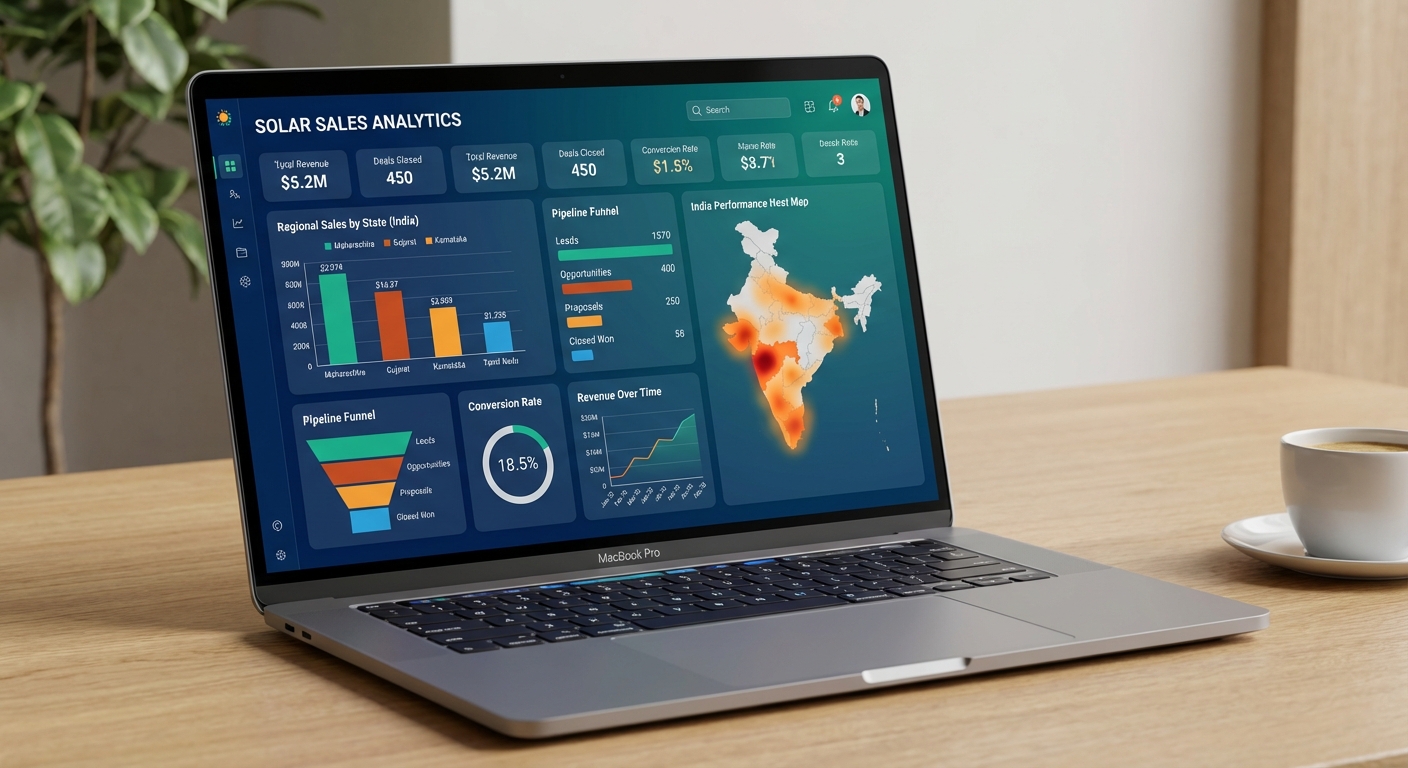
Data-driven decision making requires dashboards customized to show the metrics that actually matter for your Indian solar business. Generic CRM reports don’t account for regional performance variations, state-specific conversion patterns, or the unique KPIs that drive solar sales success in India.
Create role-specific dashboards that give each team member exactly the information they need. Sales reps need to see their personal pipeline, upcoming follow-up tasks, and daily activity metrics. Sales managers require team performance comparisons, conversion rates by stage, and pipeline velocity. Executives want high-level revenue forecasts, regional market penetration, and ROI metrics.
Essential metrics for your customized Indian solar CRM dashboard include:
- Regional conversion rates, track which states and cities deliver the highest close rates
- Proposal-to-close ratio by customer segment (residential, commercial, industrial)
- Average deal size and how it varies by region and season
- Sales cycle length from first contact to installation completion
- Lead source ROI, which marketing channels deliver the best quality leads
- Follow-up completion rates to ensure your team executes consistently
- Pipeline value by stage to forecast revenue accurately
- Customer acquisition cost compared to lifetime value
Customize your dashboards to highlight actionable insights, not just data. Use color coding to show which metrics are on track (green), need attention (yellow), or require immediate action (red). Set up automated alerts when key metrics fall below thresholds, for example, if your proposal-to-close ratio drops below 25% in a specific region, managers receive an immediate notification to investigate.
QuickEst provides real-time analytics dashboards that update automatically as your team logs activities and moves deals through the pipeline. You can customize which metrics appear, how data is visualized, and who has access to different reports. This transparency helps sales teams stay accountable and managers identify coaching opportunities before small issues become major problems.
5. Integrate India-Specific Tools and Platforms

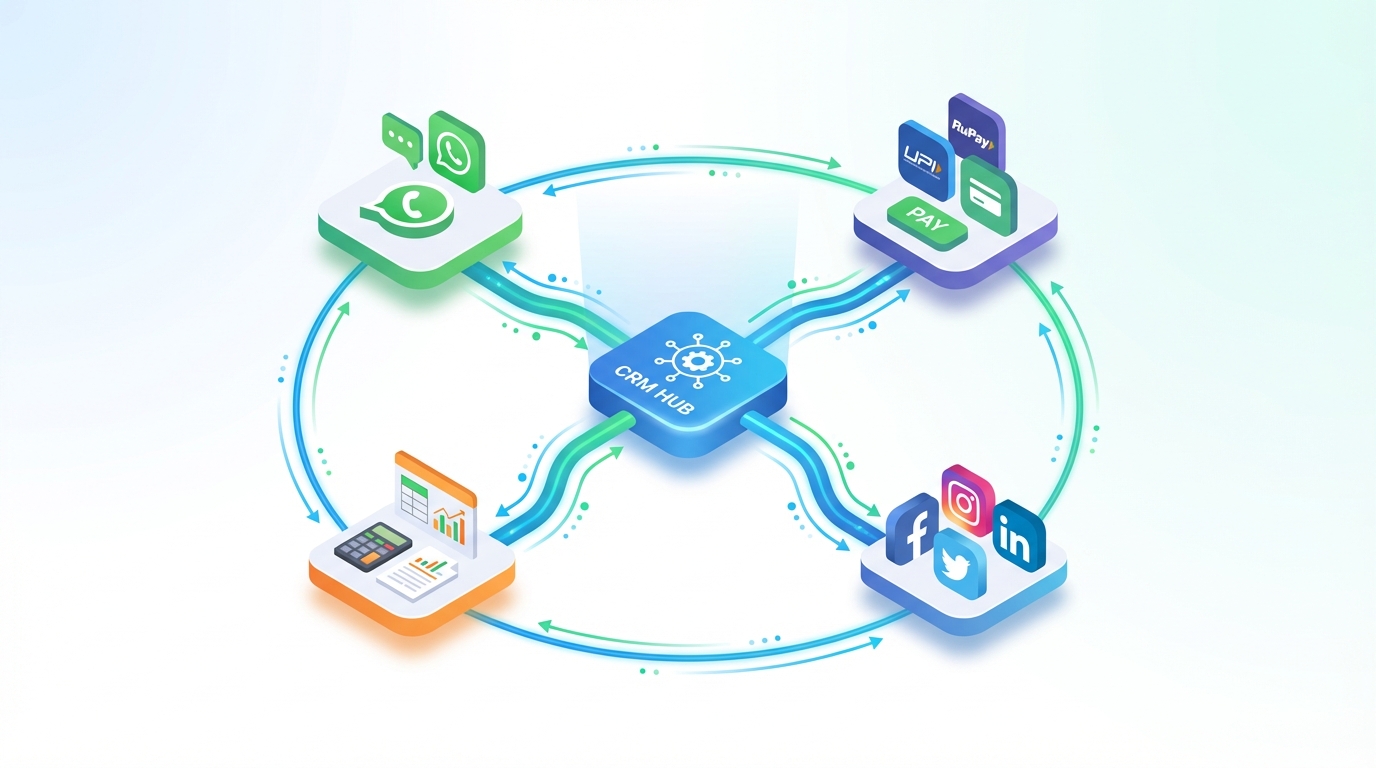
True CRM customization India means connecting your system to the tools and platforms your customers and team actually use. Indian solar businesses operate in a unique digital ecosystem where WhatsApp dominates communication, local payment gateways handle transactions, and regional platforms drive lead generation.
WhatsApp Business API integration is non-negotiable for Indian solar CRM systems. Over 500 million Indians use WhatsApp daily, and customers expect to receive proposals, updates, and support through this channel. Customize your CRM to send automated WhatsApp messages at key pipeline stages, share proposals as PDF attachments, and enable two-way conversations that sync back to the customer record.
Payment gateway integration streamlines the deposit and payment collection process. Connect your CRM to popular Indian payment platforms like:
- Razorpay, widely used for both consumer and business payments
- Paytm, strong brand recognition and broad customer adoption
- PhonePe, growing rapidly in tier-2 and tier-3 cities
- Instamojo, popular among small and medium solar businesses
When customers can pay deposits directly from the proposal link, conversion rates increase significantly. Customize payment links to include your branding and send automated payment confirmation messages via WhatsApp.
Lead generation integrations ensure no opportunity falls through the cracks. Connect your CRM to:
- Facebook Lead Ads, capture leads directly from social media campaigns
- Google Ads, automatically import leads from search campaigns
- Website contact forms, sync inquiries instantly to your CRM
- Phonebook and Excel imports, bulk upload existing customer databases
Accounting software integration eliminates double data entry and keeps financial records synchronized. Many Indian solar businesses use Tally or Zoho Books for accounting. Customize your CRM to push invoice data to these systems automatically when deals close, ensuring accurate financial tracking without manual work.
QuickEst offers built-in integrations with Facebook Ads, Pabbly Connect (which connects to 1000+ apps), and phonebook import capabilities. The platform is specifically designed for the Indian market with WhatsApp integration as a core feature, not an afterthought. For more details on connecting your sales tools, check out this guide on solar CRM integration in India.
6. Customize Lead Management and Qualification Criteria
Not all leads are created equal, and CRM customization India includes building lead scoring and qualification systems that reflect Indian solar market realities. A lead from a homeowner in a metro city with a large rooftop and high electricity bills is fundamentally different from a rural inquiry about small off-grid systems.
Start by customizing your lead capture fields to collect India-specific information:
- Property type, independent house, apartment, commercial building, industrial facility
- Rooftop area and condition, critical for feasibility assessment
- Monthly electricity bill, indicates system size and ROI potential
- Electricity connection type, single phase or three phase
- State and city, determines applicable subsidies and net metering policies
- Decision-making timeline, immediate, within 3 months, exploring options
- Budget range, helps qualify financial capacity
- Financing interest, cash purchase, loan, or OPEX model
Create a lead scoring model that assigns points based on qualification criteria. For example:
- Monthly electricity bill over ₹5,000: +20 points
- Independent house with clear rooftop: +15 points
- Located in high-subsidy state: +10 points
- Decision timeline within 3 months: +15 points
- Budget aligned with system requirements: +20 points
- Referred by existing customer: +10 points
Leads scoring above 60 points get immediate sales rep assignment and priority follow-up. Leads scoring 30-60 points enter nurture sequences. Leads below 30 points receive educational content until they show stronger buying signals.
Customize your lead source tracking to understand which marketing channels deliver the best ROI. Tag leads with specific sources like “Facebook Ad – Residential Mumbai,” “Google Search – Commercial Solar,” or “Referral – Customer Name.” This granular tracking helps you optimize marketing spend and double down on what works.
Automated lead assignment rules ensure the right rep handles each opportunity. Customize assignment based on geography (assign leads to reps covering specific territories), expertise (commercial leads go to commercial specialists), or workload balancing (distribute leads evenly across the team). QuickEst allows you to set up sophisticated assignment rules that execute automatically when new leads enter the system.
7. Configure Team Permissions and Workflows
As your solar business grows, CRM customization India must include proper access controls and approval workflows that maintain data security while enabling team collaboration. Different roles need different levels of access, and certain actions should require manager approval.
Set up role-based permissions that align with your organizational structure:
- Sales Representatives, can view and edit their own leads and deals, create proposals, log activities, but cannot delete records or access team-wide reports
- Sales Managers, can view all team member activities, access performance reports, reassign leads, and approve special pricing
- Executives/Owners, full system access including configuration changes, financial reports, and data export
- Support Staff, can view customer records and log service activities but cannot access sales pipeline or financial data
Customize approval workflows for actions that require oversight. For example, if a sales rep wants to offer a discount exceeding 10%, the system should automatically route the request to a manager for approval. This prevents unauthorized discounting while still giving reps flexibility to negotiate within guidelines.
Create territory-based team structures that reflect how your business operates across India. You might organize teams by state, by customer segment (residential vs. commercial), or by city. Customize your CRM so reps only see leads and deals in their assigned territories, reducing clutter and improving focus.
Set up collaboration features that keep everyone aligned. Use task assignment to delegate follow-ups, site surveys, or documentation collection. Enable internal notes on customer records so team members can share insights without cluttering the communication history. Configure notification preferences so reps get alerts for their high-priority tasks without being overwhelmed by irrelevant updates.
QuickEst includes team collaboration tools with customizable permissions and task assignment capabilities. You can configure exactly who sees what, ensuring data security while maintaining the transparency needed for effective sales management.
8. Optimize Mobile Access for Field Sales Teams
Indian solar sales happen in the field, on customer rooftops, in factory offices, at residential doorsteps. CRM customization India must prioritize mobile optimization so your team can work effectively anywhere, even in areas with unreliable internet connectivity.
Customize your mobile CRM interface to support on-site proposal generation. Sales reps should be able to measure rooftop dimensions, calculate system size, select equipment, and generate a professional proposal, all from their smartphone while standing with the customer. This immediacy dramatically increases conversion rates because customers receive proposals while their interest is highest.
Configure offline access capabilities for areas with poor connectivity. Your mobile CRM should allow reps to view customer information, log activities, and create proposals offline, then automatically sync data when connectivity returns. This is crucial in tier-2 and tier-3 cities where internet access can be spotty.
Set up mobile-optimized notifications that keep reps on track without being intrusive. Push notifications for upcoming follow-ups, new lead assignments, and manager messages ensure nothing falls through the cracks. Customize notification timing to respect working hours, no alerts at 10 PM unless it’s truly urgent.
Enable quick actions that streamline common mobile tasks:
- One-tap calling directly from customer records
- Quick WhatsApp message sending with pre-populated templates
- Photo upload for site documentation and rooftop conditions
- Voice-to-text for logging meeting notes hands-free
- GPS check-in to verify site visit completion
Customize the mobile interface to show priority information first. Reps don’t need to see every field on a customer record when they’re in the field, they need quick access to contact details, last interaction notes, and next steps. Design mobile views that are clean, fast, and focused on field sales efficiency.
QuickEst offers native mobile apps for both iOS and Android, specifically designed for solar sales teams working in the field. The mobile interface is optimized for quick proposal generation and includes WhatsApp integration so reps can send proposals instantly from their phone. This mobile-first approach recognizes that Indian solar sales teams spend more time with customers than at desks.
Common CRM Customization Mistakes to Avoid
While CRM customization India delivers significant benefits, certain mistakes can undermine your efforts and reduce user adoption. Learn from these common pitfalls to ensure your customization project succeeds.
Over-customization creates complexity that confuses users and slows adoption. Every custom field, pipeline stage, and workflow adds cognitive load. Before adding customization, ask: “Will this directly improve sales outcomes or efficiency?” If not, skip it. Start with essential customizations and add more only after your team has fully adopted the basics.
Ignoring user feedback during the customization process leads to systems that look good on paper but fail in practice. Your sales reps are the ones using the CRM daily, they know which fields are actually useful and which workflows make sense. Involve them in customization decisions and run pilot tests before rolling out major changes.
Failing to document customizations creates problems when team members change or you need to troubleshoot issues. Maintain clear documentation of your custom fields, pipeline stages, automation rules, and integration settings. This documentation should explain not just what you customized, but why, so future team members understand the reasoning.
Not planning for scalability means your customizations work fine with 5 sales reps but break down when you grow to 20. Design your pipeline stages, territory structures, and reporting dashboards with growth in mind. Will your current setup still work if you expand to three new states next year? If not, rethink your approach.
Skipping training after implementation is perhaps the most common mistake. You can build the perfect customized CRM, but if your team doesn’t understand how to use it, adoption will fail. Invest in comprehensive training that covers not just how to use features, but why they matter and how they make sales easier. For guidance on successful implementation, review this CRM implementation guide for India.
How QuickEst Simplifies CRM Customization India
While this guide has covered extensive customization options, you might be wondering: “Do I need technical expertise to implement all this?” The answer depends on your CRM platform. Generic CRMs often require developers or consultants to handle customization, adding cost and complexity. Solar-specific platforms like QuickEst are designed differently.
QuickEst comes pre-configured for Indian solar businesses with industry-specific templates, workflows, and integrations already built in. You get proposal templates designed for residential, commercial, and industrial segments. Pipeline stages reflect actual solar sales cycles. WhatsApp integration works out of the box. This means you can start with a system that’s 70-80% customized for your needs on day one.
The platform offers easy customization without coding. You can modify proposal templates, adjust pipeline stages, create custom fields, and set up automation rules through an intuitive interface. No technical expertise required. If you can use a spreadsheet, you can customize QuickEst to match your business processes.
WhatsApp integration built for India means you don’t need to figure out complex API connections or third-party tools. Send proposals, follow-ups, and updates via WhatsApp directly from the CRM. Customers can respond via WhatsApp and those conversations sync back to their customer record automatically.
QuickEst offers flexible pricing plans designed for Indian solar businesses of all sizes. The FREE PLAN at ₹0 lets you test the platform and start customizing without financial risk. As your business grows, the PRO PLAN at ₹6,999 per user per year unlocks advanced customization options, unlimited proposals, and priority support. This pricing structure makes professional CRM customization accessible even for smaller solar installation companies.
The platform includes implementation support and training resources to ensure your customization efforts succeed. You’re not left to figure everything out alone. QuickEst provides onboarding assistance, video tutorials, and responsive support to help you configure the system optimally for your specific business needs.
For solar businesses evaluating CRM options, understanding the full feature set is crucial. Review this comprehensive solar CRM features checklist to ensure you’re choosing a platform that supports the customizations your business requires. Also consider reviewing CRM software costs to understand the total investment beyond just subscription fees.
Take Control of Your Solar Sales with Customized CRM
The Indian solar market in 2026 is more competitive than ever. Generic CRM systems that don’t account for regional requirements, local customer behavior, and India-specific workflows put your business at a disadvantage. CRM customization India isn’t about adding complexity, it’s about aligning your sales technology with how your business actually operates and how Indian customers actually buy.
When you customize your sales pipeline to reflect real customer journeys, tailor proposals for regional requirements, configure follow-up sequences that match Indian buying patterns, build dashboards showing metrics that matter, integrate India-specific tools like WhatsApp and local payment gateways, optimize lead management for local market conditions, set up proper team workflows, and enable mobile access for field sales, you create a competitive advantage that directly impacts your bottom line.
The solar companies winning in India’s market aren’t necessarily the ones with the biggest teams or the most marketing budget. They’re the ones with sales processes optimized for efficiency, consistency, and customer experience. A properly customized CRM is the foundation of that optimization.
Start your CRM customization India journey today with QuickEst’s solar-specific platform. Whether you begin with the FREE PLAN at ₹0 to test customization capabilities or jump straight to the PRO PLAN at ₹6,999 per user per year for full features, you’ll have a system designed specifically for Indian solar businesses. Stop fighting with generic CRMs that don’t understand your market. Start closing more deals with a customized system that empowers your team and delights your customers. Contact us to learn how QuickEst can be tailored to your specific solar business needs and start generating proposals in 60 seconds while managing your entire sales process from one powerful, customized platform.
This blog post was written using thestacc.com