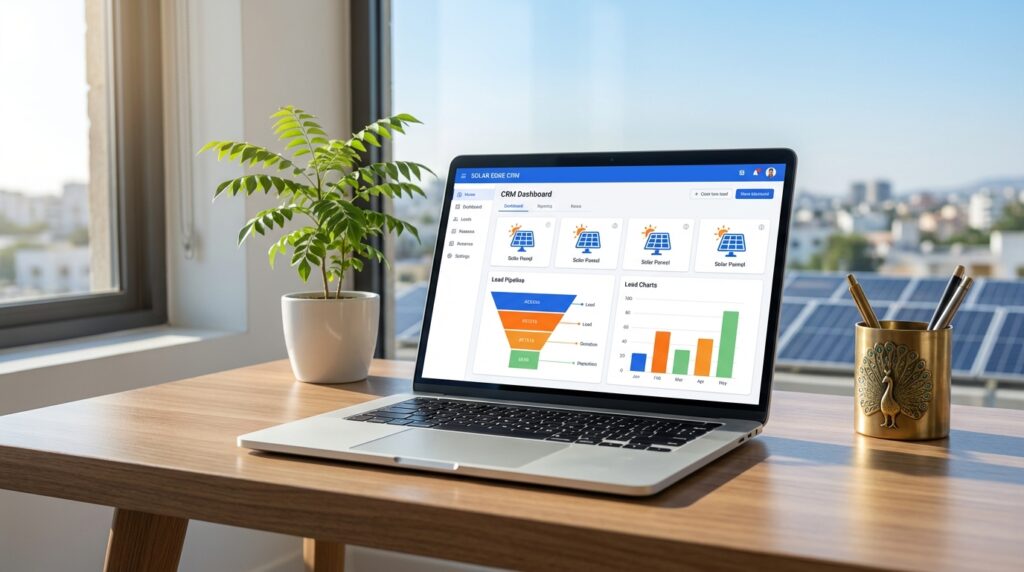
India’s solar energy sector is experiencing unprecedented growth, with the country targeting 500 GW of renewable energy capacity by 2030. As competition intensifies among solar installation companies, EPCs, and sales teams across India, the need for efficient customer relationship management has never been more critical. Solar CRM India solutions are transforming how solar businesses manage leads, create proposals, and close deals in this rapidly expanding market.
For solar businesses operating in India’s dynamic market, managing customer relationships manually is no longer viable. From capturing leads through multiple channels to generating professional proposals and tracking sales pipelines, solar companies need specialized tools designed specifically for their industry’s unique requirements. This comprehensive guide explores everything you need to know about solar CRM software in India—from essential features and implementation strategies to pricing expectations and how these platforms streamline sales operations for Indian solar businesses.
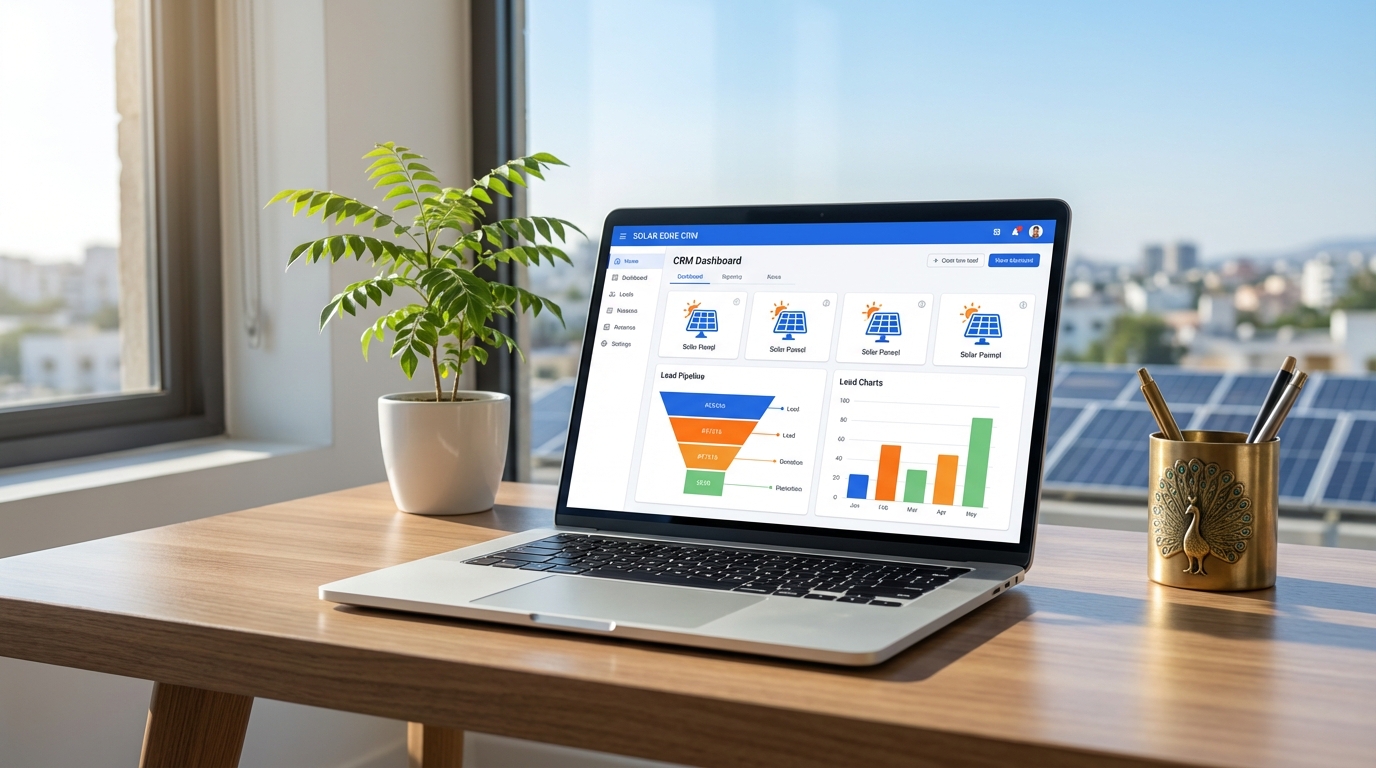
What is Solar CRM Software and Why Indian Solar Businesses Need It
Solar CRM software is a specialized customer relationship management platform designed specifically for solar installation companies, EPCs, and sales teams. Unlike general-purpose CRM systems like Salesforce or Zoho CRM, solar-specific CRM solutions come pre-built with industry-tailored features such as solar proposal generation, project tracking, and workflows optimized for the solar sales cycle.
The Indian solar market has witnessed explosive growth over the past five years, with thousands of new solar installation companies entering the space. This growth has created intense competition, making it essential for solar businesses to differentiate themselves through superior customer experience and operational efficiency. Traditional methods of managing customer relationships—spreadsheets, email threads, and manual follow-ups—simply cannot keep pace with the demands of modern solar sales.
Indian solar businesses face several unique challenges that make specialized CRM solutions particularly valuable:
- High lead volumes from multiple sources: Solar companies receive inquiries from Facebook Ads, Google searches, referrals, and trade shows, making centralized lead management critical
- Complex proposal requirements: Solar proposals involve technical specifications, financial projections, and customized system designs that require professional presentation
- Long sales cycles: Converting a solar lead to a customer often takes weeks or months, requiring consistent follow-up and relationship nurturing
- Mobile workforce: Sales teams frequently work in the field, visiting customer sites and conducting surveys, necessitating mobile-accessible tools
- Team coordination: Solar projects involve multiple stakeholders—sales, technical, and installation teams—requiring seamless collaboration
Solar CRM software addresses these challenges by providing a centralized platform that automates routine tasks, streamlines proposal creation, and provides real-time visibility into sales performance. For Indian solar businesses looking to scale operations and improve conversion rates, implementing a solar-specific CRM has become a competitive necessity rather than a luxury.
Core Features of Solar CRM Software in India
Understanding the essential features of solar CRM India platforms helps businesses evaluate solutions and identify which capabilities will deliver the most value. Modern solar CRM systems offer a comprehensive suite of tools designed to address every stage of the solar sales process.
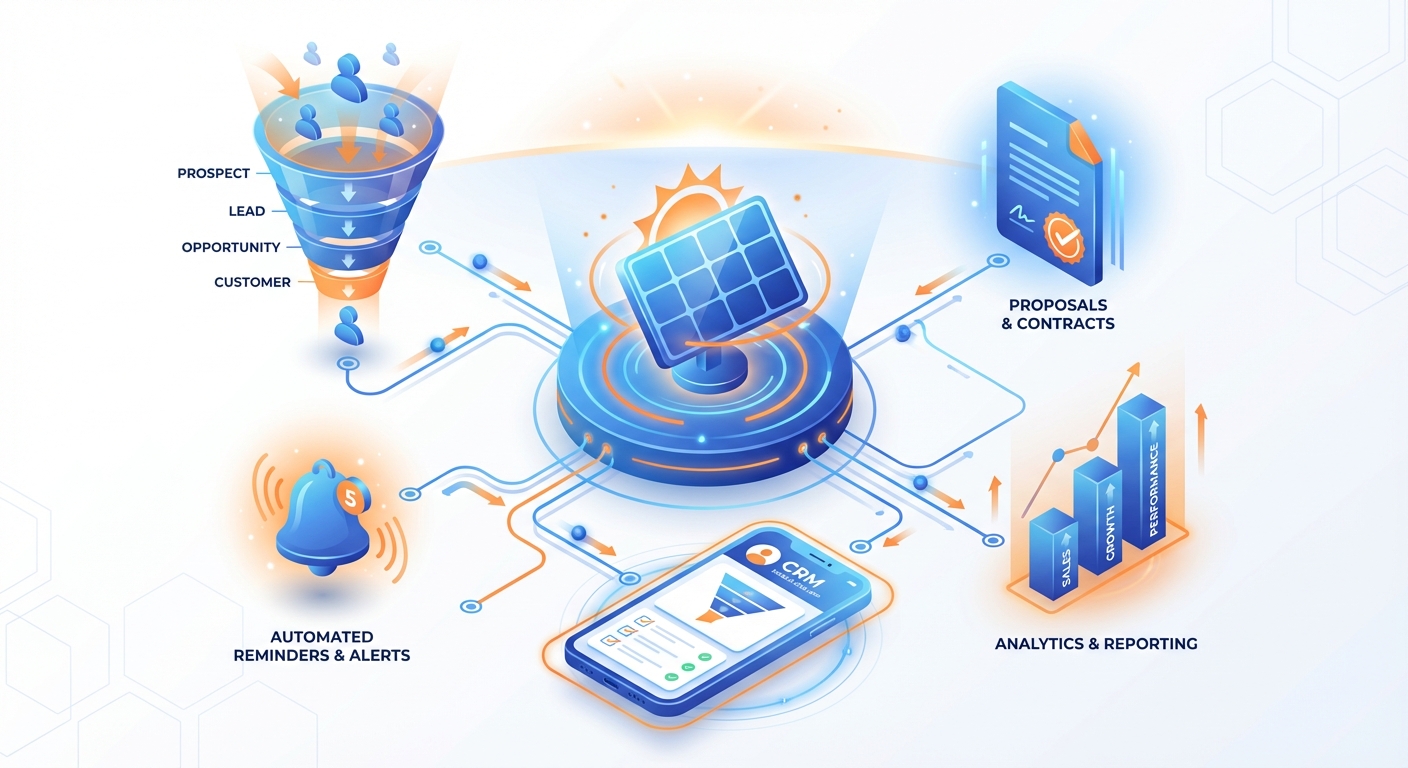
Lead Management and Customer Tracking
Effective lead management forms the foundation of any successful solar CRM implementation. Solar businesses in India need systems that can capture leads from diverse sources and track them through the entire customer journey.
Key lead management capabilities include:
- Multi-channel lead capture: Automatically import leads from Facebook Ads, website contact forms, phonebook contacts, and manual entries into a centralized database
- Bulk lead import: Upload hundreds or thousands of leads from Excel spreadsheets with a single click, eliminating manual data entry
- Lead scoring and prioritization: Automatically rank leads based on engagement level, project size, and likelihood to convert, helping sales teams focus on the most promising opportunities
- Customer journey tracking: Monitor every interaction with potential customers, from initial inquiry through proposal submission, follow-ups, and final conversion
- Lead assignment: Automatically distribute incoming leads to appropriate team members based on location, expertise, or workload
For Indian solar companies managing dozens or hundreds of leads simultaneously, centralized lead management prevents opportunities from falling through the cracks and ensures every potential customer receives timely attention.
Solar Proposal Generation and Quote Management
One of the most time-consuming aspects of solar sales is creating detailed, professional proposals for each potential customer. Traditional proposal creation can take hours or even days, significantly slowing down the sales cycle and reducing the number of quotes a sales team can generate.
Modern solar CRM platforms revolutionize this process with rapid proposal generation capabilities:
- 60-second proposal creation: Generate complete, professional solar proposals in under a minute using pre-built templates and automated calculations
- Customizable templates: Create branded proposal templates that reflect your company’s identity and professional standards
- Technical specifications: Include system size, panel specifications, inverter details, and expected energy generation in proposals
- Financial projections: Automatically calculate ROI, payback periods, and savings projections based on customer usage patterns
- Instant delivery: Send proposals directly to customers via WhatsApp or email immediately after creation, capitalizing on customer interest
- Proposal tracking: Monitor when customers open, view, and engage with proposals to time follow-up communications effectively
The ability to generate and deliver professional proposals within minutes rather than days gives solar businesses a significant competitive advantage in India’s fast-paced market. Platforms like QuickEst enable sales teams to respond to inquiries instantly, dramatically improving conversion rates.
Automated Follow-ups and Sales Workflow
Consistent follow-up is critical in solar sales, where customers often need multiple touchpoints before making a purchase decision. However, manual follow-up systems are prone to human error, with busy sales teams frequently missing critical follow-up opportunities.
Solar CRM platforms solve this challenge through intelligent automation:
- Automated reminder sequences: Set up multi-step follow-up workflows that automatically trigger based on customer actions or time intervals
- Customizable email templates: Create professional email templates for different stages of the sales process—initial contact, proposal follow-up, objection handling, and closing
- Task management: Automatically generate tasks and reminders for sales team members, ensuring no follow-up falls through the cracks
- WhatsApp integration: Leverage India’s most popular communication platform to send automated reminders and updates directly to customers’ phones
- Smart scheduling: Schedule follow-ups at optimal times based on customer engagement patterns and preferences
By automating routine follow-up tasks, solar CRM systems free sales teams to focus on high-value activities like customer consultations and relationship building, while ensuring consistent communication with every prospect.
Analytics and Performance Tracking
Data-driven decision making separates successful solar businesses from those that struggle to scale. Solar CRM platforms provide real-time visibility into sales performance, enabling managers to identify bottlenecks, optimize processes, and forecast revenue accurately.
Essential analytics capabilities include:
- Sales pipeline visualization: View all opportunities at different stages of the sales process in an intuitive visual dashboard
- Conversion rate tracking: Monitor conversion rates at each stage of the funnel to identify where prospects drop off
- Team performance metrics: Track individual and team performance with metrics like proposals sent, follow-up completion rates, and deals closed
- Revenue forecasting: Project future revenue based on pipeline value and historical conversion rates
- Activity tracking: Monitor sales team activities including calls made, emails sent, and meetings scheduled
- Custom reports: Generate detailed reports on any aspect of sales performance for management review and strategic planning
For Indian solar businesses looking to scale operations, these analytics capabilities provide the insights needed to make informed decisions about resource allocation, marketing spend, and sales strategy optimization.
Benefits of Implementing Solar CRM for Indian Solar Companies
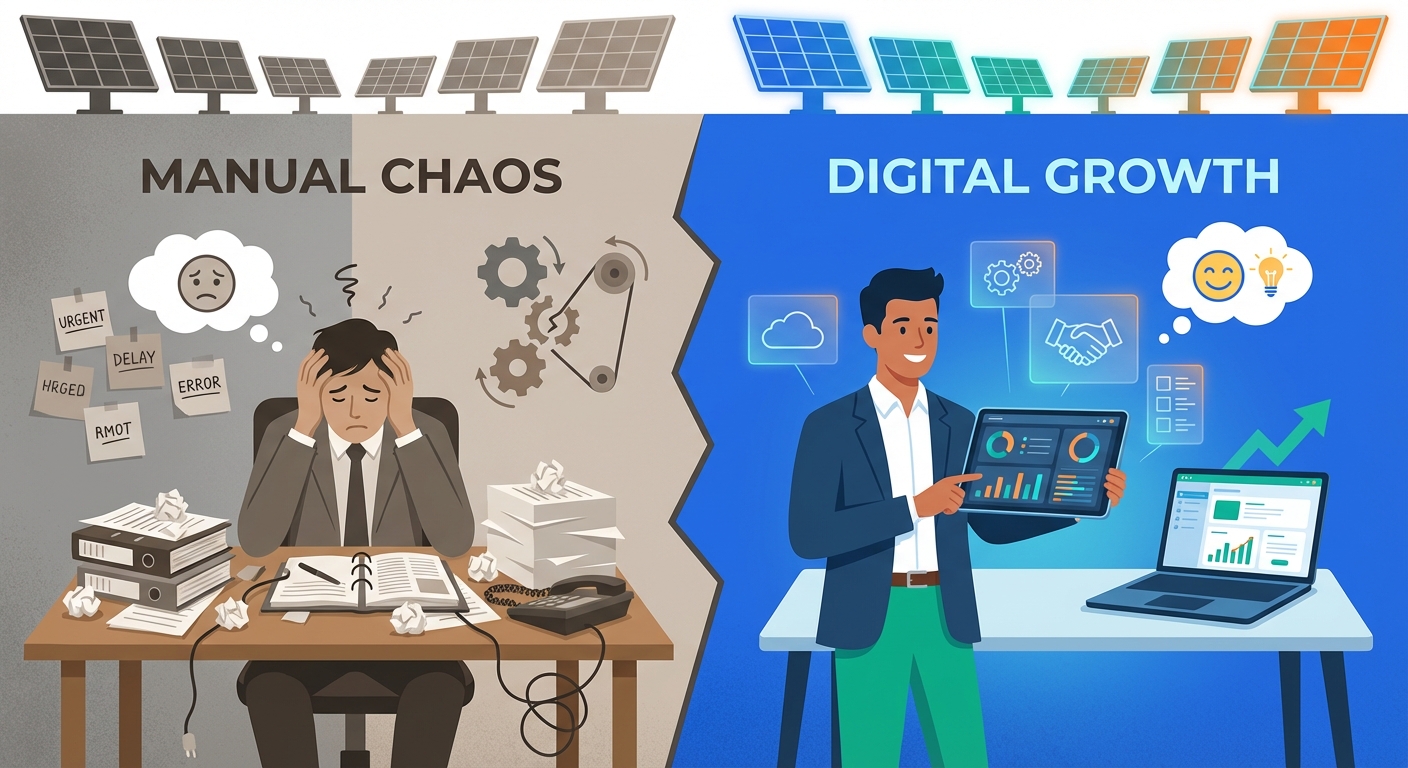
Implementing a specialized solar CRM India solution delivers measurable benefits across every aspect of solar business operations. Companies that adopt solar CRM platforms consistently report significant improvements in sales efficiency, conversion rates, and customer satisfaction.
Faster Sales Cycles and Improved Conversion Rates
Speed matters in solar sales. When a potential customer expresses interest, responding quickly with a professional proposal dramatically increases the likelihood of conversion. Solar CRM platforms enable businesses to respond to inquiries within minutes rather than days, capturing customer interest at its peak.
Companies using solar-specific CRM solutions report:
- 50-70% reduction in proposal creation time
- 30-40% improvement in lead-to-customer conversion rates
- Significantly shorter sales cycles due to automated follow-ups and faster response times
- Higher customer satisfaction from professional, timely communication
Enhanced Team Productivity and Coordination
Solar CRM platforms eliminate the inefficiencies of manual processes and disconnected tools. Sales teams spend less time on administrative tasks and more time engaging with customers. Team collaboration features ensure everyone stays aligned on customer status, project requirements, and next steps.
Productivity benefits include:
- Reduced administrative burden: Automation handles routine tasks like data entry, follow-up reminders, and report generation
- Better team coordination: Centralized information ensures sales, technical, and installation teams all have access to the same customer data
- Mobile accessibility: Field sales teams can access customer information, create proposals, and update records from anywhere using mobile apps
- Streamlined workflows: Pre-built solar sales workflows guide team members through best practices, ensuring consistency across the organization
Better Customer Experience and Professional Image
In India’s competitive solar market, customer experience differentiates successful companies from the rest. Solar CRM platforms enable businesses to deliver consistently professional interactions at every touchpoint.
Customer experience improvements include:
- Professional, branded proposals that build trust and credibility
- Timely follow-ups that demonstrate attentiveness and reliability
- Personalized communication based on customer preferences and history
- Transparent project tracking that keeps customers informed throughout the process
Scalability for Growing Solar Businesses
Manual processes that work for a small solar business quickly become unmanageable as the company grows. Solar CRM platforms provide the infrastructure needed to scale operations without proportionally increasing administrative overhead.
As your solar business expands across India, CRM systems enable you to:
- Manage increasing lead volumes without adding administrative staff
- Maintain consistent quality and processes across multiple locations and teams
- Onboard new sales team members quickly with standardized workflows and training
- Handle larger project pipelines with confidence and visibility
Competitive Advantage in the Indian Solar Market
While many Indian solar companies still rely on spreadsheets and manual processes, businesses that adopt specialized CRM solutions gain a significant competitive edge. The ability to respond faster, follow up more consistently, and present more professional proposals translates directly into winning more business.
In a market where customers often request quotes from multiple solar companies, the business that responds first with a professional proposal typically has the highest chance of winning the project. Solar CRM platforms provide the tools needed to consistently be that first responder.
Solar CRM Implementation Process: Step-by-Step Guide
Successfully implementing solar CRM software requires careful planning and execution. Following a structured implementation process ensures smooth adoption and maximizes the return on your CRM investment.
Step 1: Assess Your Solar Business Needs
Begin by evaluating your current sales processes and identifying specific pain points. Common questions to consider:
- How many leads does your business receive monthly?
- What is your current lead-to-customer conversion rate?
- How long does it take to create and send a solar proposal?
- What percentage of leads receive timely follow-up?
- How many sales team members need CRM access?
- What existing tools and platforms need to integrate with your CRM?
Document your current processes, pain points, and goals to create a clear picture of what you need from a solar CRM solution.
Step 2: Choose the Right Solar CRM Solution
Not all CRM platforms are created equal. For Indian solar businesses, choosing a solar-specific solution like QuickEst offers significant advantages over general-purpose CRM platforms that require extensive customization.
Key evaluation criteria include:
- Solar-specific features: Does the platform include proposal generation, solar project tracking, and industry-specific workflows?
- Ease of use: Can your team start using the platform quickly without extensive training?
- Mobile accessibility: Do field sales teams have full functionality on mobile devices?
- Integration capabilities: Does the CRM integrate with your existing tools like Facebook Ads, email platforms, and accounting software?
- Pricing structure: Does the pricing model fit your budget and scale with your business?
- Customer support: Is quality support available when you need assistance?
Step 3: Data Migration and System Setup
Once you’ve selected a solar CRM platform, the next step involves migrating existing customer data and configuring the system for your business.
Data migration tasks include:
- Cleaning and organizing existing customer data from spreadsheets and other sources
- Importing leads, contacts, and historical project information into the new CRM
- Setting up user accounts and permissions for team members
- Configuring proposal templates with your branding and standard offerings
- Creating custom fields specific to your business requirements
- Setting up integrations with Facebook Ads, email platforms, and other tools
Most modern solar CRM platforms offer bulk import capabilities that make data migration straightforward, even for businesses with thousands of existing customer records.
Step 4: Team Training and Onboarding
User adoption is critical to CRM success. Invest time in comprehensive training to ensure your team understands how to use the platform effectively.
Effective training approaches include:
- Hands-on training sessions covering core features and daily workflows
- Role-specific training for sales representatives, managers, and administrators
- Creating internal documentation and quick reference guides
- Designating CRM champions within your team who can assist others
- Providing ongoing support during the initial adoption period
Step 5: Customize Workflows and Automation
Configure the CRM to match your specific solar sales process. Set up automated workflows for common scenarios:
- New lead assignment and initial contact sequences
- Post-proposal follow-up reminders
- Task creation for site surveys and technical assessments
- Customer onboarding workflows after deal closure
- Automated reporting and performance tracking
Step 6: Testing and Optimization
Before fully rolling out the CRM to your entire team, conduct thorough testing with a small group of users. Identify any issues, gather feedback, and make necessary adjustments.
Step 7: Go Live and Measure Success
Launch the CRM across your entire organization and establish metrics to measure success:
- User adoption rates
- Proposal creation time reduction
- Lead response time improvement
- Conversion rate changes
- Sales cycle length
- Team productivity metrics
Regularly review these metrics and continue optimizing your CRM usage to maximize value.
Pricing Expectations for Solar CRM in India
Understanding the cost structure of solar CRM India solutions helps businesses budget appropriately and evaluate return on investment. Pricing models vary significantly across different platforms and feature sets.
Common Pricing Models
Solar CRM platforms typically use one of several pricing structures:
- Per-user annual pricing: Most common model where businesses pay an annual fee for each user who needs CRM access
- Per-user monthly pricing: Similar to annual pricing but with monthly billing, offering more flexibility
- Tiered pricing: Different feature sets at different price points, allowing businesses to choose the level that matches their needs
- Freemium models: Basic features available for free with paid upgrades for advanced capabilities
Free vs. Paid Plans
Many solar CRM platforms offer free plans that provide basic functionality, making them ideal for small solar businesses or those just starting with CRM software. Free plans typically include:
- Limited number of users (often 1-3)
- Basic lead management capabilities
- Simple proposal generation
- Limited storage and data capacity
- Core features without advanced automation
Paid plans unlock additional capabilities such as:
- Unlimited users or higher user limits
- Advanced automation and workflow customization
- Enhanced analytics and reporting
- Priority customer support
- Integration with more third-party tools
- Increased storage and data capacity
- White-label or advanced branding options
For example, QuickEst offers a FREE PLAN – ₹0 that allows solar businesses to explore the platform’s capabilities without financial commitment, as well as a PRO PLAN – ₹6999 Per User / Year that provides comprehensive features for growing solar businesses.
Cost Comparison: Solar-Specific vs. General CRM
While general-purpose CRM platforms like Salesforce or Zoho CRM may appear competitively priced, the total cost of ownership often exceeds solar-specific solutions when factoring in:
- Customization costs: General CRMs require significant customization to support solar-specific workflows, often requiring expensive consultants
- Training time: Complex general CRMs have steeper learning curves, increasing training costs and reducing productivity during adoption
- Add-on costs: Features that come standard in solar CRMs (like proposal generation) may require expensive add-ons in general platforms
- Maintenance overhead: Custom configurations require ongoing maintenance and updates
Solar-specific CRM platforms deliver better value by providing industry-tailored features out of the box, requiring minimal customization and enabling faster time-to-value.
ROI Considerations
When evaluating solar CRM pricing, consider the return on investment rather than just the upfront cost. Key ROI factors include:
- Time savings: If your sales team saves 10 hours per week on proposal creation and administrative tasks, what is that time worth?
- Increased conversions: If CRM implementation improves your conversion rate by even 5-10%, how much additional revenue does that generate?
- Reduced lost opportunities: What is the value of leads that previously fell through the cracks due to missed follow-ups?
- Scalability: How much would it cost to hire additional administrative staff to manage growing lead volumes without CRM?
For most Indian solar businesses, the ROI from implementing specialized CRM software is realized within the first few months through increased efficiency and higher conversion rates.
Solar CRM vs General CRM: What Makes Solar-Specific Solutions Better
While general-purpose CRM platforms like Salesforce, Zoho CRM, and Pipedrive offer robust functionality, solar-specific CRM solutions provide significant advantages for Indian solar businesses.
Industry-Specific Features Out of the Box
Solar CRM platforms come pre-configured with features designed specifically for solar sales:
- Solar proposal templates: Pre-built templates that include system specifications, energy production estimates, and financial projections
- Solar-specific fields: Data fields for panel types, inverter specifications, system size, and installation details
- Solar sales workflows: Pre-configured workflows that match the typical solar sales cycle from lead to installation
- ROI calculators: Built-in tools for calculating payback periods and savings projections
General CRM platforms require extensive customization to support these features, often requiring expensive consultants and weeks or months of configuration time.
Faster Implementation and Time-to-Value
Solar-specific CRM platforms can be implemented in days rather than weeks or months. Because they’re designed for solar businesses, minimal configuration is required to start generating value.
QuickEst, for example, enables solar businesses to start creating professional proposals within hours of signing up, while implementing Salesforce for solar sales typically requires weeks of customization and configuration.
Lower Total Cost of Ownership
While enterprise CRM platforms may offer more features, most solar businesses don’t need the complexity and pay for capabilities they’ll never use. Solar-specific CRMs provide exactly what solar businesses need at a fraction of the cost.
Better User Adoption
Simpler, purpose-built interfaces designed specifically for solar sales teams result in higher user adoption rates. Sales representatives can learn solar-specific CRM platforms quickly and start using them effectively without extensive training.
Understanding of Indian Solar Market
Solar-specific CRM platforms designed for the Indian market understand local requirements such as:
- WhatsApp integration for customer communication
- Support for Indian pricing and currency
- Understanding of Indian solar policies and incentives
- Mobile-first design for field sales teams
Key Considerations When Choosing Solar CRM Software in India
Selecting the right solar CRM India platform requires careful evaluation of several critical factors that impact long-term success.
Mobile Accessibility for Field Sales Teams
Indian solar sales teams spend significant time in the field conducting site surveys and meeting customers. Your CRM must provide full functionality through mobile apps for both iOS and Android platforms. Essential mobile capabilities include:
- Creating and sending proposals from mobile devices
- Accessing customer information and history on-the-go
- Updating lead status and adding notes from the field
- Receiving notifications and reminders on mobile devices
- Offline functionality for areas with poor connectivity
WhatsApp Integration
WhatsApp is the dominant communication platform in India, with over 500 million users. Solar CRM platforms that integrate with WhatsApp enable businesses to:
- Send proposals directly via WhatsApp for instant delivery
- Communicate with customers on their preferred platform
- Automate WhatsApp messages for follow-ups and reminders
- Track message delivery and engagement
This integration significantly improves response rates and customer engagement compared to email-only communication.
Data Security and Encryption Standards
Customer data security is paramount. Ensure your solar CRM provider implements robust security measures:
- Encryption in transit: TLS 1.2 or higher for data transmission
- Encryption at rest: 256-bit AES encryption for stored data
- Access controls: Role-based permissions to limit data access
- Regular backups: Automated data backups to prevent loss
- Compliance: Adherence to data protection regulations
QuickEst, for example, implements TLS 1.2 and 256-bit AES encryption to ensure customer data remains secure.
Ease of Use and Learning Curve
Complex CRM platforms with steep learning curves result in poor user adoption and wasted investment. Prioritize platforms with intuitive interfaces that sales teams can learn quickly. Look for:
- Clean, uncluttered interface design
- Logical workflow and navigation
- Minimal clicks required for common tasks
- Helpful tooltips and in-app guidance
- Comprehensive but accessible documentation
Customer Support and Training
Quality customer support makes the difference between successful CRM adoption and frustration. Evaluate:
- Support channel availability (email, phone, chat)
- Response time commitments
- Availability of training resources and documentation
- Onboarding assistance for new customers
- Community forums or user groups
Scalability as Your Business Grows
Choose a CRM platform that can grow with your solar business. Consider:
- User limits and pricing for additional users
- Data storage capacity and limits
- Performance with large datasets
- Availability of advanced features as needs evolve
- Multi-location support for geographic expansion
Integration Capabilities
Your CRM should integrate seamlessly with existing tools and platforms:
- Marketing platforms: Facebook Ads, Google Ads for lead capture
- Communication tools: Email platforms, WhatsApp, SMS services
- Accounting software: For invoicing and financial tracking
- Project management tools: For installation coordination
- Automation platforms: Like Pabbly Connect for custom workflows
Platforms with robust integration capabilities enable you to build a connected technology ecosystem that eliminates data silos and manual data transfer.
Common Challenges and How Solar CRM Solves Them
Indian solar businesses face numerous operational challenges that directly impact sales performance and profitability. Solar CRM platforms provide targeted solutions to these common pain points.
Challenge: Slow Proposal Creation
The Problem: Creating detailed solar proposals manually takes hours or days, slowing down the sales cycle and reducing the number of quotes sales teams can generate. By the time a proposal is ready, customers may have already received quotes from competitors.
The Solution: Solar CRM platforms enable 60-second proposal generation using pre-built templates and automated calculations. Sales teams can create and send professional proposals immediately after customer conversations, capitalizing on peak interest and beating competitors to the customer’s inbox.
Challenge: Missed Follow-ups
The Problem: Busy sales teams forget to follow up with prospects, resulting in lost opportunities. Manual reminder systems are unreliable, and leads fall through the cracks when team members are juggling multiple prospects.
The Solution: Automated follow-up systems ensure every prospect receives timely communication. CRM platforms automatically generate reminders, send scheduled emails, and create tasks for sales team members, eliminating the possibility of missed follow-ups.
Challenge: Poor Pipeline Visibility
The Problem: Sales managers lack real-time visibility into pipeline status, making it impossible to forecast revenue accurately or identify bottlenecks in the sales process. Spreadsheet-based tracking becomes outdated as soon as it’s created.
The Solution: Real-time dashboards provide instant visibility into every opportunity in the pipeline. Managers can see exactly where each prospect stands, identify deals at risk, and make data-driven decisions about resource allocation and sales strategy.
Challenge: Disorganized Lead Management
The Problem: Leads arrive from multiple sources—Facebook Ads, website forms, referrals, trade shows—and get scattered across email inboxes, spreadsheets, and sticky notes. This disorganization results in duplicate efforts, missed opportunities, and poor customer experience.
The Solution: Centralized lead management captures all leads in a single database regardless of source. Automated lead assignment ensures appropriate team members receive new leads immediately, and comprehensive tracking prevents duplication and ensures consistent follow-up.
Challenge: Team Coordination Issues
The Problem: Solar projects involve multiple team members—sales representatives, technical surveyors, installation crews—who need to coordinate activities. Poor communication results in scheduling conflicts, duplicated efforts, and customer frustration.
The Solution: Collaboration tools within solar CRM platforms ensure all team members have access to the same customer information. Task assignment, progress tracking, and internal notes keep everyone aligned and informed throughout the customer journey.
Challenge: Unprofessional Proposals
The Problem: Inconsistent proposal formats, typos, and unprofessional presentation damage credibility and reduce conversion rates. Customers comparing multiple solar companies often choose the one with the most professional presentation.
The Solution: Professional, branded proposal templates ensure every quote reflects your company’s quality standards. Automated calculations eliminate errors, and consistent formatting builds trust and credibility with potential customers.
Frequently Asked Questions About Solar CRM in India
What is the difference between solar CRM and regular CRM?
Solar CRM software is specifically designed for solar businesses with pre-built features like solar proposal generation, system design integration, and solar-specific workflows. Regular CRM platforms like Salesforce or Zoho CRM are general-purpose tools that require extensive customization to support solar sales processes. Solar CRM platforms provide industry-specific functionality out of the box, enabling faster implementation and better user adoption.
How long does it take to implement solar CRM software?
Implementation time varies based on the platform and your business complexity. Solar-specific CRM platforms like QuickEst can be implemented in days, with basic functionality available within hours of signing up. General-purpose CRM platforms requiring customization may take weeks or months to implement fully. Most solar businesses can start generating value from solar-specific CRM within the first week of implementation.
Can solar CRM integrate with my existing tools?
Modern solar CRM platforms offer integration capabilities with popular tools and platforms. Common integrations include Facebook Ads for lead capture, email marketing platforms, WhatsApp for customer communication, accounting software, and automation platforms like Pabbly Connect. When evaluating CRM options, verify that the platform integrates with your critical existing tools to ensure seamless data flow across your technology stack.
Is mobile access available for field sales teams?
Yes, quality solar CRM platforms provide full-featured mobile apps for both iOS and Android devices. Mobile access enables field sales teams to access customer information, create proposals, update lead status, and manage tasks from anywhere. This capability is particularly important for Indian solar businesses where sales representatives spend significant time conducting site surveys and meeting customers at their locations.
How secure is my customer data in a solar CRM?
Reputable solar CRM providers implement robust security measures including encryption in transit (TLS 1.2 or higher), encryption at rest (256-bit AES), role-based access controls, and regular automated backups. When evaluating CRM platforms, ask about their security certifications, data backup procedures, and compliance with data protection regulations. Ensure the provider takes data security seriously and implements industry-standard protection measures.
What kind of training is required for my team?
Training requirements vary based on platform complexity. Solar-specific CRM platforms with intuitive interfaces typically require minimal training—often just a few hours of hands-on practice for sales team members to become proficient. Most providers offer training resources including video tutorials, documentation, and onboarding assistance. Plan for initial training sessions covering core features, followed by ongoing support as team members encounter new scenarios and advanced features.
Can I try solar CRM before committing to a paid plan?
Many solar CRM providers offer free trials or free plans that allow you to explore the platform before making a financial commitment. Free plans typically include basic features with limitations on users or data capacity, providing an excellent way to evaluate whether the platform meets your needs. Take advantage of these trial opportunities to test the platform with your actual sales processes and team members before upgrading to paid plans.
Getting Started with Solar CRM: Next Steps for Your Business
Implementing solar CRM software represents a significant opportunity to transform your solar business operations, improve sales efficiency, and accelerate growth in India’s competitive solar market. Taking the first steps toward CRM adoption doesn’t need to be overwhelming.

Evaluate Your Current Sales Process
Begin by documenting your existing sales workflow and identifying specific pain points. Where do leads get lost? How long does proposal creation take? What percentage of leads receive consistent follow-up? Understanding your current state provides a baseline for measuring CRM impact and helps you prioritize which features will deliver the most value.
Explore Available Solar CRM Options
Research solar CRM platforms available in the Indian market. Compare features, pricing, and user reviews. Pay particular attention to platforms designed specifically for solar businesses rather than general-purpose CRM systems requiring extensive customization.
QuickEst offers a comprehensive solar CRM solution designed specifically for Indian solar businesses, with features including 60-second proposal generation, automated follow-ups, real-time analytics, and mobile accessibility. The platform addresses the unique challenges faced by solar installation companies, EPCs, and sales teams operating in India’s dynamic market.
Start with Free Trials or Free Plans
Take advantage of free trials or free plans to test platforms with your actual sales processes. Involve your sales team in the evaluation to ensure the platform meets their needs and has an intuitive interface they’ll actually use. Testing with real data and workflows provides much better insights than product demonstrations alone.
QuickEst offers a FREE PLAN – ₹0 that allows you to explore the platform’s capabilities without financial risk, making it easy to evaluate whether the solution fits your business needs.
Set Clear Goals and Success Metrics
Define what success looks like for your CRM implementation. Common goals include:
- Reduce proposal creation time by 50%
- Improve lead-to-customer conversion rate by 20%
- Ensure 100% of leads receive timely follow-up
- Increase number of proposals sent per sales representative by 30%
- Achieve 90% user adoption within first month
Clear metrics enable you to measure ROI and demonstrate the value of your CRM investment to stakeholders.
Plan Your Implementation Timeline
Create a realistic implementation timeline that includes:
- Platform selection and procurement (1-2 weeks)
- Data migration and system setup (1 week)
- Team training and onboarding (1-2 weeks)
- Testing and optimization (1 week)
- Full rollout and ongoing support (ongoing)
Building buffer time into your timeline accounts for unexpected challenges and ensures a smooth implementation process.
Take Action Today
The competitive advantage gained from implementing solar CRM software compounds over time. Every day without CRM represents missed opportunities, lost leads, and inefficient processes. The solar businesses that thrive in India’s growing market are those that embrace technology to streamline operations and deliver superior customer experiences.
Ready to transform your solar business operations? Explore how QuickEst can help you streamline sales processes, create professional proposals in 60 seconds, and close more deals. Start with the FREE PLAN – ₹0 to experience the platform’s capabilities, or upgrade to the PRO PLAN – ₹6999 Per User / Year for comprehensive features designed specifically for growing solar businesses in India.
For personalized guidance on implementing solar CRM for your specific business needs, Contact Us to speak with a solar CRM specialist who understands the unique challenges and opportunities in India’s solar market.
The future of solar sales in India is digital, automated, and customer-centric. Solar CRM software provides the foundation for building a scalable, efficient sales operation that can compete and win in this dynamic market. Don’t let manual processes and disorganized workflows hold your solar business back—unlock your sales potential with specialized solar CRM technology designed for Indian solar businesses.