

Every solar company has a goldmine sitting untapped in its customer database. Satisfied customers who love their solar installation are willing to refer friends, family, and colleagues — but most solar businesses never ask in a structured way. The result? Referral programs that exist in theory but generate almost nothing in practice. In 2026, the solar companies pulling ahead are the ones using CRM-integrated referral programs to turn every completed installation into a repeatable lead generation engine. This case study breaks down exactly how they do it, what results they’re seeing, and how you can replicate the same system for your solar business.

The Referral Opportunity Solar Companies Are Missing
Word-of-mouth is the highest-converting lead source in the solar industry. A homeowner who installs solar and saves money on electricity bills is naturally enthusiastic. They talk to neighbors, post on WhatsApp groups, and recommend their installer to anyone who asks. According to the Solar Energy Industries Association, referred leads in the solar sector convert at 3 to 5 times the rate of cold outbound leads. That’s a massive advantage — and most solar companies are leaving it on the table.
The problem isn’t that customers won’t refer. The problem is that referral programs without a CRM backbone are invisible. A sales rep might mention referrals during installation handoff, a customer might send a friend’s number over WhatsApp, and then that lead disappears into someone’s personal phone. There’s no tracking, no follow-up system, and no way to measure what’s working. Referrals happen by accident rather than by design.
This is where CRM-integrated referral programs change everything. When your referral process lives inside your CRM, every referral is captured, tagged, assigned, and nurtured automatically. You know which customers are referring, which referral leads are converting, and what incentives are driving the most activity. The difference between a solar company generating 5 referral leads a month and one generating 50 is almost always the presence of a structured, CRM-powered referral system.
What CRM-Integrated Referral Programs Actually Look Like
A CRM-integrated referral program is not a separate app or a loyalty card system. It’s a set of workflows, tags, pipeline stages, and automated messages that live inside your existing CRM and turn your customer base into an active referral network. Here’s what the core components look like in practice.
Referral Tracking and Tagging
Every customer who completes an installation gets tagged in the CRM as a potential referral source. When they send a new lead your way, that lead is created in the CRM with a “Referral” source tag and linked back to the referring customer. This creates a clean data trail that lets you see exactly how many leads each customer has generated and what the conversion rate looks like for referral-sourced leads versus other channels.
Incentive Management
Referral incentives — whether cash rewards, bill credits, or gifts, are tracked directly in the CRM against each referring customer. When a referral lead converts to a sale, the CRM triggers a task or notification to fulfill the incentive. This removes the manual overhead of tracking who gets rewarded and ensures no customer is left waiting for a promised reward, which would damage trust and kill future referrals.
Automated Follow-Up Sequences
Referral leads are often warm but not immediately ready to buy. A CRM-powered referral program includes automated follow-up sequences that send timely messages via WhatsApp or email, keeping the referral lead engaged until they’re ready to move forward. This is the piece most solar companies miss entirely when they try to run referral programs manually. For a deeper look at how follow-up automation works in the Indian solar market, see our guide on follow-up automation for Indian solar businesses.
Manual vs. CRM-Powered Referral Tracking
Without a CRM, referral tracking means spreadsheets, sticky notes, and WhatsApp messages that get buried. With a CRM, every referral is a structured record with a source, a status, an assigned sales rep, and a follow-up schedule. The operational difference is enormous, and it shows up directly in conversion rates and revenue.
Case Study: How a Solar EPC Scaled Referral Programs with CRM
Consider a mid-sized solar EPC company managing over 200 residential and commercial installations per year. Before implementing a CRM-integrated referral program, the company was receiving occasional referrals through informal channels, a customer mentioning a friend, a WhatsApp message forwarded to a sales rep’s personal number. These leads were inconsistent, often lost, and impossible to measure.
The Problem
The sales team had no visibility into how many referral leads were coming in, which customers were sending them, or what happened to those leads after initial contact. Referral incentives were promised verbally but tracked in a separate spreadsheet that was rarely updated. Customers who referred friends sometimes never received their promised reward, leading to frustration and a reluctance to refer again. The company knew referrals were valuable but had no system to scale them.
The Solution
The company implemented a CRM with dedicated referral program workflows. Every post-installation customer received an automated WhatsApp message 30 days after installation, thanking them for their business and explaining the referral incentive program. Referral leads were captured through a simple form linked in the message and automatically created in the CRM with the referring customer tagged. A dedicated “Referral” pipeline stage was created so the sales team could prioritize these high-quality leads. Incentive fulfillment was tracked as a CRM task triggered automatically when a referral lead converted.
The Results
Within six months, the company saw a 40% increase in referral-sourced leads. More importantly, referral leads converted at a rate 4 times higher than leads from paid digital advertising, at a fraction of the cost per acquisition. The sales team spent less time chasing cold leads and more time closing warm referrals. Customer satisfaction scores also improved because customers felt valued and were reliably rewarded for their referrals.
“Once we had a system in place, referrals stopped being a nice surprise and became a predictable part of our monthly lead flow. The CRM made it possible to scale something that used to be completely ad hoc.”
This kind of result is not unique to large solar companies. Any solar business with a satisfied customer base and the right CRM setup can replicate this outcome. The key is moving from informal referral conversations to a structured, automated system.
5 Referral Program Strategies Solar Companies Use Inside Their CRM
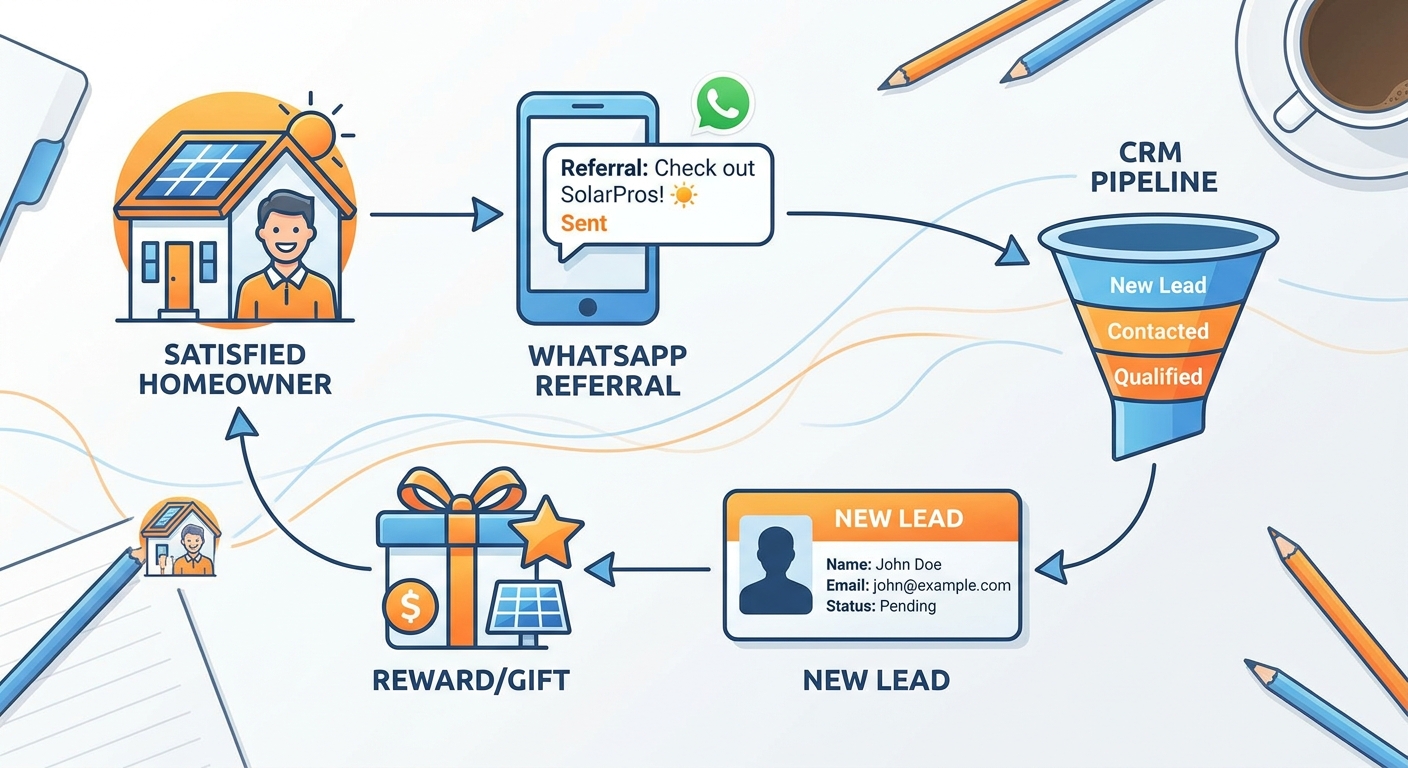
The most successful solar referral programs in 2026 share a common set of CRM-powered strategies. Here are the five that consistently drive the highest results.
1. Tag and Segment Satisfied Customers as Referral Sources
Not every customer is equally likely to refer. Customers who gave positive feedback, paid on time, and had a smooth installation experience are your best referral candidates. In your CRM, create a tag like “High Satisfaction” or “Referral Ready” and apply it to these customers after installation. This gives you a targeted segment to activate with referral program messaging rather than blasting your entire customer base.
2. Automate Referral Request Messages Post-Installation
Timing matters. The best moment to ask for a referral is when the customer is most excited, typically 30 to 60 days after installation, when they’ve seen their first reduced electricity bill. Set up an automated WhatsApp or email message in your CRM that goes out at this exact moment, explaining the referral program and making it easy to share a contact. A well-timed, personalized message converts far better than a generic ask months later.
3. Track Referral Leads in a Dedicated Pipeline Stage
Create a dedicated “Referral Lead” stage in your CRM pipeline. This does two things: it ensures referral leads are prioritized by the sales team (because they’re high-quality and warm), and it gives you clean data on referral lead volume and conversion rates. When referral leads are mixed in with all other leads, their performance is invisible. Separating them makes their value measurable and actionable.
4. Manage Incentives and Rewards Within the CRM
Every referral incentive should be tracked as a CRM record linked to the referring customer. When a referral converts, the CRM automatically creates a task to fulfill the incentive, whether that’s processing a cash transfer, applying a bill credit, or sending a gift. This removes the risk of forgotten rewards and builds the trust that drives repeat referrals. Customers who are reliably rewarded refer more often.
5. Use Analytics to Identify Top Referrers and Double Down
Your CRM analytics will quickly reveal that a small percentage of customers generate the majority of your referrals. These “super referrers” deserve special attention, a personal thank-you call, an enhanced incentive, or early access to new services. Use your CRM’s reporting dashboard to identify these customers monthly and create a VIP referral segment. Investing in your top referrers delivers compounding returns over time.
For more strategies on converting leads at a higher rate once they enter your pipeline, see our article on proven ways to boost sales conversion in solar.
How Referral Programs Fit Into Your Solar CRM Lead Management
One of the biggest mistakes solar companies make with referral programs is treating them as a separate initiative from their main sales process. In reality, referral leads should flow directly into your CRM lead management pipeline, where they receive the same structured nurturing as any other lead, just with higher priority and a personalized touch.
Integrating Referral Leads Into the Main Pipeline
When a referral lead enters your CRM, it should be automatically tagged with its source, linked to the referring customer, and assigned to a sales rep based on territory or availability. This happens in seconds with the right CRM setup, ensuring no referral lead sits unattended. The referring customer’s record is also updated to reflect the new referral, keeping your incentive tracking accurate.
Responding to Referral Leads Within 60 Seconds
Speed matters enormously with referral leads. A referred prospect has already heard good things about your company from someone they trust, but if you take 24 hours to respond, that enthusiasm fades. With proposal automation built into your CRM, your sales team can send a professional, branded solar proposal to a referral lead within 60 seconds of first contact via WhatsApp or email. This immediate responsiveness reinforces the positive impression the referring customer created and dramatically increases the chance of conversion.
Platforms like QuickEstimate are built specifically for this use case, enabling solar sales teams to generate and send professional proposals in under a minute, directly from the CRM interface, without switching between tools.
Nurturing Referral Leads with Targeted Follow-Up
Not every referral lead will convert immediately. Some need time to research, compare options, or get approval from a spouse or business partner. Your CRM’s automated follow-up sequences should be configured to send relevant content to referral leads at regular intervals, a case study of a similar installation, a breakdown of expected savings, or a limited-time consultation offer. This keeps your company top of mind without requiring manual effort from your sales team.
Tracking Referral Lead Conversion Rates
Your CRM’s analytics dashboard should show you, at a glance, how referral leads perform compared to leads from other sources. In most solar businesses, referral leads convert at 2 to 5 times the rate of cold leads. Seeing this data clearly motivates the sales team to prioritize referral follow-ups and gives management the evidence needed to invest more in the referral program. For a comprehensive look at managing leads effectively, explore our resource on CRM implementation in India.
Measuring the ROI of Solar Referral Programs
One of the most compelling arguments for investing in CRM-integrated referral programs is the ROI. Referral leads cost a fraction of what paid advertising leads cost, and they convert at a much higher rate. But you can only prove this, and optimize for it, if you’re measuring the right metrics inside your CRM.
Key Metrics to Track
- Referral lead volume: How many new leads are coming in through referrals each month?
- Referral conversion rate: What percentage of referral leads convert to paying customers?
- Cost per referral lead: Total incentive costs divided by the number of referral leads generated.
- Referral revenue contribution: What percentage of total monthly revenue comes from referral-sourced customers?
- Top referrer identification: Which customers are generating the most referrals?
- Incentive fulfillment rate: Are all promised rewards being delivered on time?
CRM Dashboards That Surface Referral Performance
A well-configured CRM dashboard gives sales managers a real-time view of all these metrics without manual reporting. When referral program performance is visible alongside other lead sources, it’s easy to see the relative value of referrals and make data-driven decisions about where to invest sales and marketing resources. This is a core advantage of CRM-integrated referral programs over informal referral efforts.
Real-World ROI Benchmarks for Solar Referral Programs in India
In the Indian solar market, where customer acquisition costs through digital advertising have risen significantly in recent years, referral programs offer a compelling alternative. Solar companies with structured CRM referral programs typically report a cost per referral lead that is 60 to 80% lower than their cost per paid advertising lead. When you factor in the higher conversion rate of referral leads, the ROI advantage is even more pronounced. According to research published by Harvard Business Review, referred customers have a 16% higher lifetime value than non-referred customers, a finding that holds true across B2B and B2C contexts, including solar.
Using Data to Optimize Incentive Structures
Your CRM data will tell you which incentive structures drive the most referral activity. Some customers respond better to cash rewards; others prefer bill credits or service upgrades. By tracking referral activity against incentive type in your CRM, you can optimize your program over time to maximize referral volume while managing costs. This data-driven approach to referral programs is only possible when your program lives inside a CRM with robust analytics.
To understand how CRM costs compare and what you’re really getting for your investment, read our breakdown of solar CRM software costs.
Setting Up Referral Programs in Your Solar CRM: Step-by-Step
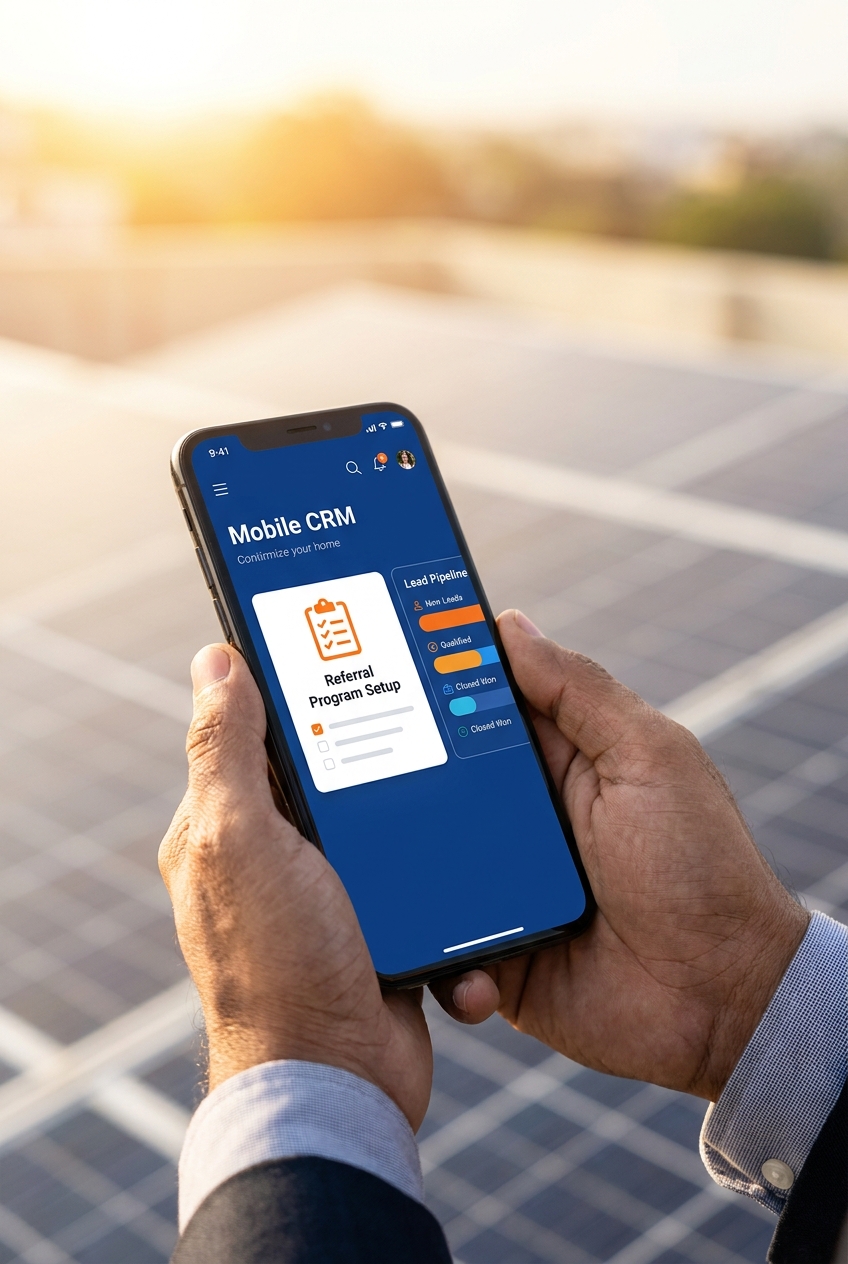
Ready to build a CRM-integrated referral program for your solar business? Here’s a practical, step-by-step setup guide you can implement in a week.
Step 1: Identify and Tag Your Happiest Customers
Start by reviewing your CRM for customers who completed installations in the last 12 months with positive outcomes, on-time delivery, positive feedback, no major complaints. Tag these contacts as “Referral Ready” in your CRM. This is your initial activation segment. Aim for at least 50 to 100 contacts to start seeing meaningful referral volume.
Step 2: Create a Referral Request Message Template
Write a short, friendly WhatsApp or email message that explains your referral program clearly. Include: what the customer gets for referring (the incentive), how easy it is to refer (a simple form or just sharing a contact), and a genuine thank-you for their business. Save this as a template in your CRM so it can be sent at scale with personalization tokens for the customer’s name and installation details.
Step 3: Set Up a Dedicated Referral Pipeline Stage
In your CRM pipeline, create a new stage called “Referral Lead” or “Referred Prospect.” Configure the CRM to automatically move any lead tagged with “Referral” source into this stage upon creation. Set up a notification to alert the assigned sales rep immediately when a new referral lead enters this stage, so response time stays under an hour.
Step 4: Configure Automated Follow-Up Sequences
Build a follow-up sequence specifically for referral leads. A simple three-touch sequence works well: an immediate welcome message acknowledging the referral, a follow-up with a proposal or consultation offer at day 3, and a check-in message at day 7 if there’s been no response. Your CRM should handle all of this automatically, freeing your sales team to focus on conversations rather than scheduling.
Step 5: Define and Track Incentive Fulfillment
Create a CRM workflow that triggers an incentive fulfillment task when a referral lead converts to a sale. Assign this task to the appropriate team member (finance, operations, or sales manager) with a deadline. Track fulfillment status in the referring customer’s CRM record so you always know who has been rewarded and who is still waiting. Never let a promised incentive go unfulfilled, it’s the fastest way to kill your referral program.
Step 6: Review Referral Analytics Monthly and Optimize
Set a monthly calendar reminder to review your referral program metrics in the CRM dashboard. Look at referral lead volume, conversion rate, top referrers, and incentive fulfillment rate. Use this data to adjust your messaging, timing, and incentive structure. The solar companies with the strongest referral programs treat them as living systems that improve continuously, not set-and-forget campaigns.
Frequently Asked Questions About Solar CRM Referral Programs
Do I need a special CRM feature for referral programs?
Not necessarily. Most modern CRMs, including platforms designed for solar businesses, have the core features needed to run effective referral programs: contact tagging, pipeline customization, automated messaging, and analytics. The key is configuring these features specifically for referral workflows rather than using a generic setup. A solar-specific CRM will make this easier because it’s already built around the solar sales process.
How do I incentivize customers without cutting into margins?
The most effective referral incentives don’t have to be expensive. Bill credits, priority service, or a small cash reward can be highly motivating. The key is to calculate your customer acquisition cost for other channels, if you’re spending a significant amount per lead on digital advertising, even a modest referral incentive is a bargain. Track your cost per referral lead in the CRM and compare it to your other channels to find the right incentive level.
How long before referral programs show results?
Most solar companies see meaningful referral lead volume within 60 to 90 days of launching a structured CRM referral program. The first month is typically spent setting up the system and activating the initial customer segment. By month two, referral leads start flowing in. By month three, you’ll have enough data to optimize your messaging and incentives for better results.
Can small solar companies benefit from CRM referral programs?
Absolutely. In fact, small solar companies often see the highest relative impact from referral programs because they have tight marketing budgets and rely heavily on reputation. Even a customer base of 50 to 100 satisfied customers can generate a consistent stream of referral leads if the program is structured correctly. A CRM makes this manageable for a small team without adding significant administrative overhead.
How does QuickEstimate help with referral program management?
QuickEstimate is a solar CRM and proposal generation platform built specifically for solar EPCs, installers, and B2B sales teams in India. It includes lead management, automated follow-up sequences, pipeline customization, and real-time analytics, all the tools needed to run effective referral programs without stitching together multiple software solutions. The platform’s 60-second proposal generation is particularly valuable for referral leads, where fast response times are critical to conversion. Over 1,000 solar businesses, including Sunnovative, Heaven Solar, JJ Solar, and Tata Power, use QuickEstimate to manage their sales processes. To understand how to evaluate CRM options for your business, see our guide on CRM scalability questions to ask before you buy.
Start Turning Your Satisfied Customers Into a Referral Lead Engine
The solar companies generating 40% more leads from referral programs in 2026 aren’t doing anything magical. They’ve simply built a structured, CRM-integrated system that captures every referral opportunity, nurtures every referral lead, and rewards every referring customer reliably. The result is a predictable, low-cost lead source that compounds over time as your customer base grows.
If your solar business has satisfied customers but no structured referral program, you’re leaving your highest-quality leads on the table. The good news is that with the right CRM setup, you can have a fully functional referral program running within a week. QuickEstimate gives you the lead management, automated follow-ups, proposal generation, and analytics you need to make referral programs a core part of your solar sales strategy, not an afterthought.
Ready to build a referral program that actually generates leads? Start with QuickEstimate’s FREE Plan at ₹0 and set up your first referral workflow today. If you’re ready to unlock the full power of solar CRM automation, the PRO Plan at ₹6,999 per user per year gives you everything you need to scale your referral programs alongside your entire sales operation. Have questions about which plan fits your business? Contact our team and we’ll help you find the right setup for your solar company’s goals.
This blog post was written using thestacc.com