

Why Workflow Automation Is Critical for Solar Sales Teams in 2026
Solar sales teams face mounting pressure in 2026. Competition intensifies daily, customer expectations rise, and the complexity of managing leads, proposals, and follow-ups grows exponentially. The average solar sales representative spends 65% of their time on administrative tasks rather than actually selling. This inefficiency doesn’t just waste time—it costs real revenue.
Every missed follow-up represents a potential lost deal. Every delayed proposal gives competitors an opportunity to swoop in. Every manual data entry task pulls your best salespeople away from what they do best: building relationships and closing deals. This is where workflow automation becomes not just helpful, but essential for survival and growth.

Workflow automation transforms how solar sales teams operate by eliminating repetitive manual tasks, ensuring consistent follow-through, and providing real-time visibility into every opportunity. Companies implementing comprehensive workflow automation report 30-50% increases in sales productivity and significant reductions in lost opportunities due to human error or oversight.
The solar industry’s unique challenges—long sales cycles, technical complexity, multiple stakeholder involvement, and price sensitivity—make automation even more critical. When your team can automatically route leads, trigger follow-ups, generate proposals in seconds, and sync data across platforms, they gain hours each day to focus on high-value activities that actually move deals forward.
This comprehensive guide explores ten essential workflow automation processes that solar sales teams can implement immediately to save time, prevent missed opportunities, and dramatically increase closing rates. Each automation addresses specific pain points that solar businesses face daily, with practical implementation steps you can apply to your own sales operations.
1. Automated Lead Assignment and Distribution
The moment a lead enters your system determines how quickly your team responds—and response speed directly impacts conversion rates. Studies show that leads contacted within five minutes are 21 times more likely to convert than those contacted after 30 minutes. Manual lead assignment creates delays, confusion, and territorial disputes that slow everything down.
Automated lead assignment eliminates these bottlenecks by instantly routing incoming leads to the right sales representative based on predefined rules. Round-robin distribution ensures fair lead allocation across your team, preventing burnout for top performers and keeping everyone engaged. Territory-based assignment routes leads by geographic location, ensuring local expertise and reducing travel time for site visits.
Implementation starts with defining your assignment criteria. Consider factors like lead source, project size, geographic location, and current workload. Solar EPCs often use hybrid approaches—routing commercial leads to experienced reps while distributing residential leads evenly across the team.
QuickEst’s automated lead distribution system instantly notifies assigned sales reps via mobile app and email the moment a new lead arrives. This immediate notification, combined with automatic assignment, ensures no lead sits unattended. The system tracks response times and provides managers with visibility into which reps engage quickly and which need coaching.
Advanced automation includes overflow rules that reassign leads if the primary rep doesn’t respond within a set timeframe, and workload balancing that considers each rep’s current pipeline before assigning new opportunities. These intelligent routing systems ensure optimal resource utilization while maximizing response speed.
2. Intelligent Follow-Up Sequences
Solar sales cycles typically span 30-90 days, requiring multiple touchpoints before prospects make decisions. The challenge? Manually tracking and executing consistent follow-ups across dozens or hundreds of prospects becomes impossible as your pipeline grows. Sales reps forget follow-ups, timing becomes inconsistent, and promising opportunities slip through the cracks.
Intelligent follow-up automation solves this by creating trigger-based sequences that execute automatically based on prospect behavior and timeline. When a prospect receives a proposal, the system automatically schedules follow-up emails for days 2, 5, and 10. When a prospect opens your proposal, it triggers an immediate notification to the sales rep to call while interest is high.
The most effective follow-up sequences combine multiple channels. Start with email for initial outreach, follow with WhatsApp messages for more personal engagement, and schedule phone call reminders for high-value opportunities. This multi-channel approach increases touchpoint effectiveness while maintaining professional persistence without being pushy.
QuickEst’s automated follow-up system allows solar teams to create customizable email templates with merge fields that personalize each message. The system tracks engagement, opens, clicks, and responses, and adjusts follow-up timing accordingly. If a prospect engages with your content, the system can accelerate the sequence. If they remain unresponsive, it can space out touchpoints to avoid overwhelming them.
Best practices for solar follow-up automation include providing value in each touchpoint rather than just checking in. Share relevant case studies, address common objections, highlight incentive deadlines, or provide energy-saving tips. Each automated message should move the conversation forward, not just remind prospects you exist.
Set up reminder notifications for your sales team that alert them when it’s time for personal outreach. While automation handles routine touchpoints, human connection remains essential for closing solar deals. The automation ensures nothing falls through the cracks while freeing reps to focus on meaningful conversations.
3. Instant Proposal Generation and Delivery
Proposal creation traditionally consumes hours of valuable selling time. Sales reps gather information, input data into templates, format documents, calculate pricing, add terms and conditions, and finally send proposals, often taking 2-4 hours per proposal. In fast-moving solar markets, this delay costs deals to competitors who respond faster.
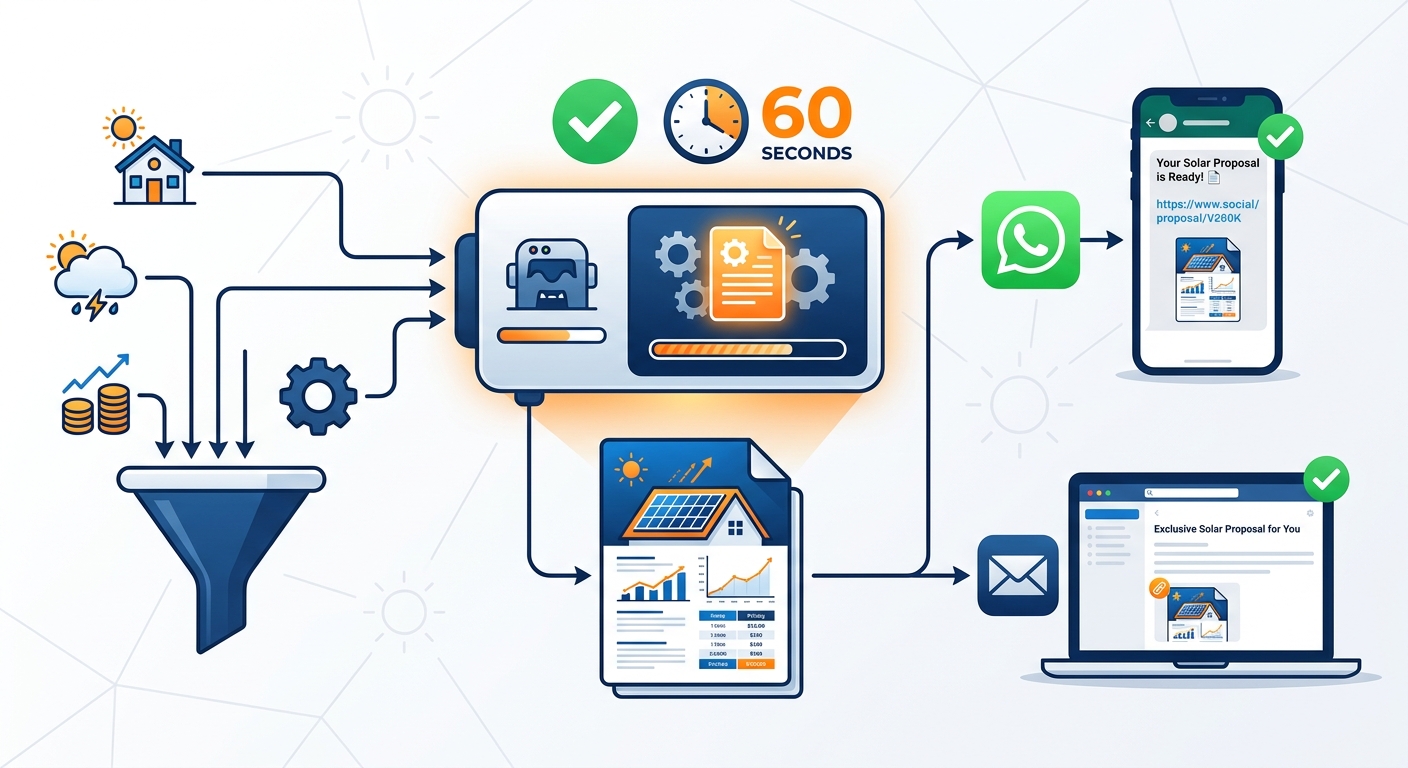
Automated proposal generation transforms this process by pulling lead data directly from your CRM and populating professional templates instantly. System details, pricing calculations, financing options, and company information auto-fill based on the opportunity parameters. What once took hours now takes seconds.
QuickEst enables solar sales teams to generate and send professional proposals within 60 seconds via WhatsApp or email. The platform maintains a library of customizable proposal templates branded to your company, ensuring consistency while allowing flexibility for different project types, residential rooftop, commercial installations, or ground-mounted systems.
Implementation begins with creating template libraries for your common project types. Include standard sections like system specifications, energy production estimates, financial analysis, warranty information, and installation timeline. Use merge fields to automatically populate customer-specific details, ensuring accuracy while maintaining speed.
Advanced proposal automation includes dynamic pricing calculations based on system size, component selection, and current material costs. The system can automatically apply seasonal promotions, financing terms, or government incentive calculations without manual intervention. This ensures pricing accuracy while eliminating calculation errors that damage credibility.
Delivery automation extends beyond just sending the proposal. The system tracks when prospects open proposals, how long they spend reviewing each section, and whether they share it with others. These engagement signals trigger automatic notifications to sales reps, enabling timely follow-up when interest peaks. Some systems even enable prospects to accept proposals digitally, streamlining the entire closing process.
The competitive advantage is clear: while your competitors spend hours creating proposals, your team responds in minutes, demonstrating professionalism and efficiency that builds trust. This speed advantage, combined with consistent quality, significantly improves conversion rates and shortens sales cycles.
4. Automatic Task Creation and Assignment
Solar sales involve numerous coordinated activities, site surveys, engineering reviews, permit applications, financing approvals, and installation scheduling. Managing these tasks manually across multiple deals creates chaos, missed deadlines, and frustrated customers. Sales managers struggle to maintain visibility into what’s actually happening across their team.
Automatic task creation eliminates this complexity by generating and assigning tasks based on pipeline stage triggers. When a deal moves to “Proposal Sent,” the system automatically creates a task for the sales rep to follow up in two days. When a deal reaches “Contract Signed,” it creates tasks for the operations team to schedule site surveys and begin permit applications.
This trigger-based approach ensures nothing falls through the cracks while maintaining accountability. Each task includes clear descriptions, due dates, priority levels, and assigned owners. Team members receive notifications when tasks are assigned, when deadlines approach, and when dependencies are completed.
Implementation requires mapping your sales process stages and identifying the critical activities required at each stage. For solar sales, typical automated tasks include:
- Initial contact within 5 minutes of lead assignment
- Qualification call scheduled within 24 hours
- Site assessment booked after qualification
- Proposal delivery within 48 hours of site visit
- Follow-up calls at days 2, 5, and 10 after proposal
- Contract review when customer indicates readiness
- Installation scheduling after contract signing
QuickEst’s task automation system allows managers to create workflow templates that automatically generate task sequences when deals enter specific stages. The platform provides real-time visibility into task completion rates, overdue items, and team workload distribution. This transparency enables proactive management rather than reactive firefighting.
Advanced task automation includes priority scoring based on deal value, customer urgency, and deadline proximity. High-value commercial projects automatically receive higher priority than smaller residential jobs, ensuring optimal resource allocation. The system can also reassign tasks if the original owner doesn’t complete them within specified timeframes, preventing bottlenecks.
The result is a self-managing sales operation where everyone knows exactly what needs to be done, when it’s due, and why it matters. Sales reps spend less time wondering what to do next and more time executing high-impact activities that move deals forward.
5. Data Syncing Between Tools and Platforms
Modern solar sales teams use multiple tools, CRM systems, proposal software, marketing platforms, accounting systems, and project management tools. When these systems don’t communicate, sales reps waste hours manually entering the same data across platforms. This duplication creates errors, inconsistencies, and frustration while pulling reps away from selling.
Automated data syncing eliminates this inefficiency by connecting your tools and enabling real-time information flow between platforms. When a lead comes in through Facebook Ads, it automatically appears in your CRM with all captured information. When a deal closes in your CRM, the customer data flows to your accounting system for invoicing and your project management tool for installation scheduling.
The benefits extend beyond time savings. Synchronized data ensures everyone works from the same information, eliminating confusion about lead status, customer details, or project specifications. Sales reps always have current information at their fingertips, enabling informed conversations without searching through multiple systems.
QuickEst offers integration capabilities with phonebooks, Facebook Ads, and other platforms through Pabbly Connect, APIs, and webhooks. These connections enable solar businesses to build custom workflow automation that matches their specific tech stack and processes. Lead data captured through marketing campaigns automatically flows into the CRM, eliminating manual import processes.
Implementation starts by identifying your most time-consuming data transfer processes. Common integration priorities for solar businesses include:
- Marketing to CRM: Automatically import leads from Facebook Ads, Google Ads, and website forms
- CRM to proposal tools: Transfer customer and project data for instant proposal generation
- CRM to accounting: Sync customer information and deal values for invoicing and financial tracking
- CRM to project management: Push closed deals to installation scheduling and project tracking systems
- Communication platforms: Sync contact information with WhatsApp Business and email marketing tools
Advanced integration includes bidirectional syncing where updates in either system automatically reflect in the other. If a customer updates their phone number during a support call logged in your project management system, that change automatically updates in your CRM, ensuring consistency across all touchpoints.
The implementation process requires careful planning to map data fields between systems and establish sync rules. Consider data flow direction, update frequency, and conflict resolution rules. Most modern platforms offer pre-built integrations for popular tools, simplifying setup significantly.
The competitive advantage is substantial. While competitors waste hours on data entry, your team focuses on customer conversations and deal progression. The accuracy and consistency of synchronized data also improves customer experience, as prospects never need to repeat information across different touchpoints.
6. Smart Notification Triggers for Sales Events
Critical sales moments require immediate action, but sales reps can’t constantly monitor their CRM for updates. A hot lead submits a contact form. A prospect opens your proposal for the third time. A high-value deal sits untouched for five days. Without automated notifications, these opportunities slip by unnoticed until it’s too late.
Smart notification triggers solve this by alerting sales teams instantly when important events occur. These real-time alerts enable timely responses that dramatically improve conversion rates. The key is configuring notifications that highlight truly important events without overwhelming reps with noise.
Effective notification automation focuses on high-intent signals and time-sensitive opportunities. When a prospect opens a proposal, the assigned sales rep receives an immediate notification to call while interest is high. When a lead’s budget exceeds a certain threshold, managers receive alerts to provide additional support. When a deal hasn’t been updated in a specified timeframe, the system sends reminders to prevent stagnation.
QuickEst’s notification system delivers alerts through multiple channels, mobile app push notifications, email, and in-platform alerts, ensuring reps receive critical information regardless of where they’re working. The mobile app is particularly valuable for field sales teams who spend significant time away from their desks conducting site visits and meeting customers.
Implementation requires identifying your most critical sales events and setting appropriate notification rules. Common notification triggers for solar sales teams include:
- New lead assignment: Instant notification when a lead is assigned to a rep
- Proposal engagement: Alerts when prospects open, view, or share proposals
- High-value opportunities: Notifications for leads exceeding specified project values
- Deal stage changes: Alerts when deals progress or regress through pipeline stages
- Stagnant deals: Reminders when opportunities haven’t been updated within set timeframes
- Task deadlines: Notifications for approaching or overdue tasks
- Customer responses: Alerts when prospects reply to emails or messages
- Competitive threats: Notifications when prospects mention considering other providers
Advanced notification systems include intelligent filtering that adjusts alert frequency based on rep preferences and workload. High performers might want immediate notifications for every event, while newer reps might prefer daily digest summaries to avoid overwhelm. The system learns from rep behavior, suppressing notifications for events they consistently ignore.
Team notifications enable collaboration on complex deals. When a sales rep marks a deal as needing manager support, the system automatically notifies the appropriate manager with context about the situation. When engineering reviews are complete, notifications alert sales reps that proposals are ready to send.
The result is a responsive sales organization that acts on opportunities at the optimal moment. Instead of discovering yesterday that a hot prospect viewed their proposal three times, reps receive real-time alerts enabling immediate follow-up while interest peaks. This responsiveness builds customer confidence and significantly improves close rates.
7. Automated Lead Scoring and Prioritization
Not all leads are created equal, but treating every inquiry with the same urgency wastes time on low-potential prospects while neglecting high-value opportunities. Sales reps struggle to determine which leads deserve immediate attention and which can wait, often relying on gut feeling rather than data-driven insights.
Automated lead scoring solves this by assigning numerical scores to each lead based on predefined criteria that indicate purchase likelihood and deal value. The system analyzes factors like project size, budget, timeline, decision-maker access, and engagement level to calculate scores that guide prioritization.
Implementation begins with identifying the characteristics of your best customers. Analyze closed deals to determine patterns, do commercial projects close faster than residential? Do leads from referrals convert better than web inquiries? Does engagement with your content correlate with closing probability? These insights inform your scoring criteria.
Typical scoring factors for solar sales include:
- Project value: Higher system sizes receive higher scores
- Budget confirmation: Leads with confirmed budgets score higher than those exploring options
- Timeline urgency: Prospects wanting installation within 3 months score higher than those planning for next year
- Decision-maker access: Direct contact with property owners scores higher than intermediaries
- Engagement level: Prospects who open emails, view proposals, and respond quickly score higher
- Lead source: Referrals and repeat customers typically score higher than cold inquiries
- Geographic location: Areas with favorable solar policies and incentives might score higher
- Property type: Commercial properties might score differently than residential based on your business model
The system automatically updates scores as new information becomes available. When a prospect opens a proposal for the third time, their score increases, triggering priority alerts. When a lead goes cold and stops responding, their score decreases, allowing reps to focus elsewhere.
Automated prioritization extends beyond just scoring. The system can automatically sort lead lists by score, highlight hot opportunities in dashboards, and even trigger different workflow automation based on score thresholds. High-scoring leads might receive immediate phone calls, while lower-scoring leads enter nurture email sequences.
Time-based lead aging is another critical automation. Leads that sit uncontacted for extended periods automatically receive score penalties, while recently engaged prospects receive boosts. This ensures reps focus on active opportunities rather than chasing cold leads that have moved on to competitors.
The impact on sales productivity is dramatic. Instead of working leads randomly or in the order they arrived, reps focus their energy on the opportunities most likely to close. This targeted approach increases conversion rates while reducing wasted effort on low-potential prospects. Sales managers gain visibility into pipeline quality, not just quantity, enabling more accurate forecasting.
8. Pipeline Stage Automation and Progression
Solar sales pipelines typically include 6-8 stages from initial contact to closed deal. Manually updating deal stages creates inconsistency, delays reporting, and provides inaccurate pipeline visibility. Sales reps forget to update stages, leading to cluttered pipelines full of stale opportunities that distort forecasting and hide real problems.
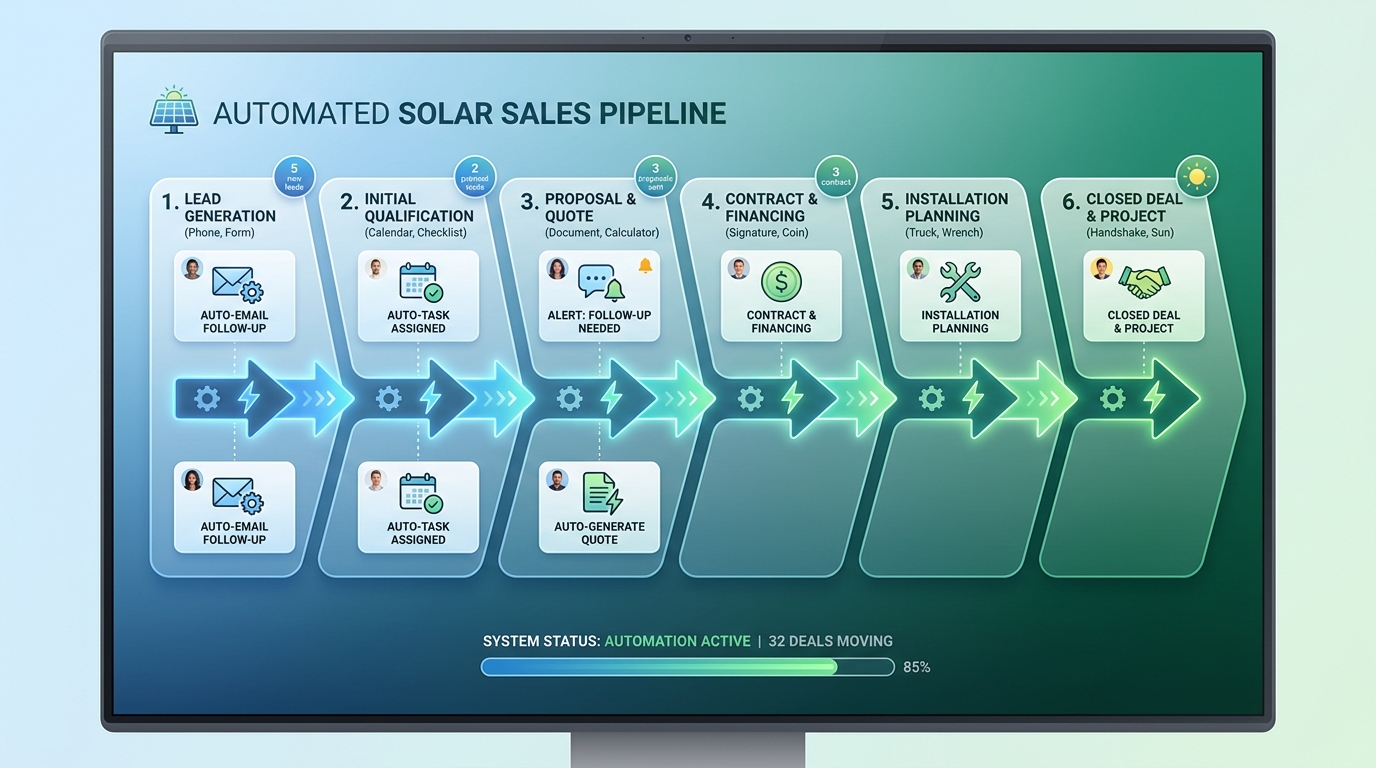
Pipeline stage automation eliminates these issues by automatically advancing deals based on completed actions and trigger events. When a sales rep sends a proposal, the system automatically moves the deal to “Proposal Sent” stage. When a customer signs a contract, the deal automatically progresses to “Closed Won” and triggers post-sale workflows.
This automation ensures pipeline accuracy while freeing reps from administrative updates. More importantly, stage progression triggers additional workflow automation, follow-up sequences, task creation, team notifications, and reporting updates, creating a self-managing sales operation.
Implementation requires clearly defining stage criteria and progression rules. Each pipeline stage should have specific entry and exit criteria. For example:
- New Lead → Contacted: Automatically progresses when first call or email is logged
- Contacted → Qualified: Progresses when qualification criteria are met (budget, timeline, authority confirmed)
- Qualified → Proposal Sent: Automatically advances when proposal is delivered
- Proposal Sent → Negotiation: Progresses when prospect requests changes or discusses terms
- Negotiation → Closed Won: Automatically advances when contract is signed
Automated stage regression is equally important. If a prospect in “Negotiation” stage stops responding for 30 days, the system can automatically move them back to “Proposal Sent” or even “Nurture,” triggering appropriate re-engagement workflows. This prevents pipeline inflation with dead deals.
QuickEst’s pipeline automation includes stagnation alerts that notify reps and managers when deals remain in a stage too long. If a deal sits in “Proposal Sent” for 15 days without progression, the system triggers alerts and suggests actions to move the deal forward or disqualify it. This prevents deals from languishing forgotten in the pipeline.
Advanced automation includes probability-based forecasting that automatically adjusts as deals progress through stages. Early-stage deals might have 10% close probability, while deals in negotiation might be 60%. The system automatically updates revenue forecasts as deals move, providing real-time visibility into expected closings.
Sales performance tracking becomes automatic as well. The system tracks how long deals spend in each stage, identifying bottlenecks in your sales process. If deals consistently stall in “Proposal Sent,” it indicates follow-up issues or proposal quality problems. If “Negotiation” stage is lengthy, it suggests pricing or terms challenges. These insights enable continuous process improvement.
The result is a clean, accurate pipeline that reflects reality rather than wishful thinking. Sales managers can trust their forecasts, reps focus on active opportunities, and the entire team gains visibility into what’s actually happening across the sales organization. This transparency enables better decision-making and more effective coaching.
9. Bulk Operations and Mass Updates
Solar businesses often need to process multiple records simultaneously, importing leads from trade shows, updating lead sources after marketing campaigns, reassigning territories when reps change, or sending announcements about incentive deadlines. Performing these operations one record at a time is tedious, time-consuming, and error-prone.
Bulk operation automation enables processing hundreds or thousands of records with single actions. Mass updates save hours of manual work while ensuring consistency and accuracy across your database. This capability becomes essential as your lead volume grows and your sales operation scales.
QuickEst’s bulk lead import functionality allows solar teams to upload entire spreadsheets of leads from Excel files, automatically creating records with all associated data. This is particularly valuable after trade shows, webinars, or purchased lead lists where you might have hundreds of new prospects to add to your system.
The import process includes intelligent field mapping that matches spreadsheet columns to CRM fields, data validation to catch errors before import, and duplicate detection to prevent creating multiple records for the same prospect. The system can automatically assign imported leads based on your distribution rules, ensuring immediate routing to appropriate sales reps.
Mass email campaigns represent another powerful bulk operation. Instead of sending individual emails, you can select multiple leads meeting specific criteria, all prospects in “Proposal Sent” stage, all leads from a specific region, all opportunities above a certain value, and send personalized emails to the entire group simultaneously.
Advanced personalization ensures these mass emails don’t feel generic. Merge fields automatically insert recipient names, company names, project details, and other custom information, making each email feel individually crafted. The system tracks opens, clicks, and responses for each recipient, enabling targeted follow-up.
Batch updates enable quick changes across multiple records. When government incentive programs change, you can update all relevant opportunities with new information. When a sales rep leaves, you can reassign all their leads to other team members in minutes rather than hours. When you refine your lead scoring criteria, you can recalculate scores across your entire database instantly.
Implementation best practices include:
- Data validation: Always review bulk operations before executing to prevent widespread errors
- Backup procedures: Ensure you can reverse bulk changes if something goes wrong
- Segmentation: Use filters and tags to target bulk operations precisely
- Testing: Test bulk operations on small samples before applying to entire databases
- Scheduling: Schedule bulk email campaigns for optimal send times based on recipient time zones
The time savings are substantial. Operations that would take days of manual work complete in minutes. More importantly, bulk automation enables marketing and sales initiatives that would be impossible manually, personalized campaigns to thousands of prospects, rapid response to market changes, and efficient database maintenance that keeps your CRM clean and useful.
10. Automated Reporting and Performance Analytics
Sales managers need visibility into team performance, pipeline health, and revenue forecasts to make informed decisions. Manually compiling reports from CRM data is time-consuming and often outdated by the time it’s completed. Sales reps waste time generating activity reports instead of selling.
Automated reporting eliminates this burden by continuously updating dashboards and generating scheduled reports without manual intervention. Real-time analytics provide instant visibility into key performance indicators, enabling proactive management rather than reactive problem-solving.
QuickEst’s real-time sales performance tracking dashboard automatically displays critical metrics including pipeline value, conversion rates, average deal size, sales cycle length, and individual rep performance. These dashboards update continuously as deals progress, providing current information without manual compilation.
Automated KPI tracking monitors metrics that matter most to solar sales success:
- Lead response time: Average time from lead assignment to first contact
- Conversion rates: Percentage of leads progressing through each pipeline stage
- Proposal-to-close ratio: How many proposals result in signed contracts
- Average deal value: Mean revenue per closed deal
- Sales cycle length: Average days from first contact to closed deal
- Activity metrics: Calls made, emails sent, proposals delivered per rep
- Pipeline velocity: How quickly deals move through stages
- Win/loss analysis: Reasons deals close or are lost
Scheduled report delivery automatically sends performance summaries to managers and stakeholders at specified intervals, daily activity reports, weekly pipeline reviews, monthly performance summaries, and quarterly trend analysis. Recipients receive these reports via email without requesting them, ensuring everyone stays informed.
Automated alerts notify managers when metrics fall outside acceptable ranges. If team conversion rates drop below historical averages, the system triggers alerts prompting investigation. If a top performer’s activity levels decline, managers receive notifications enabling early intervention before it impacts results.
Advanced analytics include trend identification that highlights patterns in your sales data. The system might identify that leads from certain sources convert better, that specific times of year see higher close rates, or that particular proposal templates perform better than others. These insights enable continuous optimization of your sales process.
Comparative analytics automatically benchmark individual rep performance against team averages, helping identify top performers to learn from and struggling reps who need coaching. The system can highlight specific areas where reps excel or need improvement, one rep might have excellent lead response times but poor follow-up consistency, while another might excel at closing but struggle with initial qualification.
The impact extends beyond just saving time on report creation. Automated analytics enable data-driven decision-making that improves sales outcomes. Managers can quickly identify problems, recognize successes, and adjust strategies based on real performance data rather than gut feelings. Sales reps gain visibility into their own performance, enabling self-improvement and accountability.
For solar businesses evaluating CRM solutions, robust reporting automation should be a critical selection criterion. The insights provided by automated analytics directly impact your ability to boost sales conversion rates and optimize team performance.
Implementing Workflow Automation: Getting Started
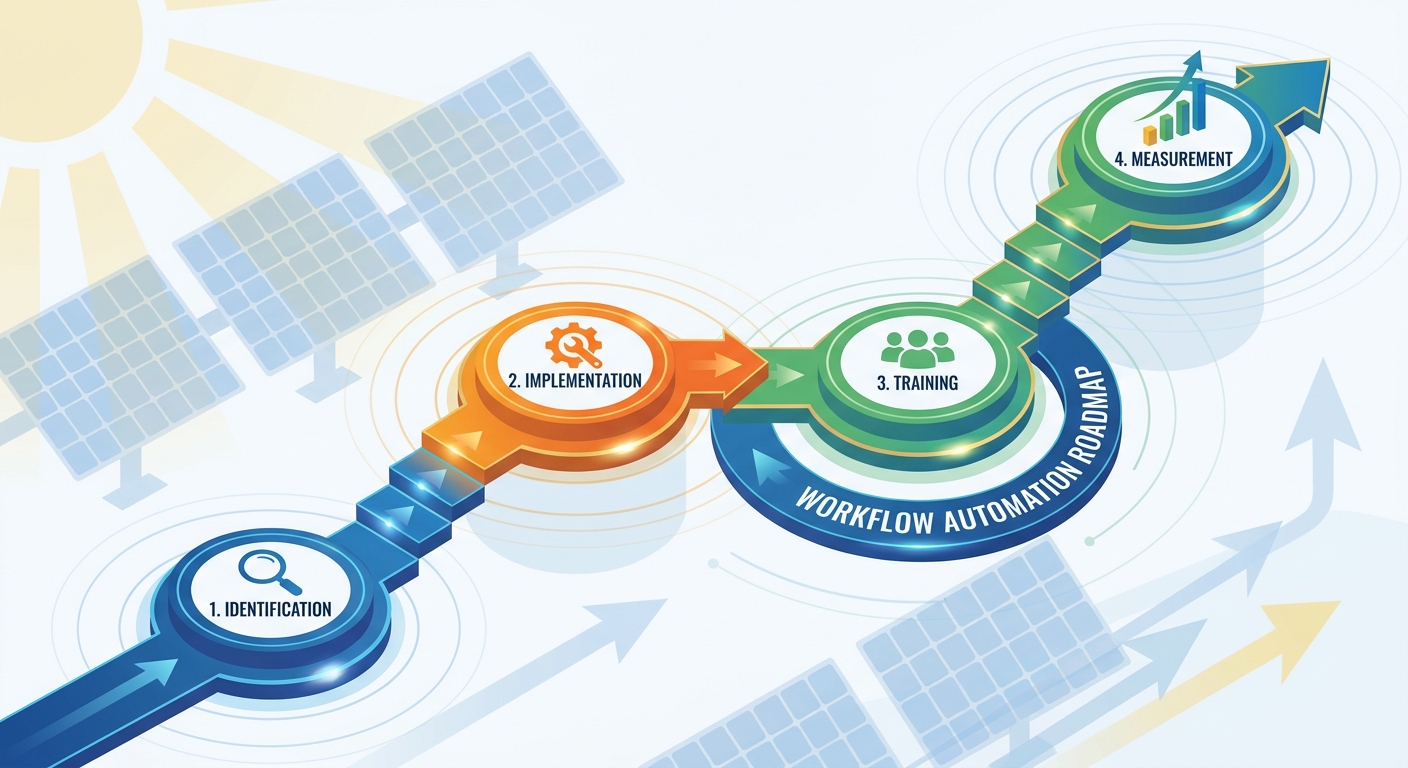
The prospect of implementing comprehensive workflow automation can feel overwhelming, especially for solar businesses currently managing sales through spreadsheets or basic tools. The key to successful implementation is starting strategically rather than trying to automate everything simultaneously.
Begin by identifying your biggest time-wasters and bottlenecks. Conduct a time audit with your sales team to understand where they spend their days. Common pain points for solar sales teams include:
- Manual proposal creation consuming hours per opportunity
- Forgotten follow-ups leading to lost deals
- Lead assignment confusion and delayed response times
- Data entry duplication across multiple systems
- Lack of visibility into pipeline status and team activities
- Inconsistent sales processes across team members
Prioritize automations that address your most painful problems first. If proposal creation is your biggest bottleneck, start there. If missed follow-ups cost you the most revenue, implement follow-up automation first. This focused approach delivers immediate value while building momentum for broader automation initiatives.
Start with high-impact, easy-to-implement automations that deliver quick wins. Automated lead assignment, follow-up reminders, and task creation typically require minimal setup but provide substantial benefits. These early successes build team confidence and demonstrate automation value, making it easier to gain buy-in for more complex implementations.
When selecting a CRM platform, consider scalability and automation capabilities as critical factors. The platform should support your current needs while providing room to grow. QuickEst offers automation features suitable for small solar businesses just starting their automation journey as well as established companies implementing sophisticated workflows.
Training your team on automated workflows is essential for successful adoption. Sales reps need to understand not just how automation works, but why it benefits them personally. Emphasize time savings, reduced administrative burden, and improved close rates rather than positioning automation as management surveillance. Involve your team in designing workflows to ensure they address real needs and gain user buy-in.
Effective training includes:
- Hands-on practice: Let reps use automation in test environments before going live
- Clear documentation: Provide step-by-step guides for common workflows
- Ongoing support: Designate automation champions who can help teammates troubleshoot
- Regular feedback: Continuously gather input on what’s working and what needs adjustment
Measuring ROI and refining your automation strategy ensures continuous improvement. Track metrics before and after implementing each automation to quantify impact. Common ROI indicators include:
- Time savings: Hours saved per rep per week on administrative tasks
- Response time improvement: Reduction in average lead response time
- Conversion rate increases: Improvement in lead-to-customer conversion
- Sales cycle reduction: Decrease in average days to close
- Revenue impact: Additional deals closed due to improved follow-through
- Team satisfaction: Improved rep satisfaction with reduced administrative burden
Refine workflows based on actual usage and results. If automated follow-up sequences aren’t generating responses, adjust timing or messaging. If lead scoring doesn’t accurately predict conversions, revise scoring criteria. Workflow automation should evolve continuously as you learn what works best for your specific market and sales process.
Consider total cost of ownership when evaluating automation platforms. While some solutions require significant upfront investment, others like QuickEst offer accessible pricing that makes automation available to solar businesses of all sizes. The platform’s FREE PLAN allows you to explore automation capabilities without financial commitment, while the PRO PLAN at ₹6,999 per user per year provides comprehensive automation features at a fraction of enterprise CRM costs.
Remember that workflow automation is a journey, not a destination. Start with foundational automations that address your most pressing needs, measure results, refine based on learnings, and gradually expand to more sophisticated workflows. This iterative approach ensures sustainable adoption while delivering continuous value to your solar sales operation.
Transform Your Solar Sales Operation with Workflow Automation
The solar industry’s competitive landscape in 2026 demands operational excellence. Sales teams that rely on manual processes, inconsistent follow-up, and administrative busy-work will fall behind competitors who leverage workflow automation to maximize efficiency and responsiveness. The ten automation processes outlined in this guide represent proven strategies that solar businesses are using to save time, prevent missed opportunities, and dramatically increase closing rates.
Implementing workflow automation isn’t about replacing human salespeople, it’s about empowering them to focus on what they do best: building relationships, understanding customer needs, and closing deals. By automating repetitive administrative tasks, your team gains hours each day for high-value activities that actually generate revenue.
The benefits extend beyond just time savings. Automated workflows ensure consistency across your sales operation, prevent opportunities from slipping through the cracks, provide real-time visibility into pipeline health, and enable data-driven decision-making that continuously improves results. Solar companies implementing comprehensive workflow automation report 30-50% productivity increases and significant improvements in conversion rates and customer satisfaction.
QuickEst provides solar sales teams with the workflow automation tools needed to compete effectively in 2026’s demanding market. From instant proposal generation and automated follow-ups to intelligent lead routing and real-time performance analytics, the platform addresses the specific challenges solar businesses face daily. With over 1000 businesses already using QuickEst to streamline their sales operations, the platform has proven its value across diverse solar companies from small installers to large EPCs.
The time to implement workflow automation is now. Every day your team spends on manual administrative tasks is a day they’re not closing deals. Every missed follow-up is potential revenue lost to competitors. Every delayed proposal is an opportunity for someone else to win the business. Start your workflow automation journey today by exploring QuickEst’s capabilities. The FREE PLAN provides immediate access to core automation features, allowing you to experience the benefits firsthand without any financial commitment. For teams ready to unlock the full power of workflow automation, the PRO PLAN at ₹6,999 per user per year delivers comprehensive automation capabilities that transform how solar sales teams operate.
Take the first step toward a more efficient, productive, and successful solar sales operation. Implement workflow automation and watch your team’s performance soar while administrative burdens disappear. Your competitors are already automating, don’t get left behind. Contact us to learn how QuickEst can transform your solar sales process through intelligent workflow automation designed specifically for the solar industry’s unique needs.
This blog post was written using thestacc.com