

India’s solar industry is experiencing unprecedented growth, with installation companies competing fiercely for every customer. Yet many solar businesses still rely on spreadsheets, WhatsApp messages, and manual tracking to manage their sales processes. This approach worked when handling 10-20 leads per month, but as the market expands and competition intensifies, the limitations of manual systems are costing Indian solar companies thousands in lost revenue. Understanding the CRM benefits India solar businesses can unlock is the first step toward transforming sales performance and staying competitive in 2026.
The difference between manual and automated CRM systems isn’t just about convenience—it’s about survival in a rapidly evolving market. Solar companies that have made the switch report conversion rate improvements of 20-40%, time savings of 10-15 hours per sales representative each week, and significantly better team coordination. This comprehensive comparison examines the tangible benefits, real costs, and measurable ROI that Indian solar installation companies experience when transitioning from manual processes to specialized solar CRM software.
The Current State of Solar Sales Management in India
Walk into most small to mid-sized solar installation companies across India, and you’ll find a familiar scene: sales teams juggling multiple Excel spreadsheets, customer information scattered across WhatsApp chats, and follow-up reminders written on sticky notes. This manual approach to sales management has become the default for many businesses, primarily because it requires no upfront investment and feels comfortable to teams accustomed to traditional methods.

However, the Indian solar market has transformed dramatically. With government initiatives like the PM-KUSUM scheme and increasing consumer awareness about renewable energy, solar companies are receiving more inquiries than ever before. A typical solar installation business in tier-2 cities now handles 40-60 leads monthly, while larger EPCs in metropolitan areas manage hundreds. Manual systems simply cannot scale to meet this demand without sacrificing quality or losing opportunities.
The consequences of outdated sales management are measurable and costly. Sales representatives spend 3-4 hours daily on administrative tasks—updating spreadsheets, searching for customer information, and manually creating proposals. Follow-ups get missed when teams are overwhelmed, with studies showing that 60-70% of leads never receive a second contact attempt. Customer data gets lost when sales reps leave the company, taking their personal WhatsApp conversations and notebooks with them. Most critically, there’s zero visibility into sales performance, making it impossible for business owners to identify bottlenecks or optimize their processes.
The growing competition in India’s solar sector means that response time and professionalism directly impact conversion rates. When a potential customer requests a quote, they’re likely contacting 3-5 different solar companies. The business that responds first with a professional proposal has a significant advantage. Manual processes, where creating a single proposal takes 2-3 hours, put companies at an immediate disadvantage against competitors using automated systems that generate proposals in minutes.
Understanding CRM Benefits India Solar Companies Experience
Customer Relationship Management (CRM) software for solar businesses goes far beyond simple contact management. A specialized solar CRM serves as the central nervous system for your entire sales operation, automating repetitive tasks, organizing customer information, and providing real-time insights into your sales pipeline. For Indian solar companies, the CRM benefits India businesses experience translate directly into competitive advantages in a crowded marketplace.
The primary benefits fall into four categories: time efficiency, where automation eliminates hours of manual work daily; improved conversion rates, as faster response times and consistent follow-ups capture more opportunities; better team coordination, with centralized information accessible to everyone; and data-driven decision making, using real-time analytics to optimize sales strategies.
What distinguishes specialized solar CRMs from generic platforms like Salesforce or Zoho CRM is their industry-specific functionality. Generic CRMs require extensive customization to handle solar-specific workflows like proposal generation with panel specifications, system sizing calculations, and ROI projections. Purpose-built solar CRMs come pre-configured with these capabilities, reducing implementation time from months to days and eliminating the need for expensive customization.
The shift from manual to automated systems fundamentally changes how solar businesses operate. Instead of reacting to leads as they come in and hoping nothing falls through the cracks, automated CRM systems enable proactive sales management. Sales teams receive automatic notifications when leads go cold, reminders trigger for scheduled follow-ups, and managers can identify struggling deals before they’re lost. This transformation from reactive firefighting to strategic sales management is among the most significant CRM benefits India solar companies report after implementation.
Manual vs Automated: Side-by-Side Workflow Comparison
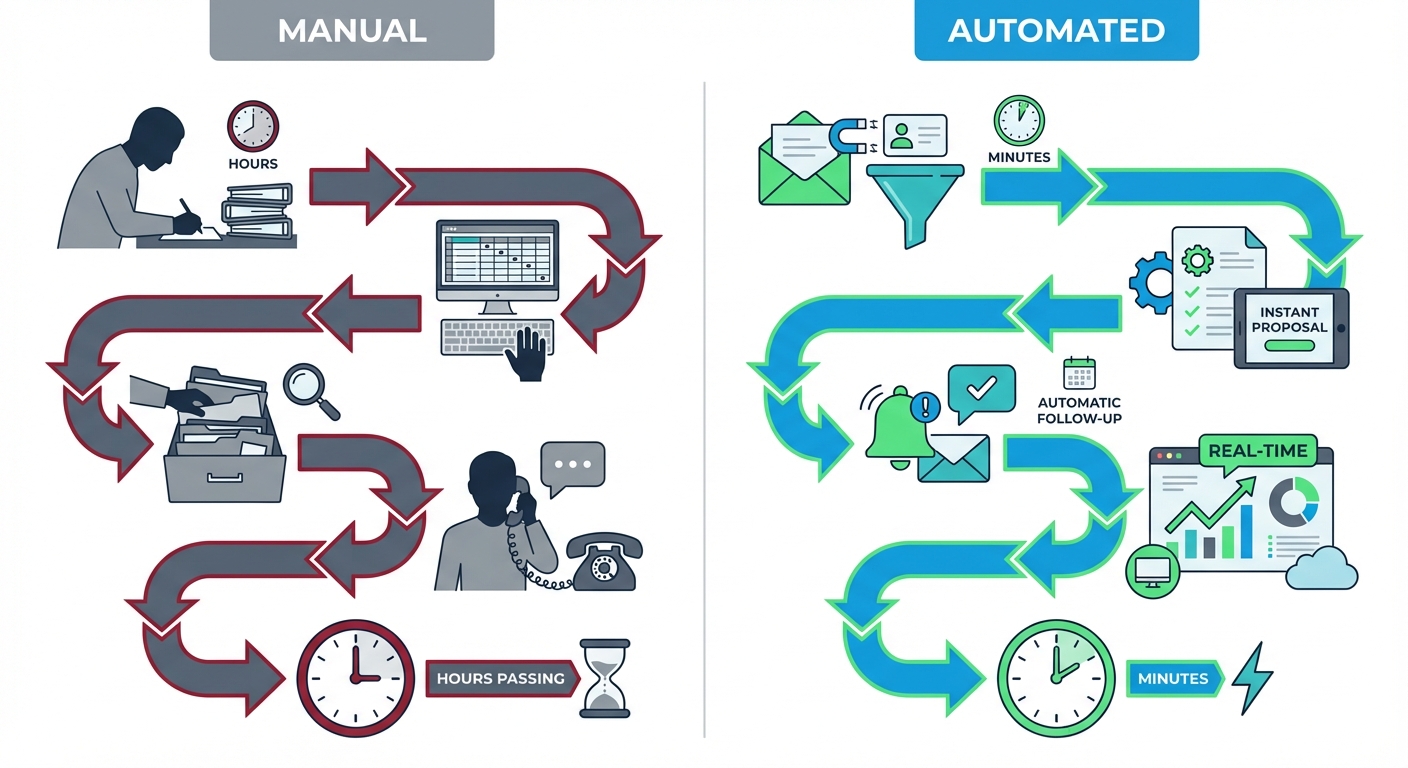
To truly understand the impact of CRM automation, let’s examine specific workflows that every solar company performs daily. The differences in efficiency, accuracy, and customer experience are striking when you compare manual and automated approaches side by side.
Lead Capture and Management
Manual Process: A potential customer fills out a contact form on your website or calls your office. The receptionist writes down their information on paper or types it into a spreadsheet. This information gets forwarded to a sales representative via WhatsApp or email. The sales rep manually enters the details into their personal tracking system (often another spreadsheet). If the lead came from Facebook Ads, the sales rep needs to log into the ads platform separately to retrieve the information. Total time: 10-15 minutes per lead, with high risk of data entry errors or lost information.
Automated CRM Process: The lead fills out the website form, and their information automatically flows into the CRM system. If the lead came from Facebook Ads, the integration captures it directly. The CRM instantly assigns the lead to the appropriate sales representative based on predefined rules (territory, product type, or workload). The sales rep receives an immediate notification on their mobile app with complete lead details. Total time: Instant, with zero manual data entry and no possibility of lost information.
Proposal Generation
Manual Process: The sales representative gathers customer requirements during a site visit or phone call. Back at the office, they open a Word or Excel template and manually input customer details, system specifications, panel quantities, pricing calculations, and ROI projections. They search through folders to find product images and company branding elements. After creating the proposal (2-3 hours), they convert it to PDF, then send it via email or WhatsApp. If the customer requests changes, the entire process repeats.
Automated CRM Process: During the customer conversation, the sales rep enters basic requirements into the mobile CRM app. The system automatically calculates system sizing, generates pricing based on current rates, and creates ROI projections. Within 60 seconds, a professionally branded proposal is ready. The sales rep sends it directly via WhatsApp or email from within the CRM. If changes are needed, they update the parameters and regenerate the proposal in seconds. This speed advantage is one of the most valued CRM benefits India solar sales teams report.
Follow-Up Management
Manual Process: The sales rep sets a reminder in their phone or writes a note to follow up with the customer in three days. When the reminder triggers, they need to search through WhatsApp messages or emails to recall the conversation context. They manually compose a follow-up message, often forgetting key details from previous interactions. If the sales rep is sick or on leave, no one else knows about pending follow-ups. Approximately 60-70% of planned follow-ups never happen due to oversight or workload.
Automated CRM Process: When creating the lead, the sales rep schedules automated follow-ups at optimal intervals (day 3, day 7, day 14). The system sends personalized follow-up emails or WhatsApp messages automatically, using templates customized for different scenarios. Each message includes the complete conversation history, ensuring context is never lost. If a sales rep is unavailable, their manager can see all pending follow-ups and reassign them. Follow-up completion rate: 95-100%.
Team Collaboration and Reporting
Manual Process: The business owner wants to know how many leads were received this month and the current conversion rate. They ask each sales representative to send their spreadsheets. After collecting data from multiple sources, they spend hours consolidating information, removing duplicates, and calculating metrics. The resulting report is already outdated by the time it’s completed, and there’s no way to verify accuracy.
Automated CRM Process: The business owner opens the CRM dashboard and instantly sees real-time metrics: leads received, conversion rates by source, average deal size, sales pipeline value, and individual rep performance. They can filter by date range, product type, or region with a single click. The entire team has access to the same data, ensuring everyone works from a single source of truth.
Time Savings: The Most Immediate CRM Benefit
When Indian solar companies implement automated CRM systems, time savings represent the most immediately noticeable benefit. These aren’t marginal improvements—we’re talking about reclaiming 10-15 hours per sales representative every week, time that can be redirected toward actual selling activities rather than administrative busywork.
Let’s quantify the time investment for common sales activities. Proposal generation drops from 2-3 hours per proposal to 60 seconds with automated systems. A sales rep creating 10 proposals weekly saves 20-30 hours monthly—nearly a full work week. Data entry and lead management consumes 30-45 minutes daily in manual systems as reps update spreadsheets, log activities, and search for customer information. Automated lead capture and centralized data eliminate this entirely, saving 10-15 hours monthly per representative.
Follow-up preparation takes 15-20 minutes per follow-up in manual systems, as sales reps search through previous conversations to recall context and compose personalized messages. Automated follow-up systems with conversation history and template libraries reduce this to 2-3 minutes for customization review, saving 8-10 hours monthly. Reporting and pipeline reviews require 3-4 hours weekly for managers manually consolidating data from multiple sources. Real-time CRM dashboards provide instant visibility, eliminating this task completely.
A mid-sized solar installation company with five sales representatives can reclaim 250-300 hours monthly through CRM automation. At an average fully-loaded cost of ₹500 per hour for sales staff, that’s ₹125,000-150,000 in monthly productivity gains. Annually, this translates to ₹1.5-1.8 million in recovered time value—far exceeding the investment in CRM software.
Beyond the quantifiable time savings, there’s a qualitative improvement in how sales teams spend their time. Instead of drowning in administrative tasks, representatives can focus on high-value activities: conducting site visits, building customer relationships, and closing deals. This shift from administrative burden to strategic selling is among the most appreciated CRM benefits India solar sales professionals cite when discussing their experience with automation. For more insights on how automation transforms sales workflows, explore our guide on follow-up automation in India.
Conversion Rate Improvements with Automated CRM Systems
Time savings are impressive, but the real financial impact comes from improved conversion rates. Indian solar companies implementing specialized CRM systems typically see conversion rate improvements of 20-40% within the first six months. These gains stem from several factors that automated systems enable.
Response time is the single most critical factor in solar sales. Research shows that leads contacted within five minutes are 21 times more likely to convert than those contacted after 30 minutes. Manual systems, where leads sit in spreadsheets waiting for sales reps to notice them, simply cannot compete with automated lead routing and instant notifications. When a potential customer submits an inquiry at 8 PM, automated CRM systems can send an immediate acknowledgment message and schedule a follow-up for the next morning, while manual systems leave the lead untouched until the next business day.
Consistent follow-up dramatically improves conversion rates. Industry data shows that 80% of sales require five or more follow-up attempts, yet 44% of sales reps give up after just one follow-up. Manual tracking makes consistent follow-up nearly impossible when managing 30-40 active leads. Automated follow-up sequences ensure every lead receives optimal nurturing, with personalized messages at strategic intervals. Solar companies report that 30-35% of their closed deals come from leads that would have been abandoned in manual systems.
Professional presentation builds customer trust and justifies premium pricing. When a solar company sends a professionally branded proposal within an hour of the initial inquiry, it signals competence and reliability. Manual proposals created in Word or Excel often look inconsistent and unprofessional, undermining customer confidence. The ability to generate polished proposals in 60 seconds gives automated CRM users a significant competitive advantage, particularly when competing against companies still using manual methods.
Lead nurturing capabilities prevent drop-off during the consideration phase. Solar purchases involve significant investment, and customers typically research for 2-4 weeks before deciding. Automated email sequences that provide educational content, customer testimonials, and financing information keep your company top-of-mind throughout this journey. Manual systems lack the capacity for this level of sophisticated nurturing, resulting in leads going cold or choosing competitors who stayed more engaged.
Consider a solar installation company handling 50 leads monthly with a 15% conversion rate using manual processes. That’s 7-8 closed deals monthly. After implementing a CRM system and improving conversion to 21% (a conservative 40% improvement), they close 10-11 deals monthly. At an average deal value of ₹250,000, that’s an additional ₹750,000-1,000,000 in monthly revenue—₹9-12 million annually. These conversion improvements represent the most significant CRM benefits India solar companies experience, often delivering ROI within the first quarter of implementation.
Cost Analysis: Manual Processes vs CRM Investment
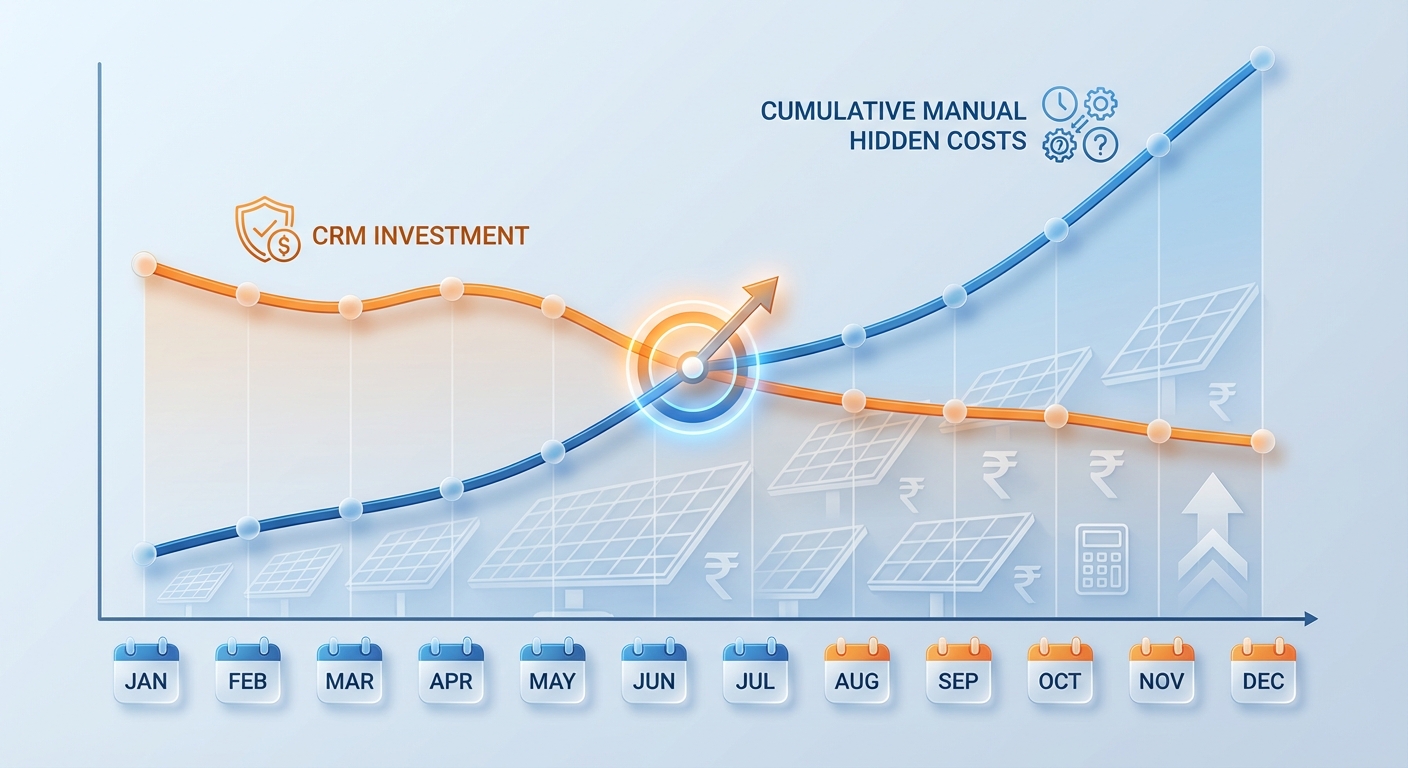
Many solar business owners hesitate to invest in CRM software because they perceive manual processes as “free.” However, a thorough cost analysis reveals that manual systems carry substantial hidden costs that far exceed the investment in automation.
Hidden Costs of Manual Processes
Lost opportunity cost represents the largest hidden expense. When 60-70% of leads never receive adequate follow-up, and conversion rates lag 20-40% behind automated competitors, the revenue impact is substantial. For a company generating ₹2 crore in annual revenue with manual processes, improving conversion by just 25% would add ₹50 lakh in revenue. The opportunity cost of not implementing CRM is ₹50 lakh annually.
Administrative time waste costs ₹1.5-1.8 million annually for a five-person sales team, as calculated earlier. This represents salary expense that generates zero revenue because team members are updating spreadsheets instead of selling.
Customer acquisition cost inflation occurs when poor lead management wastes marketing investment. If you spend ₹2,000 in Facebook Ads to acquire a lead, but that lead gets lost in a spreadsheet and never receives follow-up, you’ve wasted the entire acquisition cost. Manual systems typically waste 30-40% of marketing spend through poor lead handling, costing companies ₹3-5 lakh annually in mid-sized operations.
Employee turnover costs increase with manual systems because sales reps become frustrated with administrative burden and lack of tools. Replacing a sales representative costs ₹2-3 lakh in recruitment, training, and lost productivity. Companies with better sales tools experience 30-40% lower turnover in sales roles.
CRM Investment Breakdown
Modern solar CRM solutions designed for the Indian market offer pricing that makes automation accessible even for small businesses. QuickEst, for example, provides a free plan for companies just starting their automation journey, allowing them to experience CRM benefits India businesses gain without any financial commitment. For growing teams, professional plans typically range from ₹6,999 per user annually, providing comprehensive features including proposal automation, follow-up systems, and analytics.
For a five-person sales team, the annual CRM investment would be approximately ₹35,000-40,000 (₹6,999 × 5 users). Implementation costs are minimal with modern cloud-based systems, most companies are fully operational within 2-3 days with no additional consulting fees. Training time is typically 2-4 hours per user, as contemporary CRM platforms prioritize user-friendly interfaces.
Compare this ₹35,000-40,000 annual investment against the hidden costs of manual processes: ₹50 lakh in lost revenue opportunities, ₹18 lakh in wasted administrative time, ₹4 lakh in squandered marketing spend, and ₹2-3 lakh in turnover costs. The ROI is overwhelming, companies typically achieve complete payback within 2-3 weeks of implementation. To understand the full pricing landscape, review our detailed analysis of solar CRM software costs.
Long-Term Cost Advantages
Beyond immediate ROI, automated CRM systems provide long-term cost advantages through scalability. Adding your sixth, seventh, and eighth sales representatives requires no additional infrastructure, just additional user licenses. Manual systems become exponentially more chaotic as teams grow, requiring additional administrative staff to manage coordination. CRM systems actually become more valuable as you scale, with network effects improving team collaboration and data insights.
Data retention and institutional knowledge preservation also deliver long-term value. When a sales rep leaves a company using manual systems, they take their customer relationships and knowledge with them. CRM systems retain complete customer histories, conversation logs, and deal details, ensuring business continuity regardless of personnel changes. This knowledge preservation is worth hundreds of thousands of rupees over time.
Real-World Scenarios: Before and After CRM Implementation
Abstract benefits and statistics are helpful, but real-world scenarios illustrate how CRM automation transforms daily operations for Indian solar companies. Let’s examine three typical businesses at different stages of growth.
Scenario 1: Small Solar Installation Company (5-Person Team)
Before CRM: Rajesh Solar Solutions in Pune handles 30-40 leads monthly with a team of four sales representatives and one owner. Leads come from Google Ads, Facebook, and referrals, recorded in a shared Excel spreadsheet. Each sales rep maintains their own WhatsApp conversations and personal notes. The owner spends 6-8 hours weekly trying to understand pipeline status by asking each rep for updates. Proposal creation takes 2-3 hours, limiting each rep to 2-3 proposals daily. Follow-ups are inconsistent, with approximately 50% of leads receiving only one contact attempt. Monthly conversion rate: 12% (4-5 deals closed). Monthly revenue: ₹12-15 lakh.
After CRM Implementation: All leads automatically flow into QuickEst from website forms and Facebook Ads integration. Sales reps receive instant mobile notifications and can generate professional proposals in 60 seconds during site visits. Automated follow-up sequences ensure every lead receives 5-6 touchpoints over three weeks. The owner monitors real-time dashboard showing pipeline value, conversion rates by source, and individual rep performance. Each sales rep now creates 8-10 proposals daily (up from 2-3), and follow-up completion rate reaches 95%. Monthly conversion rate: 18% (7-8 deals closed). Monthly revenue: ₹20-24 lakh. Time saved: 50 hours monthly across the team. Revenue increase: 60-70%.
Scenario 2: Mid-Sized Solar EPC Managing 80+ Leads Monthly
Before CRM: SunPower EPC in Bangalore receives 80-100 leads monthly from multiple sources including direct sales, channel partners, and digital marketing. With eight sales representatives, coordination is chaotic. Lead assignment happens manually via WhatsApp groups, often resulting in duplicate contacts or missed leads. No centralized visibility exists, the sales manager spends 10-12 hours weekly collecting data from individual reps to create pipeline reports. Customer data is fragmented across personal spreadsheets, emails, and WhatsApp. Proposal quality varies significantly between reps. Monthly conversion rate: 14% (11-14 deals). Monthly revenue: ₹35-40 lakh.
After CRM Implementation: Automated lead routing assigns incoming leads based on territory and workload, eliminating duplicates and ensuring balanced distribution. All customer interactions are logged in the centralized system, accessible to the entire team. The sales manager monitors real-time dashboards showing each rep’s pipeline, deal stages, and performance metrics. Standardized proposal templates ensure consistent quality and branding. Automated follow-up sequences handle initial nurturing, allowing reps to focus on high-value interactions. Monthly conversion rate: 20% (16-20 deals). Monthly revenue: ₹50-60 lakh. Time saved: 120 hours monthly. Revenue increase: 40-50%.
Scenario 3: Solar Distributor with Multiple Sales Representatives
Before CRM: GreenTech Distributors in Delhi supplies solar equipment to installers across North India with 12 sales representatives managing B2B relationships. Each rep maintains their own customer database in Excel, creating data silos. When reps leave the company, customer relationships and deal history disappear with them. Quote generation requires manual price lookups and calculations, taking 45-60 minutes per quote. No systematic follow-up process exists for quotes sent. Management has no visibility into which customers are active, which are at risk, or what the pipeline value is. Monthly conversion rate: 10% (25-30 deals from 250+ inquiries). Monthly revenue: ₹80-90 lakh.
After CRM Implementation: All customer data resides in the centralized CRM, accessible to appropriate team members based on permissions. When sales reps transition, complete customer histories remain intact. Automated quote generation with current pricing pulls from integrated inventory systems, reducing quote creation to 5-10 minutes. Automated follow-up sequences for quotes ensure no opportunity is forgotten. Management dashboards provide real-time visibility into customer health scores, pipeline value by region, and rep performance. Customer segmentation enables targeted campaigns for different installer types. Monthly conversion rate: 15% (37-45 deals). Monthly revenue: ₹1.2-1.4 crore. Time saved: 200+ hours monthly. Revenue increase: 50-55%.
These scenarios demonstrate that CRM benefits India solar companies experience scale with business size. Smaller companies gain efficiency and professionalism that help them compete with larger players. Mid-sized companies achieve the coordination and visibility needed to scale further. Larger organizations gain the data insights and process standardization required to maintain quality as they grow.
Key CRM Features Driving Benefits for Indian Solar Businesses
Not all CRM systems deliver equal value for solar companies. The specific features that drive the most significant benefits for Indian solar businesses differ from generic CRM capabilities. Understanding which features matter most helps companies evaluate options and maximize their investment.
Quick Proposal Generation with Solar-Specific Templates
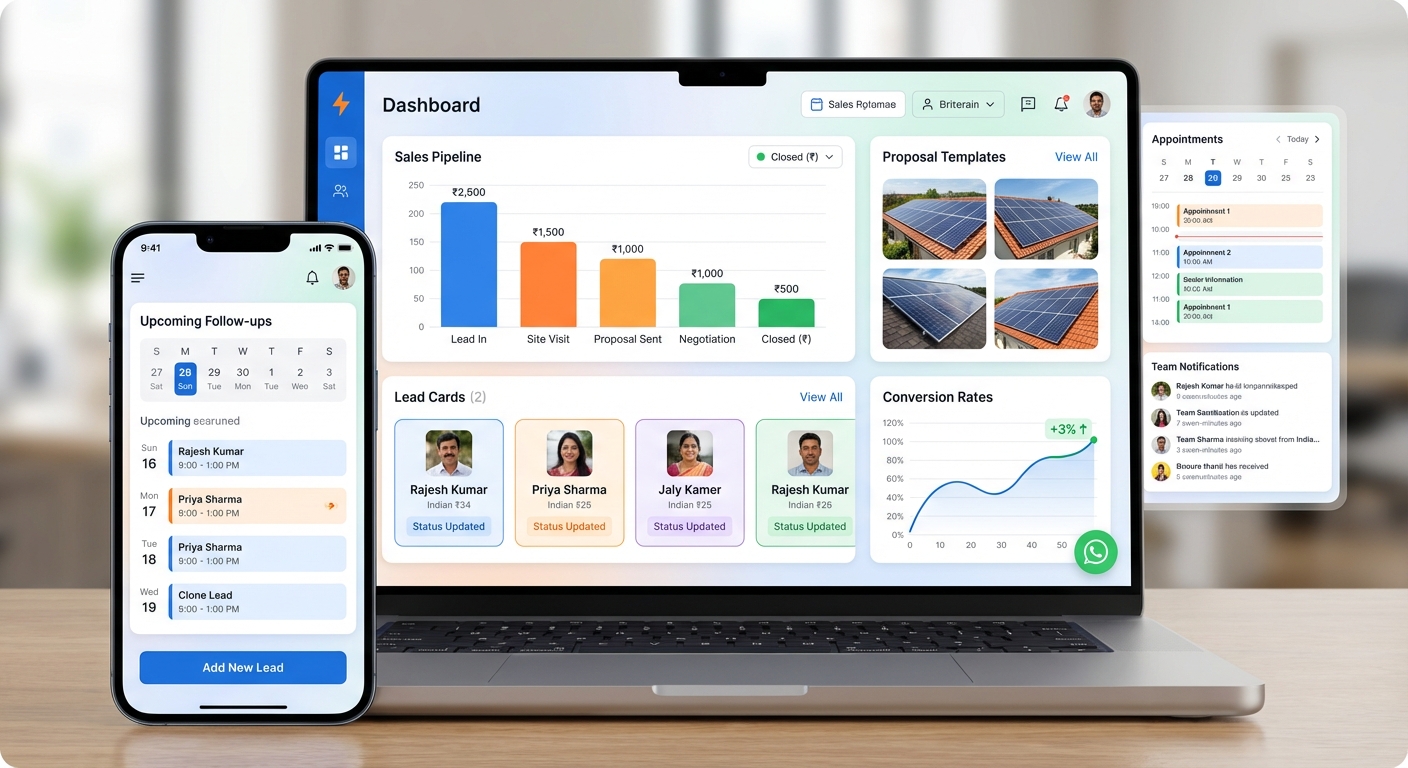
The ability to create professional solar proposals in 60 seconds represents the most valued feature among Indian solar sales teams. Generic CRMs lack solar-specific templates with system sizing, panel specifications, ROI calculations, and financing options. Purpose-built solar CRMs like QuickEst include pre-configured templates that automatically calculate system requirements based on customer usage, generate accurate pricing, and project savings over 25 years. This feature alone saves 15-20 hours weekly for active sales teams while dramatically improving proposal quality and customer perception.
WhatsApp and Email Integration for the Indian Market
Indian customers overwhelmingly prefer WhatsApp for business communication, making WhatsApp integration essential rather than optional. The ability to send proposals, follow-ups, and updates directly via WhatsApp from within the CRM eliminates the need to switch between applications and ensures all communication is logged. Email integration remains important for formal documentation and B2B communications. CRM systems that support both channels with conversation tracking provide the flexibility Indian solar businesses need.
Mobile Accessibility for Field Sales Teams
Solar sales happen in the field, during site visits, at customer locations, and at industry events. Mobile apps that provide full CRM functionality enable sales reps to access customer information, create proposals, log activities, and update deal status from anywhere. The best mobile CRM apps work offline and sync when connectivity returns, crucial for sales reps visiting rural areas or locations with poor network coverage. Mobile accessibility transforms dead time (travel, waiting) into productive selling time.
Real-Time Analytics and Pipeline Visibility
Data-driven decision making requires real-time visibility into sales performance. Dashboard features showing lead sources, conversion rates by channel, average deal size, sales cycle length, and individual rep performance enable managers to identify what’s working and what needs improvement. Pipeline visibility showing deal stages, probability, and projected close dates helps forecast revenue and allocate resources. These analytics capabilities transform sales from guesswork into a measurable, optimizable process.
Automated Follow-Up Systems and Reminders
Consistent follow-up is the difference between 12% and 20% conversion rates, making automated follow-up systems among the most valuable CRM features. The ability to create follow-up sequences triggered by specific actions (lead created, proposal sent, site visit completed) ensures no opportunity falls through the cracks. Customizable email and WhatsApp templates with merge fields for personalization maintain the human touch while automating the process. Reminder notifications keep sales reps on schedule for calls and meetings. Our comprehensive guide on follow-up automation explores these capabilities in depth.
Team Collaboration and Task Management
Solar sales often involve multiple team members, sales reps, technical specialists, installation teams, and finance personnel. CRM features that enable task assignment, progress tracking, and internal notes ensure smooth handoffs and coordination. When a sales rep closes a deal, they can assign installation scheduling to the operations team, who can see complete customer requirements and preferences. This collaboration eliminates the information gaps and miscommunication that plague manual systems.
For a detailed evaluation framework covering these and other essential capabilities, consult our complete buyer’s checklist for solar CRM features.
Overcoming Common Objections to CRM Adoption
Despite overwhelming evidence of CRM benefits, many Indian solar companies hesitate to make the transition. Understanding and addressing common objections helps businesses move past unfounded concerns and capture the advantages of automation.
“It’s Too Expensive for Our Small Business”
This objection stems from outdated perceptions of CRM pricing from the era when systems cost lakhs in licensing and implementation fees. Modern cloud-based solar CRMs designed for the Indian market offer pricing accessible to even the smallest businesses. QuickEst provides a free plan that allows companies to start experiencing automation benefits immediately without any financial commitment. Professional plans at ₹6,999 per user annually cost less than ₹600 monthly, far less than the value of even a single lost deal. When you calculate the ROI including time savings, improved conversion rates, and reduced customer acquisition waste, the investment pays for itself within weeks.
“It’s Too Complicated to Implement and Use”
This concern reflects experiences with legacy CRM systems that required months of implementation and extensive training. Contemporary solar CRMs prioritize user experience and quick deployment. Most companies are fully operational within 2-3 days, with training completed in 2-4 hours. Modern interfaces are intuitive, designed for sales professionals rather than IT specialists. Mobile apps mirror familiar smartphone experiences, requiring minimal learning curve. The key is choosing a CRM purpose-built for solar businesses rather than attempting to customize a generic platform. For step-by-step guidance on smooth implementation, review our CRM implementation guide for India.
“Our Sales Team Won’t Use It”
User adoption concerns are valid, a CRM only delivers value if the team actually uses it. However, resistance typically stems from systems that create more work rather than reducing it. When a CRM genuinely makes sales reps’ lives easier, generating proposals in 60 seconds instead of 2 hours, automatically handling follow-ups, providing mobile access to customer information, adoption happens naturally. The key is demonstrating immediate value. Start with the features that save the most time (proposal generation, automated follow-ups), then gradually expand usage. When sales reps see their colleagues closing more deals with less effort, adoption accelerates.
“We’re Too Small to Need a CRM”
Many business owners believe CRM systems are only for large enterprises managing thousands of leads. In reality, small businesses benefit most from automation because they have the least margin for error. When you’re handling 30-40 leads monthly, losing even 5-6 opportunities to poor follow-up represents 15-20% of your potential revenue. Small teams can’t afford dedicated administrative staff, making automation even more critical. Additionally, implementing CRM early establishes good processes and data practices that enable smooth scaling as you grow. Companies that wait until they’re “big enough” often struggle with the transition because they’re trying to change established habits while managing growth.
Addressing Data Security and Privacy Concerns
Customer data security is a legitimate concern, particularly with increasing awareness of privacy regulations. Reputable CRM providers implement enterprise-grade security measures including TLS 1.2 encryption for data transmission and 256-bit AES encryption for data storage. Cloud-based systems often provide better security than local spreadsheets, which are vulnerable to laptop theft, hard drive failure, and unauthorized access. When evaluating CRM options, verify security certifications, data backup procedures, and compliance with Indian data protection requirements. QuickEst, for example, implements bank-level security protocols to protect customer information.
Making the Switch: Transition Strategy from Manual to Automated
Understanding the benefits of CRM automation is one thing; successfully implementing it is another. A structured transition strategy ensures smooth adoption and rapid value realization.
Assessing Your Current Sales Process and Pain Points
Begin by documenting your existing sales workflow from lead capture through deal closure. Identify specific pain points: Where do leads get lost? Which tasks consume the most time? Where do deals stall? Which processes frustrate your sales team? This assessment helps you prioritize which CRM features will deliver the most immediate value. For example, if proposal creation is your biggest bottleneck, focus on mastering proposal automation first. If follow-up inconsistency is costing you deals, prioritize automated follow-up sequences.
Choosing the Right CRM for Your Solar Business Needs
Not all CRMs are created equal for solar businesses. Generic platforms like Salesforce and Zoho CRM offer broad functionality but require extensive customization for solar-specific workflows. Purpose-built solar CRMs like QuickEst provide industry-specific features out of the box, dramatically reducing implementation time and cost. Evaluate options based on: solar-specific features (proposal generation, system sizing), ease of use, mobile accessibility, integration capabilities (Facebook Ads, WhatsApp, accounting software), pricing structure, and customer support quality. Take advantage of free trials or free plans to test functionality before committing.
Implementation Timeline and Team Training
Modern cloud-based CRM systems can be implemented in days rather than months. A typical timeline includes: Day 1, Account setup, user creation, and basic configuration (2-3 hours). Day 2, Data migration from spreadsheets, proposal template customization, and follow-up sequence creation (3-4 hours). Day 3, Team training on core features and mobile app setup (2-4 hours). Days 4-7, Parallel operation where team uses both old and new systems to build confidence. Week 2 onward, Full transition to CRM with ongoing optimization.
Training should focus on immediate value features first. Teach proposal generation and lead management in the initial session, then introduce advanced features like analytics and automation in follow-up training. Hands-on practice with real customer scenarios builds confidence faster than theoretical instruction.
Data Migration from Spreadsheets to CRM
Most CRMs support bulk import from Excel spreadsheets, making data migration straightforward. Clean your existing data before migration, remove duplicates, standardize formatting, and fill in missing information. Prioritize migrating active leads and recent customers first; historical data from years past may not warrant the effort. Many CRM providers offer migration assistance as part of onboarding, helping ensure data integrity during the transition.
Measuring Success and Optimizing Workflows
Define success metrics before implementation so you can measure impact objectively. Key metrics include: time spent on proposal creation, follow-up completion rate, lead response time, conversion rate by source, average sales cycle length, and pipeline value. Review these metrics monthly to identify improvements and optimization opportunities. Most companies see measurable improvements within 2-4 weeks of implementation, with full benefits realized within 3-6 months as the team masters advanced features.
Continuous optimization is key to maximizing CRM benefits India solar companies can achieve. Regularly review which follow-up sequences perform best, which proposal templates convert highest, and which lead sources deliver the best ROI. Use these insights to refine your processes and improve results over time. For guidance on connecting your CRM with other business tools to maximize efficiency, explore our guide on solar CRM integration in India.
Unlock Your Solar Business Potential with CRM Automation
The evidence is overwhelming: Indian solar companies that transition from manual processes to automated CRM systems experience transformative improvements in efficiency, conversion rates, and revenue. Time savings of 10-15 hours per sales representative weekly, conversion rate improvements of 20-40%, and ROI within weeks make CRM automation one of the highest-impact investments solar businesses can make in 2026.
The competitive landscape in India’s solar market is intensifying, with customers expecting faster responses, more professional presentations, and better service throughout their buying journey. Manual systems simply cannot deliver the speed and consistency required to compete effectively. Companies that embrace automation gain decisive advantages in response time, follow-up consistency, and sales team productivity, advantages that translate directly into market share and revenue growth.
The CRM benefits India solar businesses unlock extend beyond immediate sales improvements. Automated systems provide the data visibility needed for strategic decision-making, the scalability required for growth, and the process standardization that ensures consistent quality regardless of team size. These capabilities transform solar companies from reactive operations struggling to keep up with leads into proactive, data-driven organizations that systematically optimize their sales performance.
The barrier to entry has never been lower. Modern solar CRMs designed for the Indian market offer accessible pricing, rapid implementation, and intuitive interfaces that require minimal training. QuickEst provides a free plan that allows you to experience automation benefits immediately, with no financial risk. For growing teams ready to unlock their full potential, the Pro Plan at ₹6,999 per user annually delivers comprehensive features including 60-second proposal generation, automated follow-ups, real-time analytics, and mobile accessibility, everything needed to compete and win in today’s solar market.
The question isn’t whether to implement CRM automation, it’s how quickly you can capture the competitive advantages it provides. Every day spent managing leads in spreadsheets, creating proposals manually, and missing follow-ups is a day your competitors are pulling ahead. Take the first step toward transforming your solar sales performance today. Start with QuickEst’s free plan to experience how automation can revolutionize your sales process, or contact us to discuss how our solar-specific CRM can address your unique business challenges and help you achieve the growth you’re targeting in 2026.
The future of solar sales in India is automated, data-driven, and customer-centric. Companies that embrace these capabilities now will dominate their markets, while those clinging to manual processes will struggle to compete. The choice is clear, and the time to act is now. Unlock the full potential of your solar business with CRM automation and join the growing number of Indian solar companies experiencing the transformative CRM benefits India businesses need to thrive in an increasingly competitive marketplace.
This blog post was written using thestacc.com