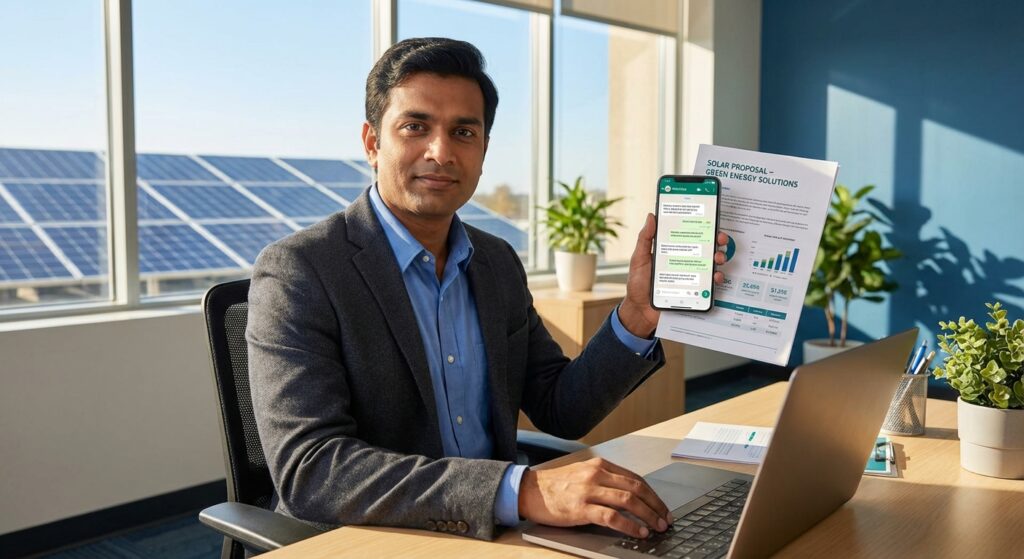
In India’s rapidly evolving solar industry, sales teams face mounting pressure to respond faster, engage more effectively, and close deals before competitors do. Traditional email proposals often languish in crowded inboxes, taking hours or even days to reach decision-makers. Enter WhatsApp proposals—a game-changing approach that’s transforming how solar companies deliver quotes, engage customers, and accelerate their sales cycles.
With over 500 million WhatsApp users in India, this messaging platform has become the preferred communication channel for business conversations. Solar installation companies, EPCs, and sales teams are discovering that sending proposals via WhatsApp dramatically improves open rates, response times, and ultimately, conversion rates. But how exactly does it work? What are the best practices? And how can you implement this modern sales approach in your solar business?
This comprehensive FAQ guide answers 22 of the most common questions about WhatsApp proposals for the solar industry. Whether you’re a solar sales professional looking to boost efficiency or a business owner seeking competitive advantages, you’ll find practical answers to help you leverage WhatsApp as a powerful proposal delivery channel in 2026.
Getting Started with WhatsApp Proposals
1. What are WhatsApp proposals and how do they work?
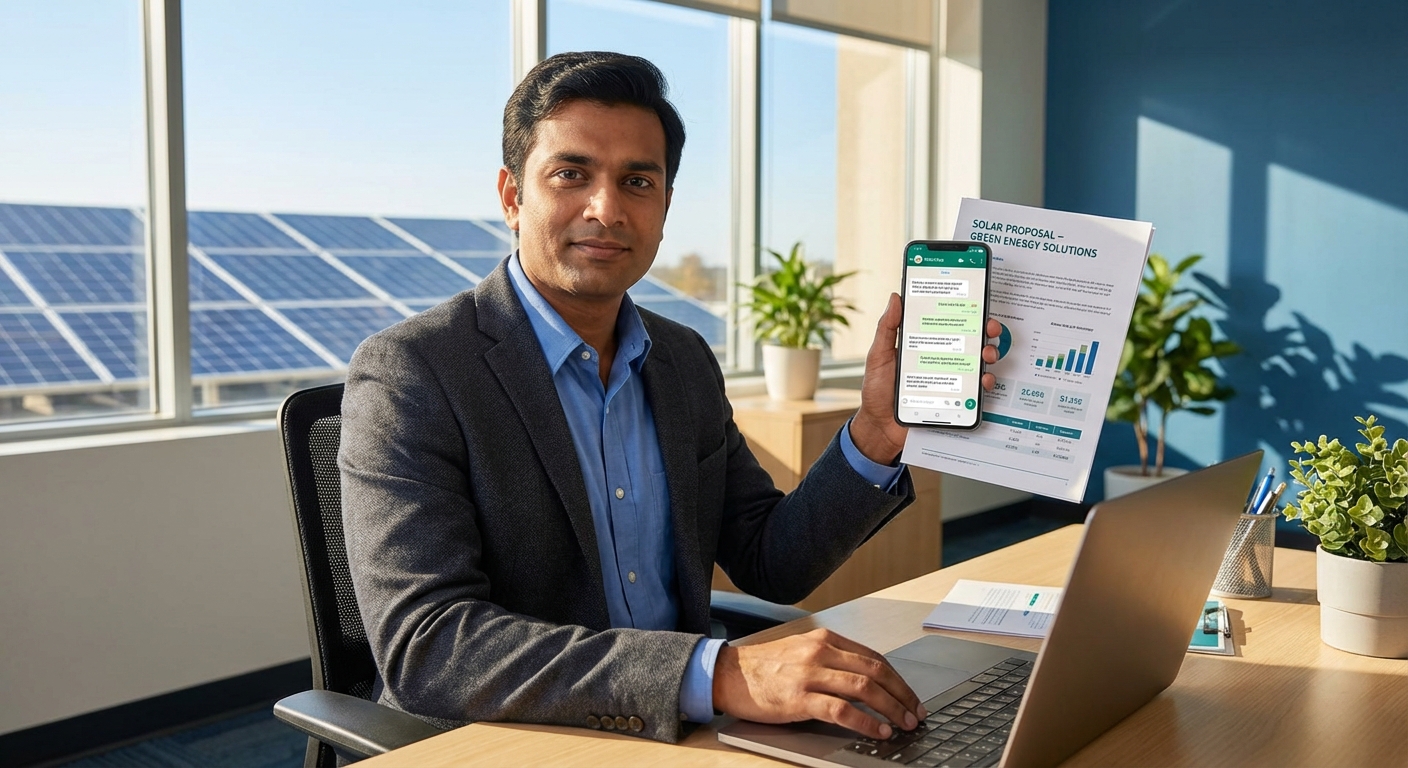
WhatsApp proposals are professional solar quotes, estimates, or project proposals delivered directly to customers through the WhatsApp messaging platform. Instead of sending proposals via email, sales teams generate a PDF document containing pricing, system specifications, savings projections, and terms, then share it instantly through WhatsApp.
The process typically involves creating a proposal using specialized software like solar CRM systems with proposal generation features, then delivering the document through WhatsApp Business API or the standard WhatsApp application. Customers receive an instant notification, can view the proposal immediately on their mobile device, and respond with questions or acceptance—all within the same conversation thread.
2. Why should solar companies use WhatsApp for proposals?
Solar companies in India are adopting WhatsApp proposals for several compelling reasons. First, the platform boasts a 98% open rate compared to email’s 20-30%, meaning your proposals actually get seen. Second, customers typically read WhatsApp messages within 3 minutes of receiving them, while emails may sit unopened for hours or days.
Beyond speed and visibility, WhatsApp creates a more personal, conversational sales experience. Customers feel comfortable asking questions immediately after viewing a proposal, leading to faster objection handling and decision-making. The platform also eliminates common email problems like spam filters, promotional tabs, and lost attachments. For solar sales teams competing in India’s crowded renewable energy market, these advantages translate directly into shorter sales cycles and higher conversion rates.
3. What equipment or software do I need?
To send WhatsApp proposals effectively, you need three basic components: a smartphone with WhatsApp installed, proposal generation software, and ideally, integration between the two. At minimum, you can manually create proposals in any document software, export to PDF, and share through WhatsApp—but this approach lacks efficiency and tracking capabilities.
Professional solar businesses typically use specialized solar CRM India platforms that generate branded proposals and integrate with WhatsApp for one-click delivery. QuickEst, for example, enables sales teams to create professional solar proposals within 60 seconds and send them directly via WhatsApp or email from a single interface. This integrated approach eliminates manual steps, ensures consistent branding, and provides tracking capabilities that standalone tools cannot offer.
4. Can I send proposals through WhatsApp Business vs regular WhatsApp?
Both WhatsApp Business and regular WhatsApp support document sharing, so technically you can send WhatsApp proposals through either platform. However, WhatsApp Business offers significant advantages for professional solar companies. The Business version provides a business profile with company information, catalog features, automated greeting messages, and quick reply templates that streamline customer communication.
For larger solar organizations sending high volumes of proposals, the WhatsApp Business API offers even more capabilities including CRM integration, automated notifications, and multi-user access. Small to medium solar businesses typically find WhatsApp Business (the free app) sufficient for their needs, while enterprises benefit from API-level integration with their CRM implementation India systems.
5. How do I get started with WhatsApp proposal delivery?
Starting with WhatsApp proposals requires a systematic approach. First, download WhatsApp Business and set up your business profile with your solar company’s name, description, address, and contact information. Second, ensure you have a reliable method for generating professional proposals, either through dedicated proposal software or a comprehensive solar CRM platform.
Third, establish a workflow: capture lead information, create the proposal, generate a PDF, and share it via WhatsApp with a personalized message. Fourth, train your sales team on best practices for WhatsApp communication, including response time expectations, professional messaging etiquette, and follow-up protocols. Finally, implement tracking mechanisms to monitor which proposals are opened, which customers respond, and what your conversion rates look like compared to traditional email delivery.
Speed and Efficiency Questions
6. How fast can I send a solar proposal via WhatsApp?
With the right tools, you can send a complete WhatsApp proposal in under 60 seconds from initial customer inquiry to delivered quote. Modern proposal automation systems like QuickEst enable sales teams to input basic customer requirements, roof size, energy consumption, location, and instantly generate a professional, branded proposal with system design, pricing, savings calculations, and financing options.
Once generated, sharing via WhatsApp takes just seconds: tap the share button, select WhatsApp, choose the customer contact, add a brief personalized message, and send. This speed advantage is transformative for solar sales teams who often compete with multiple vendors for the same customer. Being first to deliver a professional proposal frequently determines who wins the deal, making WhatsApp proposals a competitive necessity rather than a luxury.
7. Do customers receive WhatsApp proposals faster than email?
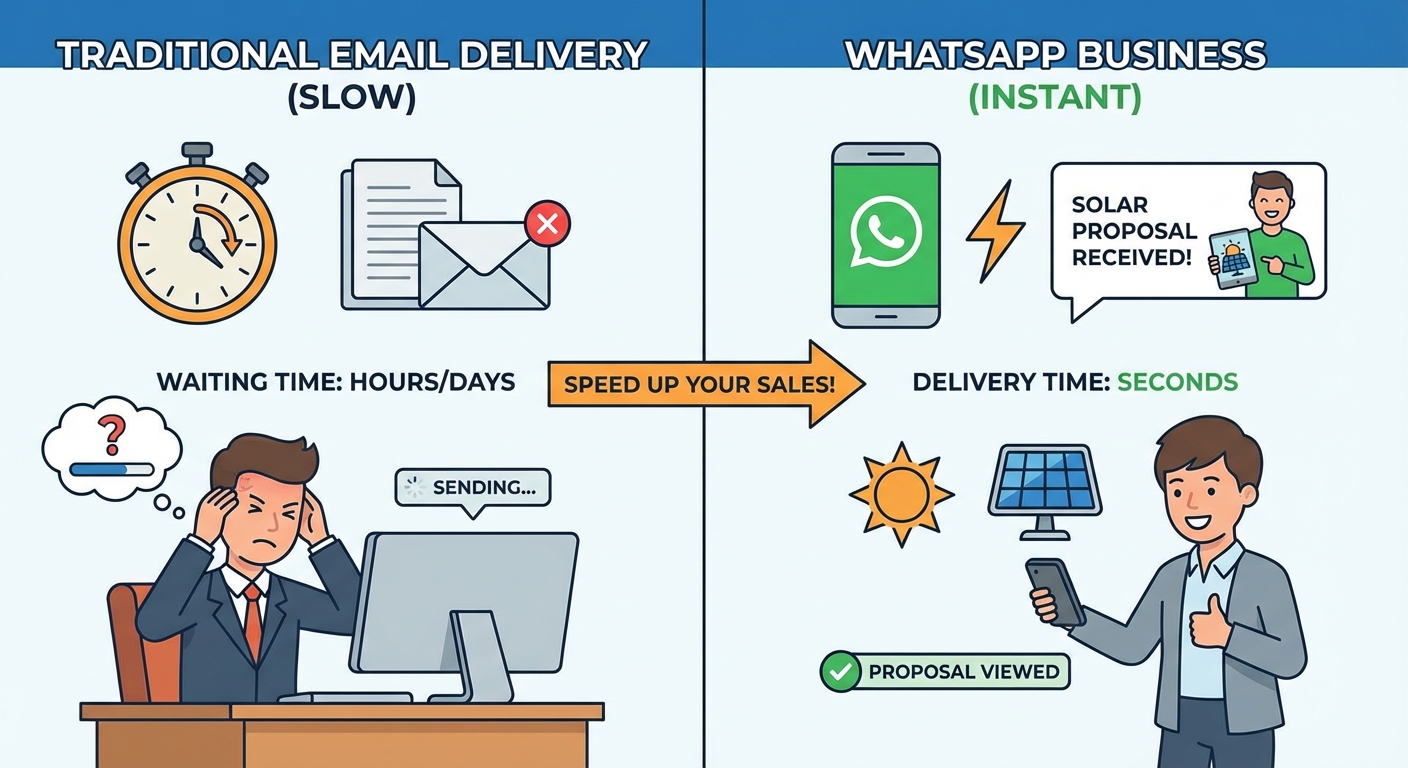
Absolutely. WhatsApp proposals deliver instantaneously, with customers receiving push notifications within seconds of sending. Email proposals, by contrast, face multiple delays: server processing time, potential spam filter checks, and the customer’s email checking habits. In practice, WhatsApp proposals reach customers 10-100 times faster than email.
More importantly, customers notice WhatsApp messages immediately. The average person checks WhatsApp 23 times per day and responds to messages within minutes, while email checking happens just 3-5 times daily with much longer response delays. For time-sensitive solar proposals, especially in competitive bidding situations, this speed difference directly impacts your win rate. Customers appreciate the immediacy and often make faster decisions when proposals arrive through their preferred communication channel.
8. Can I create and send proposals from my mobile phone?
Yes, and this mobile capability represents one of the biggest advantages of WhatsApp proposals for solar sales teams. Field sales representatives can meet with customers, gather requirements, create a proposal on their smartphone, and deliver it via WhatsApp before leaving the customer’s property, all without returning to the office or accessing a desktop computer.
Mobile-optimized solar CRM India platforms like QuickEst provide iOS and Android apps specifically designed for on-the-go proposal generation. Sales teams can access customer data, select from proposal templates, customize pricing and specifications, generate professional PDFs, and share via WhatsApp, all from a single mobile application. This mobility eliminates the “I’ll send you a proposal when I get back to the office” delay that often costs solar companies deals to faster-moving competitors.
9. How does proposal automation work with WhatsApp?
Proposal automation streamlines the entire process from lead capture to WhatsApp delivery. Advanced systems integrate with your lead sources, website forms, Facebook Ads, phone inquiries, automatically creating customer records in your CRM. When a sales representative is ready to send a proposal, the system pre-populates customer information, suggests appropriate system sizes based on consumption data, calculates pricing using your predefined margins, and generates a branded proposal document.
The automation extends to WhatsApp delivery as well. Rather than manually exporting PDFs and switching between applications, integrated systems offer one-click sharing that opens WhatsApp with the proposal attached and a customizable message template ready to send. Some advanced platforms even support automated follow-up sequences that send reminder messages via WhatsApp if customers haven’t responded within specified timeframes, ensuring no opportunity falls through the cracks.
Professional Formatting and Presentation
10. Can WhatsApp proposals look professional?
Absolutely. WhatsApp proposals can be just as professional, if not more so, than traditional email proposals. The key lies in using proper proposal generation software that creates polished, branded PDF documents rather than sending plain text messages or hastily created screenshots.
Professional WhatsApp proposals include your company logo, brand colors, professional typography, detailed system specifications, high-quality images of solar equipment, financial projections with charts, warranty information, and clear terms and conditions. When delivered via WhatsApp, these proposals open in the recipient’s PDF viewer with full formatting intact, providing the same professional presentation as email attachments but with the speed and engagement advantages of messaging platforms.
11. What file formats work best for WhatsApp proposals?
PDF format is the gold standard for WhatsApp proposals in the solar industry. PDFs maintain consistent formatting across all devices, support embedded images and graphics, can be easily saved and shared by customers, and appear professional regardless of whether viewed on smartphones, tablets, or computers.
While WhatsApp technically supports various document formats including Word documents and Excel spreadsheets, PDFs offer superior advantages: they cannot be accidentally edited by recipients, they preserve your branding and layout exactly as designed, they’re universally compatible, and they’re perceived as more official and final than editable document formats. Most professional solar CRM systems generate proposals exclusively in PDF format for these reasons.
12. How do I add my company branding to WhatsApp proposals?
Branding your WhatsApp proposals requires using proposal software with customization capabilities. Look for systems that allow you to upload your company logo, define brand colors, select fonts, create custom headers and footers, and design proposal templates that reflect your solar company’s visual identity.
QuickEst and similar solar CRM India platforms provide template libraries where you can customize every visual element of your proposals. Once configured, every proposal generated automatically includes your branding, ensuring consistent professional presentation across all customer communications. This branding consistency builds trust and recognition, making your WhatsApp proposals instantly identifiable as coming from your company rather than appearing generic or unprofessional.
13. Can I include images, charts, and technical specifications?
Yes, comprehensive WhatsApp proposals should include visual elements that help customers understand your solar solution. Professional proposals typically incorporate system layout diagrams showing panel placement on the customer’s roof, equipment photos of the specific panels and inverters being proposed, financial charts illustrating savings over time, and detailed technical specifications tables.
Modern proposal automation tools automatically generate these visual elements based on the system parameters you input. For example, when you specify a 5kW system with particular panel models, the software creates appropriate diagrams, inserts manufacturer product images, generates savings charts based on local electricity rates, and compiles technical specification sheets, all embedded in the PDF that gets shared via WhatsApp. These visual elements significantly improve customer comprehension and increase conversion rates compared to text-only proposals.
Customer Engagement and Conversion Rates
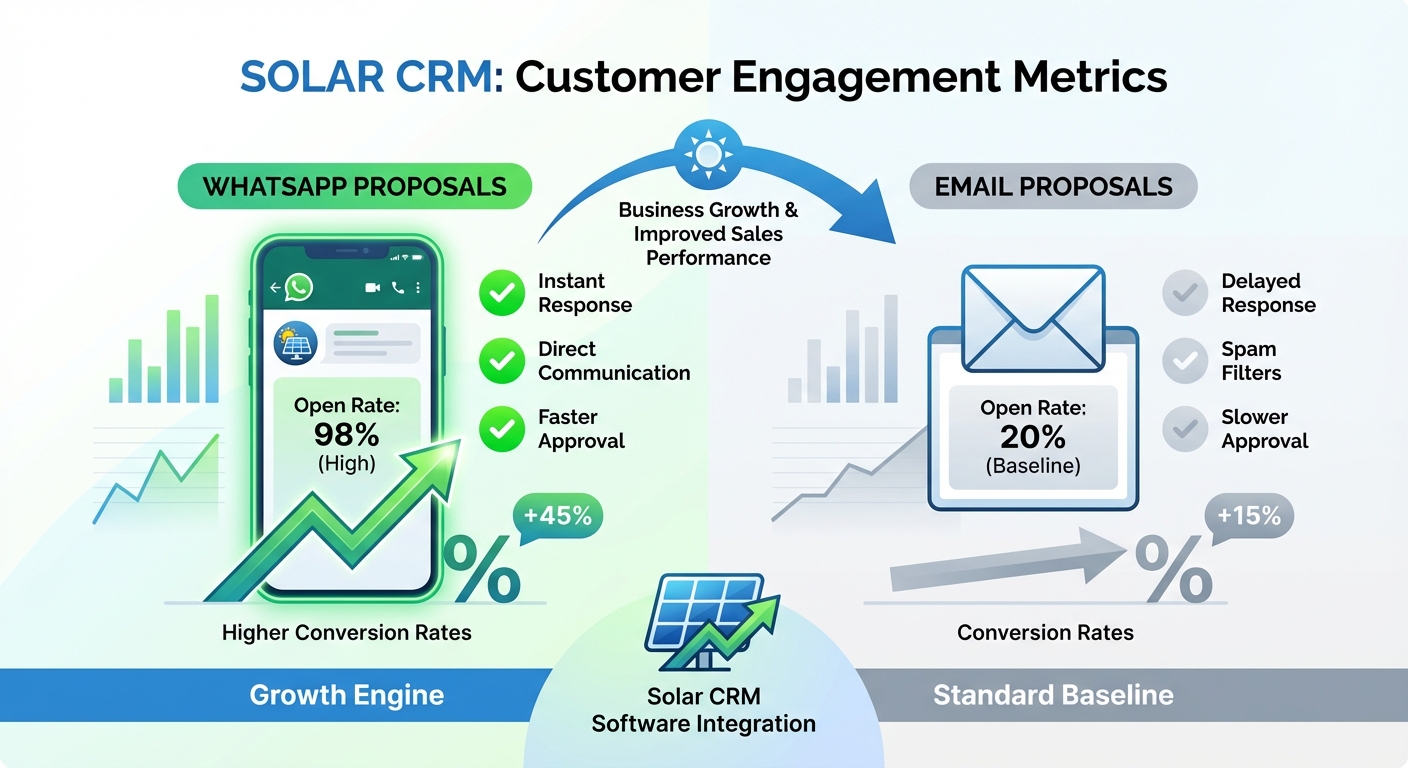
14. Why do WhatsApp proposals convert better than email?
WhatsApp proposals consistently outperform email proposals in conversion rates for several psychological and practical reasons. First, the immediacy of WhatsApp creates urgency, customers view proposals within minutes rather than hours or days, maintaining the momentum from initial inquiry. Second, the conversational nature of WhatsApp makes it easier for customers to ask questions, reducing the friction that often stalls email-based sales processes.
Third, WhatsApp’s personal nature builds stronger relationships. When customers receive proposals through the same platform they use to communicate with friends and family, the interaction feels more personal and trustworthy than formal business emails. Fourth, the ease of responding via WhatsApp, simply typing a quick message rather than composing a formal email, encourages faster decision-making. Solar companies implementing WhatsApp proposals typically report 30-50% higher conversion rates compared to email-only approaches.
15. What are typical open rates for WhatsApp vs email proposals?
The difference is dramatic: WhatsApp proposals achieve 95-98% open rates, while email proposals average just 20-30%. This means nearly every customer who receives a WhatsApp proposal actually views it, whereas 70-80% of email proposals never get opened at all.
This disparity stems from fundamental differences in how people use these platforms. WhatsApp notifications are immediate and prominent, appearing on lock screens and generating alerts that demand attention. Email notifications are easily ignored, especially for business addresses that receive dozens or hundreds of messages daily. For solar sales teams, this open rate advantage means your effort in creating proposals actually reaches customers rather than disappearing into digital oblivion. Even if conversion rates were identical, the 3-4x higher open rate alone makes WhatsApp proposals significantly more effective.
16. How quickly do customers respond to WhatsApp proposals?
Customers typically respond to WhatsApp proposals within 15-60 minutes, compared to 24-72 hours for email proposals. This accelerated response time transforms sales cycles, allowing solar companies to move from initial inquiry to signed contract in days rather than weeks.
The speed advantage compounds throughout the sales process. When customers have questions about your proposal, they ask immediately via WhatsApp. You can answer within minutes, address objections in real-time, and maintain engagement momentum. This rapid back-and-forth communication, impossible with email’s slower pace, enables solar sales teams to guide customers toward decisions much faster. In competitive situations where multiple vendors are bidding, being able to iterate and refine your proposal through quick WhatsApp exchanges often determines who wins the contract.
17. Can I track when customers view my proposals?
Tracking capabilities for WhatsApp proposals depend on your delivery method and tools. WhatsApp itself provides basic read receipts showing when messages are delivered and read, giving you visibility into whether customers have opened your message. However, this doesn’t confirm they’ve actually opened and viewed the attached PDF proposal document.
Advanced solar CRM systems with WhatsApp integration offer more sophisticated tracking. Some platforms generate unique proposal links that log when customers open documents, how long they spend viewing each page, and whether they share proposals with others. This tracking data helps sales teams prioritize follow-ups, focusing on customers who’ve thoroughly reviewed proposals rather than those who haven’t engaged. When evaluating solar CRM software costs, consider whether proposal tracking features justify the investment for your sales process.
CRM Integration and Workflow Management
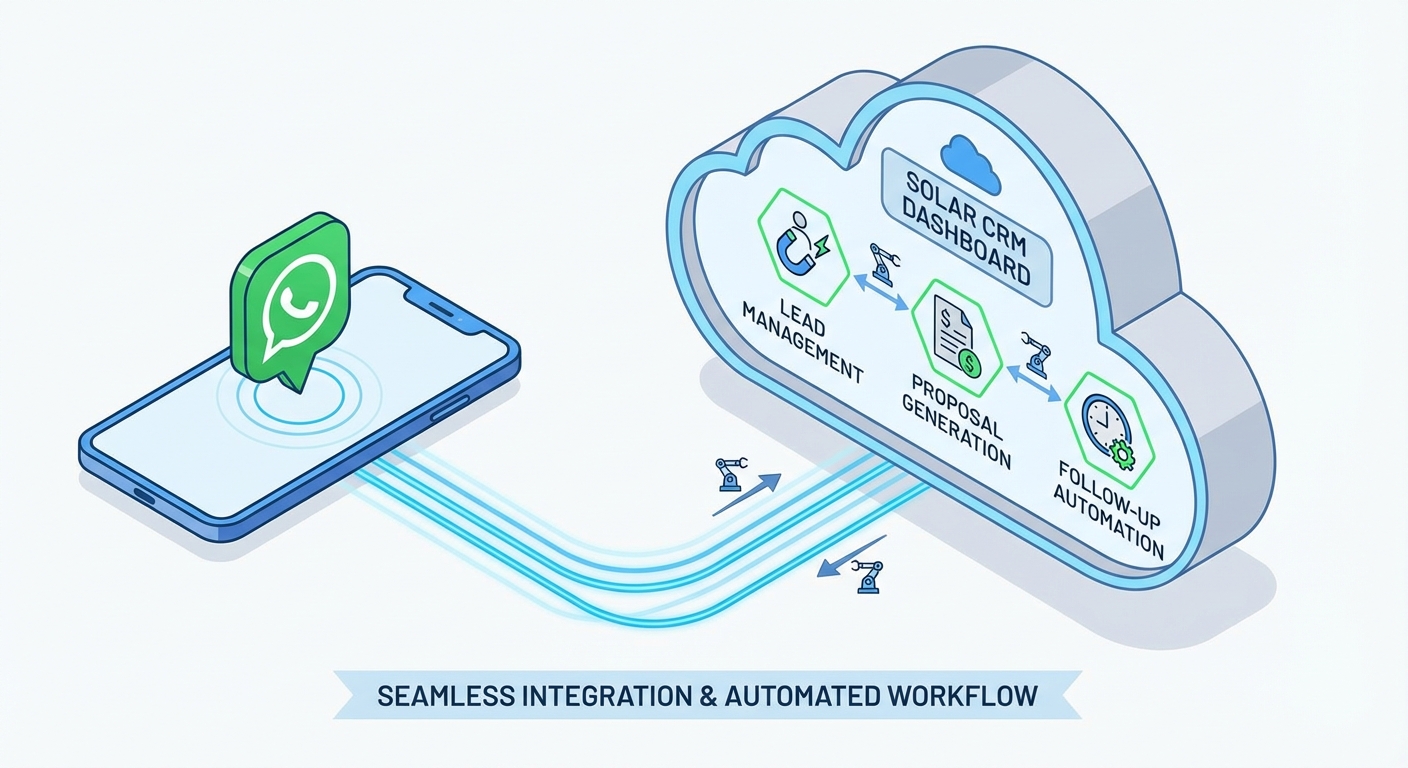
18. Can WhatsApp proposals integrate with my solar CRM?
Yes, modern solar CRM India platforms offer WhatsApp integration that streamlines the entire proposal workflow. Rather than using separate systems for CRM, proposal generation, and WhatsApp delivery, integrated platforms like QuickEst provide unified interfaces where you manage leads, create proposals, and send via WhatsApp from a single application.
Integration eliminates manual data entry and context switching. When you create a proposal for a lead in your CRM, customer information auto-populates, and you can deliver via WhatsApp with one click. The system logs the delivery in the customer’s activity history, enabling your entire sales team to see exactly what proposals were sent, when, and through which channel. For solar companies serious about sales automation India, this integration is essential for maintaining efficiency as your business scales. Learn more about connecting your tools in our guide to solar CRM integration in India.
19. How do I manage multiple proposals sent via WhatsApp?
Managing multiple WhatsApp proposals requires systematic organization, ideally through a dedicated lead management India system. Without proper tools, tracking which proposals were sent to which customers, when follow-ups are due, and what responses you’ve received becomes chaotic as volume increases.
Professional solar CRM platforms solve this challenge by maintaining a complete history of all customer interactions, including WhatsApp proposal deliveries. You can view dashboards showing all outstanding proposals, filter by status (sent, viewed, responded, converted), set follow-up reminders, and assign proposals to specific team members. This centralized management ensures no opportunities slip through the cracks and enables sales managers to monitor team performance and pipeline health effectively.
20. Can I automate follow-ups after sending WhatsApp proposals?
Absolutely. Follow-up automation is one of the most powerful features of integrated WhatsApp proposal systems. Rather than manually remembering to follow up with each customer, automated systems send scheduled reminder messages at predefined intervals, for example, 24 hours after proposal delivery, then again at 72 hours if no response is received.
Advanced automation goes beyond simple reminders. Systems can send different follow-up messages based on customer behavior: one message for customers who viewed the proposal but haven’t responded, another for those who haven’t opened it yet, and personalized messages for customers who asked questions but haven’t made decisions. This intelligent automation maintains engagement without requiring constant manual effort from your sales team. QuickEst’s automated follow-up system includes customizable templates and scheduling, ensuring consistent customer engagement that drives higher conversion rates.
21. How does lead tracking work with WhatsApp delivery?
Lead management India systems with WhatsApp integration track the complete customer journey from initial inquiry through proposal delivery to final conversion. When you send a WhatsApp proposal, the system logs this activity in the lead’s record, creating a timeline of all interactions.
This tracking enables powerful analytics: you can measure conversion rates for WhatsApp versus email proposals, identify which sales representatives close the most WhatsApp-delivered deals, calculate average time from proposal delivery to conversion, and determine which proposal templates perform best. These insights help solar companies continuously optimize their sales processes. Additionally, lead tracking ensures seamless handoffs when multiple team members interact with the same customer, preventing confusion and maintaining professional consistency.
Compliance, Security, and Best Practices
22. Is it legal to send business proposals via WhatsApp in India?
Yes, sending WhatsApp proposals is legal in India, but you should follow best practices to respect customer preferences and privacy regulations. The key principle is consent: you should only send proposals via WhatsApp to customers who have provided their phone numbers and expressed interest in receiving information about your solar services.
Unlike unsolicited marketing messages, proposals sent in response to customer inquiries are generally welcomed and expected. However, avoid adding customers to broadcast lists or sending promotional content without permission. WhatsApp’s terms of service prohibit spam and unsolicited commercial messages, so maintain professional standards: send proposals only when requested, respect customer communication preferences, and provide easy ways for customers to opt out of future communications if desired.
23. How secure are WhatsApp proposals for sensitive pricing information?
WhatsApp uses end-to-end encryption for all messages and attachments, meaning WhatsApp proposals are transmitted securely between your device and the customer’s device. This encryption prevents interception during transmission, making WhatsApp more secure than unencrypted email for sharing sensitive pricing and customer information.
However, security extends beyond transmission. Ensure your solar CRM platform also employs strong security measures, data encryption, secure authentication, regular backups, and access controls. QuickEst, for example, uses TLS 1.2 and 256-bit AES encryption to protect customer data. When evaluating systems, verify they meet security standards appropriate for handling customer financial information and personal data, especially given India’s evolving data protection regulations.
24. What are the best practices for WhatsApp proposal delivery?
Successful WhatsApp proposals follow several best practices. First, always include a personalized message when sending the proposal document, don’t just share the PDF without context. A brief message like “Hi Rajesh, as discussed, here’s your customized solar proposal for your 3BHK home. I’ve included the 5kW system we talked about with 25-year warranty. Please review and let me know if you have any questions!” adds personal touch and context.
Second, send proposals during business hours when customers are likely to review them immediately. Third, follow up promptly when customers respond with questions, the speed advantage of WhatsApp only works if you maintain responsiveness. Fourth, use professional language and proper grammar despite WhatsApp’s casual nature. Fifth, save proposal PDFs with clear, descriptive filenames like “SolarProposal_RajeshKumar_5kW_March2026.pdf” rather than generic names. Finally, track your results and continuously refine your approach based on what drives the highest conversion rates for your specific customer base.
25. How do I handle customer questions after sending a WhatsApp proposal?
The conversational nature of WhatsApp makes handling customer questions seamless. When customers ask about specific aspects of your WhatsApp proposal, pricing, equipment specifications, installation timeline, warranties, respond promptly with clear, concise answers. Use WhatsApp’s voice message feature for complex explanations that benefit from verbal communication, and share additional images or documents to clarify technical details.
For common questions, create saved responses in WhatsApp Business that you can quickly send without retyping. Track frequently asked questions and consider updating your proposal templates to proactively address these concerns. When questions require detailed calculations or revised proposals, use your solar CRM system to generate updated versions and share them immediately via WhatsApp. This responsive, iterative approach, impossible with email’s slower pace, helps you address objections and guide customers toward decisions much faster than traditional sales methods.
Implementing WhatsApp Proposals in Your Solar Business
Transitioning to WhatsApp proposals represents a strategic shift that can dramatically improve your solar company’s sales performance. The implementation process doesn’t require massive investment or lengthy timelines, most solar businesses can begin sending WhatsApp proposals within days of deciding to adopt this approach.
Start by evaluating your current proposal creation process. If you’re manually creating proposals in Word or Excel, consider upgrading to dedicated proposal automation software that generates professional documents quickly. If you already use a solar CRM system, check whether it offers WhatsApp integration or can be connected through tools like Pabbly Connect. For companies without existing CRM infrastructure, implementing an integrated platform like QuickEst provides the fastest path to WhatsApp proposal capability.
Train your sales team on the new workflow, emphasizing the importance of speed and responsiveness. Set clear expectations: proposals should be sent within 60 minutes of customer inquiry, and WhatsApp messages should be answered within 15 minutes during business hours. Create proposal templates that reflect your brand and include all necessary information, so sales representatives can generate complete proposals quickly without starting from scratch each time.
Measure your results rigorously. Track metrics like time from inquiry to proposal delivery, proposal open rates, customer response times, conversion rates, and sales cycle length. Compare WhatsApp proposal performance against email proposals to quantify the impact. Most solar companies implementing WhatsApp proposals see measurable improvements within the first month, faster response times, higher engagement rates, and increased conversions.
Common mistakes to avoid include sending proposals without personalized messages, failing to follow up promptly, using unprofessional formatting, neglecting to track results, and not integrating WhatsApp with your broader CRM and sales processes. The companies that succeed with WhatsApp proposals treat them as part of a comprehensive sales system rather than an isolated tactic.
As India’s solar market continues its rapid growth, customer expectations for speed and convenience will only increase. Solar companies that embrace modern communication channels like WhatsApp position themselves to capture market share from competitors still relying on outdated email-based sales processes. The question isn’t whether to adopt WhatsApp proposals, but how quickly you can implement them to gain competitive advantage.
Ready to transform your solar sales process with instant WhatsApp proposals? QuickEst enables your team to create professional solar proposals within 60 seconds and deliver them via WhatsApp or email from a single platform. Our specialized solar CRM India solution includes proposal automation, lead management, automated follow-ups, and real-time analytics, everything you need to close more deals faster. Explore our FREE PLAN – ₹0 to experience WhatsApp proposal delivery firsthand, or upgrade to our PRO PLAN – ₹6999 Per User / Year for advanced automation and team collaboration features. Start sending WhatsApp proposals today and watch your conversion rates soar. Contact us to learn how QuickEst can revolutionize your solar sales process.
This blog post was written using thestacc.com