
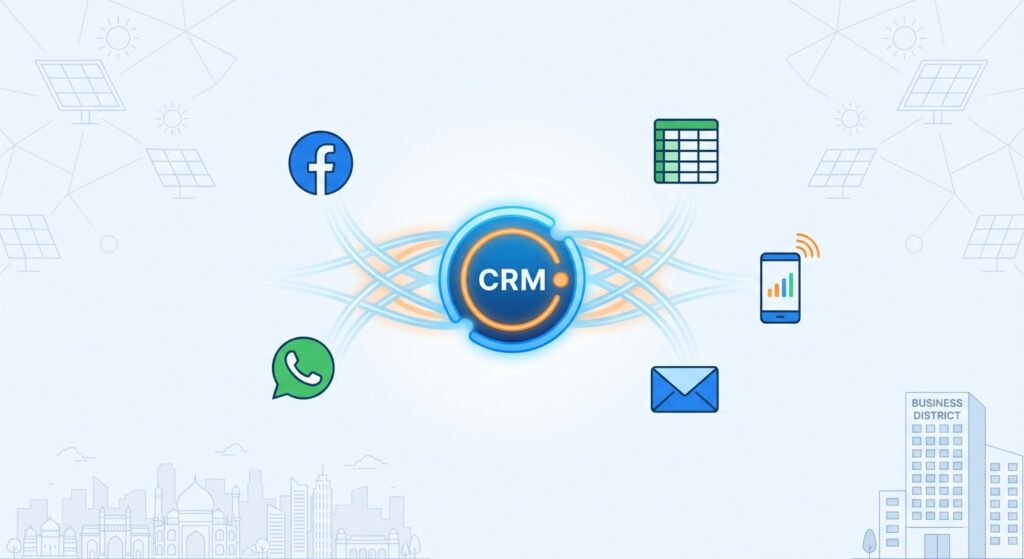
In India’s rapidly expanding solar market, sales teams are drowning in manual data entry. Every Facebook lead gets copied by hand. Every WhatsApp conversation lives in isolation. Every Excel spreadsheet requires tedious uploading. This disconnected chaos costs Indian solar businesses countless hours and missed opportunities every single day.
CRM integration India solutions are transforming how solar companies operate, eliminating the time-consuming manual work that slows down sales cycles and frustrates teams. By connecting your existing tools—Facebook Ads, WhatsApp, Excel, email platforms, and more—directly to your CRM system, you create a seamless workflow that captures leads automatically, triggers instant follow-ups, and gives your team back the time they need to actually sell solar solutions.
This comprehensive guide walks you through everything Indian solar businesses need to know about CRM integration in 2026: which integrations matter most, how to implement them effectively, and how to overcome the unique challenges faced by solar companies operating in India’s diverse market conditions.
Why CRM Integration Matters for Indian Solar Businesses
The average solar sales representative in India spends 3-4 hours daily on manual data entry tasks. They copy lead information from Facebook Lead Ads into spreadsheets. They manually upload contact details from trade shows. They switch between WhatsApp, email, and their CRM to track conversations. This fragmented approach creates multiple critical problems:
Delayed lead response times directly impact conversion rates. When a potential customer submits a Facebook Lead Ad inquiry about rooftop solar installation, every minute counts. Manual data entry means leads wait hours—sometimes days—before receiving a response. Research shows that responding to solar leads within 5 minutes increases conversion rates by up to 400% compared to waiting even 30 minutes.
Manual processes also introduce data entry errors that plague solar sales pipelines. A mistyped phone number means a lost customer. An incorrectly recorded project size leads to inaccurate proposals. These mistakes compound across your sales pipeline, creating confusion and damaging your professional reputation.
Perhaps most critically, disconnected systems provide no visibility into your sales performance. When lead sources, conversations, and proposal data live in separate tools, you cannot accurately track which marketing channels deliver the best ROI, which sales representatives need support, or where prospects drop out of your pipeline.
CRM integration solves these challenges by creating automated data flows between your tools. When a prospect fills out your Facebook Lead Ad, their information instantly appears in your CRM with automated follow-up tasks already assigned. When your sales team sends a WhatsApp message, the conversation history syncs automatically. When you import leads from an Excel spreadsheet, duplicate detection and data validation happen instantly.
For Indian solar businesses competing in an increasingly crowded market, this operational efficiency translates directly into competitive advantage. Companies with integrated CRM systems close deals 15-20% faster and convert 25-30% more leads than competitors still relying on manual processes.
Understanding CRM Integration: What It Means for Solar Companies
CRM integration refers to the process of connecting your Customer Relationship Management software with other business tools and platforms you use daily. Rather than manually moving data between systems, integrations create automated data flows that keep information synchronized across all your tools.
For solar businesses in India, CRM integration typically involves three types of connections:
Native integrations are built directly into your CRM platform by the software vendor. These integrations typically offer the deepest functionality and most reliable performance because they’re designed specifically for the CRM system. For example, QuickEst provides native integration with Facebook Ads for lead capture and WhatsApp for proposal delivery, ensuring seamless data flow without requiring additional tools or technical configuration.
Third-party integration platforms like Pabbly Connect, Zapier, or Make (formerly Integromat) act as middleware, connecting your CRM to hundreds of other applications. These platforms use APIs to move data between systems based on triggers and actions you define. While they require some initial setup, integration platforms enable connections to virtually any cloud-based tool your solar business uses.
Custom API integrations involve direct programming to connect your CRM with proprietary systems or specialized solar industry tools. These integrations require technical development but offer complete control over data flow and functionality. Most Indian solar businesses find that native integrations and third-party platforms handle 90% of their needs without requiring custom development.
The ROI from proper CRM integration typically manifests within 30-60 days. Solar companies report saving 15-20 hours per week on administrative tasks, improving lead response times from hours to minutes, and increasing overall sales productivity by 25-35%. When you consider that the average solar sales representative in India can close 2-3 additional deals per month with these time savings, the business case becomes compelling.
Essential CRM Integrations for Indian Solar Businesses
Not all integrations deliver equal value. Based on how Indian solar companies actually operate in 2026, these integrations provide the highest impact for streamlining your sales workflow:

Facebook Ads integration ranks as the most critical connection for solar lead generation. With over 450 million Indian users, Facebook (including Instagram) represents the largest digital advertising platform for reaching residential and commercial solar prospects. Automatic lead capture from Facebook Lead Ads eliminates manual data entry and enables instant follow-up, dramatically improving conversion rates.
WhatsApp integration addresses how Indian customers actually prefer to communicate. With WhatsApp penetration exceeding 500 million users in India, your prospects expect to receive proposals, updates, and support through this channel. CRM integration enables you to send professional solar proposals directly via WhatsApp, track message delivery and read receipts, and maintain complete conversation history within your CRM system.
Excel import capabilities remain essential for Indian solar businesses that collect leads at trade shows, purchase lead lists, or migrate data from previous systems. Robust bulk import functionality with duplicate detection, data validation, and field mapping ensures you can quickly bring existing prospect data into your CRM without manual record creation.
Email marketing platform connections enable sophisticated nurture campaigns for solar prospects who aren’t ready to buy immediately. Integrating tools like Mailchimp, SendGrid, or Indian platforms like WebEngage ensures your email campaigns sync with CRM data, automatically updating contact records based on email engagement and triggering sales follow-ups when prospects show buying signals.
Phone system integrations with VoIP providers or Indian telecom platforms enable click-to-call functionality, automatic call logging, and call recording. For solar sales teams making dozens of calls daily, eliminating manual call notes saves significant time while ensuring complete conversation history.
Payment gateway integrations tailored for the Indian market, including Razorpay, Paytm, Instamojo, and traditional banking systems, streamline the proposal-to-payment process. When customers accept solar proposals, integrated payment processing reduces friction and accelerates cash flow.
Facebook Ads to CRM Integration: Capturing Leads Automatically
Facebook Lead Ads have become the dominant lead generation channel for Indian solar companies, offering precise targeting based on homeownership, income levels, geographic location, and interest in sustainability. However, the true power of Facebook advertising only materializes when leads flow automatically into your CRM system.
Without integration, the typical workflow looks like this: A prospect submits a Facebook Lead Ad form. Your marketing team downloads leads from Facebook Ads Manager (usually once or twice daily). Someone manually copies each lead into your CRM or a spreadsheet. Sales representatives eventually receive lead assignments. By the time your team contacts the prospect, hours or even days have passed, and the lead has likely contacted multiple competitors.
With proper CRM integration India solutions, the workflow transforms completely: A prospect submits your Facebook Lead Ad form. Within seconds, their information appears in your CRM as a new lead record. Automated workflows immediately assign the lead to the appropriate sales representative based on territory or round-robin distribution. The sales representative receives an instant notification with complete lead details. Automated follow-up sequences begin immediately, sending a welcome email or WhatsApp message while the prospect’s interest remains hot.
Setting up Facebook Ads integration typically involves connecting your Facebook Business account to your CRM through the platform’s API. Modern solar CRM systems like QuickEst provide straightforward connection processes that require no technical expertise. You authenticate your Facebook account, select which Lead Ad forms to sync, and map Facebook form fields to corresponding CRM fields (name, phone, email, project type, etc.).
The most sophisticated implementations include automated lead scoring based on Facebook form responses. For example, leads indicating immediate interest in solar installation receive higher priority scores and faster follow-up than those requesting general information. Geographic data from Facebook can automatically assign leads to the correct regional sales representative, ensuring local expertise and faster site visits.
Tracking ROI becomes dramatically simpler with integrated Facebook Ads. Your CRM can attribute closed deals back to specific Facebook campaigns, ad sets, and even individual ads. This visibility enables data-driven optimization of your advertising spend, focusing budget on the campaigns that actually generate solar installations rather than just clicks or form submissions.
WhatsApp Integration: Meeting Indian Customers Where They Are
WhatsApp dominates business communication in India in a way unmatched in most other markets. Indian solar prospects expect to receive information, proposals, and updates via WhatsApp, making this integration absolutely essential for competitive solar businesses in 2026.
The most valuable WhatsApp integration capability for solar companies is proposal delivery directly from your CRM. When your sales representative completes a solar proposal within your CRM system, they can instantly send the professional PDF document via WhatsApp with a single click. The prospect receives the proposal on their preferred communication channel, can easily share it with family members or business partners for decision-making, and can respond with questions immediately.
QuickEst’s 60-second proposal generation combined with WhatsApp delivery creates a powerful competitive advantage. While competitors email proposals that sit unread in inbox folders, your solar proposals arrive via WhatsApp where they’re seen within minutes and generate immediate engagement.
Beyond proposal delivery, WhatsApp integration enables conversation tracking within your CRM. Every WhatsApp message exchanged with a prospect syncs to their CRM record, providing complete communication history. When a sales representative takes over an account or a manager reviews pipeline status, they can see the entire WhatsApp conversation thread without switching applications.
Automated WhatsApp follow-ups represent another powerful capability. Your CRM can trigger scheduled WhatsApp messages based on prospect behavior: a reminder message three days after sending a proposal, a check-in message one week after a site survey, or a special offer message for prospects who’ve gone quiet. These automated touchpoints keep your solar company top-of-mind without requiring manual effort from your sales team.
For solar businesses using WhatsApp Business API (required for official business accounts with multiple users), CRM integration becomes even more critical. The API enables multiple team members to manage WhatsApp conversations from within the CRM interface, with proper message routing, team collaboration, and conversation assignment capabilities.
Excel Import and Data Migration: Bringing Your Existing Data into Your CRM
Despite the digital transformation of Indian business, Excel spreadsheets remain ubiquitous in solar sales operations. Trade show lead lists arrive in Excel format. Purchased lead databases come as CSV files. Legacy customer data lives in spreadsheets accumulated over years. Effective CRM integration must accommodate this reality with robust Excel import capabilities.
The most common scenarios requiring Excel import for Indian solar businesses include:
- Trade show and event leads: After participating in solar exhibitions, renewable energy conferences, or local business events, you return with hundreds of business cards or sign-up sheets that get compiled into Excel spreadsheets
- Purchased lead lists: Many solar companies purchase targeted lead lists from data providers specializing in homeowners or businesses matching solar customer profiles
- Partner referrals: Channel partners, solar equipment distributors, or financing companies often provide referral leads in bulk Excel format
- CRM migration: When switching from a previous CRM system or graduating from spreadsheet-based lead tracking, you need to import historical customer data
- Marketing campaign responses: Offline marketing campaigns may generate responses collected in Excel before CRM import
Effective Excel import functionality includes several critical capabilities. Field mapping allows you to match columns in your Excel file to corresponding fields in your CRM, accommodating different naming conventions and data structures. Duplicate detection prevents creating multiple records for the same prospect by checking phone numbers, email addresses, or other unique identifiers. Data validation identifies formatting issues, missing required fields, or invalid data before import, preventing data quality problems.
Best practices for preparing Excel data for CRM import include standardizing phone number formats (particularly important in India with various mobile number formats), ensuring email addresses are properly formatted, removing empty rows and columns, using consistent naming for fields like lead source or project type, and including all available information even if some fields are incomplete.
Modern solar CRM platforms like QuickEst provide intuitive bulk import interfaces that guide you through the process: upload your Excel or CSV file, map columns to CRM fields using dropdown menus, preview the import to verify data accuracy, and execute the import with automatic duplicate handling. The entire process typically takes 5-10 minutes even for lists containing thousands of leads.
Third-Party Integration Platforms: Connecting Everything Else
While native integrations handle the most common connections, solar businesses often need to integrate specialized tools, regional platforms, or custom workflows. Third-party integration platforms bridge this gap, enabling connections between your CRM and virtually any cloud-based application.
Pabbly Connect has emerged as a popular choice for Indian businesses due to its competitive pricing structure and unlimited automation capabilities. Unlike competitors that charge based on the number of tasks executed, Pabbly Connect offers flat-rate pricing that makes it cost-effective for high-volume solar businesses. The platform supports connections to over 1,000 applications, including most tools used by Indian solar companies.
Common workflows that Indian solar businesses automate using integration platforms include:
- Automatically creating CRM leads from Google Forms submissions (useful for website contact forms or survey responses)
- Syncing CRM contacts to email marketing platforms for newsletter campaigns
- Sending SMS notifications to sales representatives when high-priority leads enter the pipeline
- Creating tasks in project management tools like Trello or Asana when deals reach specific pipeline stages
- Logging customer support tickets from platforms like Freshdesk or Zoho Desk into CRM records
- Updating inventory management systems when solar equipment quotes are generated
- Posting new customer wins to team communication channels like Slack or Microsoft Teams
Setting up integrations through platforms like Pabbly Connect follows a trigger-action model. You define a trigger event in one application (such as a new lead created in your CRM), then specify actions to execute in other applications (such as sending a Slack notification and creating a Google Calendar event). The platform handles the technical API connections, data formatting, and error handling automatically.
Cost considerations for integration platforms vary significantly. Pabbly Connect offers plans starting around ₹1,500-2,000 monthly for unlimited workflows, making it accessible for small to mid-sized solar businesses. International platforms like Zapier typically cost more but offer broader application support and more sophisticated features. When evaluating costs, consider the time savings from automation, if integration platforms save your team even 10 hours monthly, the ROI justifies the investment.
The decision between native integrations and third-party connectors depends on your specific needs. Use native integrations when available, as they typically offer better performance, deeper functionality, and simpler setup. Deploy third-party platforms for connecting specialized tools, creating custom workflows, or integrating applications that don’t offer native CRM connections.
Implementing CRM Integration: Step-by-Step Process
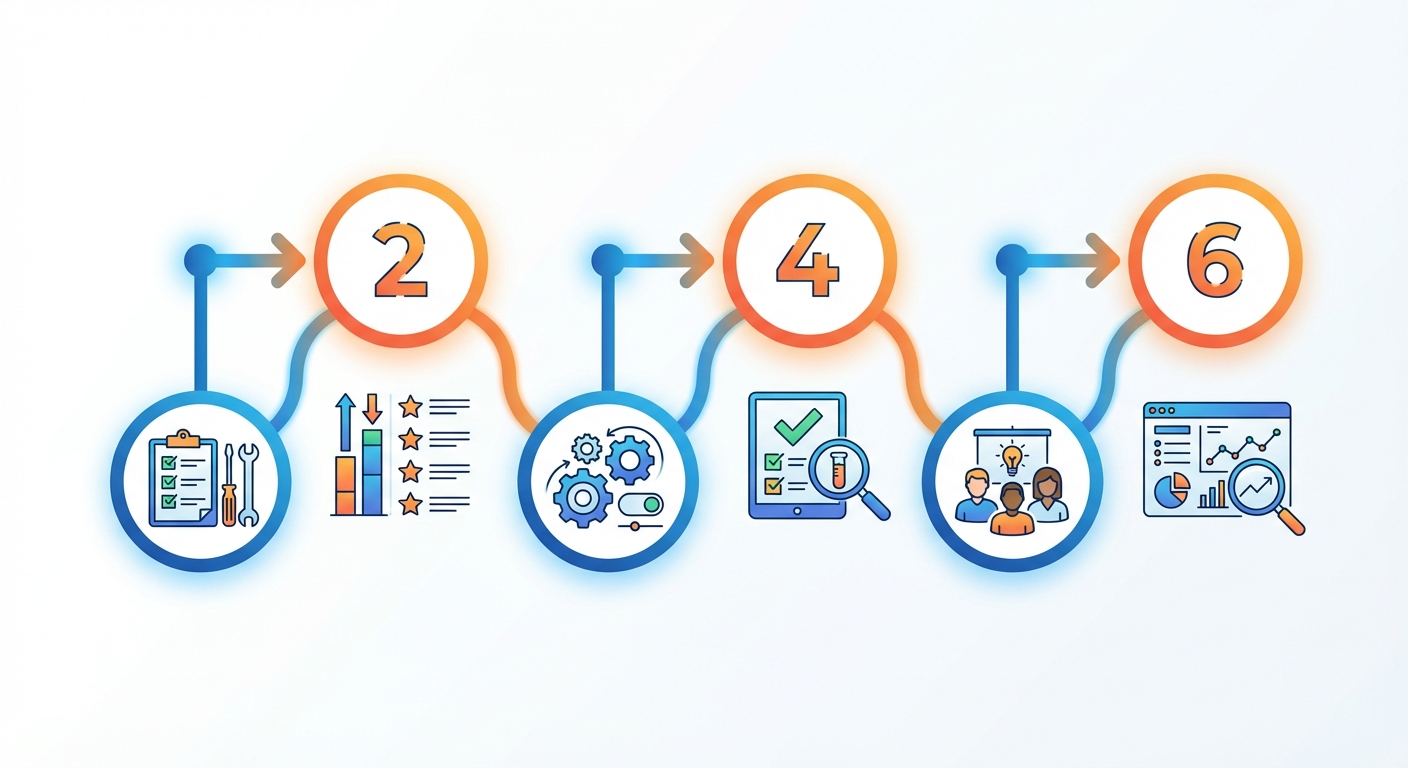
Successfully implementing CRM integration requires a structured approach that balances technical setup with team adoption. Follow this proven process to ensure your solar business realizes the full benefits of integrated systems:
Step 1: Audit Your Current Tools and Identify Integration Needs
Begin by documenting every tool and platform your solar business currently uses for sales, marketing, and customer management. Create a comprehensive list including advertising platforms (Facebook Ads, Google Ads), communication tools (WhatsApp, email, phone systems), data sources (Excel spreadsheets, lead databases), marketing automation platforms, payment processors, and any specialized solar software.
For each tool, identify how data currently flows into or out of your CRM. Which processes require manual data entry? Where do information gaps exist? Which workflows consume the most time? This audit reveals your highest-priority integration opportunities.
Step 2: Prioritize Integrations Based on Business Impact
Not all integrations deliver equal value. Prioritize based on three factors: time savings potential (how many hours will this integration save weekly?), impact on conversion rates (will faster lead response or better follow-up increase sales?), and implementation complexity (how difficult is this integration to set up?).
For most Indian solar businesses, the priority sequence looks like this: Facebook Ads integration first (highest lead volume, immediate response time improvement), WhatsApp integration second (customer preference, proposal delivery efficiency), Excel import third (data migration and bulk lead handling), followed by email marketing, phone systems, and payment gateways.
Step 3: Verify Technical Requirements and Prerequisites
Before implementing integrations, confirm you have the necessary access and permissions. Facebook Ads integration requires admin access to your Facebook Business account. WhatsApp Business API integration requires an approved WhatsApp Business account. Third-party integration platforms need API access enabled in your CRM settings.
Review any technical limitations or restrictions. Some CRM platforms limit the number of API calls or integrations available on lower-tier plans. Ensure your current subscription level supports your integration requirements, or plan for necessary upgrades.
Step 4: Test Integrations Before Going Live
Never deploy integrations directly into your production environment without thorough testing. Create test leads, submit test Facebook Lead Ads, send test WhatsApp messages, and import small test Excel files to verify data flows correctly and appears in the expected CRM fields.
Pay particular attention to data formatting issues common in the Indian context: phone numbers with or without country codes, names with various character sets, addresses with inconsistent formatting. Ensure your integrations handle these variations gracefully.
Step 5: Train Your Sales Team on Integrated Workflows
Technology only delivers value when your team actually uses it. Conduct hands-on training sessions showing sales representatives how integrated workflows change their daily routines. Demonstrate how Facebook leads now appear automatically, how to send WhatsApp proposals with one click, and how to access complete communication history within the CRM.
Create simple reference guides or video tutorials covering common integration scenarios. Assign integration champions within your team who can help colleagues troubleshoot issues and share best practices.
Step 6: Monitor Performance and Optimize
After deployment, actively monitor integration performance. Track key metrics including lead response time (should decrease significantly), time spent on data entry (should drop by 70-80%), lead-to-opportunity conversion rates (should improve by 20-30%), and sales cycle length (should shorten by 15-25%).
Review integration logs regularly to identify any failed data transfers or error conditions. Most integration platforms provide dashboards showing successful and failed automation runs, enabling quick troubleshooting.
Continuously refine your automated workflows based on team feedback and performance data. Add new integrations as you adopt additional tools, and optimize existing integrations to handle edge cases or special scenarios that emerge during real-world use.
Common CRM Integration Challenges in India and How to Overcome Them

While CRM integration delivers substantial benefits, Indian solar businesses face several unique challenges when implementing and maintaining integrated systems. Understanding these obstacles and their solutions ensures successful deployment:
Challenge: Internet Connectivity and Reliability
Despite improvements in Indian internet infrastructure, connectivity remains inconsistent in many regions where solar businesses operate. Integration failures due to network interruptions can result in lost leads or incomplete data synchronization.
Solution: Choose CRM platforms with robust offline capabilities and automatic retry mechanisms. Modern systems like QuickEst cache data locally when connectivity drops and automatically sync when connection restores. Implement mobile apps that function offline for field sales teams, syncing data when they return to areas with reliable connectivity. For critical integrations like Facebook Ads, ensure your CRM platform includes automatic retry logic that attempts failed data transfers multiple times before flagging errors.
Challenge: Data Security and Privacy Concerns
Integrating multiple systems increases the number of platforms storing customer data, raising security and privacy concerns. Indian solar businesses must comply with data protection regulations while ensuring customer information remains secure across integrated systems.
Solution: Select CRM platforms and integration tools that implement enterprise-grade security measures including TLS 1.2 encryption for data transmission and 256-bit AES encryption for data storage. Verify that integration platforms comply with relevant data protection standards. Implement role-based access controls limiting which team members can access sensitive customer information. Regularly audit which applications have access to your CRM data and revoke permissions for tools no longer in use. QuickEst provides secure data encryption and access controls specifically designed for Indian business requirements.
Challenge: Integration Costs and Budget Constraints
Small and mid-sized Indian solar businesses often operate with limited technology budgets. The combined costs of CRM subscriptions, integration platform fees, and potential custom development can seem prohibitive.
Solution: Focus on high-ROI integrations first, implementing connections that deliver immediate time savings and revenue impact. Many CRM platforms, including QuickEst, include essential native integrations at no additional cost. When third-party integration platforms are necessary, choose options like Pabbly Connect that offer unlimited automation at flat rates rather than per-task pricing. Calculate the actual ROI by measuring time saved, if integration eliminates 15 hours of manual work weekly at an average labor cost of ₹500 per hour, you save ₹30,000 monthly, easily justifying integration platform costs of ₹2,000-3,000 monthly.
Challenge: Technical Expertise Gaps
Many Indian solar businesses lack dedicated IT staff or technical expertise to configure and maintain integrations. Sales teams may feel overwhelmed by technical setup requirements.
Solution: Prioritize CRM platforms that offer user-friendly integration setup requiring no coding or technical knowledge. Look for vendors providing comprehensive onboarding support, video tutorials, and responsive customer service. QuickEst offers guided integration setup with step-by-step instructions designed for non-technical users. Consider engaging integration consultants for initial setup if needed, the one-time investment typically pays for itself within weeks through improved efficiency. Build internal knowledge by training one or two team members as integration specialists who can handle routine configuration and troubleshooting.
Challenge: Vendor Support and Localization
International CRM platforms may provide limited support during Indian business hours or lack understanding of India-specific requirements like WhatsApp integration, Indian payment gateways, or local business practices.
Solution: Choose CRM vendors with dedicated Indian support teams or strong presence in the Indian market. Verify that support is available during your business hours and in languages your team speaks. Evaluate whether the CRM platform includes integrations with India-specific tools like Razorpay, Paytm, WhatsApp Business API, and Indian telecom providers. Platforms built specifically for Indian solar businesses, like QuickEst, inherently understand local requirements and provide relevant integration options.
Measuring Success: KPIs for CRM Integration
Implementing CRM integration represents a significant investment of time and resources. Measuring specific key performance indicators ensures you realize expected benefits and identifies areas for optimization:
Time Saved on Manual Data Entry
Track the hours your team previously spent on manual data entry tasks versus time spent after integration. Survey sales representatives about their daily routines before and after implementation. Most solar businesses report saving 15-20 hours per week per sales representative after implementing core integrations. Multiply these time savings by your team size and average hourly cost to calculate direct labor savings.
Lead Response Time Improvements
Measure the average time between lead submission and first contact before and after integration. With automated Facebook Ads integration and instant lead assignment, response times should drop from hours to minutes. Track this metric by lead source to identify which integrations deliver the greatest impact. Research consistently shows that responding within 5 minutes increases conversion rates by 400% compared to 30-minute response times.
Conversion Rate Changes Post-Integration
Monitor your lead-to-opportunity and opportunity-to-customer conversion rates before and after implementing integrations. Improved response times, better follow-up consistency, and enhanced data quality typically increase conversion rates by 20-30%. Segment conversion rates by lead source to understand which integrated channels perform best.
Sales Cycle Length Reduction
Calculate the average number of days from initial lead contact to closed deal before and after integration. Integrated workflows that automate follow-ups, streamline proposal delivery, and improve team coordination typically shorten sales cycles by 15-25%. Faster sales cycles mean improved cash flow and increased sales capacity.
Team Productivity Metrics
Track the number of proposals created, leads contacted, and deals closed per sales representative before and after integration. With time previously spent on administrative tasks now available for actual selling activities, productivity should increase measurably. Most solar businesses see 25-35% productivity improvements within 60 days of implementing comprehensive CRM integration.
ROI Calculation for CRM Integration Investments
Calculate total integration costs including CRM subscription fees, integration platform costs, implementation time, and training expenses. Compare these costs against measurable benefits including labor savings from reduced manual work, revenue increases from improved conversion rates, and cash flow improvements from shortened sales cycles. Most Indian solar businesses achieve positive ROI within 90 days of implementing core integrations.
Choosing a Solar CRM with Strong Integration Capabilities
When evaluating solar CRM India options, integration capabilities should rank among your top selection criteria. A CRM with limited integration options will create the same disconnected workflow problems you’re trying to solve, regardless of how strong its core features may be.
Key integration features to prioritize when selecting a solar CRM include:
Native integrations with essential platforms: Verify the CRM offers built-in connections to the tools you already use, particularly Facebook Ads for lead generation and WhatsApp for customer communication. Native integrations typically provide better reliability and easier setup than third-party connectors.
Robust Excel import capabilities: Ensure the CRM supports bulk data import with field mapping, duplicate detection, and data validation. This functionality remains critical for Indian solar businesses that regularly work with Excel-based lead lists and data sources.
Open API access: Even if the CRM doesn’t offer native integration with every tool you use, open API access enables connections through third-party integration platforms like Pabbly Connect. Verify that API access is included in your subscription tier without additional charges.
Webhook support: Webhooks enable real-time data push from your CRM to other systems when specific events occur (new lead created, deal closed, proposal sent). This capability is essential for sophisticated automation workflows.
Integration documentation and support: Evaluate the quality of integration documentation, availability of setup guides, and responsiveness of technical support. Poor documentation can turn simple integrations into frustrating technical challenges.
Questions to ask CRM vendors during evaluation include: Which integrations are included in the base subscription versus requiring additional fees? How long does typical integration setup take? What support is available if integrations fail or encounter errors? Are there any limitations on API calls or data transfer volumes? How does the platform handle integration errors and data synchronization issues?
When comparing CRM alternatives India, create a matrix scoring each platform on integration capabilities alongside other critical factors like proposal automation, lead management features, mobile accessibility, and pricing. Remember that a CRM with strong integration capabilities delivers compounding value over time as you add new tools and optimize workflows.
QuickEst was built specifically for Indian solar businesses with integration requirements in mind. The platform includes native Facebook Ads integration for automatic lead capture, WhatsApp integration for instant proposal delivery, robust Excel import with duplicate detection, and Pabbly Connect compatibility for connecting additional tools. These integration capabilities combine with QuickEst’s 60-second proposal generation, automated follow-up system, and real-time sales analytics to create a comprehensive solution for solar sales teams.
The platform offers flexible pricing to accommodate solar businesses at different stages. The FREE PLAN at ₹0 provides core CRM functionality with essential integrations, enabling small solar businesses to experience the benefits of integrated workflows without upfront investment. As your business grows and integration needs expand, the PRO PLAN at ₹6999 per user per year unlocks advanced automation capabilities, unlimited proposals, and priority support for integration setup.
Balancing integration needs with CRM pricing requires honest assessment of which integrations deliver the highest ROI for your specific business. Start with the integrations that address your biggest pain points, typically Facebook Ads for lead capture and WhatsApp for proposal delivery, then expand to additional connections as you realize time savings and efficiency gains.
Take Control of Your Solar Sales Workflow Today
The disconnected chaos of manual data entry, delayed lead response, and fragmented customer information costs Indian solar businesses countless opportunities every single day. In 2026’s competitive solar market, operational efficiency isn’t optional, it’s the difference between thriving and merely surviving.
CRM integration India solutions transform how solar companies operate, eliminating the time-consuming manual work that frustrates sales teams and slows down revenue growth. By connecting Facebook Ads for instant lead capture, WhatsApp for immediate proposal delivery, Excel for bulk data management, and other essential tools directly to your CRM system, you create the seamless workflow that modern solar sales demands.
The implementation process doesn’t require technical expertise or massive budgets. Start with high-impact integrations like Facebook Ads and WhatsApp that deliver immediate time savings and conversion rate improvements. Expand to additional connections as your team experiences the benefits of automated workflows. Monitor key metrics like lead response time, conversion rates, and sales cycle length to quantify the ROI from your integration investments.
Most importantly, choose a CRM platform built specifically for Indian solar businesses with integration capabilities designed for your actual workflow requirements. Generic CRM systems require extensive customization and complex integration setup. Purpose-built solar CRM platforms like QuickEst include the native integrations, bulk import capabilities, and India-specific features that solar sales teams actually need.
Stop wasting hours on manual data entry. Stop losing leads to competitors who respond faster. Stop struggling with disconnected systems that hide your sales performance. Take the first step toward streamlined, integrated solar sales operations that unlock your team’s full potential. Contact us to discover how QuickEst’s comprehensive integration capabilities can transform your solar business workflow, or explore the FREE PLAN at ₹0 to experience integrated CRM functionality with no upfront investment. Your sales team deserves tools that work together seamlessly, and your business deserves the competitive advantage that integration delivers.
This blog post was written using thestacc.com